
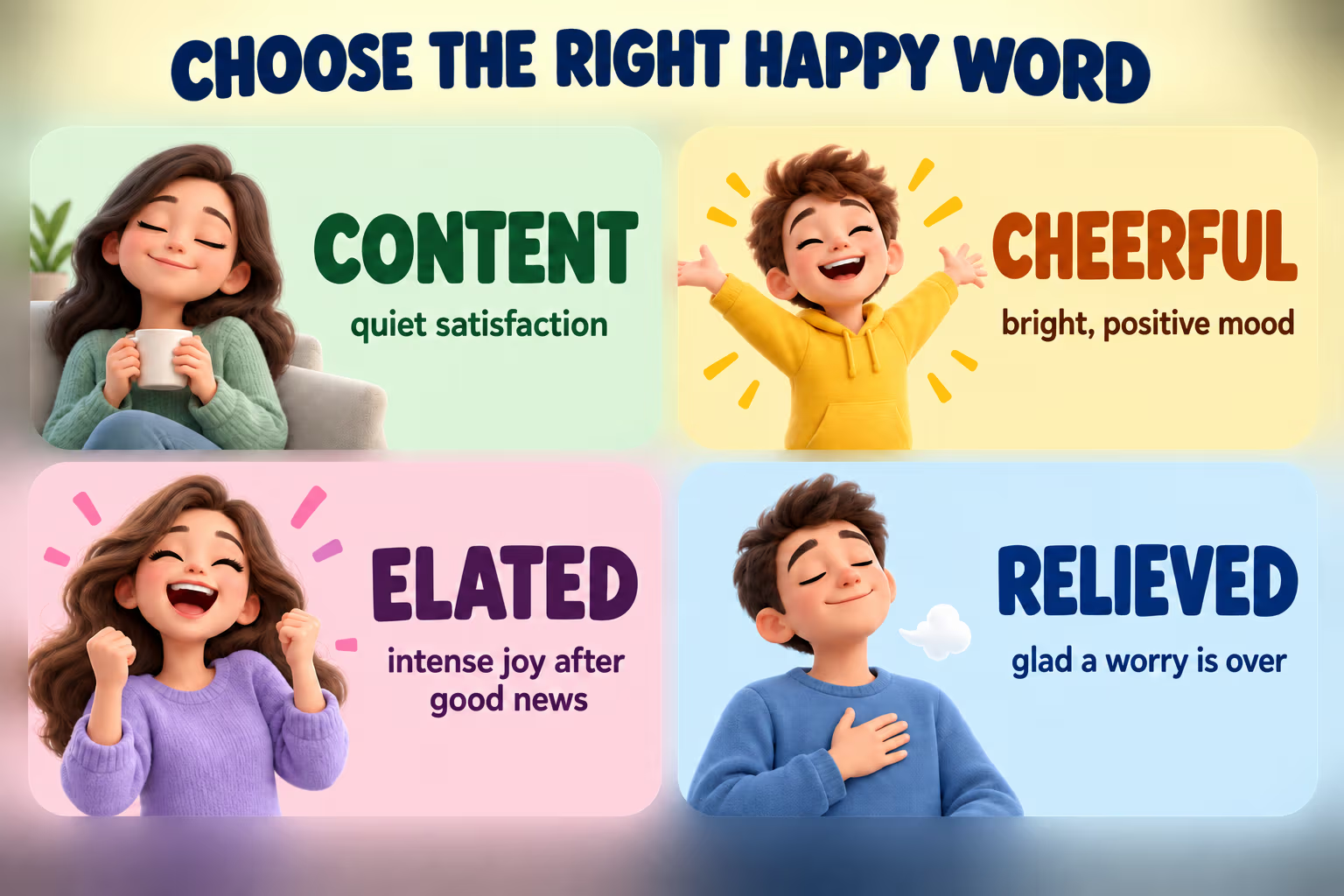
Adjectives for happy name different kinds of pleasure: cheerful suggests a bright, positive mood; content describes quiet satisfaction; elated signals intense excitement, often after good news; and relieved fits happiness after a worry ends. Choose the word that matches the feeling’s cause and intensity, because these terms are related but not interchangeable.
Key Facts: Adjectives for Happy
- Cheerful describes a positive mood or an inviting, bright quality.
- Content describes satisfaction with the present situation, often without excitement.
- Elated and ecstatic express very strong happiness; elated often follows news or an achievement.
- Jubilant fits great happiness connected with success.
- Relieved focuses on being glad that something unpleasant did not happen or has ended.
- The original article’s 19 A–Z tables and five supporting tables are preserved; together they include mixed word forms, expressions, and contrasting moods.
Which Adjective for Happy Fits the Feeling?
Use the situation and emotional intensity to choose a precise word; this is a practical guide, not a fixed ranking. Cambridge Dictionary describes happy as pleasure or satisfaction, cheerful as happy and positive, and content as pleased with one’s situation and not hoping for change. Elated suggests very strong excitement, ecstatic means extremely happy, and jubilant often connects great happiness with success. Relieved fits a worry that has ended or been avoided.
| Word | Best fit | Example |
|---|---|---|
| happy | General pleasure or satisfaction | “I’m happy with the plan.” |
| pleased | Satisfaction about a result, choice, or event | “She was pleased with her progress.” |
| cheerful | A bright, positive mood or manner | “He sounded cheerful on the call.” |
| content | Quiet satisfaction with the present situation | “They felt content with a quiet afternoon.” |
| delighted | Strong pleasure or approval | “I was delighted to see my friends.” |
| elated | Intense happiness and excitement, often after news or an achievement | “The team felt elated after the win.” |
| ecstatic | Extremely happy | “She was ecstatic about the result.” |
| jubilant | Great happiness, especially because of success | “The jubilant crowd celebrated the victory.” |
| relieved | Glad that a worry or difficult possibility has passed | “He was relieved to hear everyone was safe.” |
How Can You Choose a More Precise Mood Word?
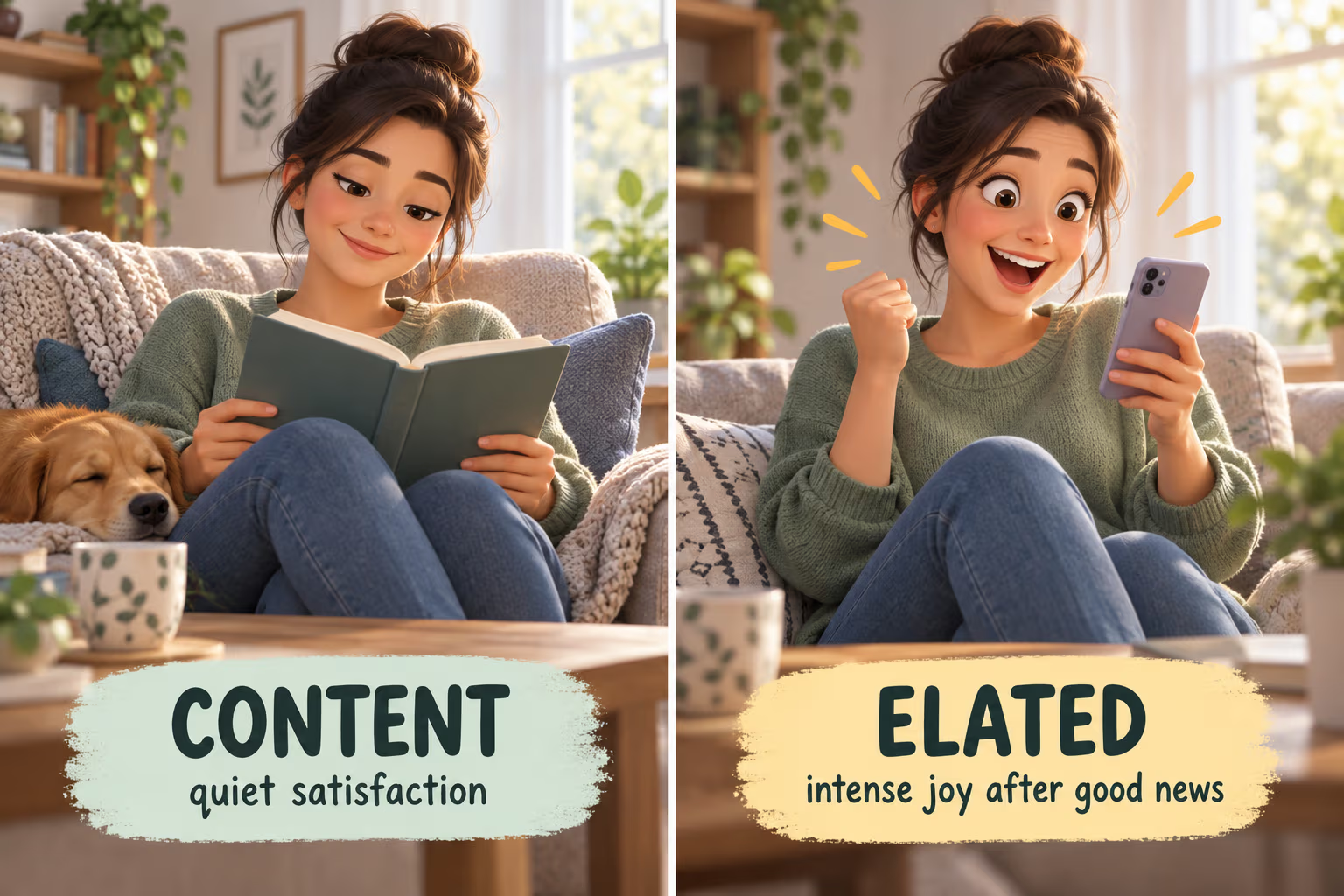
Start with what caused the feeling, then choose a word that fits its strength and tone. A calm, satisfied afternoon may feel content; a friendly greeting can sound cheerful; a long-awaited success can leave someone elated or jubilant; and the end of a stressful wait can make someone relieved. These words overlap, but the cause gives the reader useful context.
- For everyday pleasure: happy, glad, pleased, or cheerful.
- For calm satisfaction: content or contented.
- For high intensity: delighted, overjoyed, elated, or ecstatic.
- For success: jubilant, especially when a win or achievement is central.
- For a worry that passes: relieved.
Check what the adjective modifies, too. A person can feel cheerful, a voice can sound cheerful, and a room can look cheerful; in the last two examples, the word describes an impression or atmosphere. Happy to help can also mean willing or glad to help, so it does not always promise intense excitement. If you are describing a group, see our guide to positive words to describe a team; for playful language, browse adjectives for fun.
Are All the A–Z Entries Positive Adjectives?
No. The original A–Z tables below are retained in full as a word-finding directory, but they are not a list of interchangeable positive adjectives. The source article has 19 alphabetic tables and five additional tables for descriptions, examples, synonyms, and antonyms. Some directory entries are other word forms: Cambridge labels gaiety a noun and unfortunately an adverb. Cambridge classifies be on cloud nine as an informal idiom. Other entries, including anxious, depressed, and miserable, can describe worry or unhappiness rather than a happy mood. Check a word’s meaning and grammatical form before using it as a synonym.
For a sentence, put an adjective where it naturally belongs: “a cheerful person,” “a content expression,” or “they felt relieved.” A noun such as gaiety needs a different frame (“the gaiety of the celebration”); an adverb such as unfortunately comments on the clause (“Unfortunately, the event ended early”). Keeping the original directory intact lets readers browse it without implying every entry has the same meaning or part of speech.
When you’re happy, you feel good. You might feel like you’re on top of the world, like everything is going your way. You might feel like you’re floating on air. Whatever it is that happiness feels like to you, there are plenty of adjectives to describe it.
Adjective is just a fancy word for a describing word, and there are lots of them for happiness. It’s up to you to choose the ones that fit how you’re feeling. Some examples might be: content, elated, overjoyed, thrilled, ecstatic, and relieved.
Adjectives For Happy
When you’re happy, you feel joy, love, and contentment. You might also feel hopeful, excited, and grateful. Here are some other adjectives that can describe how happy you feel:
- Elated: feeling very happy and excited
- Jubilant: feeling very happy and triumphant
- Merry: feeling happy and festive
- Cheerful: feeling happy and optimistic
- Content: feeling satisfied and fulfilled
- Peaceful: feeling calm and serene
What makes you happy? Maybe it’s spending time with your family, being in nature, achieving a goal, or simply enjoying a quiet moment. No matter what brings you happiness, it’s a good idea to savor those happy moments and feelings.

A
| Alive | Amused | Amusing |
| Animated | Anxious | Applauding |
| Appropriate | Apt | At-Peace |
| Auspicious |
B
| Beaming | Beatific | Becoming |
| Befitting | Beguiled | Beside-Oneself |
| Better | Blessed | Blest |
| Blissful | Blithe | Bonny |
| Breezy | Bright | Buoyant |
C
| Captivated | Carefree | Carousing |
| Cavorting | Celebrating | Charmed |
| Cheerful | Cheering | Cheery |
| Chipper | Chirpy | Chuckling |
| Chuff | Chuffed | Cloudless |
| Cock-A-Hoop | Comfortable | Congenial |
| Content | Contented | Convivial |
| Correct | Cosh | Crying |
D
| Dashing | Debonair | Delectable |
| Delight | Delighted | Delightful |
| Delirious | Depressed | Disappoint |
| Discouraged | Dissatisfied | Diverting |
E
| Ebullient | Ecstatic | Effervescent |
| Elated | Elysian | Emotional |
| Enchanted | Enjoyable | Enraptured |
| Entertaining | Enthusiastic | Esprit |
| Euphoric | Excited | Exhilarated |
| Exuberant | Exultant |
F
| Fain | Felicitous | Festive |
| Fit | Fitting | Forsaken |
| Fortuitous | Fortunate | Frisky |
| Frolicsome | Fulfilled | Full-Of-Beans |
| Fun-Loving | Funny |
G
| Gaiety | Gala | Gay |
| Genial | Giddy | Giggling |
| Glad | Gladdened | Gladsome |
| Gleeful | Good-Humored | Gracious |
| Grateful | Gratified | Gratifying |
| Grin | Guffawing |
H
| Halcyon | Happy | Happy-Go-Lucky |
| Hearty | Heaven | High |
| High-Spirited | Hilarious | Hopeful |
| Hopeless | Humorous | Hysterical |
I
| In A Good Mood | In Good Spirits | In Seventh Heaven |
| In The Good Mood | Interested | Intoxicated |
| Invigorating |
J | K
| Jaunty | Jesting | Jocular |
| Jocund | Joking | Jolly |
| Jovial | Joyful | Joyous |
| Jubilant | Keen |
L
| Laughing | Light | Light-Hearted |
| Lighthearted | Lightsome | Lively |
| Luck | Lucky |
M | N
| Meet | Melancholy | Merry |
| Mirth | Mirthful | Miserable |
| Morose | Mourning | Never Been Better |
| Nice |
O
| On Cloud Nine | On The Cloud Nine | On Top Of The World |
| Optimistic | Over The Moon | Overjoyed |
P
| Pained | Peace Of Mind | Peaceful |
| Peppy | Perky | Playful |
| Pleasant | Pleased | Pleasing |
| Positive | Proper | Propitious |
| Prosperous | Proud | Providential |
R
| Radiant | Rapt | Rapturous |
| Ravishing | Rejoicing | Relaxed |
| Relieved | Relish | Reveling |
| Rhapsodic | Right | Roaring |
| Rollicking |
S
| Sad | Satisfied | Serene |
| Shouting | Smiley | Smiling |
| Sorrowful | Sparkling | Spirited |
| Sportive | Sprightly | Successful |
| Sunny | Sure | Surprised |
T
| Tailor-Made | Thankful | Thrilled |
| Tickled | Tickled Pink | Transported |
| Troubled |
U | V
| Unalloyed | Unfortunate | Unfortunately |
| Unhappy | Unlucky | Untroubled |
| Upbeat | Vivacious |
W | Z
| Wacky | Waggish | Walking On Air |
| Weal | Weeping | Weleful |
| Well | Well-Chosen | Willing |
| Zany | Zestful | Zesty |
| Zingy | Zippy |
Feeling happy is a wonderful emotion that we all strive for in our lives. It’s that warm and fuzzy feeling that brings a smile to our faces and a skip to our step. But have you ever wondered if there are more words to describe this delightful state of being? Well, look no further! In this article, I’ll be sharing with you a collection of adjectives that perfectly capture the essence of happiness. So whether you’re feeling ecstatic, elated, or simply content, get ready to expand your vocabulary and explore the many shades of happiness.
When it comes to describing happiness, the English language offers a treasure trove of adjectives that can truly bring your emotions to life. From the sheer joy of experiencing something delightful to the serene bliss of being at peace, there are countless ways to express your happiness. In this article, I’ll be diving into a variety of adjectives that will help you paint a vivid picture of your happiness, whether it’s a bright and sunny day or a heartwarming moment with loved ones. So, let’s embark on this linguistic journey and discover the perfect words to describe your happiness.
How to Describe Happy? – Different Scenarios
When it comes to describing happiness, the English language offers a wide array of adjectives to capture the various shades of joyful emotions. In different scenarios, we can use different words to convey the varying intensities and nuances of happiness. Let’s explore some scenarios and the adjectives that best describe them:
1. The Burst of Joy
In moments of pure excitement and delight, we can use adjectives like “ecstatic,” “elated,” or “overjoyed” to describe the heightened sense of happiness. These words convey a sense of intense joy and euphoria. For example:
- I was ecstatic when I won the first prize in the competition.
- She was elated when she received the good news.
- They were overjoyed to see their favorite band perform live.
Read: Mastering Proper Adjectives from Geographical Locations
2. The Contentment of Serene Bliss
In moments of peaceful happiness and contentment, we can choose adjectives such as “serene,” “tranquil,” or “blissful.” These words describe a calm and content state of mind. For example:
- I felt serene as I watched the sunset on the beach.
- The peaceful atmosphere in the garden made it tranquil.
- After a long day, a hot cup of tea brought me blissful comfort.
3. The Warmth of Pleasant Happiness
In scenarios where happiness is gentle and comforting, we can use adjectives like “joyful,” “happy,” or “cheerful” to express a lighter and more relaxed form of happiness. For example:
- The children’s laughter filled the room with joyful energy.
- She had a happy smile on her face after receiving a thoughtful gift.
- The cheerful music lifted everyone’s spirits at the party.
4. The Excitement of Anticipation
In situations where happiness is derived from anticipation and excitement, we can use adjectives such as “thrilled,” “eager,” or “excited.” These words capture the sense of joy that arises from looking forward to something. For example:
- I was thrilled to go on a vacation to my dream destination.
- The children were eager to open their presents on Christmas morning.
- We were all excited about the upcoming concert.
Describing Words for Happy in English
When it comes to expressing happiness, there is a wide range of adjectives that can be used to describe this joyful emotion. By using descriptive words for happy, we can effectively convey the nuances and depth of happiness in different situations. Here are some adjectives that can be used to describe the feeling of happiness:
- Exhilarated – Feeling extremely excited and joyful.
- Ecstatic – Overwhelming joy and delight.
- Content – A state of peaceful happiness and satisfaction.
- Blissful – Extreme joy and happiness.
- Elated – Feeling great happiness and excitement.
- Cheerful – Full of happiness and positivity.
- Radiant – Beaming with joy and happiness.
- Thrilled – Feeling an intense excitement and pleasure.
- Jubilant – Experiencing a joyous and triumphant feeling.
- Grateful – Feeling thankful and appreciative, which brings happiness.
These adjectives can be used to add depth and richness to your descriptions of happy moments. Whether you are writing a story, expressing your feelings, or teaching children about different emotions, these words can help create a more vivid picture.
Read: Beautiful Soul Adjectives: Examples & Describing Words
Let’s take a closer look at how these words can be used in different contexts:
| Adjective | Definition |
|---|---|
| Exhilarated | Feeling extremely excited and joyful. |
| Ecstatic | Overwhelming joy and delight. |
| Content | A state of peaceful happiness and satisfaction. |
| Blissful | Extreme joy and happiness. |
| Elated | Feeling great happiness and excitement. |
| Cheerful | Full of happiness and positivity. |
| Radiant | Beaming with joy and happiness. |
| Thrilled | Feeling an intense excitement and pleasure. |
| Jubilant | Experiencing a joyous and triumphant feeling. |
| Grateful | Feeling thankful and appreciative, which brings happiness. |
Adjectives for Happy
Positive Adjectives for Happy with 10 Example Sentences
When it comes to describing happiness, there are numerous positive adjectives that can evoke the joy and positivity of those moments. Let me share with you ten of these adjectives along with example sentences to demonstrate their usage:
| Adjective | Example Sentence |
|---|---|
| Exhilarated | I was exhilarated after winning the race. |
| Ecstatic | She was ecstatic when she received her acceptance letter. |
| Content | I feel content whenever I spend time with my loved ones. |
| Blissful | The couple shared a blissful moment as they watched the sunset. |
| Elated | He was elated to hear that he got the job. |
| Cheerful | The children were cheerful as they played in the park. |
| Radiant | The bride was radiant on her wedding day. |
| Thrilled | We were thrilled to see our favorite band perform live. |
| Jubilant | The team was jubilant after winning the championship. |
| Grateful | I am grateful for the support of my friends and family. |
Negative Adjectives for Happy with 5 Example Sentences
While happiness is typically associated with positive emotions, there are also negative adjectives that can describe moments of unhappiness. Here are five such adjectives along with example sentences to provide a broader understanding:
| Adjective | Example Sentence |
|---|---|
| Sad | I felt sad when my best friend moved away. |
| Disappointed | She was disappointed when her favorite team lost the game. |
| Frustrated | He became frustrated when he couldn’t find his keys. |
| Unfulfilled | Despite his success, he felt unfulfilled in his career. |
| Heartbroken | She was heartbroken after the end of a long-term relationship. |
By using these adjectives, we can effectively convey the range of emotions that fall under the umbrella of happiness. Whether it’s the exhilaration of achieving a goal or the sadness of a loss, these words help us paint a more vivid picture of our experiences.
Read: Describing Words for Energy: Examples of Adjectives
Synonyms and Antonyms With Example Sentences
Synonyms for Happy
When describing happiness, there are various synonyms that can be used to convey different shades of joy. Here are some synonyms for “happy” along with example sentences showcasing their usage:
| Synonym | Example Sentence |
|---|---|
| Delighted | I was delighted to receive a surprise gift. |
| Elated | She felt elated after winning the competition. |
| Ecstatic | They were ecstatic when they heard the good news. |
| Joyful | The children were joyful as they played in the park. |
| Content | He felt content with his life choices. |
| Gleeful | The audience was gleeful during the comedy show. |
Antonyms for Happy
On the other hand, there are also antonyms for “happy” that describe moments of unhappiness. Here are some antonyms for “happy” along with example sentences:
| Antonym | Example Sentence |
|---|---|
| Sad | She looked sad after her favorite team lost the game. |
| Disappointed | He felt disappointed when he didn’t get the promotion. |
| Frustrated | I was frustrated when I couldn’t find my car keys. |
| Unfulfilled | She felt unfulfilled in her current job. |
| Heartbroken | He was heartbroken after his long-time pet passed away. |
By using these synonyms and antonyms, you can effectively convey a wide range of emotions related to happiness.
In this article, I have explored a variety of adjectives that can be used to describe happiness in different contexts. By utilizing these adjectives, such as delighted, elated, ecstatic, joyful, content, and gleeful, individuals can effectively express their emotions and experiences of happiness. Additionally, I have provided example sentences to illustrate the usage of these adjectives, allowing readers to grasp their meaning and apply them in their own writing.
Furthermore, I have also touched upon the antonyms of happiness, including sad, disappointed, frustrated, unfulfilled, and heartbroken. By understanding these contrasting emotions, we can better appreciate the range of human experiences and the significance of happiness in our lives.
By incorporating these adjectives and their antonyms into our vocabulary, we can enhance our ability to communicate and convey the complexities of happiness. Whether it’s expressing pure joy or acknowledging moments of sadness, having a rich repertoire of descriptive words enables us to connect with others on a deeper level.
The adjectives discussed in this article serve as valuable tools for articulating the various shades of happiness and its contrasting emotions. By harnessing the power of language, we can effectively convey our feelings and experiences, fostering greater understanding and connection with those around us.
Final verdict
When it comes to finding happiness, using positive adjectives can be a helpful way to reframe your thinking and see the good in any situation. Some common happy adjectives include content, joyful, peaceful, and relieved.
If you’re struggling to find happiness, try thinking of some positive adjectives that describe how you’re feeling and see if that helps shift your perspective. It might not be easy, but with a little effort, you can find happiness in even the darkest of situations.
Frequently Asked Questions
What is the best adjective for happy?
There is no single best adjective for every happy feeling. Use cheerful for a bright, positive mood, content for calm satisfaction, elated for intense excitement, jubilant for happiness linked to success, or relieved when a worry ends. The cause and strength of the feeling guide the choice.
What is the difference between happy, cheerful, and content?
Happy is the broadest everyday word for pleasure or satisfaction. Cheerful highlights an upbeat, positive mood or manner and can also describe a bright, pleasant place. Content emphasizes being satisfied with the situation as it is, so it often sounds calmer than cheerful or excited.
Does “relieved” mean happy?
Relieved can describe a happy feeling, but it specifically points to an unpleasant possibility that did not happen or has ended. Someone may feel relieved after hearing a friend is safe, even if the person is not excited or celebrating. Use glad or happy when the source of the pleasure is not a worry passing.
Is “on cloud nine” an adjective?
On cloud nine is an idiomatic phrase that means extremely happy; it is not a single-word adjective. It works in a sentence such as “She was on cloud nine after the announcement.” For a one-word substitute, try elated, ecstatic, or overjoyed, depending on tone and context.
Are all 200-plus A–Z entries positive adjectives?
No. The original directory is preserved, but some entries are nouns, adverbs, expressions, unrelated descriptors, or words for worry and unhappiness. Treat it as a broad word bank rather than a synonym list. Check a dictionary entry and confirm the part of speech before placing a word in a sentence about a happy person or mood.


