
Adjectives for a headache describe the sensation, location, intensity, timing, and effect on daily activities. Words such as throbbing, tight, dull, or sharp can help explain what a person feels, but no adjective by itself identifies the cause; a clear description adds when it began, how it changed, and any other symptoms.
Key points
- Use one or two words for pain quality, then describe where the pain is and when it starts.
- Explain whether the pain is steady, pulsing, brief, recurring, or changing over time.
- A personal intensity rating is most useful when paired with what the pain stops you from doing.
- Headache patterns can overlap; descriptive words communicate an experience, not a diagnosis.
- A short headache record can capture timing, duration, location, symptoms, and impact for a conversation with a health professional.
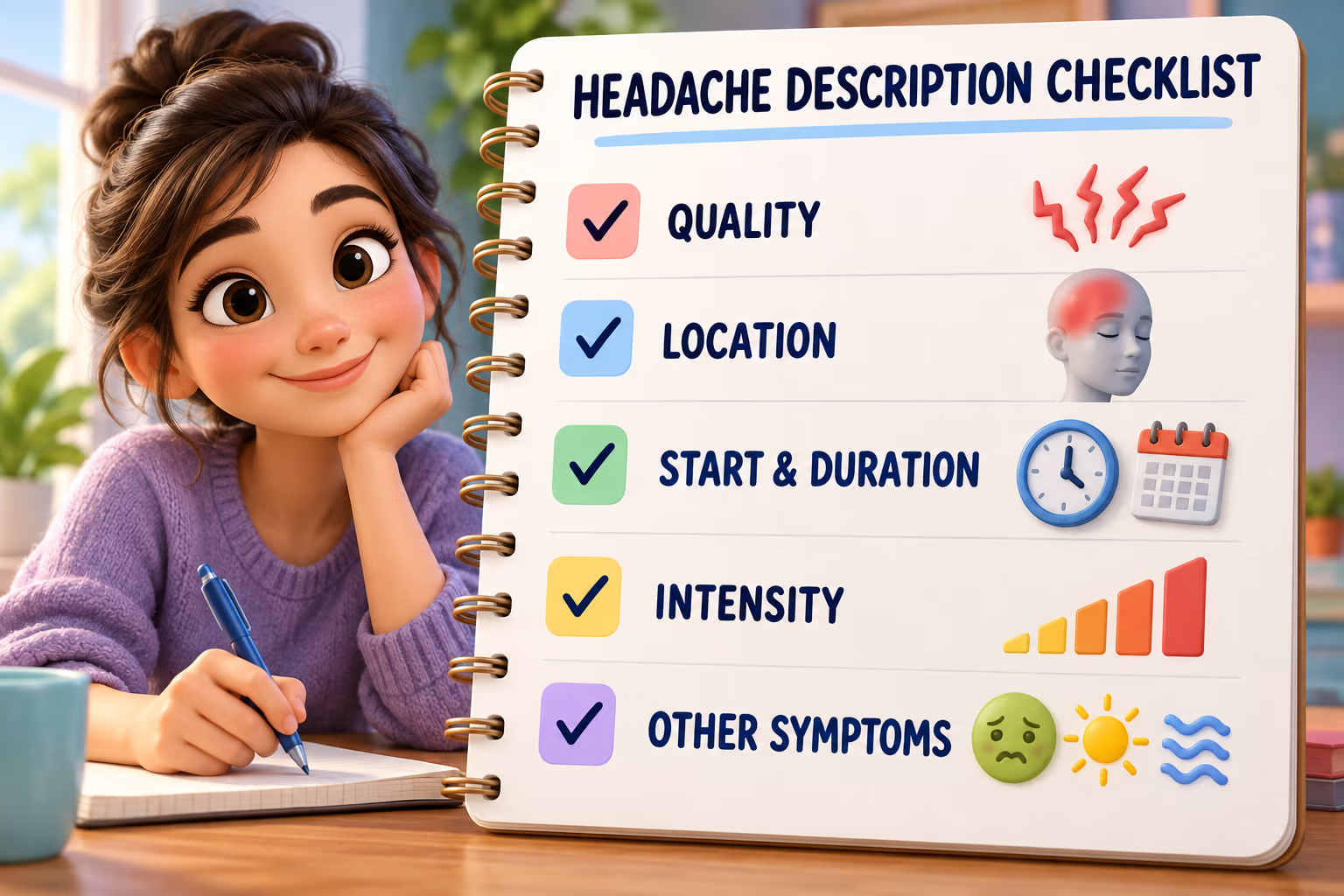
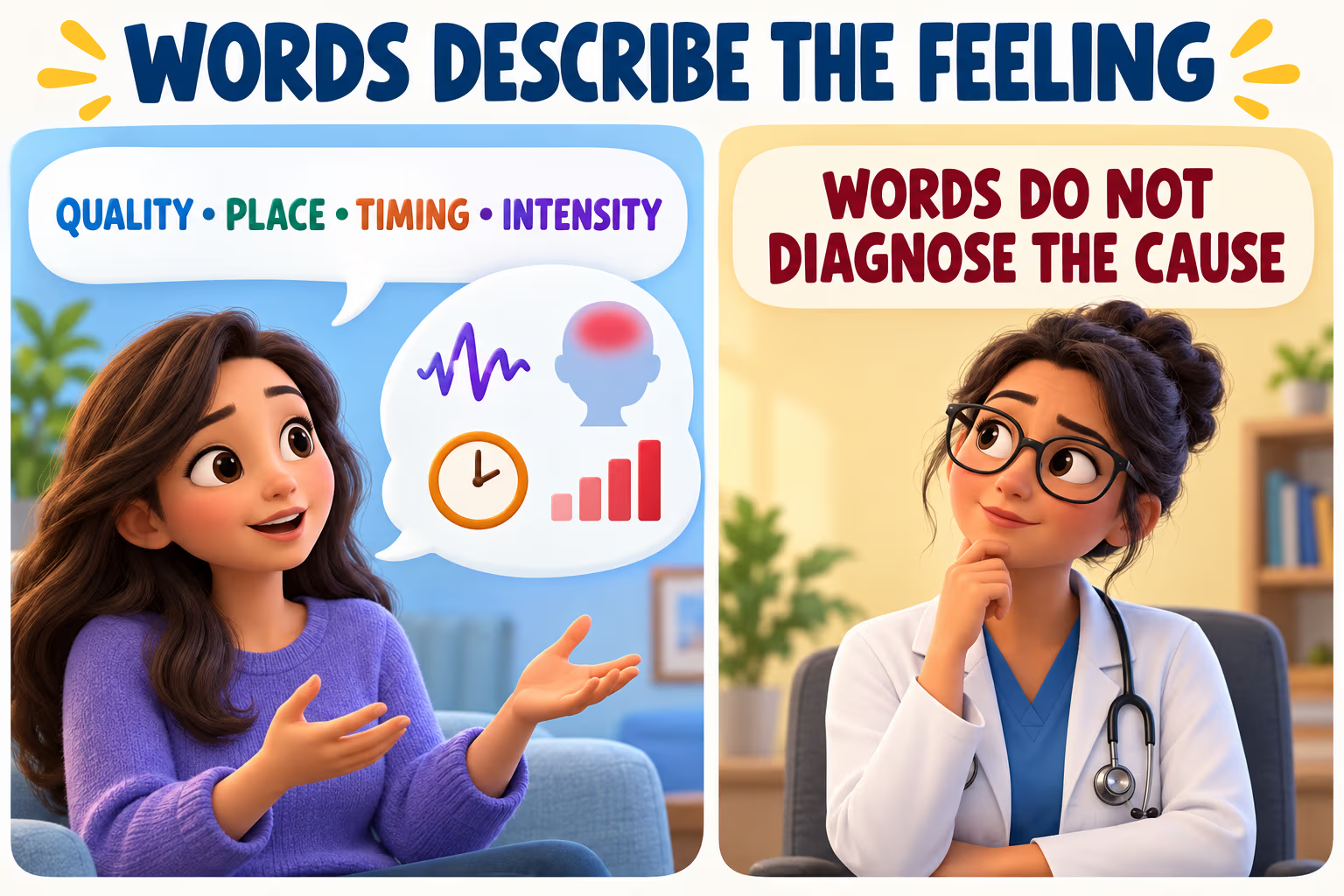
Headache language works best when it stays close to what you can actually notice. “Pulsing at my left temple since midmorning” gives more detail than “bad,” while a phrase such as “like a tight band across both sides” gives a listener a concrete comparison. These descriptions do not establish why the pain is happening.
Quick Headache Word Guide
| Detail | Words to try | Example |
|---|---|---|
| Quality | throbbing, pulsing, aching, tight, sharp | “A steady ache with occasional pulses.” |
| Location | one-sided, both-sided, frontal, temple, behind the eye | “Pressure across my forehead and temples.” |
| Timing | gradual, sudden, brief, persistent, recurring | “It began gradually after lunch and has come and gone.” |
| Intensity | mild, moderate, severe, distracting, disabling | “The pain is moderate, but reading is difficult.” |
| Other sensations | nauseating, light-sensitive, sound-sensitive, dizzy | “Bright light feels uncomfortable, and I feel nauseated.” |
The guide below keeps the original article intact and adds a practical system for choosing and combining headache adjectives.
Ever experienced a pounding, throbbing headache that feels like a jackhammer inside your skull? Or perhaps you’ve had a dull, persistent headache that lingers all day, making it hard to concentrate? As someone who has dealt with my fair share of headaches, I know just how frustrating and debilitating they can be. That’s why I’ve put together this guide on adjectives for headache – describing words that can help you articulate and understand the different types of headaches you might experience. In this article, I’ll provide you with a comprehensive list of descriptive adjectives for headaches, along with examples to help you better describe and identify your specific type of headache. So, whether you’re dealing with a splitting, stabbing, or pulsating headache, this guide is here to help you find the right words to express your pain.
How to Describe headache? – Different Scenarios
Now that we have explored various adjectives to describe headaches, let’s delve into different scenarios where we can apply these descriptive words. When it comes to headaches, each situation may present unique characteristics and symptoms. By understanding and articulating these details, we can better communicate our experiences and seek appropriate treatment. Below, I’ll outline different scenarios and provide examples of how to describe headaches in each case:
1. Migraine Headaches
Migraine headaches are notorious for causing intense pain and a range of other symptoms. When describing a migraine headache, you can use adjectives like:
- Throbbing: “I have a throbbing migraine that feels like a jackhammer in my head.”
- Pulsating: “The pulsating pain of my migraine is becoming unbearable.”
- Severe: “I’m experiencing a severe migraine that’s affecting my ability to function.”
2. Tension Headaches
Tension headaches are often described as a dull, pressure-like pain. When discussing a tension headache, consider using adjectives such as:
- Aching: “I have a constant, aching pain from this tension headache.”
- Heavy: “It feels like there’s a heavy weight pressing down on my head with this tension headache.”
- Persistent: “The persistent tension headache is making it difficult to concentrate.”
3. Cluster Headaches
Cluster headaches are excruciatingly intense and typically occur in cyclical patterns. Here are some adjectives that can be used to describe cluster headaches:
- Stabbing: “I’m experiencing sharp, stabbing pains on one side of my head with this cluster headache.”
- Explosive: “The explosive pain of a cluster headache is unbearable.”
- Unrelenting: “These cluster headaches are unrelenting and causing significant distress.”
Remember, these are just a few examples of how to describe headaches in different scenarios. The key is to pay attention to the specific characteristics of your headache and choose adjectives that accurately portray your experience. This will not only help you communicate your symptoms effectively but also assist healthcare professionals in providing appropriate treatment.
| Headache Type | Adjective |
|---|---|
| Migraine | Throbbing, Pulsating, Severe |
| Tension | Aching |
Describing Words for headache in English
When it comes to describing headaches, having the right words can make all the difference. As someone who has experienced various types of headaches myself, I understand the importance of being able to communicate the specifics of your pain. In this section, I will share with you a range of adjectives that can help you describe different aspects of a headache. Whether you’re experiencing a migraine, tension headache, or cluster headache, these words will come in handy.
1. Migraine Headache
Migraine headaches can be incredibly debilitating and often come with a range of symptoms. Here are some words that can help you articulate the experience of a migraine:
- Throbbing
- Pulsating
- Intense
- Unbearable
- Sharp
- Nauseating
Examples:
- I have a throbbing migraine that makes it difficult to concentrate.
- The pulsating pain in my head is making me feel nauseous.
2. Tension Headache
Tension headaches are commonly caused by stress and are characterized by dull, persistent pain. Here are some words that can help you describe a tension headache:
- Aching
- Pressure
- Tight
- Band-like
- Dull
- Squeezing
Examples:
- I have this aching tension headache that won’t go away.
- The pressure in my head feels like a tight band.
3. Cluster Headache
Cluster headaches are intense and often have a cyclical pattern, with clusters of headaches followed by periods of remission. Here are some words that can help you convey the nature of a cluster headache:
- Excruciating
- Stabbing
- Unrelenting
- Penetrating
- Severe
- Agonizing
Examples:
- These excruciating cluster headaches make it impossible for me to sleep.
- The stabbing pain in my head feels unrelenting.
Using these adjectives can help you accurately describe your headache experience to healthcare professionals, enabling them to provide the appropriate treatment. Remember, being able to effectively communicate your symptoms is crucial for receiving the relief you need.
Note: Consult with a healthcare professional if you consistently experience severe headaches or if your symptoms worsen.
Now let’s move on to the next section, where we will explore some common triggers for headaches.
Adjectives for headache
When it comes to describing a headache, there are a wide range of adjectives that can help convey the intensity, type, and sensation of the pain. Whether you’re discussing your symptoms with a healthcare professional or simply trying to articulate your experience to others, using descriptive words can be incredibly helpful. In this section, I’ll provide you with both positive and negative adjectives for describing headaches, along with example sentences to demonstrate their usage.
Positive Adjectives for Headache
When using positive adjectives to describe headaches, we’re focusing on the sensation of relief or the absence of pain. Here are some examples:
- Soothing: It’s such a soothing headache after taking a long nap.
- Mild: I’m thankful that my headache is only mild and not too severe.
- Bearable: Although it’s not pleasant, the pain is still bearable.
- Comforting: I find comfort in knowing that the headache will eventually go away.
- Temporary: Thankfully, this headache seems to be only temporary.
- Easing: The medicine is slowly easing my headache.
- Remitting: The headache is remitting after a good night’s sleep.
- Subsiding: I can feel the pain subsiding little by little.
- Manageable: It’s a manageable headache compared to previous ones.
- Improving: With each passing hour, my headache seems to be improving.
- Fading: The headache is slowly fading away.
- Restorative: A good rest can be incredibly restorative for a headache.
Negative Adjectives for Headache
On the other hand, negative adjectives for describing headaches focus on the severity, intensity, and discomfort associated with the pain. Here are some examples:
- Excruciating: The headache I’m experiencing is absolutely excruciating.
- Debilitating: This debilitating headache has made it impossible to concentrate.
- Agonizing: Every movement I make intensifies the agonizing pain in my head.
- Unbearable: The pain has become unbearable, and I can’t function properly.
- Pounding: My head feels like it’s being pounded by a sledgehammer.
Using these adjectives can help you express the specific characteristics of your headache and provide clearer information to healthcare professionals. Remember, it’s important to consult with a professional if you are experiencing severe or worsening symptoms.
In the next section, I’ll discuss different scenarios and situations in which these descriptive adjectives can be applied to further enhance your communication of headache experiences.
Synonyms and Antonyms with Example Sentences
Synonyms for headache
When it comes to describing headaches, there are several synonyms that can help you convey the intensity or specific type of headache you are experiencing. Here are some useful synonyms for headache:
- Migraine: A severe, debilitating headache often accompanied by nausea and sensitivity to light.
- Cephalalgia: A medical term for a headache.
- Pounding: Describes a headache with a pulsating or throbbing sensation.
- Splitting: Refers to a very intense or severe headache.
- Throbbing: Describes a headache with a rhythmic pulsation or pounding sensation.
- Tension: Relates to a headache caused by tightness or tension in the muscles of the head and neck.
- Sinus: Refers to a headache caused by inflammation or congestion in the sinuses.
Example sentences using synonyms for headache:
- I woke up with a pounding headache that made it difficult to focus.
- The bright lights triggered a throbbing headache that lasted all day.
- I tried to relax my neck muscles to ease the tension headache I was experiencing.
Antonyms for headache
Antonyms provide a contrasting perspective and can be useful in describing the absence of a headache or a relief from the pain. Here are some antonyms for headache:
- Comfort: The opposite of a headache, indicating a state of ease and lack of pain.
- Relief: Describes the sensation of having a headache alleviated or eliminated.
- Calm: Suggests a state of tranquility without any headache symptoms.
- Clear-headed: Refers to the absence of any mental or physical discomfort associated with a headache.
Example sentences using antonyms for headache:
- After taking the medication, I felt a sense of relief as my headache disappeared.
- It was such a relief to wake up and feel clear-headed, without any trace of a headache.
- I enjoyed a peaceful afternoon at the park, feeling a sense of calm and comfort without a headache bothering me.
Remember, effectively communicating your symptoms to healthcare professionals is crucial for appropriate treatment. If you are experiencing severe or worsening symptoms, consult with a healthcare professional.
Conclusion
Describing headaches accurately is crucial in effectively communicating symptoms to healthcare professionals. Throughout this article, we have explored a range of adjectives that can be used to convey the intensity or specific type of headache. By using descriptive words such as throbbing, pounding, or piercing, we can paint a clearer picture of our pain.
Additionally, we have discussed the importance of describing the absence of a headache or the relief from the pain. Words like relieved, eased, or alleviated can help convey the sense of relief we experience when the pain subsides.
Remember, if you are experiencing severe or worsening symptoms, it is always advisable to consult with a healthcare professional. They can provide a proper diagnosis and recommend the appropriate treatment for your specific type of headache.
By utilizing these adjectives, we can better express our symptoms and seek the necessary medical attention. So, the next time you experience a headache, remember to choose your words wisely to accurately describe your pain.
How Can You Describe a Headache More Precisely?
A useful headache description combines a sensation word with a location, a time pattern, and a concrete effect. You do not need a long list of adjectives; begin with what you noticed first, then add the details that changed or mattered.
- Name the quality: choose the closest everyday word, such as aching, pulsing, pressure-like, stabbing, or burning.
- Point to the location: say whether it is in one area, on one side, on both sides, around an eye, across the forehead, or toward the back of the head or neck.
- Describe the timeline: say when it began, whether it came on gradually or suddenly, how long it lasted, and whether it returned.
- Explain the intensity: use a familiar label or a personal number rating, then say what the pain makes harder to do.
- Add other symptoms: mention nausea, light or sound sensitivity, visual changes, dizziness, or anything else you noticed, without assuming it explains the pain.
- Give context: note what you were doing when it started and what has changed since; this records timing without proving a trigger.
| Less informative | More specific | What the extra detail adds |
|---|---|---|
| “I have a bad headache.” | “A steady, dull ache sits across my forehead and has lasted since this morning.” | Quality, location, and duration. |
| “It is pounding.” | “The pain pulses near my right temple every few seconds and feels stronger when I walk.” | Location, rhythm, and a noticed change with activity. |
| “It is unbearable.” | “The pain is severe enough that I stopped reading and went to a quiet room.” | Intensity plus a specific effect on function. |
| “I keep getting headaches.” | “I had three episodes this week; each began in the afternoon and lasted about two hours.” | Frequency, timing, and duration. |
Which Words Describe Different Headache Sensations?
Choose a quality adjective by comparing the sensation to a familiar pattern, not by trying to identify a medical label. The same person may use several words for one episode, and a sensation may shift over time.
Throbbing, pulsing, or pounding
Throbbing and pulsing describe a repeated beat or wave; pounding often emphasizes force. For example: “A pulsing pain comes in waves behind my left eye.” A pulse-like description can be useful context, but it does not, on its own, tell you what condition is responsible.
Tight, squeezing, or pressure-like
Tight, squeezing, and pressure-like suggest a constricted or pressing feeling. “It feels like a band around my forehead” is a comparison, not a literal measurement. The National Institute of Neurological Disorders and Stroke describes pressure or a tightened-belt feeling among common tension-type headache descriptions, while emphasizing that headache patterns have other features too (NINDS, Headache).
Aching, dull, or heavy
Aching often means a lingering soreness; dull contrasts with a sharp or pointed sensation; heavy describes a weight-like feeling. A person can clarify intensity separately: “a mild, dull ache” and “a severe, dull ache” use the same quality word but communicate different levels of impact.
Sharp, stabbing, or piercing
Sharp, stabbing, and piercing describe a pointed or sudden-feeling sensation. Clarify whether it lasts for a moment or remains, where it occurs, and whether it repeats. “Sharp” alone does not prove that the pain is from an injury or a particular kind of headache.
Burning, tender, or sensitive
Burning compares the sensation to heat; tender or sore describes discomfort when an area is touched; sensitive can refer to a response to light, sound, or movement. Be specific about what is sensitive: “light makes the pain harder to tolerate” differs from “the skin over my scalp feels tender.”
How Do Location, Timing, and Intensity Change the Meaning?
Location, timing, and intensity make a short adjective more useful because they show where and how the experience unfolds. Describe observations in ordinary language; do not infer a diagnosis from a single location or pattern.
- Location: forehead, temples, behind one eye, one side, both sides, back of the head, or head and neck.
- Onset: gradual, sudden, or noticed on waking. If sudden, state how quickly it reached its strongest point rather than relying on a vague label.
- Duration: seconds, minutes, hours, or days, as accurately as you can remember.
- Course: constant, intermittent, recurring, fading, worsening, or changing location.
- Intensity and impact: mild, moderate, severe, or a personal 0–10 rating, alongside what you could or could not do.
A number rating is a shorthand, not a universal measurement: two people may give the same number to different experiences. If you use one, use the same scale consistently and add a real-world example, such as whether you could work, read, sleep, or complete a usual task.
What Other Symptoms Belong in a Description?
Record accompanying symptoms as separate observations rather than folding them into one adjective. NINDS notes that migraine attacks can involve throbbing or pulsating pain and may also include nausea, vomiting, or sensitivity to light, sound, or smells; these features vary and do not make a lay description a diagnosis.
Useful wording is specific: “ordinary room light felt too bright,” “I felt nauseated but did not vomit,” or “I noticed blurred vision before the pain.” If a symptom is new, severe, or worrying, say so plainly and seek appropriate medical advice instead of trying to classify it through a word list. For broader vocabulary about physical discomfort, see our guide to adjectives for pain.
Can Headache Adjectives Identify a Headache Type?
No single adjective can identify a headache type or its cause. Words such as “throbbing,” “band-like,” “sharp,” or “sinus” describe a reported sensation or impression; health professionals consider the full history, associated symptoms, pattern, and examination when they assess a headache.
Some descriptions are associated with common patterns: NINDS describes migraine pain as often throbbing or pulsating, while tension-type pain may feel like steady pressure. Those are general descriptions, not a word-matching test. Symptoms overlap, people describe pain differently, and a person may have more than one relevant feature at once.
In particular, “sinus-like” pressure or pain near the face does not establish sinus disease. When communicating, separate what you feel (“pressure at the bridge of my nose”) from what you think might explain it (“I wonder whether it is sinus-related”). This distinction preserves useful observations without presenting a guess as a fact.
How Can a Simple Headache Record Help?
A brief record can make patterns easier to describe than memory alone. The NHS says a headache diary may help a person work out possible triggers; recording a time relationship does not prove that a particular event caused the headache (NHS, Headaches).
For each episode, note the date and start time, when it ended or eased, the location, quality words, intensity, other symptoms, effect on ordinary activities, and anything notable that happened beforehand. Keep entries short and use the same terms from one entry to the next. If a feature changes—such as a familiar headache becoming suddenly different—record the change in plain language.
A simple entry might read: “Tuesday, about 2 p.m.; pressure across both temples; moderate; lasted around three hours; sound felt irritating; stopped a video call early.” This is an example of clear reporting, not a template that needs to fit everyone. Share the record with a qualified health professional if you seek advice; it can support a conversation but cannot diagnose the cause by itself.
When Does a Headache Need Urgent Attention?
Get urgent medical help for a sudden, extremely painful headache or one accompanied by serious new symptoms. NHS guidance includes sudden extreme pain, seizure, numbness or weakness, trouble speaking or balancing, confusion, loss of vision, a recent head injury, or fever with a stiff neck among reasons for immediate emergency action (NHS, urgent headache advice).
Use your local emergency number or urgent-care service because services differ by country. If headaches recur, worsen, or change from a familiar pattern, contact a health professional for advice; do not use an adjective list to decide that a concerning symptom is harmless.
Frequently Asked Questions About Headache Adjectives
What are good words to describe a headache?
Useful words include throbbing, pulsing, pounding, aching, dull, tight, pressure-like, sharp, stabbing, or burning. Add where the pain is and when it began to make the description clearer. The best word is the one that matches your experience; no single adjective identifies why the headache is happening.
What is the difference between throbbing and pounding?
Throbbing usually emphasizes a repeated pulse or beat, while pounding often emphasizes a stronger, forceful sensation. People may use the terms differently, so an example can clarify: “a pulse that comes and goes near my temple” describes rhythm, while “a forceful pain that interrupts reading” adds impact.
How do I describe headache pain to a doctor?
State when it began, where it hurts, what the sensation feels like, how long it lasts, how intense it is, and what other symptoms occur. Explain how it affects your usual activities and whether this episode differs from earlier ones. A concise record is more useful than guessing at a diagnosis.
Does a throbbing headache always mean migraine?
No. Throbbing is one description that may occur with migraine, but a word alone cannot determine a headache type. Other symptoms, timing, recurrence, health history, and clinical assessment matter. Describe what you notice accurately and leave diagnosis to a qualified professional.
What should I record if headaches keep returning?
Record dates, start times, duration, location, quality, intensity, associated symptoms, daily impact, and relevant context. Use consistent wording so entries can be compared. A diary may help you and a health professional discuss patterns, but a pattern in a diary does not by itself prove a cause.
Conclusion
The clearest adjectives for headache are paired with a location, timeline, intensity, and effect on daily activities. “A steady, dull ache across my forehead since this morning” communicates more than “bad headache,” while avoiding unsupported claims about the cause. Use the words that match your experience, and seek qualified medical advice when symptoms are concerning or changing.


