How to describe honey accurately
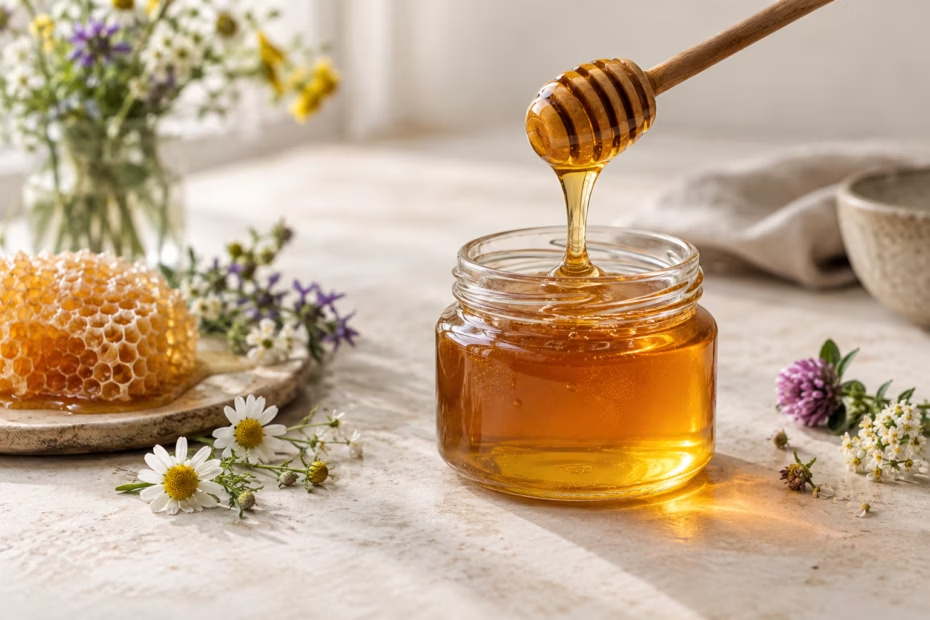
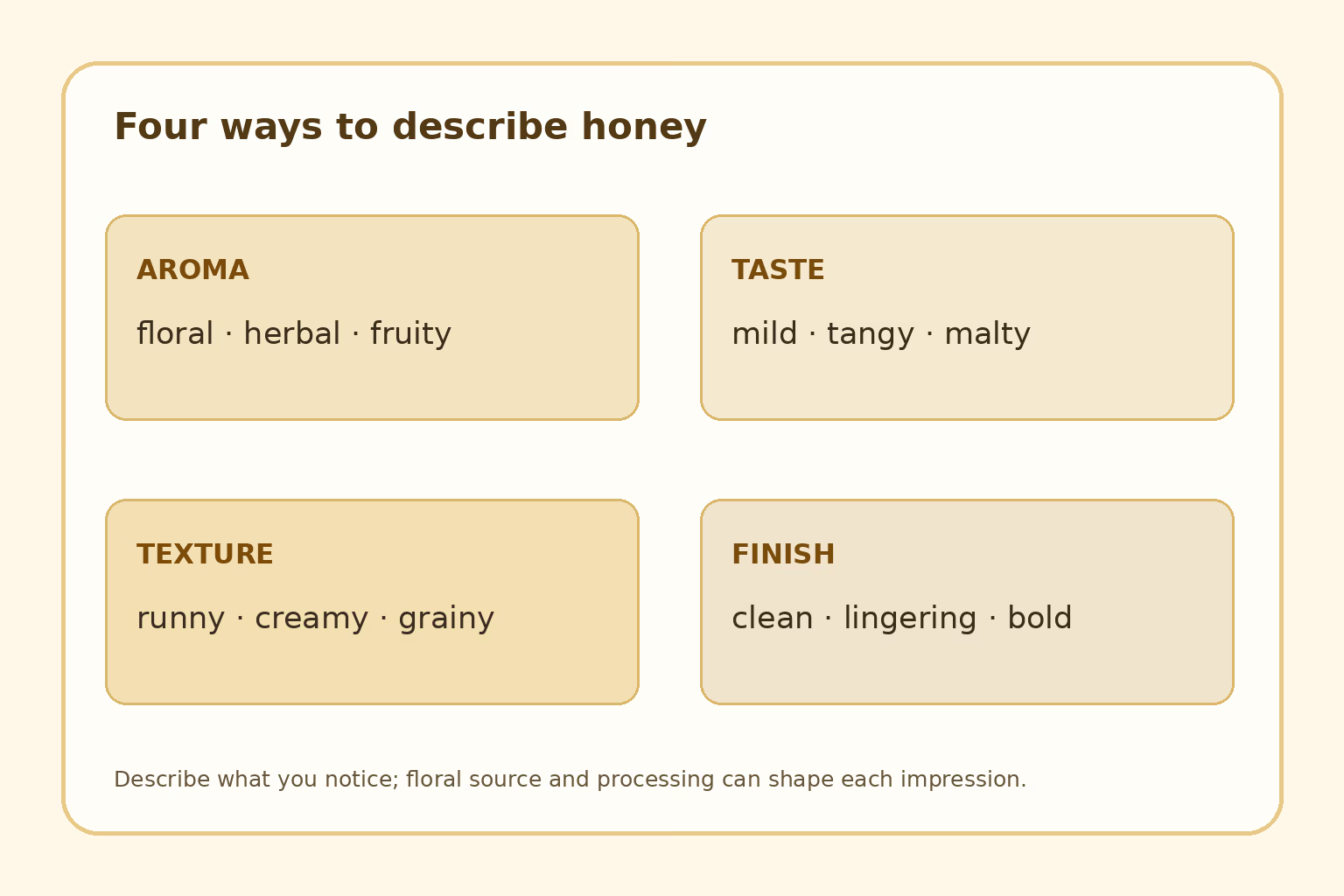
Honey can be described by its aroma, flavor, color, texture, and finish. These categories make a description more useful than a string of general praise: “a floral aroma, mild sweetness, and a clean finish” tells a reader more than “delicious honey.” A jar’s floral source, region, season, and handling can all influence what you notice, so treat tasting words as observations rather than fixed promises.
A simple honey-tasting method
- Look: note whether the honey is pale, amber, or dark, and whether it is clear, cloudy, or crystallized. Color can help describe appearance, but it does not by itself tell you whether a honey tastes mild or strong.
- Smell: take a gentle sniff and choose a comparison that fits: floral, fruity, herbal, woody, earthy, or malty. One or two concrete notes are easier to picture than a long string of adjectives.
- Taste: use a small amount and notice the order of impressions. It may seem mildly sweet at first, then show a tangy, citrus-like, toasted, or gently bitter note. Taste words are subjective, so frame them as what you detect.
- Notice texture and finish: describe whether it pours easily or feels creamy, smooth, or grainy. Then say whether the flavor fades quickly or lingers.
For a fair comparison, taste samples at room temperature in small portions and drink water between them. Smell and taste are closely connected, so an aroma comparison such as “orange blossom” may also suggest a flavor impression. The University of Arizona Cooperative Extension’s honey-tasting guide uses sensory descriptors including floral, fruity, herbal, and woody.
Precise adjectives for honey, with examples
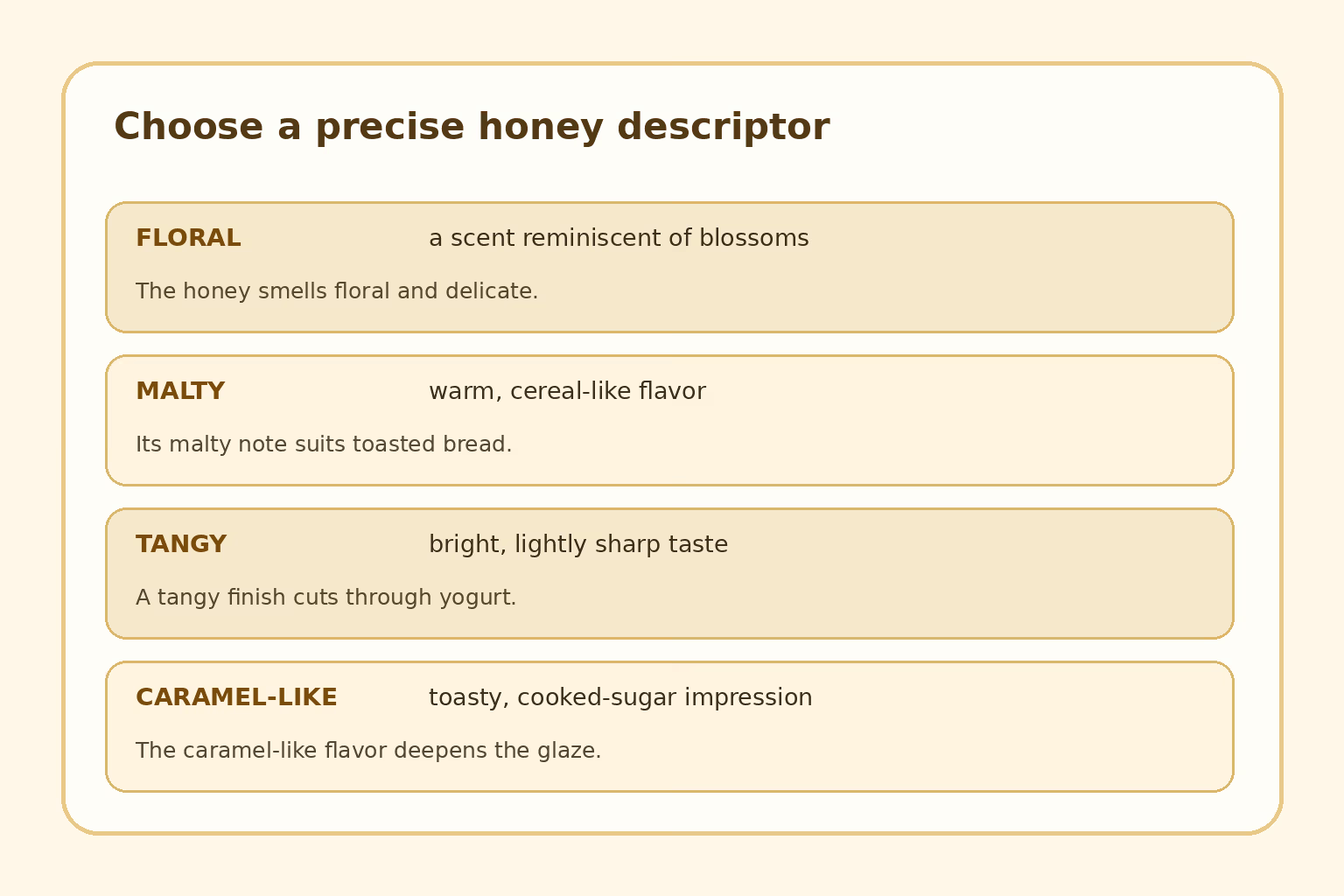
- Floral: suggests an aroma or flavor reminiscent of blossoms. The floral honey added a light perfume to the tea.
- Fruity: evokes fruit-like notes without claiming that fruit was added. A fruity note made the honey pair well with soft cheese.
- Herbal: describes an impression like fresh or dried herbs. The herbal aroma balanced the sweetness of the glaze.
- Malty: points to a warm, cereal-like or toasted impression. Its malty depth worked especially well on brown bread.
- Tangy: describes a bright, lightly sharp taste. The tangy finish kept the yogurt from tasting too sweet.
- Robust: signals a pronounced, full flavor. Robust buckwheat honey stood up to the spices in the marinade.
- Mild: means gentle or restrained in flavor, not flavorless. She chose a mild honey so it would not overpower the fruit.
- Crystallized: names a change in physical state, not a taste. The crystallized honey spread easily on warm toast.
Use sweet for the basic taste, then add one or two more discriminating terms. “Sweet, floral, and lightly tangy” gives more information than “very sweet and delicious.” Avoid treating an adjective as a guarantee that every jar from a named plant will taste identical.
How floral source shapes a description
Honey made largely from one nectar source is often called monofloral; mixed-source honey may be labeled wildflower or described by its blend. These labels describe the predominant source or a blend, and local growing conditions can affect the character. University of Florida IFAS Extension, for example, describes orange-blossom honey as citrus-like and gallberry honey as tangy, while noting the variety of colors and aromas among honeys. The University of Arizona guide also cautions that flavor relates closely to smell and to a taster’s own experience.
When writing a review, distinguish what you know from what you sense: “labeled clover honey, pale amber in color, with a mild floral aroma” separates the label, appearance, and tasting impression. If the source is unknown, describe the sensory evidence instead of guessing its botanical origin.
What crystallized honey looks and feels like
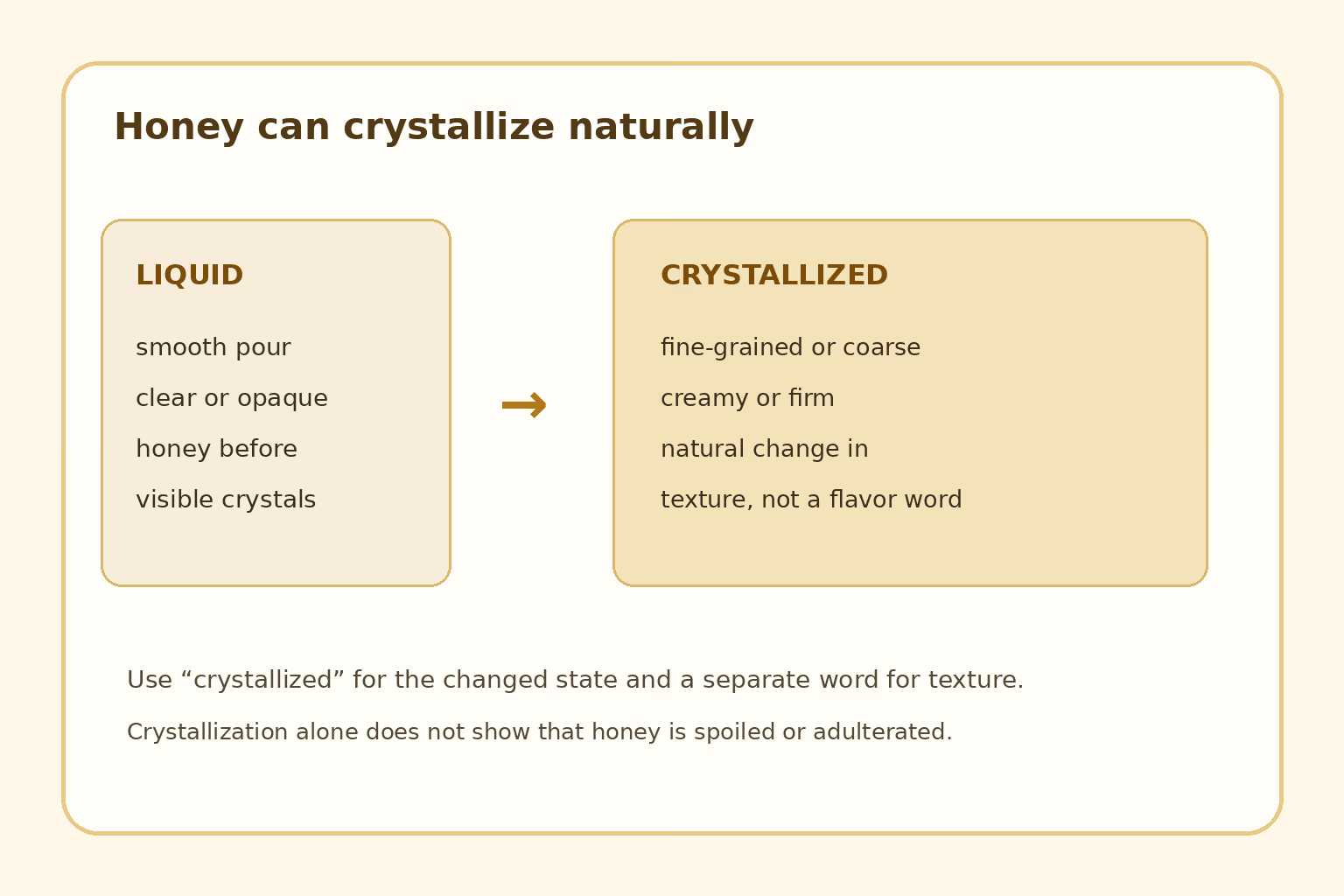
Honey may crystallize naturally during storage. The USDA’s commercial honey specification describes granulation as a natural process and says its rate depends on factors including sugar balance, particles, and storage temperature; it also identifies crystallized honey as the basis for smoothly textured creamed honey. Therefore, crystallized does not automatically mean spoiled or adulterated. If you are describing the jar, add a texture word such as fine-grained, creamy, or firm. It is separate from flavor words such as floral or malty.
Useful sentence patterns
- Review: “This honey has a ___ aroma, a ___ sweetness, and a ___ finish.”
- Food pairing: “Its ___ flavor complements ___ without overwhelming it.”
- Appearance and texture: “The ___ honey is ___ in color and ___ in texture.”
- Careful comparison: “Compared with the first sample, this one tastes ___ and leaves a more ___ aftertaste.”
Example: “The pale honey smells floral, tastes mildly sweet with a citrus-like note, and finishes cleanly.” This sentence gives separate sensory observations and avoids claiming a source the taster has not verified.
Sources and tasting note
These descriptions are sensory examples, not official flavor grades. For background, see the University of Arizona Cooperative Extension guide to tasting honey, University of Florida IFAS Extension’s overview of honey varieties, and the USDA commercial item description for honey.

When it comes to honey, there’s no denying its sweet and golden allure. But have you ever stopped to think about the various adjectives that can be used to describe this delectable treat? From rich and velvety to floral and aromatic, honey possesses a wide range of characteristics that can be captured in words. In this article, I’ll be exploring the world of adjectives for honey, providing you with a comprehensive list of descriptive words and examples to help you appreciate the diverse flavors and qualities that honey has to offer. So, whether you’re a honey connoisseur or simply curious about the different types of honey out there, get ready to delve into the enticing world of adjectives for honey.
Honey, with its natural sweetness and versatility, has long been a favorite ingredient in culinary creations and remedies. But how do we accurately describe the unique attributes of this golden nectar? That’s where adjectives come in. From light and delicate to bold and robust, the right adjective can paint a vivid picture of the taste, texture, and aroma of different types of honey. In this article, I’ll be sharing a curated selection of adjectives for honey, along with examples that showcase the diverse range of flavors and characteristics found in this liquid gold. So, whether you’re looking to expand your vocabulary or simply want to appreciate honey in a whole new way, join me as we explore the fascinating world of descriptive words for honey.
How to Describe honey? – Different Scenarios
When it comes to describing honey, there are several adjectives that can capture its unique qualities. Whether you’re talking about its taste, color, texture, or even its aroma, choosing the right words can help paint a vivid picture. Here are some different scenarios in which you can describe honey:
- Taste
- Color
- Texture
- Aroma
Remember, the world of honey is vast, with countless variations that can be found across different regions and floral sources. Exploring the diverse range of adjectives to describe honey can deepen your appreciation for this sweet and versatile treat. So, the next time you enjoy a spoonful of honey, take a moment to savor its distinct flavors and characteristics.
Describing Words for honey in English
As a beekeeper and honey enthusiast, I have come across a wide variety of honey types, each with its own unique characteristics. Describing honey accurately can be challenging, but with the right adjectives, you can paint a vivid picture of its taste, color, texture, and aroma. Here are some describing words that can help you capture the essence of honey:
Taste
- Sweet: Honey is renowned for its natural sweetness, which is its most prominent characteristic.
- Floral: Some honey varieties have distinct floral notes, such as lavender, orange blossom, or wildflower.
- Fruity: Certain types of honey, like blueberry or cherry blossom, exhibit hints of fruit flavors.
- Mild: You might use this word to describe honey that has a gentle and subtle taste.
- Rich: When honey has a deep, full-bodied flavor, you can describe it as rich.
Color
- Golden: Many people associate honey with its classic golden hue.
- Amber: Some honey varieties lean towards a darker, amber color, giving them a more intense appearance.
- Light: Honey that is pale in color could be described as having a light or delicate shade.
- Dark: For honey that has a deeper tone, describing it as dark can accurately portray its color.
Texture
- Runny: Some honey flows smoothly and easily, making it appear runny.
- Viscous: This word can be used to describe honey that is thick and syrupy in texture.
- Creamy: Certain types of honey have a creamy consistency, making them easy to spread.
- Crystallized: Honey that has solidified into crystals can be described as crystallized.
Aroma
- Sweet-smelling: Use this adjective to convey the sweet scent of honey.
- Floral-scented: Some honey varieties have a distinct floral aroma that can be described as floral-scented.
- Fragrant: When honey has a pleasant and noticeable aroma, you can describe it as fragrant.
Remember, honey is incredibly diverse, and these adjectives only scratch the surface of its varied qualities. Don’t hesitate to explore different honey varieties and experiment with different words to capture their unique characteristics.
Adjectives for honey
When it comes to describing honey, there are numerous adjectives that come to mind. Each adjective captures a unique aspect of this delectable and diverse natural sweetener. Whether you want to describe its taste, color, texture, or aroma, there’s an adjective out there to help you paint a vivid picture. In this section, I’ll provide you with examples of both positive and negative adjectives for honey, giving you plenty of options to choose from. Let’s dive in!
Positive Adjectives for Honey with 12 Example Sentences
- Sweet: Honey is known for its irresistible sweetness, making it the perfect natural substitute for sugar.
- Floral: Some varieties of honey, like lavender or orange blossom, have a delightful floral aroma and taste, adding a touch of nature to your culinary creations.
- Fruity: Certain types of honey, such as blueberry or raspberry honey, have a distinctly fruity flavor that adds a burst of fruity goodness to your dishes.
- Golden: The stunning golden color of honey is not only visually appealing but also hints at its richness and natural goodness.
- Viscous: Honey’s thick and sticky consistency is one of its defining characteristics, making it easy to drizzle or spread on your favorite foods.
- Smooth: When you taste honey, you’ll notice its smooth texture, which adds a luxurious mouthfeel to any dish it’s added to.
- Luscious: The lusciousness of honey can be experienced when it coats your taste buds, leaving behind a lingering sweetness.
- Delicious: It goes without saying that honey is simply delicious, making it a beloved ingredient in a wide range of culinary creations.
- Aromatic: The aromatic nature of honey is evident in its pleasant and enticing smell, which adds an extra sensory dimension to your food.
- Versatile: Honey’s versatility shines through, as it can be used in both savory and sweet dishes, adding a touch of natural sweetness and depth of flavor.
- Nourishing: Honey is not only delicious but also packed with essential nutrients and antioxidants that provide nourishment and health benefits.
- Pure: With its all-natural production process, honey is often described as pure, free from additives or artificial ingredients.
- Overwhelming: In some cases, the sweetness of honey can be overwhelming, so it’s important to use it sparingly.
- Runny: While honey’s viscosity can be a desirable trait, some varieties may be too runny, making it harder to handle or measure accurately.
- Cloying: If used excessively, honey can become cloying, overpowering other flavors in a dish.
- Crystalized: Over time, honey can crystalize, forming sugar crystals and changing its texture. However, this can be easily remedied by gently heating the honey.
- Sticky: Honey’s sticky nature can be inconvenient at times, especially if it gets on surfaces or utensils. But with a little warm water, it’s easy to clean up.
As you can see, honey can be described using a wide range of adjectives, each capturing a different aspect of its taste, color, texture, and aroma. Whether you want to highlight its sweetness, emphasize its natural goodness, or even point out any potential drawbacks, these adjectives will help you do just that. So, go ahead and explore the diverse world of honey, experiment with words, and find the perfect adjectives to describe this delightful treat.
Synonyms and Antonyms with Example Sentences
Synonyms for Honey
When it comes to describing honey, there are several synonyms that can be used to capture its unique characteristics. Here are some examples:
| Synonym | Definition |
|---|---|
| Sweet | Having a pleasant taste, like sugar or honey. |
| Floral | Having the scent or taste of flowers. |
| Fruity | Having the taste or aroma of fruit. |
| Golden | Having a rich and vibrant golden color. |
| Viscous | Having a thick and sticky consistency. |
| Smooth | Having a uniform texture without any lumps or grains. |
| Luscious | Highly pleasing to the taste or smell. |
| Delicious | Tasting extremely good or enjoyable. |
| Aromatic | Having a strong and pleasant odor. |
| Versatile | Able to be used in a variety of ways or for different purposes. |
| Nourishing | Providing the body with essential nutrients and energy. |
| Pure | Completely free from impurities or contaminants. |
Example sentences using these synonyms:
- The sweet honey dripped down my spoon.
- I love the floral notes in this honey.
- The fruity honey adds a burst of flavor to my yogurt.
- The golden honey glistened in the sunlight.
- The viscous honey slowly oozed off the spoon.
- I love the smooth texture of this honey on my toast.
- The luscious honey melted in my mouth.
- This honey is absolutely delicious, I can’t get enough of it!
- The aromatic honey filled the room with its enticing scent.
- Honey is a versatile ingredient that can be used in sweet and savory dishes.
- I always start my day with a spoonful of nourishing honey.
- I prefer to use pure honey in my recipes for the best flavor.
Antonyms for Honey
While there are many positive adjectives that can be used to describe honey, there are also some antonyms that highlight different aspects of its characteristics. Here are a few examples:
| Antonym | Definition |
|---|---|
| Overwhelming | Having a strong or overpowering taste. |
| Runny | Having a thin or watery consistency. |
| Cloying | Overly sweet or sticky. |
| Crystallized | Solidified into crystals. |
| Sticky | Adhesive or gooey. |
Example sentences using these antonyms:
- I find the taste of this honey to be overwhelming.
- Be careful, this honey is quite runny and might drip.
- Some people find honey to be cloying, but I enjoy its sweetness.
- The honey has crystallized and formed into solid chunks.
- The honey is so sticky that it’s hard to get off my fingers.
As you can see, honey has a wide range of adjectives that can be used to describe its taste, color, texture, and aroma. Next time you enjoy a jar of honey, take a moment to appreciate its unique characteristics and try using some of these adjectives to describe it.
Conclusion
Describing honey can be a delightful exercise in capturing its multifaceted nature. Throughout this article, we have explored a wide range of adjectives that can be used to paint a vivid picture of honey’s taste, color, texture, and aroma. From positive descriptors like sweet, floral, and fruity to negative ones such as overwhelming and sticky, there is a rich tapestry of words that can be used to express the unique qualities of honey.
By experimenting with these adjectives, we can truly appreciate the diversity of honey and the sensory experience it offers. Whether it’s the golden hue, the smooth and viscous texture, or the luscious and aromatic flavors, honey has the ability to captivate our senses and elevate our culinary creations.
So, the next time you savor a spoonful of honey, take a moment to reflect on its characteristics and find the perfect words to describe it. Let your imagination run wild and uncover the myriad of adjectives that can capture the essence of this natural wonder. Remember, honey is not just a sweet treat, but a complex and versatile ingredient that deserves to be celebrated with the power of words.


