
Adjectives for ice cream describe its flavor, texture, temperature, appearance, or the impression it creates. Words such as creamy, tart, and speckled tell readers different things, so choose terms that match what you actually taste or see. Specific observations make a clearer description than a long string of general praise.


What can an ice-cream adjective describe?
An adjective can describe a sensory quality, such as a smooth texture or a tart berry flavor, or a personal reaction, such as comforting or indulgent. Separate what you observe from whether you like it: “dense” describes body, while “delicious” reports a preference.
| Dimension | Useful adjectives | Example |
|---|---|---|
| Flavor and aroma | sweet, tart, nutty, buttery, fruity, toasted, floral, cocoa-rich | The toasted, nutty flavor balances the sweet base. |
| Texture and body | creamy, smooth, velvety, dense, airy, chewy, grainy | The dense scoop feels smooth and rich. |
| Temperature or state | frozen, chilled, frosty, softened, melting | The softened ice cream melts into a glossy pool. |
| Appearance | pale, golden, glossy, speckled, marbled, swirled | Dark chocolate ribbons streak the pale base. |
| Overall impression | refreshing, rich, comforting, delicate, indulgent | The light citrus scoop tastes refreshing after dinner. |
Flavor names and adjectives are related but not identical. “Pistachio” names a flavor or ingredient; “nutty” describes a flavor impression; “green” may describe the scoop’s color, the taste of herbs, or both. Add a clarifying noun when a word could be read in more than one way.
Which flavor words make tasting notes more precise?
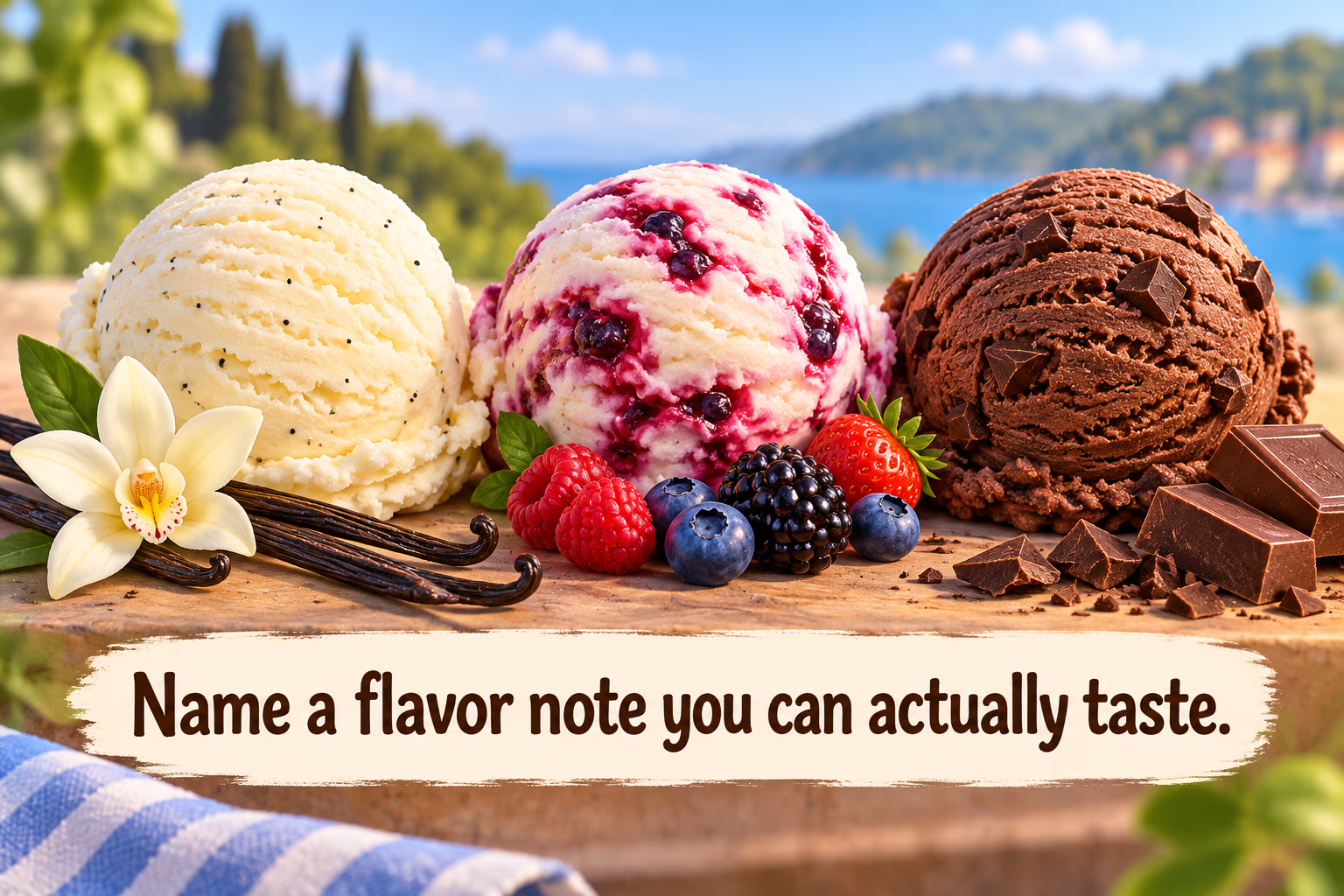
Start broad, then name a specific note: fruity can become tart raspberry; chocolatey can become dark, cocoa-forward, and bittersweet. Use a descriptor only when it matches the sample, since recipes and brands vary.
- Sweet and dessert-like: sugary, honeyed, caramelized, vanilla-scented.
- Fruit-forward: bright, tart, tangy, citrusy, jammy, ripe.
- Roasted or nutty: toasted, nutty, cocoa-rich, coffee-like.
- Dairy or spice notes: buttery, milky, creamy, cinnamon-scented, floral.
- Unexpected or unpleasant: sour, bitter, stale, rancid, or artificial. These are negative impressions; do not label a product with them unless the taste supports it.
A 2009 sensory study by Kansas State University’s Sensory Analysis Center developed a defined vocabulary for comparing ice cream and gelato, including attributes for fruity, dairy, vanilla, chocolate, and texture notes. Its panel described samples by particular attributes rather than relying only on a general like-or-dislike judgment. See the study on sensory characteristics of ice cream and gelato.
How do texture adjectives differ?
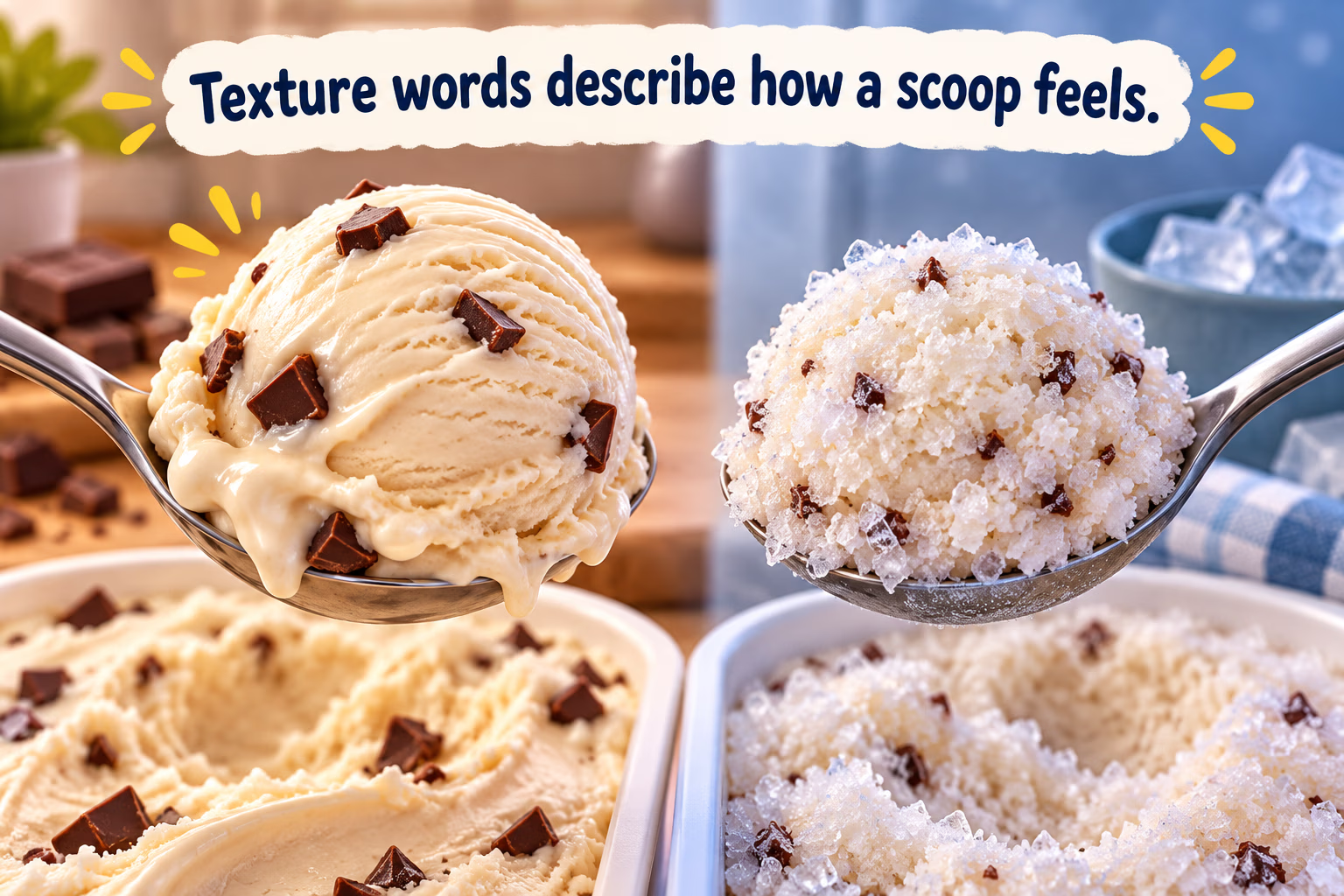
Texture words describe how the frozen dessert feels as it is scooped, chewed, and melted. North Carolina State University’s Sensory Service Center says smoothness, creaminess, air, and ice-crystal size affect an ice cream’s texture; it describes excessive air as fluffy and noticeable crystals as icy or gritty.
| Word | What it suggests | Example |
|---|---|---|
| creamy, smooth, velvety | Even, soft mouthfeel | The custard-style scoop felt velvety as it melted. |
| dense, heavy | Substantial body; “heavy” can sound less positive | A dense chocolate scoop held its shape. |
| airy, fluffy | Light body with more incorporated air; “fluffy” can signal excess air in technical judging | The airy scoop felt light on the spoon. |
| icy, coarse | Noticeable ice crystals | The refrozen scoop had a coarse, icy texture. |
| sandy, gritty, grainy | Rough or particulate sensation; technical cause can vary | The sample felt grainy against the tongue. |
| chewy, gummy, crumbly | Resistance, pastiness, or a flaky body | The gummy texture lingered after the flavor faded. |
Technical sources do not always use these defect labels in exactly the same way. The University of Guelph’s Ice Cream Technology text distinguishes icy texture from a sandy sensation caused by lactose crystals, while NC State’s educational overview groups sandy or gritty texture with oversized crystals. Unless you know the cause, describe the sensation you noticed rather than diagnosing the manufacturing defect. Read NC State’s ice-cream sensory guide and the University of Guelph text on body and texture defects.
How do you write a useful ice-cream description?
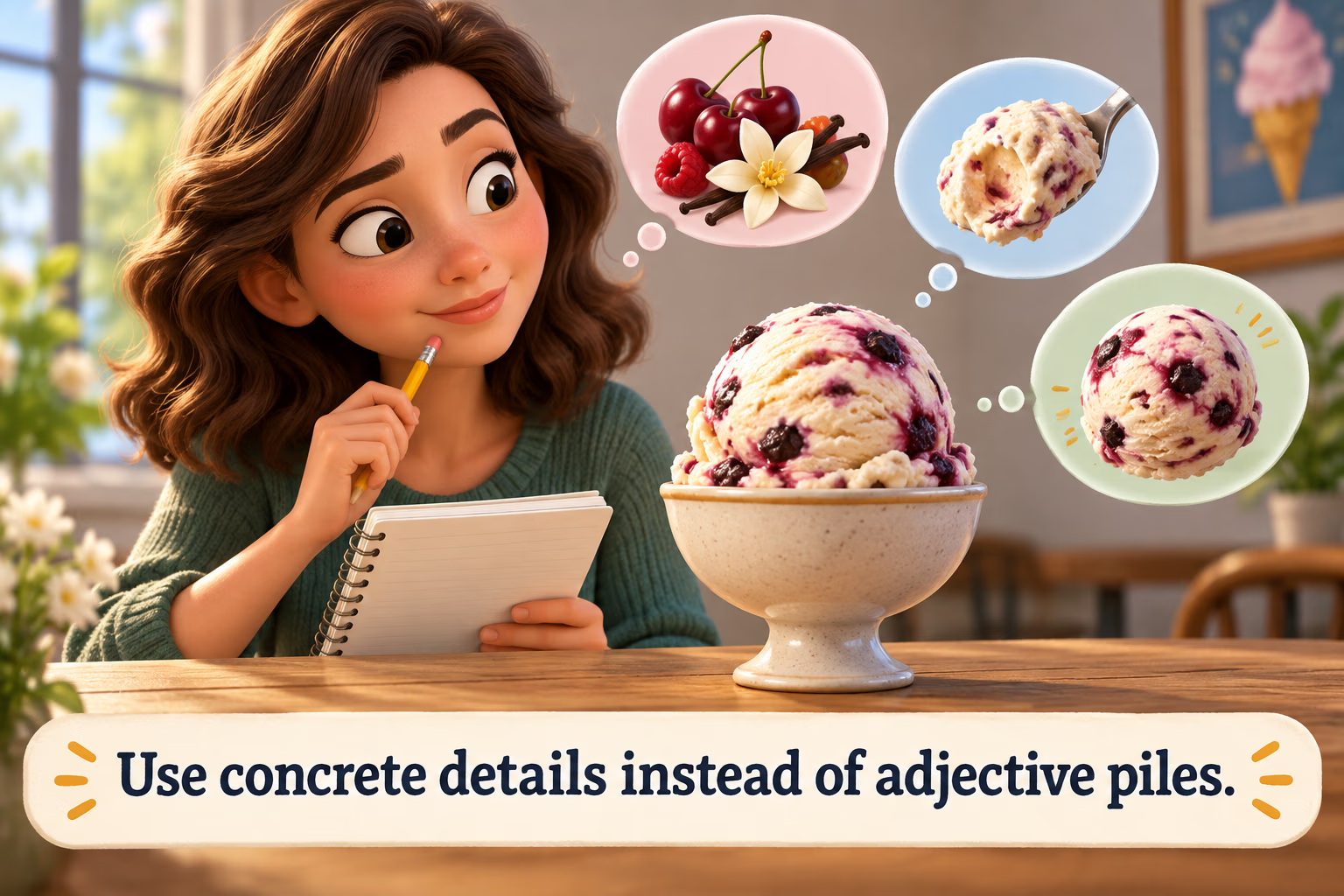
A useful description combines a specific sensory word with an observable detail. “Delicious, amazing, wonderful ice cream” says that the writer likes it; “tart raspberry ribbons cut through the sweet cream base” gives a reader a clearer expectation.
- Identify the feature: flavor, texture, appearance, temperature, or finish.
- Choose a precise adjective: tart rather than merely “good,” speckled rather than “interesting.”
- Add a concrete comparison or ingredient: cocoa-like, lemony, or crisp wafer pieces.
- Keep preference separate: “I enjoyed the tangy finish” distinguishes opinion from the flavor note.
Try these examples:
- Menu: “Silky vanilla ice cream with a bright, tart strawberry ripple.”
- Review: “The toasted pecans add a crisp contrast to the creamy, buttery base.”
- Story: “A pale scoop softened in the sun, its chocolate ribbons slowly melting down the cone.”
- Simple sentence: “The cold, minty ice cream tasted refreshing.”
Are adjectives like “healthy” or “natural” objective?
Not by themselves. Words such as healthy, light, natural, and premium can imply nutrition, ingredients, or product quality, but they do not give those facts. A description should not make a health claim unless it is supported by the product’s nutrition and ingredient information and the context in which the claim is used.
For a neutral description, state verifiable details: “made with oat milk,” “contains chopped almonds,” or “a ½-cup serving lists 14 grams of added sugar” (when that matches the actual label). Flavor adjectives alone cannot establish that a food is healthy or suitable for an individual diet. The original list is vocabulary material, not nutrition advice.
Common Questions About Ice-Cream Adjectives
What are positive adjectives for ice cream?
For a favorable description, try creamy, smooth, velvety, rich, refreshing, or delicate—but choose only words that fit the scoop. “Rich” can describe a full flavor or mouthfeel; it is not a nutrition measurement.
What is the difference between creamy and smooth?
Smooth describes an even texture without noticeable particles or crystals. Creamy often suggests a soft, rich mouthfeel. A scoop can be smooth without tasting rich, and a rich flavor does not guarantee a smooth texture.
How can I describe an ice-cream flavor?
Name the main flavor, then refine it with a sensory note: “tart cherry,” “toasted hazelnut,” or “dark cocoa.” Add a separate word for sweetness or finish if useful, such as “a sweet base with a lingering coffee note.”
What words describe bad ice-cream texture?
Icy, coarse, gritty, grainy, gummy, or crumbly can describe unwanted textures. The exact technical cause is not always obvious from eating a sample, so describe what you perceive instead of guessing how it was made or stored.
Choose ice-cream adjectives that match the scoop
Adjectives for ice cream are most useful when they tell readers what the sample tastes like, how it feels, or what it looks like. Pair one specific flavor or texture word with a concrete detail, distinguish observation from personal praise, and avoid treating vague product claims as evidence about nutrition or quality.
Sources: North Carolina State University Sensory Service Center: dairy sensory evaluation; University of Guelph: ice-cream body and texture defects; Journal of Sensory Studies: sensory characteristics of ice cream and gelato.
Note on the original word list: The source below is preserved unchanged. Its long A–Z list includes apparent misspellings, fragments, proper nouns, flavor names, brand-like terms, and words that are not useful sensory adjectives. It also includes technical-sounding labels such as bacterial, antiseptic, inflammatory, and protective, plus a broad claim that ice cream can be a healthy snack. Do not treat that list as a vetted food-quality, food-safety, or nutrition guide; use terms only when they accurately describe the product.
Who doesn’t love ice-cream? It’s refreshing, it’s delicious, and it comes in a wide variety of flavors. But what exactly is ice-cream? And how did it come to be such a popular treat?
Adjectives for ice-cream: Adjectives are words that modify or describe other words. They can describe the physical appearance of something, or they can express more abstract concepts like courage or happiness. When it comes to describing food, adjectives can be particularly useful in conveying both the physical properties of the dish and the diner’s emotional reaction to it.
When it comes to ice cream, there are a wide range of adjectives that can be used to describe this delicious treat. For example, ice cream can be described as cold, creamy, smooth, rich, sweet, or refreshing. It can also be described in terms of its flavor, such as chocolate, strawberry, or mint. Depending on the ingredients and preparation method used, ice cream can also be described as light, fluffy, dense, or even crispy. Ultimately, the adjectives you use to describe ice cream will depend on your personal preferences and the specific dish you’re enjoying.
Adjectives For Ice-Cream
In this article, we’ll be exploring some adjectives for ice-cream. Ice-cream is a delicious treat that comes in many flavors, textures, and colors. It’s the perfect food for hot summer days, or cold winter nights. And, it can be a healthy snack, if you choose the right kind. Here are some adjectives that can be used to describe ice-cream:
- Rich: Ice-cream that is high in fat and calories.
- Velvety: Smooth and creamy ice-cream that melts in your mouth.
- Fluffy: A light and airy type of ice-cream that is often made with whipped cream or egg whites.
- Icy: Refers to an ice-cream that has crystalized or is painfully cold.
- Nutty: An ice-cream flavor that contains nuts, or is made with a nut-based syrup.
- Fruity: A flavor of ice-cream that contains fruit, or is made with a fruit puree.
Whatever adjectives you choose, make sure they accurately describe the taste, texture, and appearance of the ice-cream. And, most importantly, enjoy!

A
| Absolute | Actual | Albuminous |
| American | Anti | Antiseptic |
| Artisanal | Asparagus |
B
| Bacterial | Barly | Bavarian |
| Big | Black | Black Berry |
| Black Cherry | Bland | Boyl |
| Branded | Brown | Butter |
| Buttery |
C
| Chaeban | Cherry | Chicory |
| Classic | Clotted | Clouted |
| Coconut | Cold | Color |
| Commercial | Concentrated | Cone |
| Corn Meal | Cosmetic | Creamsolid |
| Cup | Curdling |
D | E
| Decent | Deep | Delicious |
| Different | Double | Doubtless |
| Enjoy | Evaporated | Expensive |
| Extra | Extra Ordinary |
F
| Famous | Fancy | Fat |
| Fat Free | Favorite | Feastkouskous |
| Figureice | Fine | Firm |
| Flavor | Flavorful | Floating |
| Fluffy | Forthcoming | Fourth |
| Fragrant | French | Fresh |
| Frizz | Frostbitten | Frosty |
| Frozen | Fruit And Nut | Fruity |
G | H
| Garlic | Golden | Green |
| Green Tea | Half Melted | Heavy |
| Helpful | Homemade | Hot |
| Hydrating |
I | K | L
| Iced | Incredible | Indian |
| Inflammatory | Inner | Italian |
| Kulfi | Large | Legendary |
| Light | Lightweight | Liquid |
| Local | Low Fat |

M
| Mastic | Medium | Mellow |
| Mexican Fried | Milkfull | Milkpart |
| Milky Shake With | Mint | Mochi |
| Mock | Mouldy | Multi Flavour |
| Mushy |
N | O
| Nearby | Nice | No Churn |
| Nuto | Oily | Orange |
| Ordinary |
P
| Pale | Persian | Pile |
| Pink | Pistachio | Plain |
| Plastic | Plum Wine | Premium |
| Proper | Protective | Pumpkin |
| Pure |
R
| Rancid | Real | Regular |
| Reserved | Rich | Rich Rich |
| Rum Raisin |
S
| Scented | Semifreddo | Short Lived |
| Simple | Single | Sleepy |
| Smooth | Soft | Sour |
| Spaghetti | Spanish | Sticky |
| Strange | Strawberry Cream | Sugary |
| Sweet | Sweet Chinese | Sweetest |
| Synthetic |

T | U | V | Y | Z
| Tablespoonful | Terrific | Textured |
| Thick | Thin | Topical |
| Unforgettable | Unsteady | Usual |
| Vanilla | Yellow | |
| Yummy | Zwieback |
Final verdict
In conclusion, adjectives are a great way to describe ice cream. They can be used to describe the flavor, texture, and appearance of the ice cream. Adjectives can also be used to describe the feeling of eating ice cream. By using adjectives, we can create a more vivid and accurate picture of ice cream in our minds.


