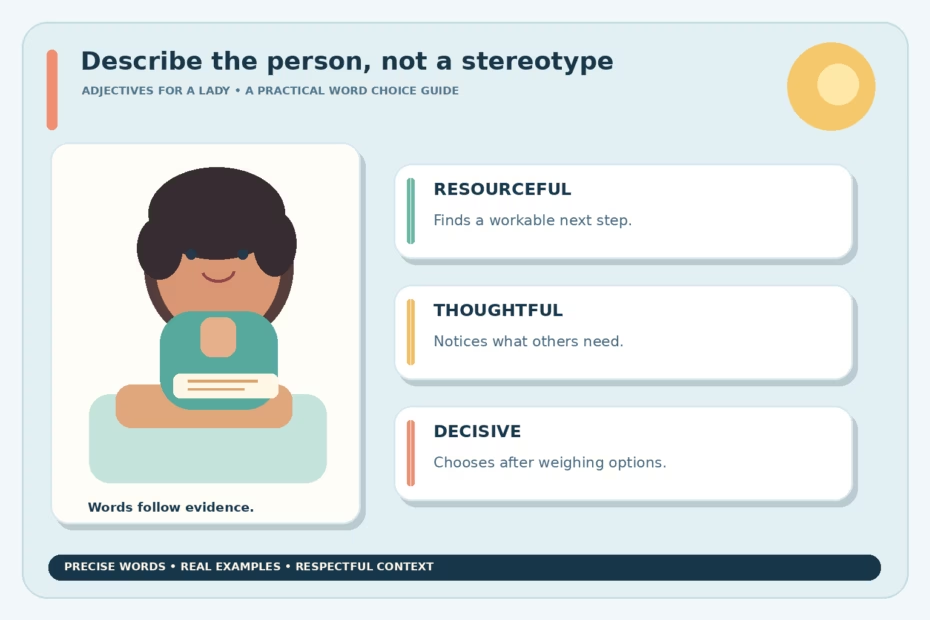
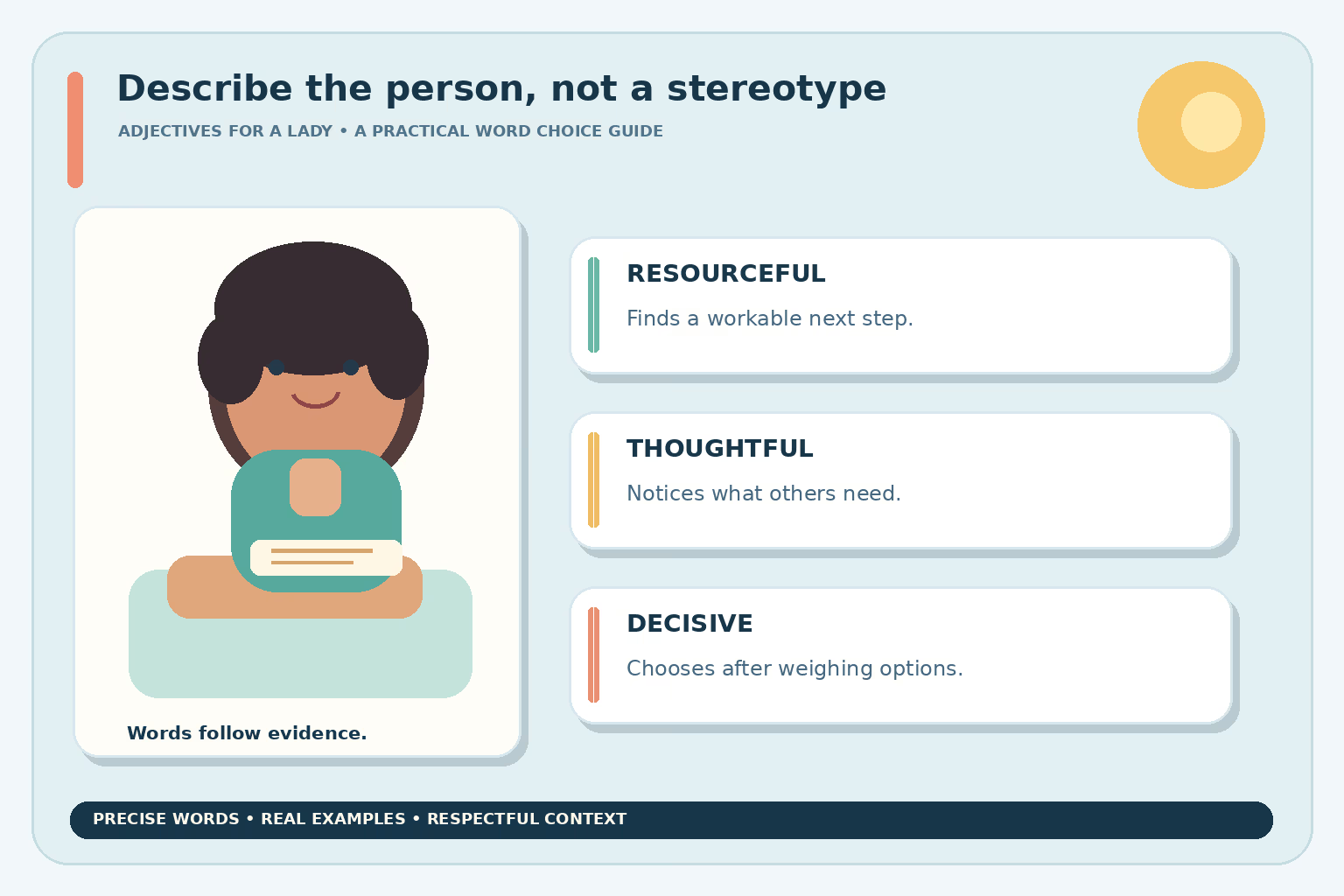
Choose a word that describes the person’s demonstrated quality, not a rule about how women should behave. For a tribute, profile, review, or story, precise adjectives such as resourceful, thoughtful, decisive, witty, or generous communicate more than a broad label such as “classy.” Pair the adjective with an observable example, and consider whether “woman” is the clearer noun for your audience and context.
The word lady can be a polite or old-fashioned way to refer to a woman, a form of address, or a title; its meaning depends on context. Cambridge Dictionary also notes that using it to address an unknown woman can sound impolite to many women. When a sentence is about an adult person rather than a title, woman is often more direct. Cambridge Dictionary: “lady”
How do you choose an adjective that fits?
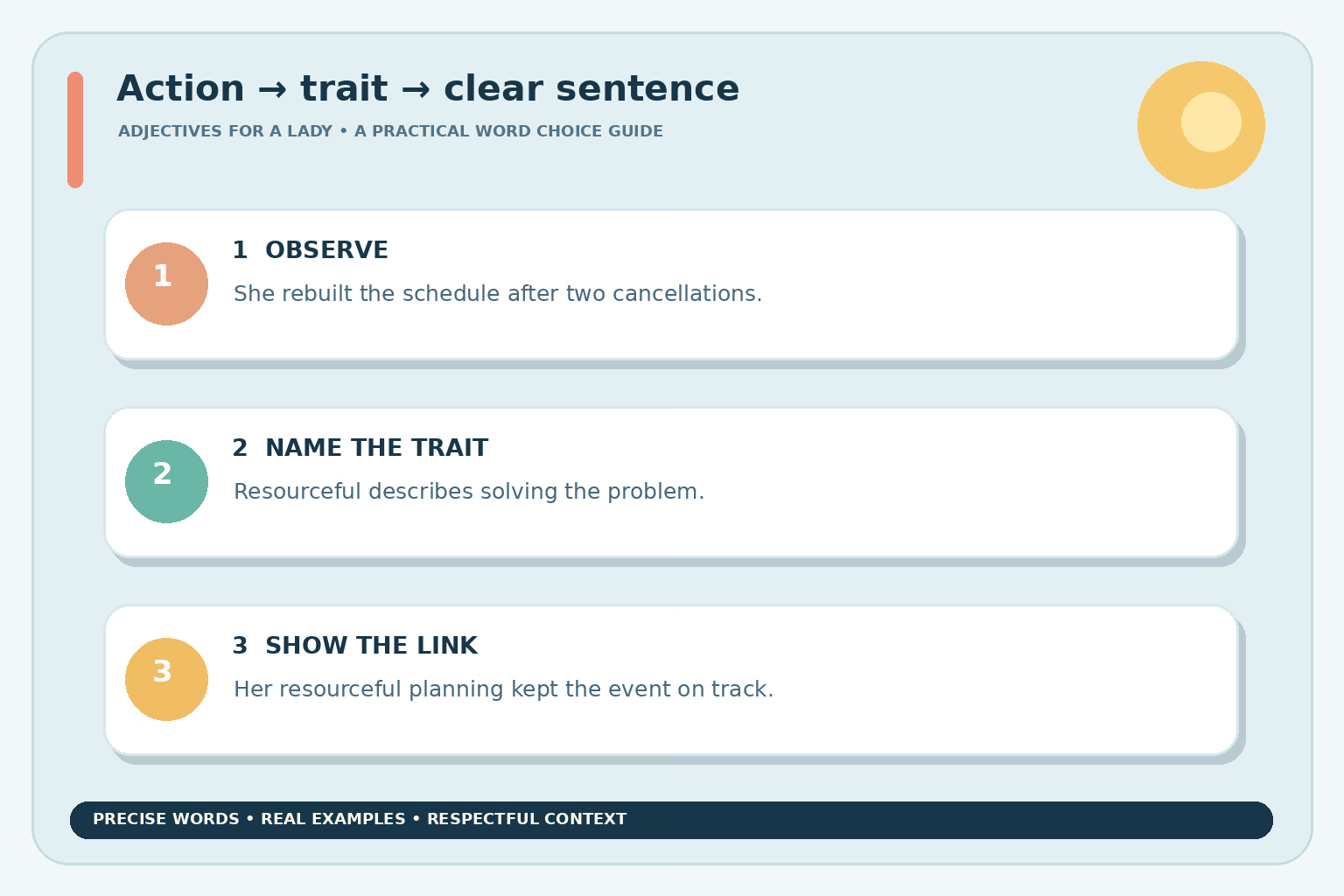
Start with what the person did, then name the quality the action supports. “She reorganized the volunteer schedule when two people canceled” supports resourceful or adaptable; “she checked in with each volunteer” supports thoughtful or considerate. The example makes the adjective more credible and useful to readers.
Adjectives modify nouns or pronouns and describe qualities or features, according to Cambridge’s English Grammar Today. They do not prove a person has one fixed character. Treat them as a writer’s description of relevant behavior or a point of view, rather than as an objective verdict about an entire person. Cambridge Grammar: adjectives
| What you observed | Possible adjective | Example sentence |
|---|---|---|
| She tested two approaches before choosing one. | Pragmatic, analytical | Her analytical approach helped the team compare both options. |
| She shared credit and invited quieter colleagues to speak. | Generous, inclusive | She was inclusive in meetings and made room for other voices. |
| She kept practicing after an early setback. | Persistent, resilient | Her persistence helped her finish the difficult project. |
| She changed her view after hearing new evidence. | Open-minded, reflective | She was open-minded enough to revise her first interpretation. |
| She explained a complex plan in clear steps. | Articulate, clear | Her clear explanation helped new volunteers get started. |
| She noticed a practical need and quietly addressed it. | Considerate, attentive | Her attentive response made the guest feel welcome. |
Which describing words work in different contexts?
The best adjective depends on what you are writing and what your reader needs to know. A recommendation benefits from evidence of reliability; a character sketch may need a distinctive voice or contradiction; a personal note may call for warmth. This quick guide connects each context to words that are easier to support with examples.
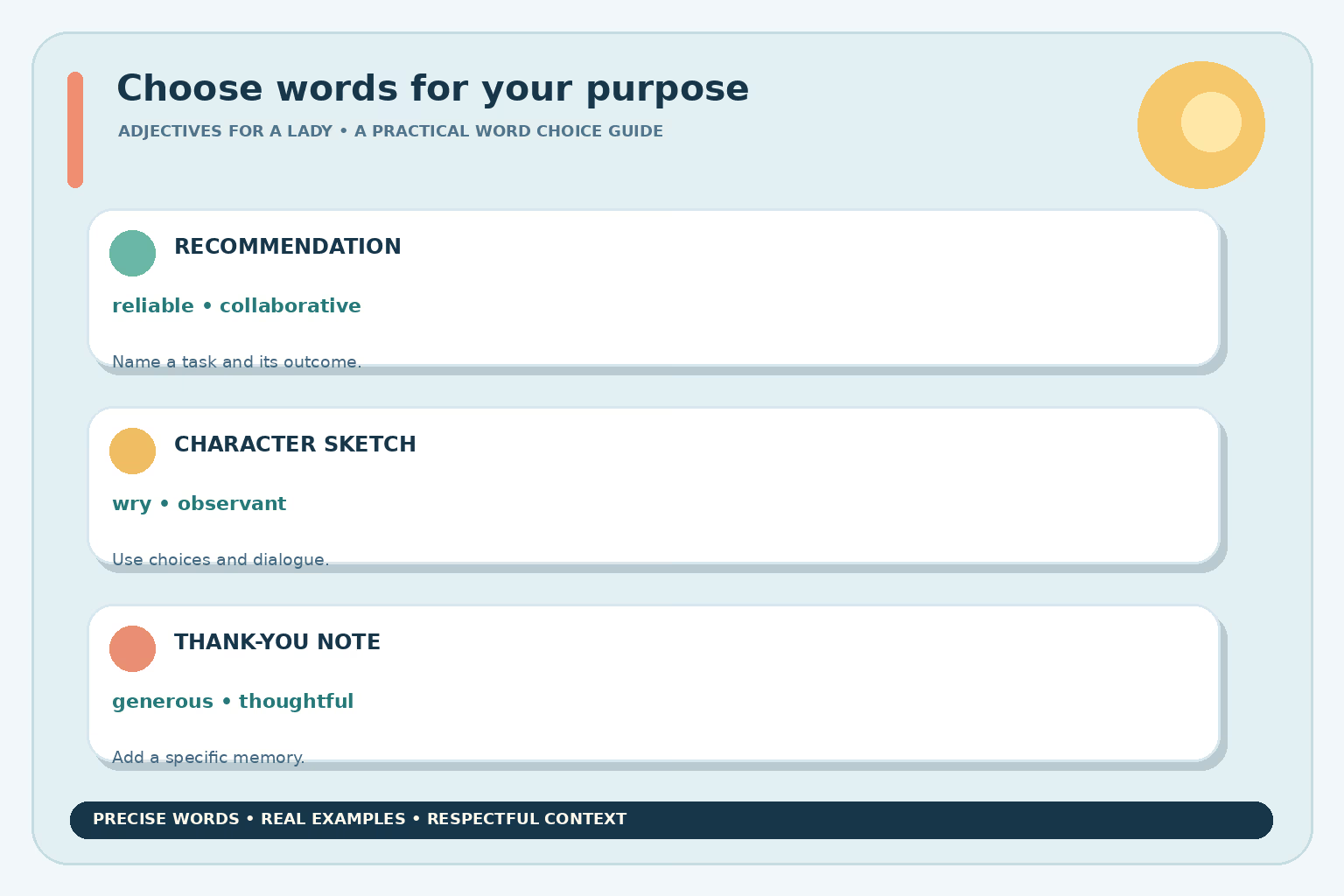
- Professional recommendation: dependable, collaborative, meticulous, adaptable. Name a project or task that shows the quality.
- Personal tribute: generous, reassuring, curious, loyal. Add a memory that shows why the trait matters to you.
- Fiction or character profile: observant, wry, guarded, impulsive, resourceful. Mix strengths and limitations so the character feels individual.
- Neutral biography: prefer verifiable roles, work, interests, and choices to appearance-based praise.
Use a small number of specific words instead of stacking near-synonyms. “Thoughtful, considerate, caring, compassionate, and kind” can blur together unless the surrounding details distinguish them. Two well-supported adjectives usually give a clearer picture.
What is the difference between similar adjectives?
Near-synonyms carry different implications. Confident describes assurance; assertive points to direct communication or action; ambitious describes strong goals; and bossy is a negative judgment about how someone directs others. Select the term that matches the behavior and the tone you intend.
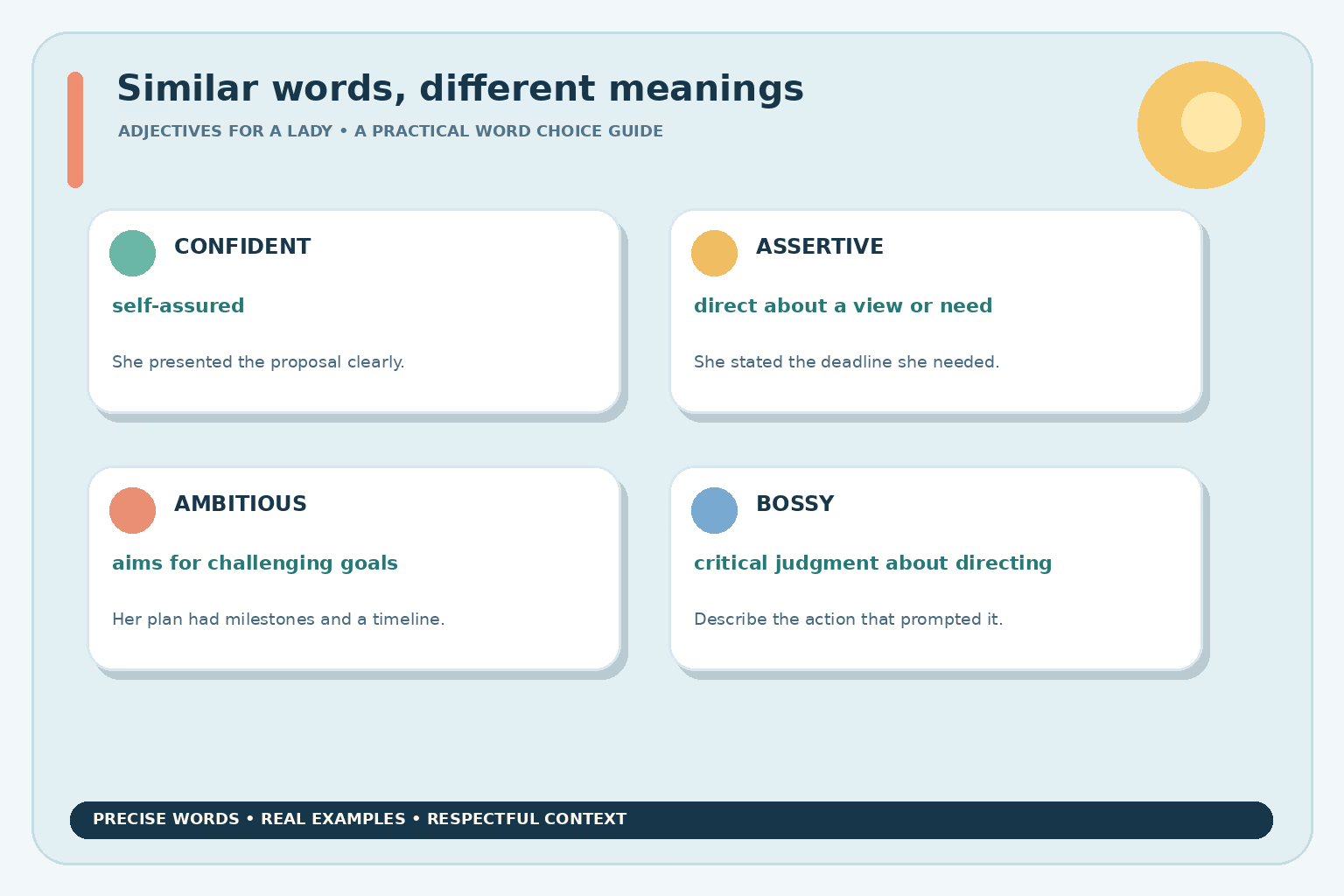
| Word | Core meaning or tone | Example with context |
|---|---|---|
| Confident | Self-assured; usually positive or neutral | She sounded confident when she presented the proposal. |
| Assertive | Clear and direct in expressing a need or view | She was assertive about the deadline and the resources required. |
| Ambitious | Strongly motivated to achieve challenging goals | Her ambitious plan included a realistic timeline and milestones. |
| Bossy | Informal, critical label for someone perceived as overly controlling | Instead of calling her bossy, describe the specific decision or interaction. |
| Reserved | Quiet or restrained in showing thoughts or feelings | She was reserved in the first meeting but asked detailed questions afterward. |
| Arrogant | Negative judgment that someone overstates their importance | Show the dismissive remark or action that led to the impression. |
Critical adjectives deserve the same precision as praise. Words such as manipulative, cruel, dishonest, or jealous make claims about intent, conduct, or emotion. In workplace feedback or a public profile, describe the specific action and its impact first; use a label only if it adds justified information. A single disagreement does not establish a person’s character.
Is “lady” always the right word?
No. In many contexts, woman is the straightforward word for an adult person, while lady can sound formal, dated, or context-dependent. Use a name, role, or the person’s own preferred wording when known. Lady also appears in formal titles, where capitalization and the specific title matter; that use is different from a general descriptive noun.
For example, “The woman who led the workshop was patient and precise” is direct and gives relevant information. “The lady was elegant and proper” may sound vague and can frame expected manners as a standard for women. If etiquette is relevant to your subject, describe the actual behavior rather than implying all women should meet one ideal.
Frequently asked questions
What are good adjectives to describe a woman professionally?
Choose work-related qualities you can support: reliable, collaborative, analytical, inventive, meticulous, or adaptable. Pair the word with an outcome: “She was meticulous in checking the figures and caught a costly discrepancy.” This is more informative than a list of praise with no example.
How can I describe a woman without focusing on appearance?
Describe her choices, skills, interests, relationships, or contributions. Words such as curious, decisive, patient, inventive, and generous can work when a specific example supports them. In a biography or professional introduction, prioritize details that explain why the person is relevant to the reader.
Are “lady” and “woman” interchangeable?
Sometimes, but their tone differs. Cambridge describes lady as a polite or old-fashioned way to refer to a woman in some uses and also records its use as a title. In direct, neutral writing, woman is often clearer; choose the noun that fits the context and the person.
How many adjectives should I use?
There is no fixed number, but one or two precise adjectives with an example are often stronger than a long string of similar words. In fiction, show qualities through action and dialogue as well as naming them. In a short tribute, choose the traits that best explain your relationship or memory.

Ladies, the epitome of grace and elegance. They possess an undeniable charm that captivates hearts and leaves a lasting impression. But how do we put into words the essence of a lady? In this article, I’ll be sharing with you a collection of adjectives that beautifully describe the qualities of a lady, along with examples to illustrate their meaning.
From sophisticated to compassionate, these adjectives will help you paint a vivid picture of the remarkable traits that define a lady. Whether you’re writing a heartfelt tribute, crafting a character in a story, or simply looking to appreciate the women in your life, these descriptive words will guide you in capturing the essence of a true lady.
So, let’s dive into the world of adjectives and explore the vast spectrum of qualities that make a lady truly extraordinary. Get ready to be inspired and discover the perfect words to celebrate the remarkable women who grace our lives.
How to Describe lady? – Different Scenarios
When it comes to describing a lady, there are several scenarios in which different adjectives can be used to capture her remarkable qualities. Whether you are writing a tribute, creating a character, or simply appreciating the women in your life, here are some examples of adjectives that can help you paint a vivid picture:
- Elegant: A lady exudes elegance in her appearance, manners, and style. She carries herself with grace and sophistication.
- Confident: She is self-assured and displays a sense of confidence in her abilities and choices.
- Kind-hearted: A lady is known for her warm and compassionate nature. She is always willing to lend a helping hand and show empathy towards others.
- Intelligent: She possesses a sharp mind and showcases intelligence in her thoughts, ideas, and actions.
- Strong: A lady demonstrates inner strength, resilience, and determination in the face of challenges and adversity.
- Sincere: She is genuine and sincere in her words and actions, always being true to herself and others.
- Beautiful: A lady radiates beauty, both inside and out. Her inner beauty shines through her kind and caring nature.
- Respectful: She treats others with respect and values different perspectives and opinions.
- Classy: A lady embodies sophistication and elegance, displaying refined tastes and manners.
- Independent: She is self-reliant and capable of making her own decisions, standing on her own two feet.
These are just a few examples of the adjectives that can be used to describe a lady. Remember, each person is unique, so you can mix and match these words or explore other adjectives to capture the essence of the remarkable women in your life.
Examples of Descriptive Adjectives for a Lady
| Adjective | Sentence |
|---|---|
| Elegant | She walked into the room with an elegant and graceful stride. |
| Confident | Her confident demeanor commanded attention and respect. |
| Kind-hearted | She has a kind-hearted nature and is always there to help others. |
| Intelligent | Her intelligent remarks left us in awe of her knowledge. |
| Strong | She faced the challenges with a strong sense of determination. |
Describing Words for lady in English
When it comes to describing a lady, there are countless adjectives that can capture her unique qualities and characteristics. In this section, I will explore some of the most commonly used adjectives to describe a lady in English. Whether you are trying to find the perfect word to depict someone’s elegance, kindness, or intelligence, these adjectives will help you express your thoughts with precision.
Let’s dive into the world of describing words for a lady:
Elegant
A lady who possesses elegance exudes grace, sophistication, and style in everything she does. Her refined manners, impeccable fashion sense, and poised demeanor make her stand out effortlessly.
Confident
Confidence is the hallmark of a strong and empowered lady. Whether she’s taking charge in a boardroom or tackling new challenges, her self-assured attitude radiates and inspires those around her.
Kind-hearted
A kind-hearted lady is known for her compassion, generosity, and empathy. She genuinely cares about others and always goes above and beyond to lend a helping hand and bring positivity to the lives of those she encounters.
Intelligent
An intelligent lady is sharp, quick-witted, and intellectually curious. Her insightful thoughts, extensive knowledge, and ability to engage in meaningful conversations make her a true force to be reckoned with.
Strong
Strength goes beyond physical prowess – it’s about resilience, determination, and the ability to overcome obstacles. A strong lady displays unwavering courage and perseverance in the face of adversity, inspiring others to do the same.
Sincere
A sincere lady is genuine, honest, and true to herself. Her authenticity and transparency create trusting relationships, and her words hold weight because they come from the heart.
Beautiful
Beauty comes in many forms, and a lady can possess both inner and outer beauty. Beyond physical appearance, a beautiful lady’s grace, kindness, and confidence make her truly captivating.
Respectful
Respect is at the core of a lady’s character. She treats others with kindness, values diverse perspectives, and appreciates the importance of mutual respect in building harmonious relationships.
Classy
A lady with class embodies sophistication, refinement, and good taste. She exudes elegance in her manners, style, and overall demeanor, making her a true embodiment of grace.
Independent
Independence is a trait that defines a lady who is self-reliant, self-assured, and capable of standing on her own.
Adjectives for lady
Positive Adjectives for Lady with 12 Example Sentences
When describing a lady, there are various positive adjectives that can be used to capture her unique qualities. Let’s explore some of these adjectives along with example sentences to help paint a vivid picture of what makes a lady remarkable:
- Elegant: She carries herself with grace and sophistication. For example, she gracefully entered the room, turning heads with her elegant presence.
- Confident: She exudes self-assurance and belief in her abilities. For instance, she confidently stood on the stage, delivering a powerful speech.
- Kind-hearted: She is compassionate and caring towards others. I witnessed her kind-hearted nature when she volunteered at the local homeless shelter, offering a helping hand to those in need.
- Intelligent: She possesses a sharp mind and is intellectually inclined. I’m always impressed by her intelligent insights during our discussions.
- Strong: She displays inner strength and resilience in the face of challenges. Despite facing setbacks, she remains strong and perseveres.
- Sincere: She is genuine and true in her thoughts and actions. You can always count on her sincerity and honesty.
- Beautiful: She possesses both inner and outer beauty. Her captivating smile and radiant personality make her truly beautiful.
- Respectful: She treats others with kindness and respect. She always speaks to people in a respectful and considerate manner.
- Classy: She has a refined and timeless sense of style. Her tasteful fashion choices reflect her classy persona.
- Independent: She is self-reliant and capable of making her own decisions. She confidently tackles challenges on her own, showcasing her independence.
- Nurturing: She has a caring and nurturing nature. She lovingly takes care of those around her, always putting their needs first.
- Empathetic: She understands and shares the feelings of others. Her empathetic nature allows her to provide comfort and support to those in distress.
Negative Adjectives for Lady with 5 Example Sentences
While it’s important to focus on the positive qualities of a lady, there are also negative adjectives that can be used to describe certain behaviors or traits. Here are a few examples:
- Manipulative: She uses cunning tactics to control and influence others for her own gain.
- Arrogant: She displays a sense of superiority and looks down on others.
- Cruel: She intentionally inflicts harm or pain on others without remorse.
- Jealous: She harbors envy and resentment towards others’ successes or possessions.
- Dishonest: She tells lies or deceives others for personal gain.
Remember that these negative adjectives don’t define a lady as a whole, but rather describe specific behaviors or traits that may be displayed at times.
Using a combination of positive adjectives to highlight a lady’s remarkable qualities and negative adjectives to acknowledge certain behaviors can help create a nuanced and balanced description. It’s important to remember that everyone is unique, and these adjectives can only serve as a starting point to capture the essence of the remarkable women in our lives.
Synonyms and Antonyms with Example Sentences
Synonyms for lady
When describing a lady, there are several synonyms that can be used to paint a clear picture of her qualities and character. Here are some adjectives that can be used as synonyms for a lady:
- Elegant – Graceful and stylish in appearance or manner.
- Confident – Having a strong belief in one’s abilities and qualities.
- Kind-hearted – Showing kindness and compassion towards others.
- Intelligent – Possessing a sharp intellect and the ability to think critically.
- Strong – Having emotional or physical strength and resilience.
- Sincere – Genuine, honest, and free from deceit.
- Beautiful – Having qualities that please the senses and inspire admiration.
- Respectful – Treating others with politeness, esteem, and consideration.
- Classy – Exhibiting refined or sophisticated taste and behavior.
- Independent – Capable of thinking and acting for oneself.
- Nurturing – Providing care, support, and guidance to others.
- Empathetic – Understanding and sharing the feelings of others.
Example sentences using these synonyms:
- She carried herself with unabashed elegance, attracting everyone’s attention.
- With a confident smile, she approached the stage to deliver her speech.
- Her kind-hearted nature was evident in the way she volunteered to help those in need.
- An intelligent woman like her has the ability to solve any problem that comes her way.
- Despite facing numerous challenges, she remained strong and never gave up.
- His sincere apology touched her heart and mended their damaged relationship.
- People would often stop and stare at her beautiful face, captivated by her charm.
- She always treated others with respect, regardless of their social status.
- Dressed in a classy black gown, she made a grand entrance at the party.
- Being independent, she never relied on others to achieve her goals.
- Her nurturing nature made her an excellent mother who always put her children’s needs first.
- With her empathetic nature, she could understand and relate to the struggles of others.
Antonyms for lady
While it’s important to use positive adjectives when describing a lady, it’s also essential to acknowledge that negative traits exist too. Here are some antonyms, or opposites, for the qualities associated with a lady:
- Manipulative – Exerting control or influence over others for personal gain.
- Arrogant – Having an exaggerated sense of one’s own importance or abilities.
- Cruel – Willfully causing pain or suffering to others.
- Jealous – Feeling or showing envy or resentment towards others.
- Dishonest – Lacking truthfulness or integrity.
Example sentences using these antonyms:
- Her manipulative nature made it difficult for others to trust her intentions.
- He displayed an arrogant attitude, believing he was superior to everyone else.
- The cruel words she spoke left a lasting impact on those who heard them.
- She couldn’t help but feel jealous of her friend’s success and achievements.
- Her dishonest behavior tarnished her reputation and damaged her relationships.
Remember to use a balanced approach when describing a lady, encompassing both the positive and negative aspects of her character.
Conclusion
Describing a lady involves recognizing her positive qualities and acknowledging that she, like everyone else, has both positive and negative traits. In this article, I have provided a range of adjectives that can be used to describe a lady in a positive light. These adjectives highlight her grace, elegance, intelligence, and kindness. By using these adjectives, we can paint a picture of a lady who embodies these qualities.
Additionally, I have introduced synonyms for the word “lady” to offer alternative ways of describing her. These synonyms, such as “woman” or “gentlewoman,” provide a broader range of options when it comes to portraying her character.
It is important to remember that no one is perfect, and a lady is no exception. I have also discussed the importance of acknowledging negative traits and have provided antonyms for the positive qualities associated with a lady. By considering both the positive and negative aspects, we can present a more realistic and balanced description of a lady.
Describing a lady requires a thoughtful and nuanced approach. By using the adjectives, synonyms, and antonyms provided in this article, we can create a well-rounded portrayal of a lady’s character.


