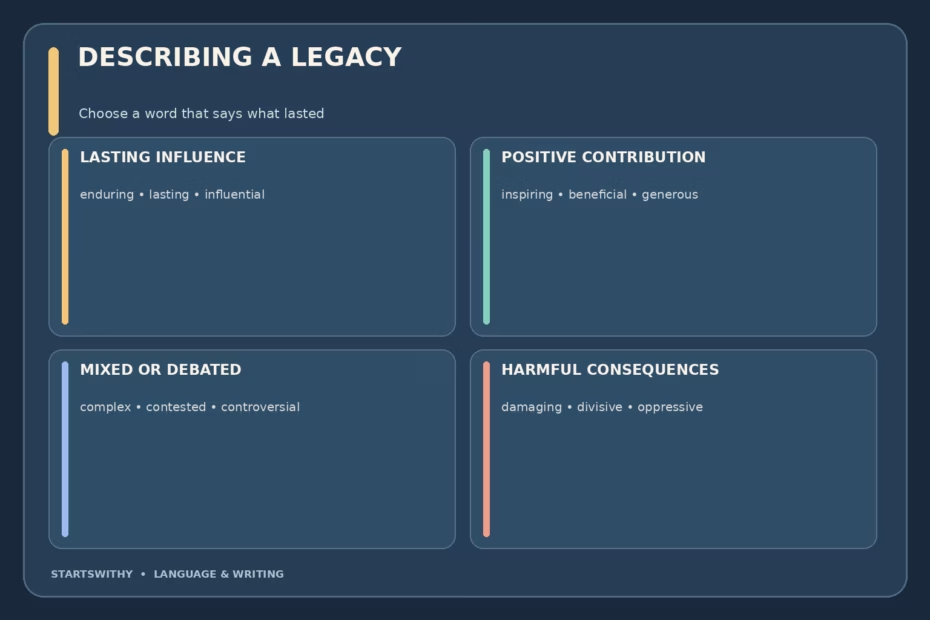
What Does “Legacy” Mean?
A legacy is something handed down or left behind. It can mean money or property passed on after a death, but in descriptions of a person or institution it usually means the influence, achievements, ideas, or consequences that continue after the original actions. A legacy can be personal, cultural, political, artistic, scientific, or environmental. It may be praised, criticized, or understood differently by different people.
In this article, the adjectives describe the legacy, not the person alone. That distinction helps make the sentence more precise: “She was a generous leader” describes the person, while “She left a generous legacy of scholarships” describes what continued. A legacy is not automatically positive. An enduring legacy can include beneficial work and harmful consequences at the same time.
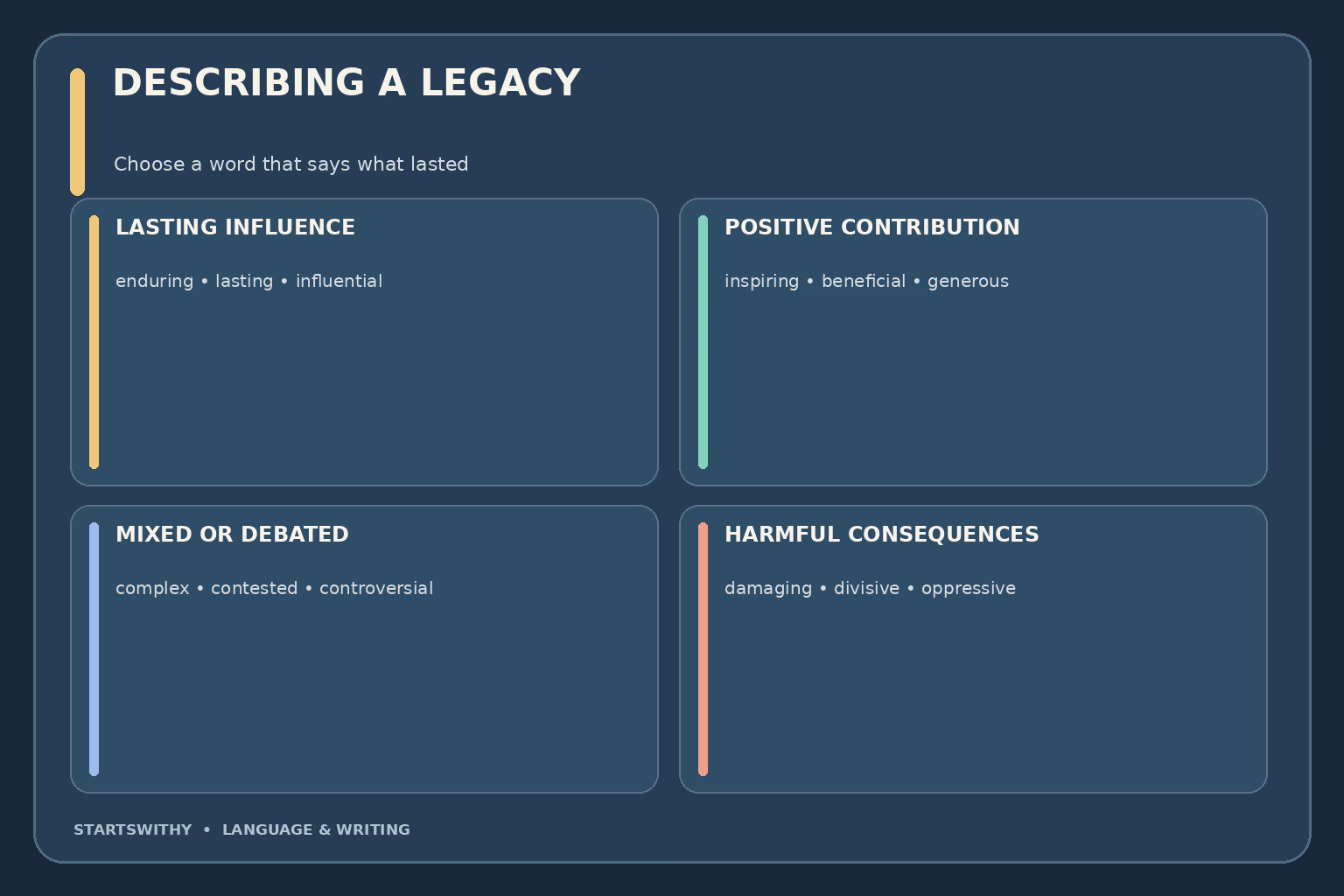
Adjectives for Different Kinds of Legacy
Start by asking what you want to describe: how long an influence lasts, what it changed, who it helped, or what harm it caused. These categories offer options with distinct meanings rather than a list of interchangeable synonyms.
Words for influence that lasts
- Enduring: continuing over a long period. “The composer’s enduring influence can be heard in generations of film scores.”
- Lasting: continuing to have an effect. “The library created a lasting resource for the neighborhood.”
- Timeless: remaining relevant or appealing across time. “Her timeless stories still connect with new readers.” Use this when the work remains meaningful, not simply because it is old.
- Influential: having the power to affect ideas, decisions, or other people. “His influential research changed how clinicians discussed the condition.”
- Profound: having a deep or significant effect. “The experience left a profound mark on the community.” This describes depth, not necessarily duration.
Words for a positive contribution
- Inspiring: encouraging others to act or create. “Her example left an inspiring legacy for young athletes.”
- Beneficial: producing an advantage or improvement. “The wetlands restoration left a beneficial legacy for nearby residents and wildlife.”
- Empowering: giving people greater confidence, agency, or ability. “The mentorship program built an empowering legacy of peer support.”
- Generous: marked by giving or a willingness to share. “His generous legacy included funding for public arts programs.”
- Transformative: causing a major change. “The reform had a transformative effect on access to the service.” Use this for substantial change, not any improvement.
- Innovative: introducing new ideas or methods. “The scientist’s innovative work opened a new line of research.”
Words for a complicated or disputed legacy
- Complex: involving several connected parts or interpretations. “Her complex legacy includes groundbreaking art and difficult personal decisions.”
- Contested: actively debated or disputed. “The contested legacy of the public works project reflects its benefits and displacement.”
- Mixed: containing both favorable and unfavorable elements. “The mayor left a mixed legacy of expanded services and mounting debt.”
- Ambiguous: open to more than one interpretation. “The policy’s ambiguous legacy is still being assessed.” This signals uncertainty more than disagreement.
Words for harmful consequences
- Damaging: causing harm or weakening something. “The company’s damaging legacy included polluted soil that required years of cleanup.”
- Divisive: creating or deepening disagreement between groups. “The divisive decision strained relationships across the town.”
- Destructive: causing severe damage or ruin. “The destructive policy displaced families and erased historic sites.”
- Oppressive: imposing unjust control or hardship. “The archive documents the oppressive system and its lasting effects.”
- Regrettable: deserving regret or disappointment. “It was a regrettable legacy of preventable mistakes.” This expresses evaluation, so explain which actions warrant it.
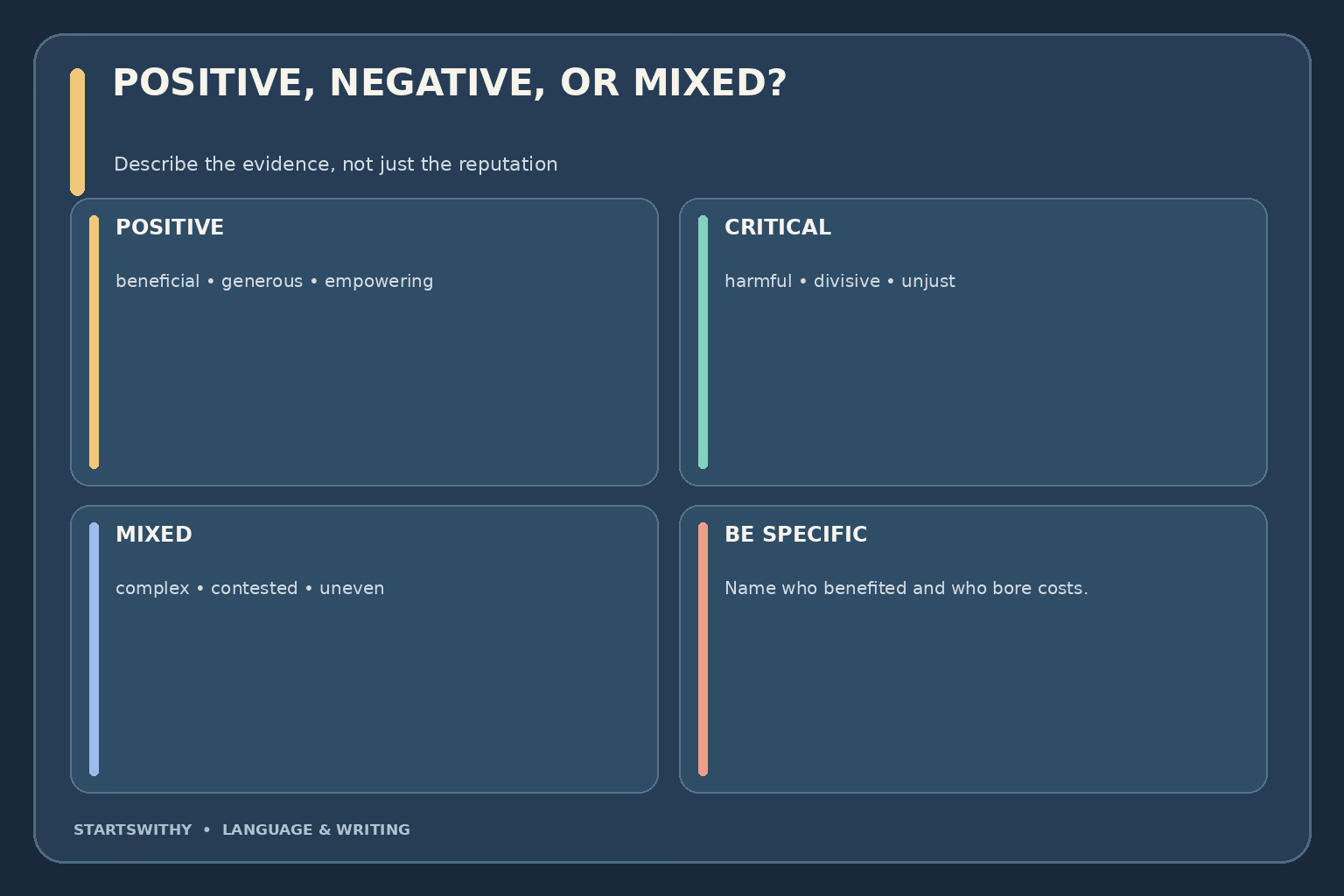
Legacy Adjectives in Example Sentences
The noun that follows an adjective often shows exactly what you are evaluating. Compare the broad phrase “a remarkable legacy” with a concrete description of the work, people affected, or outcome.
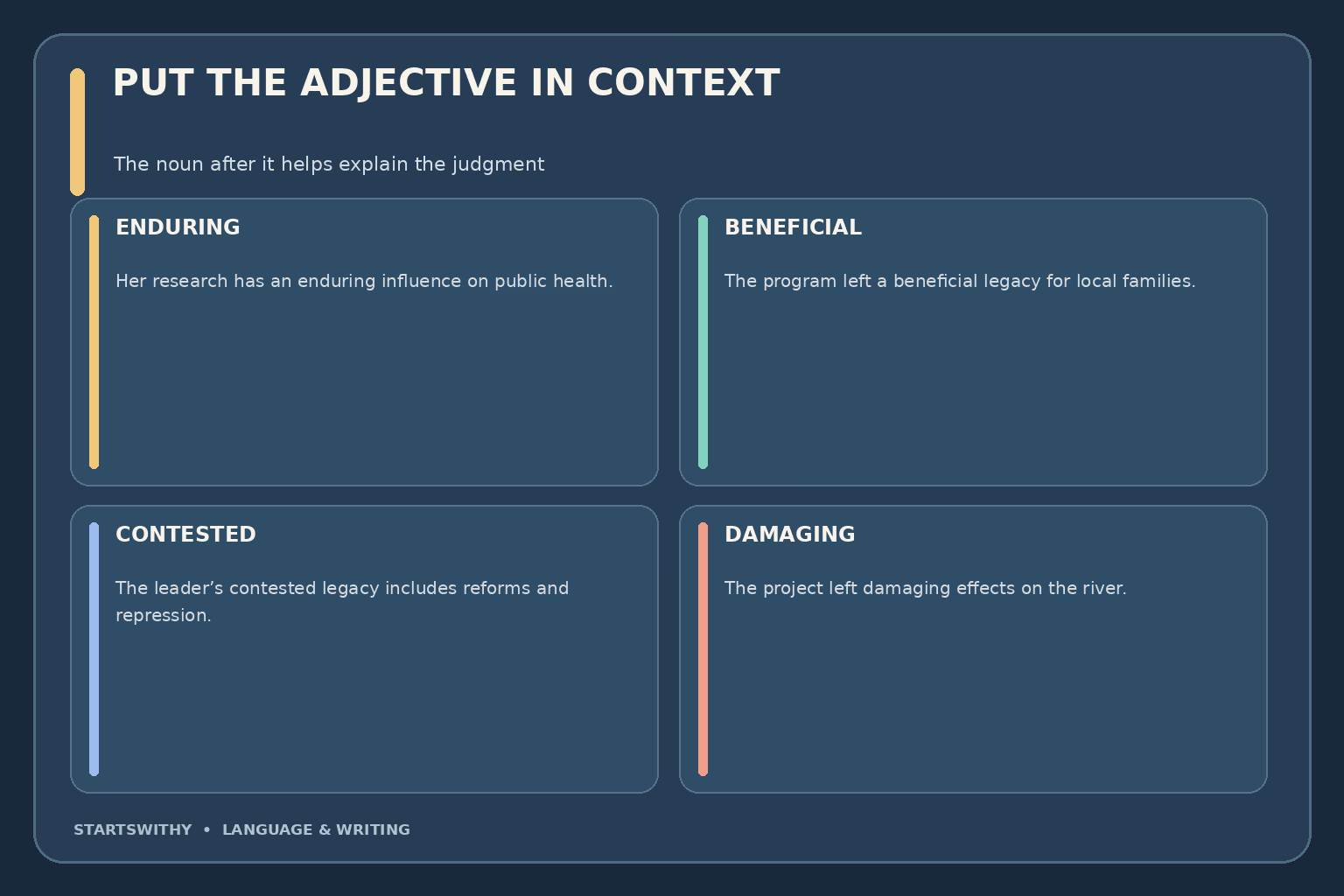
- Enduring influence: “The educator’s enduring influence is visible in the community schools she helped establish.”
- Beneficial legacy: “The public garden left a beneficial legacy by giving residents a shared green space.”
- Contested record: “The governor’s contested legacy includes expanded infrastructure as well as policies that restricted voting.”
- Damaging consequences: “The factory left a damaging environmental legacy that required soil and water cleanup.”
- Transformative work: “Her transformative research changed treatment options for patients with the disease.”
- Mixed reputation: “The founder’s mixed legacy combines generous philanthropy with unsafe workplace practices.”
- Inspiring example: “His quiet, persistent advocacy became an inspiring legacy for later organizers.”
- Lasting contribution: “The artist’s lasting contribution was a public collection that continues to welcome new audiences.”
How to Choose an Accurate Adjective
Adjectives shape a reader’s judgment, so match the word to the evidence. Influential says something affected others; beneficial says it produced an advantage; lasting says the effect continued. These meanings overlap, but one does not prove the others. A work can be influential and harmful, or beneficial for one group while imposing costs on another.
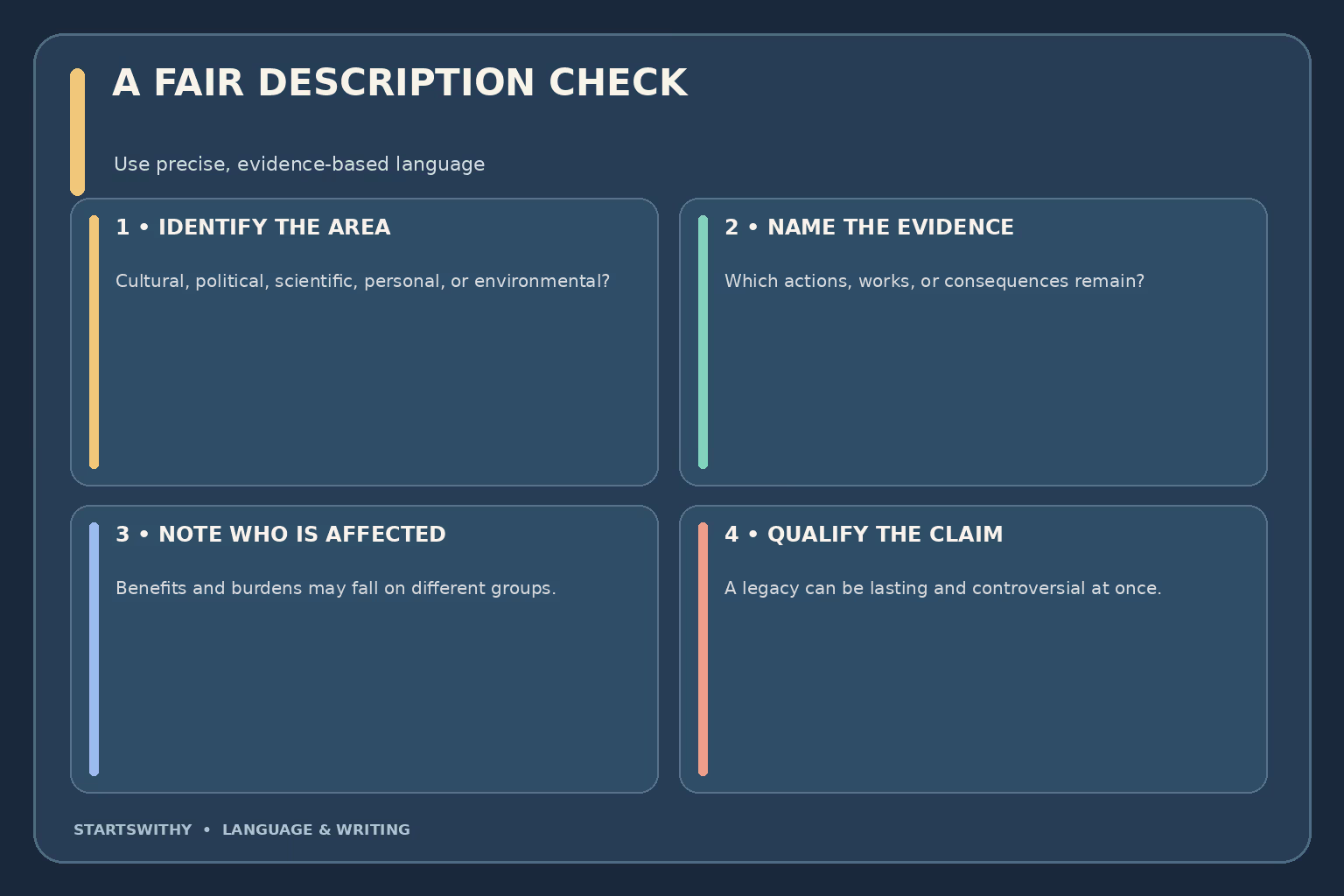
- Name the area. Are you describing a person’s art, public service, policies, research, family influence, or environmental impact?
- Identify the evidence. Point to a work, decision, institution, result, or documented consequence.
- Consider who experienced the effect. Ask who benefited, who was excluded, and whose perspective is represented.
- Choose the degree of certainty. If interpretations remain debated, contested or complex may be more accurate than declaring the legacy wholly good or bad.
- Give a specific example. A concrete detail supports the adjective and helps readers understand your meaning.
For a eulogy or tribute, words such as generous, inspiring, and enduring can express admiration, especially when paired with a particular action or memory. In biography or history, show the basis for the judgment and include relevant counterevidence. In an academic or news context, phrases such as “a contested legacy” can introduce differing outcomes without flattening them into a single verdict.
Common Questions About Describing a Legacy
Is “legacy” a noun or an adjective?
In the phrase “a person’s legacy,” legacy is a noun. English also uses it before another noun in phrases such as legacy system, where it functions as a modifier. In this article, the listed adjectives—such as enduring and divisive—describe the noun legacy.
What is a positive adjective for legacy?
Beneficial, inspiring, generous, empowering, and enduring can express positive qualities. Select the word that matches the specific contribution: a long-lasting influence is not automatically beneficial, and a beneficial outcome may not be widely influential.
What is a negative adjective for legacy?
Damaging, divisive, destructive, and oppressive describe harmful effects or conditions. They are critical descriptors, not antonyms of the noun legacy; the antonym of a word depends on its meaning in context.
Can a legacy be both positive and negative?
Yes. A person or institution may produce meaningful advances while also causing harm. Calling a legacy complex, mixed, or contested can acknowledge more than one outcome; follow the label with evidence so readers can see why.
What is a synonym for “lasting legacy”?
Depending on the sentence, enduring influence, long-term impact, or continuing contribution may work. These phrases emphasize persistence, but the best choice depends on what continues and how it affects people.
Sources and Further Reading
- Cambridge Dictionary: “legacy” (noun meanings and the adjective use before another noun).
- Oxford Advanced Learner’s Dictionary: “legacy” (inheritance and continuing effects from past events).
- Purdue OWL: The Difference between Adjectives and Adverbs (adjectives modify nouns and add detail).

When it comes to describing a legacy, the right adjectives can make all the difference. They have the power to capture the essence of someone’s impact on the world, whether it be through their achievements, values, or contributions. In this article, I’ll be exploring a variety of adjectives that can be used to paint a vivid picture of a person’s legacy. From words that convey greatness and influence to those that highlight their lasting impact, we’ll delve into the rich tapestry of adjectives that can be used to describe a legacy.
One adjective that often comes to mind when describing a powerful legacy is “inspiring.” This word encapsulates the ability of someone’s actions or beliefs to motivate and encourage others. For example, a leader who dedicated their life to fighting for social justice can be described as an inspiring figure, as their legacy continues to inspire generations to make a difference. Another adjective that can be used to describe a legacy is “enduring.” This word emphasizes the long-lasting nature of someone’s impact, highlighting their ability to leave a lasting imprint on the world. An artist whose work continues to be celebrated and admired decades after their passing can be described as having an enduring legacy.
In this article, we’ll dive deeper into these adjectives and many more, providing examples and insights into how they can be used to describe a legacy. Whether you’re writing a eulogy, a biography, or simply reflecting on someone’s impact, these adjectives will help you paint a vivid and accurate picture of their lasting influence. So, let’s explore the world of adjectives for legacy and discover the words that can truly capture the essence of someone’s impact on the world.
How to Describe legacy? – Different Scenarios
When it comes to describing someone’s legacy, choosing the right adjectives is crucial. It allows us to paint a vivid picture of their impact on the world. In different scenarios, there are specific adjectives that beautifully capture the essence of a person’s lasting influence. Let’s explore these scenarios and the adjectives that best describe them:
- Inspirational Legacy: When someone’s legacy is centered around inspiring others, there are several adjectives that can be used. They include:
- Enduring Legacy: An enduring legacy refers to a lasting impact that remains throughout time. Here are some adjectives that perfectly describe such a legacy:
- Transformative Legacy: A transformative legacy signifies significant and positive change. Use these adjectives to describe such a legacy:
- Impactful Legacy: An impactful legacy leaves a profound and meaningful impact on individuals and society. Here are some adjectives that capture its essence:
Remember, choosing the right adjectives depends on the specific scenario and the nature of the legacy being described. By carefully selecting appropriate adjectives, we can accurately convey the magnitude and significance of a person’s lasting influence.
Describing Words for legacy in English
When we think about someone’s legacy, we often want to find the right words to describe their impact and influence. The words we choose can convey the essence of their achievements and the lasting impression they have left behind. In this section, I will provide you with a range of adjectives that can be used to describe a person’s legacy in different scenarios. Whether it’s an inspirational legacy, an enduring legacy, a transformative legacy, or an impactful legacy, finding the right words is key. Let’s explore some examples:
- Inspirational Legacy
An inspirational legacy is one that motivates and uplifts others, igniting a spark of inspiration. Here are some adjectives that capture the essence of an inspirational legacy:
- Motivational: Their legacy inspires others to take action and achieve their goals.
- Empowering: They empower others to believe in themselves and reach their full potential.
- Courageous: Their legacy reflects bravery and fearlessness, inspiring others to overcome challenges.
- Resilient: They demonstrate perseverance and resilience, inspiring others to never give up.
- Enduring Legacy
An enduring legacy stands the test of time, leaving a lasting impact on future generations. Here are some adjectives that describe an enduring legacy:
- Timeless: Their legacy remains relevant and meaningful across generations.
- Profound: Their impact is deep and far-reaching, touching the lives of many.
- Enduring: Their influence continues to be felt long after they are gone.
- Time-honored: Their legacy is respected and honored throughout history.
- Transformative Legacy
A transformative legacy brings about significant change and advancement. Here are some adjectives that capture the transformative nature of a legacy:
- Revolutionary: Their legacy sparks a revolution and leads to groundbreaking change.
- Innovative: They introduce new ideas and ways of thinking, pushing boundaries.
- Progressive: Their legacy represents progress and forward-thinking.
- Transformative: They have a profound and lasting impact on the world around them.
- Impactful Legacy
- Influential: Their legacy has a significant and lasting influence on others.
- Elevating: Their impact lifts others up and creates positive change.
Adjectives for legacy
As I delve into the world of adjectives that describe a person’s legacy, I am reminded of the power of language to capture the essence of a life well-lived. Adjectives offer a unique opportunity to convey the impact, significance, and lasting impression that one leaves behind. In this section, I will explore both positive and negative adjectives that can be used to describe a legacy, accompanied by example sentences to illustrate their usage.
Positive Adjectives for Legacy
A positive legacy is one that inspires, uplifts, and serves as a beacon of hope for future generations. Here are 12 examples of adjectives that beautifully capture the essence of a positive legacy:
| Adjective | Definition | Example Sentence |
|---|---|---|
| Motivational | Inspiring and encouraging others to take action | His speeches were always motivational, urging everyone to follow their dreams. |
| Empowering | Giving someone the confidence and ability to do something | Her leadership style was empowering, and she empowered others to reach their full potential. |
| Courageous | Demonstrating bravery in the face of adversity | His courage in standing up for what was right left a lasting legacy. |
| Resilient | Able to recover quickly from difficult situations | His resilience in the face of challenges inspired others to persevere. |
| Visionary | Having the ability to think creatively and imaginatively about the future | His visionary ideas transformed the way we think about technology. |
| Innovative | Introducing new ideas or methods that bring about positive change | Her innovative approach to problem-solving revolutionized the industry. |
| Impactful | Leaving a strong, lasting impression on others | His impactful presence touched the lives of many. |
| Inspirational | Filled with the power to motivate and move others | Her life story was truly inspirational and touched the hearts of many. |
| Enduring | Having a lasting impact that spans across generations | Their enduring legacy continues to shape our world today. |
| Timeless | Not affected by the passage of time; eternal | His timeless wisdom resonates with people of all ages. |
| Time-honored | Honored or respected because of its age or long-standing tradition | The time-honored values she lived by continue to inspire us. |
| Transformative | Bringing about significant change or transformation | His transformative leadership ushered in a new era of progress. |
Negative Adjectives for Legacy
While we often focus on the positive aspects of a legacy, it’s important to acknowledge that legacies can also have negative connotations. Here are 5 examples of adjectives that describe a negative legacy:
| Adjective | Definition | Example Sentence |
|---|---|---|
| Controversial | Causing disagreement or argumentation | His controversial legacy left a divided society in its wake. |
| Divisive | Tending to cause disagreement or hostility | Her leadership style was divisive, causing rifts within the organization. |
| Damaging | Causing harm or negative impact | The damaging effects of his actions tarnished his legacy. |
| Regrettable | Worthy of regret or disappointment | It is regrettable that his legacy will be remembered for its failures. |
| Disgraceful | Bringing shame or dishonor | His disgraceful behavior marred his once esteemed legacy. |
Synonyms and Antonyms with Example Sentences
Synonyms for legacy
When describing a person’s legacy, there are several synonyms that can be used to capture the essence of their impact. Here are some examples with their meanings:
| Synonym | Meaning |
|---|---|
| Enduring | Lasting for a long time |
| Timeless | Not affected by the passage of time |
| Impactful | Having a strong effect or influence |
| Transformative | Causing a significant change or improvement |
| Inspirational | Providing motivation or encouragement |
| Visionary | Thinking ahead and creating new ideas for the future |
| Innovative | Introducing new methods or ideas |
| Motivational | Providing encouragement or drive to achieve goals |
| Courageous | Showing bravery in the face of challenges |
| Resilient | Able to recover quickly from difficult situations |
| Empowering | Giving power or confidence to others |
| Time-honored | Respected and valued because it has been used or done for a long time |
Example sentences:
- His enduring legacy will be remembered by generations to come.
- The timeless wisdom he shared continues to inspire us today.
- Her impactful work in the community has made a real difference.
- The transformative changes he brought about revolutionized the industry.
- His inspirational speeches touched the hearts of millions.
- She was a visionary leader, always pushing boundaries and exploring new possibilities.
- His innovative ideas brought about significant advancements in technology.
- The motivational quotes he shared motivated people to achieve their goals.
- Her courageous actions inspired others to face their fears.
- Despite facing setbacks, his resilient spirit never wavered.
- Her empowering message empowered young women to pursue their dreams.
- The time-honored traditions he upheld reflected the values of his culture.
Antonyms for legacy
On the other hand, there are also antonyms that can be used to describe a negative legacy. These words highlight the negative impact or regrettable actions that someone may have left behind. Here are some examples with their meanings:
| Antonym | Meaning |
|---|---|
| Controversial | Causing disagreement or debate |
| Divisive | Tending to cause division or disagreement |
| Damaging | Causing harm or negative effects |
| Regrettable | Worthy of regret or sorrow |
| Disgraceful | Deserving of shame or disapproval |
Example sentences:
- His controversial actions tarnished his legacy and divided public opinion.
- The divisive decisions he made created a rift within the community.
- The damaging effects of his policies are still felt today.
- It is regrettable that his actions led to such negative consequences.
- His disgraceful behavior brought shame to his reputation.
The choice of adjectives to describe a person’s legacy is crucial in capturing the essence of their impact. Whether positive or negative, these words can paint a powerful depiction of the legacy someone leaves behind.
Conclusion
Describing a person’s legacy is a powerful way to capture the impact they have had on the world. Through the use of adjectives, we can paint a vivid picture of their lasting impression. In this article, we have explored a range of adjectives that can be used to describe both positive and negative legacies.
Positive adjectives such as enduring, timeless, impactful, and transformative highlight the lasting and meaningful contributions that individuals have made. These adjectives convey a sense of inspiration, innovation, and courage that can inspire future generations.
On the other hand, negative adjectives like controversial, divisive, and damaging shed light on legacies that have left a negative mark. These adjectives serve as a reminder of the importance of responsible actions and the consequences they can have.
By using adjectives to describe a person’s legacy, we can honor their achievements, learn from their mistakes, and inspire others to make a positive impact. The power of language lies in its ability to capture the essence of a well-lived life, and it is through these words that legacies live on.


