Party Adjectives: A Quick Guide
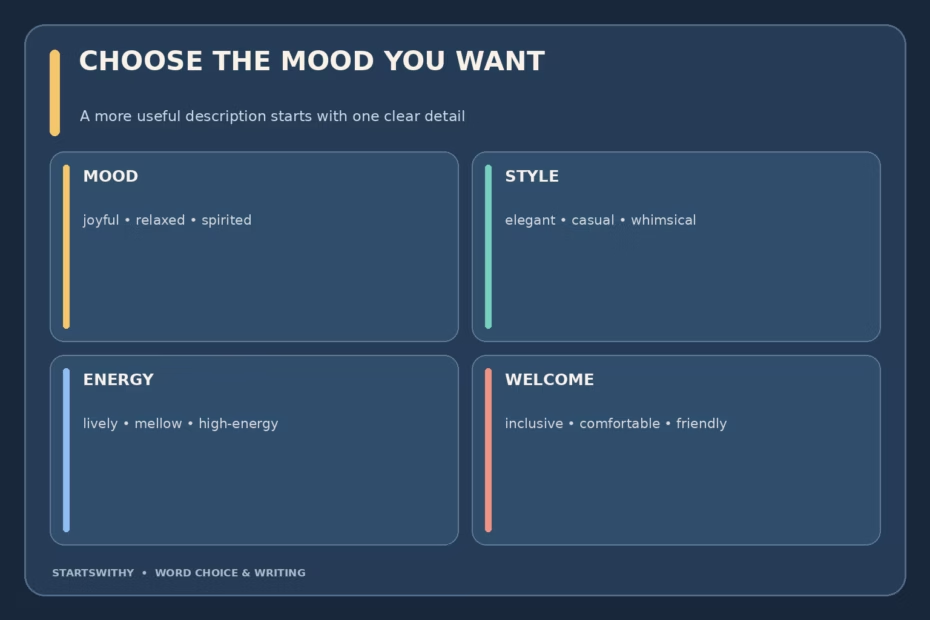
The most useful adjectives for a party tell readers what they can expect: the mood, style, energy, or level of formality. Try joyful or welcoming for a warm gathering, elegant for a polished dinner, playful for a children’s birthday, or high-energy for a dance party. A concrete detail such as “live music” or “garden games” makes the description more vivid than stacking several near-synonyms.
Quick picks: joyful, festive, lively, relaxed, elegant, cozy, playful, glamorous, intimate, casual, welcoming, and memorable. Choose words that match the event you are actually planning; “relaxed” and “formal,” for example, create different expectations.
Positive Party Adjectives by Mood
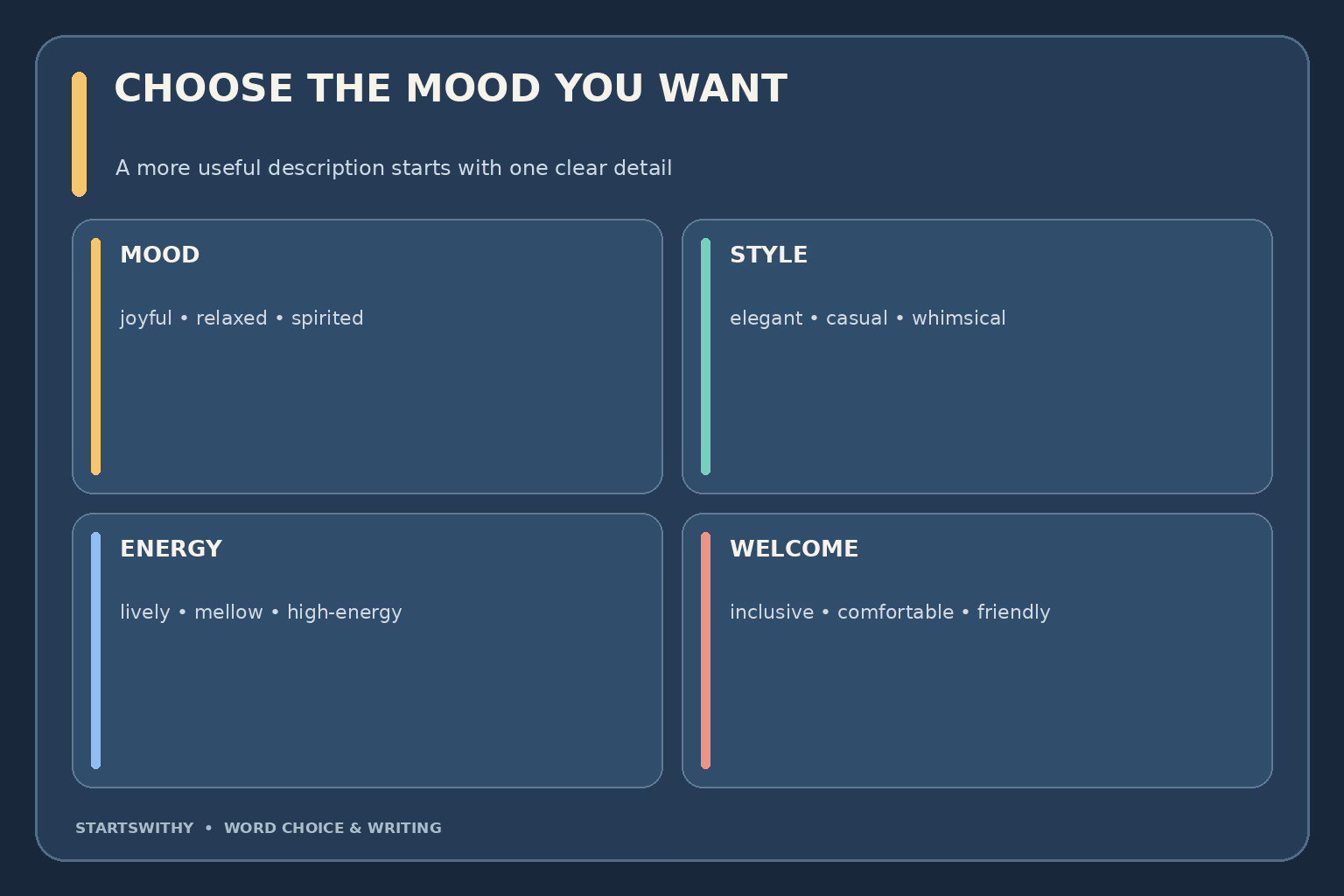
Use these positive words when you want to convey a welcoming or enjoyable atmosphere. Their meanings overlap, but each emphasizes a slightly different quality:
- Joyful: full of happiness. “We’re hosting a joyful family celebration with dinner and music.”
- Festive: suited to a celebration, often with decorations, food, or lively activity. “Join us for a festive holiday open house.”
- Welcoming: making guests feel accepted and comfortable. “It will be a welcoming, come-as-you-are evening.”
- Memorable: likely to be remembered. “The small, memorable gathering will include a toast and a favorite playlist.”
- Delightful: very pleasant or enjoyable. “A delightful afternoon of tea and conversation is planned.”
- Inclusive: designed so people can take part and feel considered. “We’re planning an inclusive celebration with quiet space and varied food options.”
“Fun” is friendly and informal; “delightful” sounds more polished. “Festive” points to a celebratory quality, while “joyful” focuses on happiness. For an invitation, one or two well-matched words are usually clearer than a string such as “fun, exciting, wonderful, amazing, and unforgettable.”
Party Adjectives for Different Events
Let the event guide your word choice. The same adjective can fit several occasions, but these combinations give you a practical starting point:
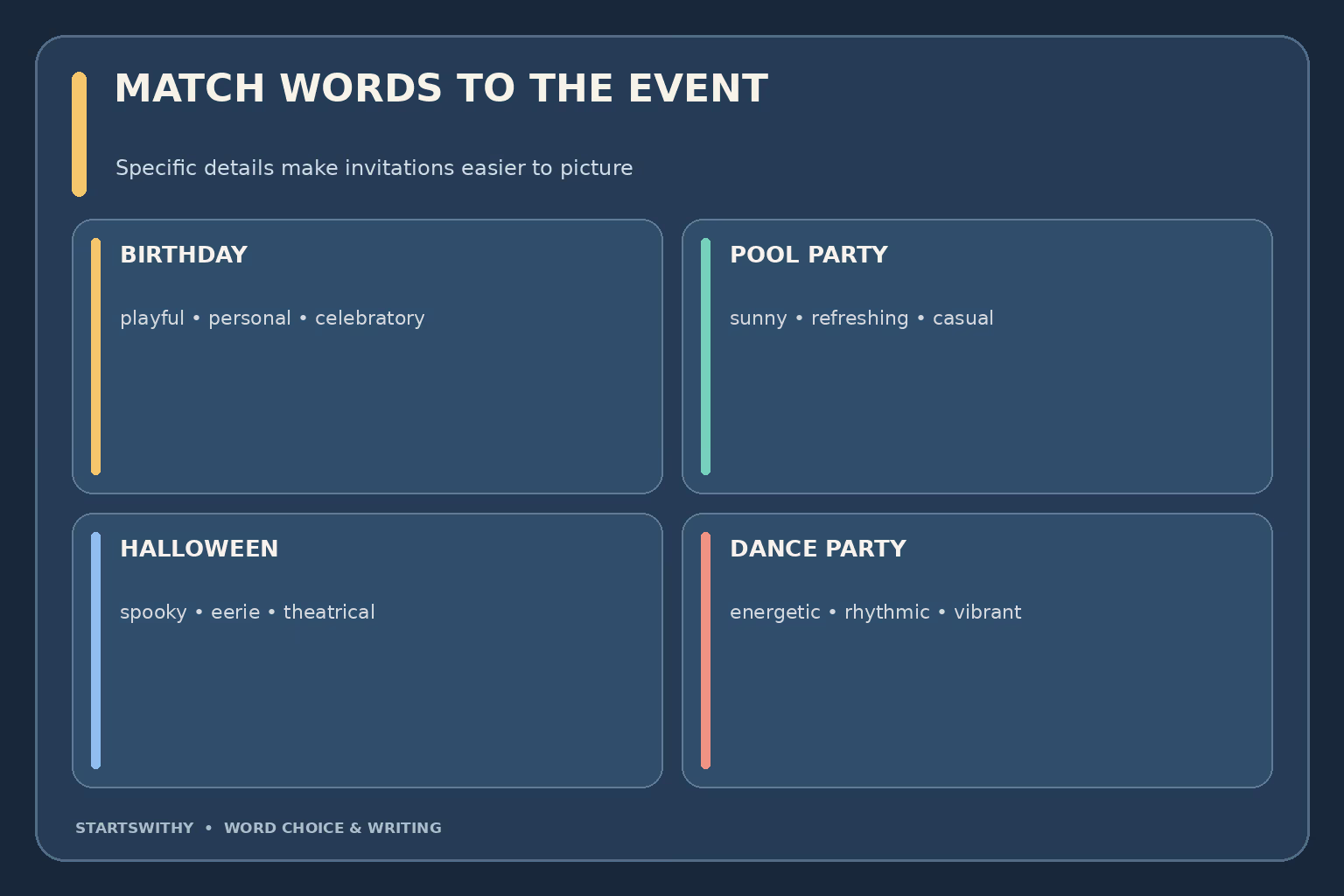
- Birthday party: playful, personal, cheerful, lively, or low-key. “A playful backyard birthday with cake and lawn games” is more informative than simply “a great party.”
- Pool party: sunny, refreshing, relaxed, casual, or splashy. If guests need to bring swimwear or towels, state that plainly instead of relying on an adjective.
- Halloween party: spooky, eerie, theatrical, mysterious, or whimsical. “Spooky” signals a scarier tone; “whimsical” suggests something lighter.
- Dance party: energetic, rhythmic, vibrant, upbeat, or high-energy. Add the music style or start time if that is important to guests.
- Dinner party: intimate, elegant, cozy, convivial, or relaxed. “Intimate” usually suggests a small gathering; it does not by itself say whether the event is formal.
- Surprise party: secret, joyful, low-key, or celebratory. Keep the wording private if the guest of honor might see the invitation.
Words for Decorations, Food, Music, and Guests
Sometimes the best adjective describes one part of the event, not the party as a whole. This makes descriptions more precise:
- Decorations: colorful, elegant, handmade, festive, understated, or whimsical. Example: “Colorful paper lanterns will brighten the patio.”
- Food: savory, plentiful, seasonal, homemade, spicy, or refreshing. Example: “A seasonal menu and homemade desserts will be served.”
- Music: mellow, upbeat, soulful, lively, or danceable. Example: “Expect mellow music early in the evening and a livelier playlist later.”
- Setting: cozy, airy, candlelit, outdoorsy, intimate, or spacious. Example: “We’ll gather in a cozy candlelit room.”
- Company: friendly, familiar, supportive, or welcoming. Avoid describing people with labels they may not choose for themselves; describe the atmosphere or specific behavior instead.
How to Use Party Adjectives in Invitations
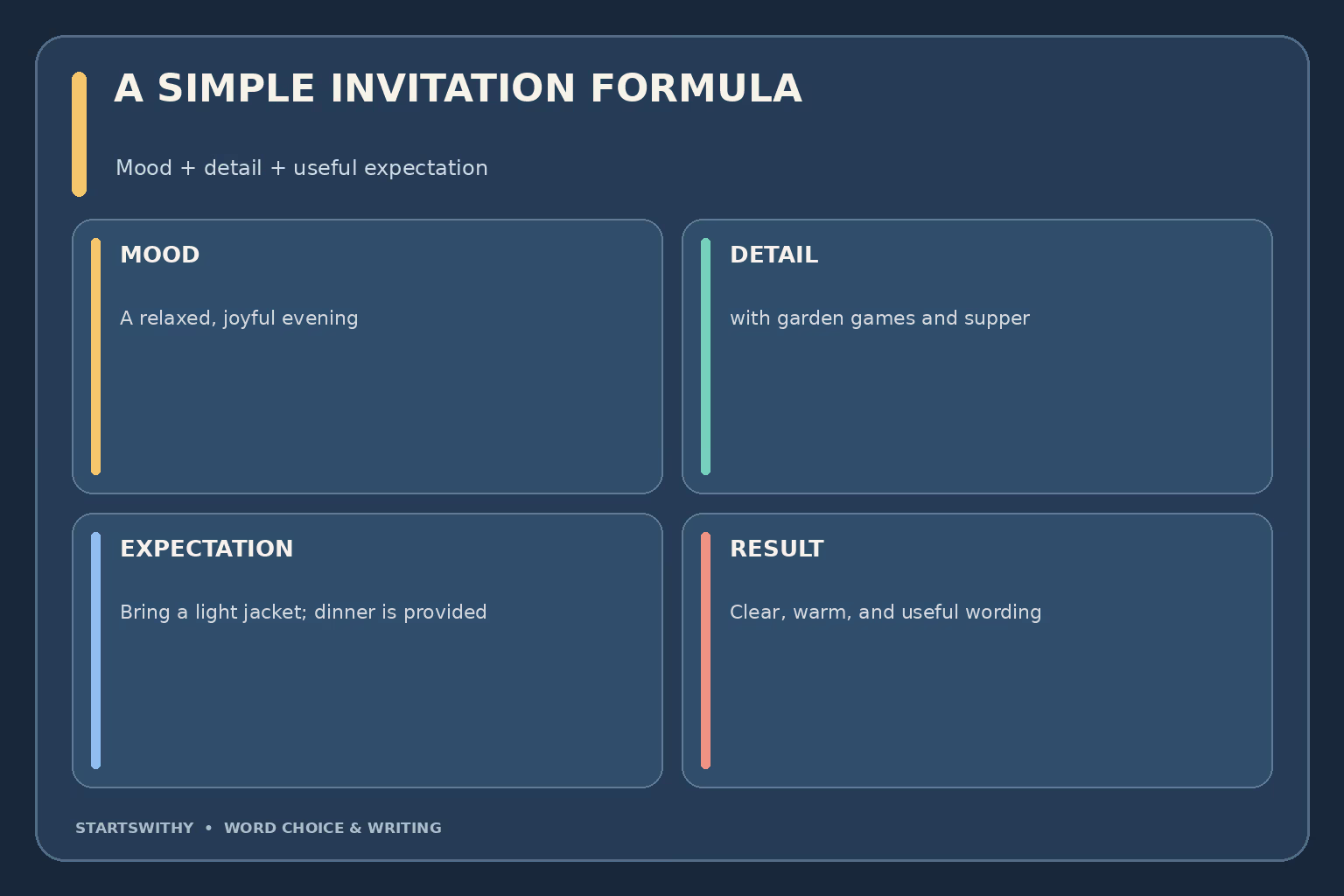
A simple pattern is mood + specific detail + practical information. For example: “Join us for a relaxed garden evening with live acoustic music. Dinner will be served at 6:30; bring a light jacket.” The adjective gives the tone, the detail helps guests picture the event, and the final sentence answers a useful question.
Here are a few adaptable examples:
- “Celebrate with us at a joyful, casual birthday lunch in the park.”
- “You’re invited to an elegant evening of dinner, conversation, and candlelight.”
- “Come by for a playful Halloween get-together with costumes, snacks, and family-friendly games.”
- “Join us for a lively dance party; comfortable shoes are encouraged.”
Adjectives modify nouns by adding descriptive information, so place them near the thing they describe: “a lively party,” “colorful decorations,” or “the music was mellow.” If you are unsure whether a word is an adjective or an adverb, check what it modifies: “The band played loudly” describes how it played, while “the loud music” describes the music.
Negative Adjectives: Be Specific and Fair
When a gathering disappoints you, a precise description is more useful than a sweeping insult. Crowded, noisy, disorganized, awkward, and underwhelming identify different experiences. Instead of “The party was terrible,” you might say, “The room felt crowded, and the schedule was unclear.” This separates an observation from an overall judgment and gives a host something concrete to improve.
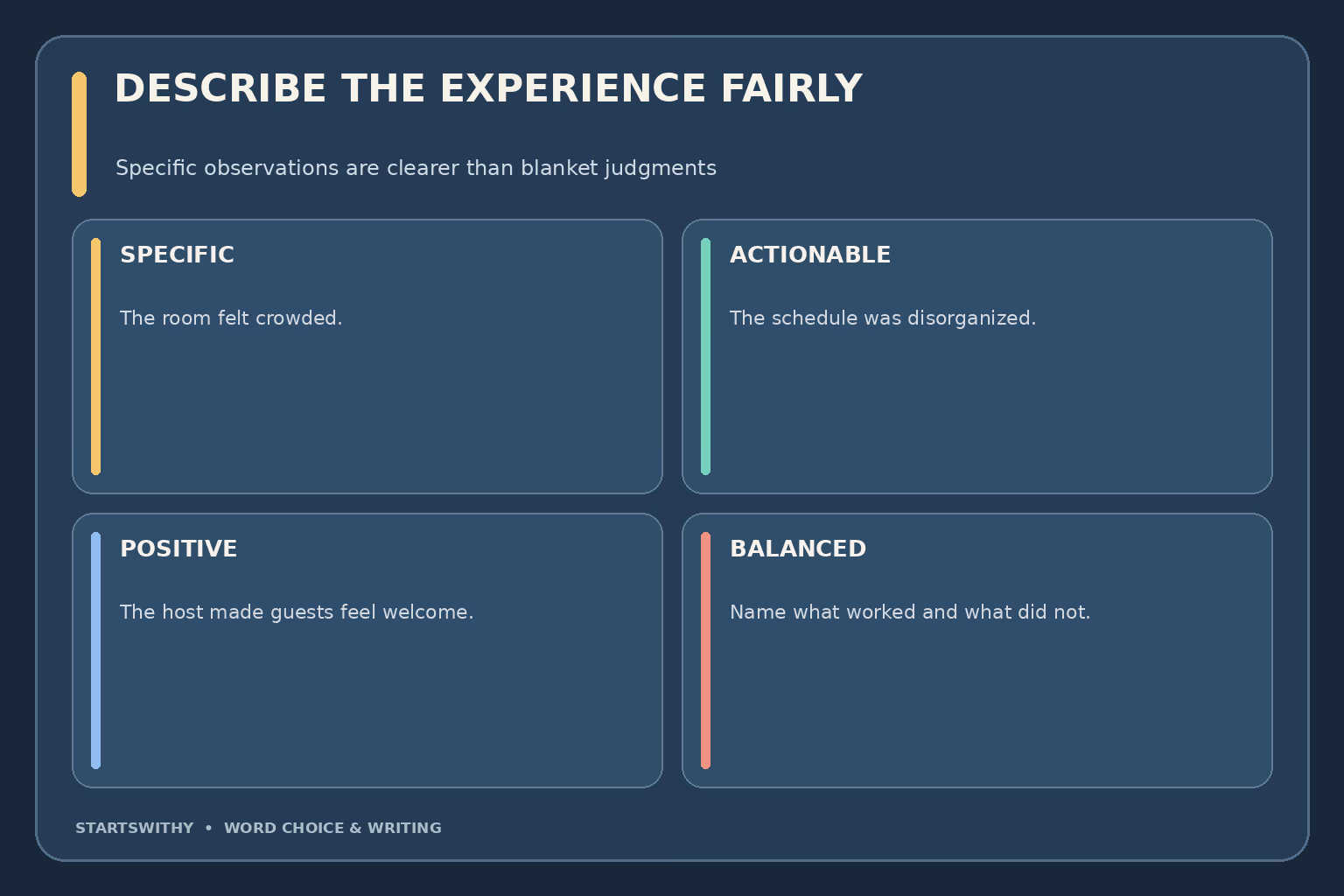
Negative descriptions can also be softened without hiding the point: “The music was louder than I expected” is more specific than “awful”; “I found it hard to join the conversation” explains why a large, noisy room felt uncomfortable. If you are writing a public review, describe what you personally experienced and avoid presenting a preference as an objective fact.
Frequently Asked Questions
What are good adjectives to describe a party?
Joyful, festive, lively, relaxed, elegant, cozy, playful, welcoming, and memorable are useful choices. The best word depends on the mood and style you want guests to expect.
What is another word for a fun party?
Try “lively,” “festive,” “joyful,” “spirited,” or “enjoyable.” “Lively” emphasizes activity and energy, while “festive” highlights the celebratory atmosphere.
How do I describe a formal party?
Words such as elegant, refined, sophisticated, and black-tie can suggest formality. Use “black-tie” only when that is the actual dress code; include practical details so guests know what to wear.
How many adjectives should I use in an invitation?
One or two specific adjectives are often enough. Pair them with concrete information about the venue, food, music, schedule, or dress code.
What adjectives describe a disappointing party?
Crowded, noisy, disorganized, awkward, or underwhelming may fit particular situations. Pick the word that reflects what happened and explain the detail rather than relying on a broad label.
Sources and Further Reading
- Purdue OWL: The Difference between Adjectives and Adverbs (how adjectives modify nouns and how adverbs differ).
- Cambridge Dictionary: Glamorous (a usage example for a style-focused party adjective).

Planning a party and want to make sure it’s an unforgettable experience? Well, I’ve got you covered! In this article, I’ll be sharing a list of adjectives that will help you describe your party in the most vibrant and exciting way possible. Whether you’re hosting a wild and energetic bash or a sophisticated and elegant soir√©e, these adjectives will add that extra touch of flair to your party invitations, decorations, and conversations. So, let’s dive in and discover the perfect words to make your party truly extraordinary.
When it comes to describing a party, the right adjectives can make all the difference. From describing the atmosphere to the decorations and even the guests, the words you choose can set the tone and create anticipation for your event. Imagine using words like “exhilarating,” “glamorous,” or “enchanting” to captivate your guests’ imaginations and get them excited about attending your party. In this article, I’ll not only provide you with a comprehensive list of adjectives but also give you examples of how to use them effectively. So, get ready to transform your party into an unforgettable experience with these descriptive words.
How to Describe party? – Different Scenarios
When it comes to describing a party, the right choice of words can make all the difference. Depending on the type of party and the atmosphere you want to create, you can use different adjectives to paint a vivid picture for your guests. Here are a few scenarios and examples of how to describe them:
- Birthday Party
- Pool Party
- Halloween Party
- Dance Party
Remember, adjectives are just tools to enhance the description of your party. Play around with different words to find the perfect ones that capture the essence of your event. By using the right adjectives, you can create anticipation and excitement among your guests, making your party truly extraordinary.
Now that we’ve explored how to describe a party in different scenarios, let’s move on to the next section where we’ll provide you with a comprehensive list of adjectives that you can use to describe your party. So stay tuned!
Adjectives for a Party – Describing Words
Describing Words for party in English
When it comes to describing parties, there is a rich variety of adjectives to choose from. These descriptive words can paint a vivid picture and capture the essence of the event. Whether you’re organizing a birthday party, a pool party, a Halloween gathering, or a dance party, using the right adjectives can bring your descriptions to life.
Let’s explore some examples of adjectives that can be used to describe different types of parties:
- Birthday Party:
- Pool Party:
- Halloween Party:
- Dance Party:
Remember, these adjectives are just a starting point. Feel free to experiment and find the perfect words that capture the essence of your party.
Adjectives for party
Positive Adjectives for Party with 12 Example Sentences
When describing a party, it’s important to use the right adjectives to capture the atmosphere and mood. Here are some positive adjectives that you can use to bring your party description to life:
- Lively: The party was filled with energetic music and dancing.
- Vibrant: The decorations were colorful and bright, creating a festive atmosphere.
- Joyful: Everyone at the party had smiles on their faces and laughter filled the air.
- Exciting: The party was full of thrilling activities and surprises.
- Fun-filled: There were games, activities, and entertainment for everyone to enjoy.
- Energetic: The guests were enthusiastic and eager to participate in the festivities.
- Cheerful: The party was filled with happiness and positive energy.
- Enthusiastic: The guests were passionate and excited about the event.
- Lively: The party had a lively atmosphere with music and dancing.
- Memorable: The party was unforgettable, leaving a lasting impression on the guests.
- Inclusive: Everyone at the party felt welcome and included.
- Delightful: The party was a delightful experience, with enjoyable activities and pleasant company.
Using these positive adjectives will help create a vivid description of your party, emphasizing the joyous and exciting aspects of the event.
Negative Adjectives for Party with 5 Example Sentences
While we strive for positive experiences, there may be times when we need to describe a party that wasn’t as enjoyable. Here are some negative adjectives that you can use to describe such situations:
- Boring: The party lacked excitement and entertainment.
- Dull: The atmosphere was lacking energy and enthusiasm.
- Disappointing: The party didn’t live up to expectations and left guests feeling let down.
- Chaotic: The party was disorganized and hectic.
- Unpleasant: The party had a negative atmosphere and left guests feeling uncomfortable.
Though it’s not ideal to focus on the negative aspects of a party, these adjectives can be useful when describing a less enjoyable experience.
Synonyms and Antonyms with Example Sentences
Synonyms for Party
When it comes to describing parties, there are plenty of synonyms that can help us paint a vivid picture. Here are a few adjectives that you can use to add depth and excitement to your descriptions:
- Lively: The party was filled with lively music and dancing.
- Vibrant: The vibrant decorations brought the party to life.
- Joyful: Everyone had a joyful time celebrating together.
- Exciting: The party was full of exciting games and activities.
- Fun-filled: The party was a fun-filled event with laughter and enjoyment.
- Energetic: The party had an energetic atmosphere with people dancing and socializing.
- Cheerful: The party was a cheerful gathering, with smiles all around.
- Enthusiastic: The guests were enthusiastic and actively participated in the festivities.
- Memorable: It was a memorable party that no one will forget.
- Inclusive: The party was inclusive and brought people from different backgrounds together.
- Delightful: The party was a delightful experience with delicious food and delightful company.
Antonyms for Party
Not all parties are enjoyable, and sometimes we need adjectives to describe the less exciting ones. Here are a few antonyms that can help convey a different tone:
- Boring: The party was boring, with very little entertainment or interaction.
- Dull: The party lacked excitement and was rather dull.
- Disappointing: The party turned out to be disappointing, with a lack of fun activities.
- Chaotic: The party was chaotic and disorganized, making it difficult to enjoy.
- Unpleasant: The party was unpleasant, with unfriendly guests and a tense atmosphere.
Using these adjectives, you can create a more vivid and descriptive portrayal of parties, whether they are positive or negative. So, next time you want to capture the essence of a party, don’t be afraid to explore the wide range of adjectives available to you.
Conclusion
Describing a party can be a fun and creative task, and adjectives play a crucial role in capturing the essence of the event. In this article, we explored a range of adjectives that can be used to describe parties, both positive and negative.
From lively and vibrant to joyful and exciting, positive adjectives help paint a vivid picture of a party filled with energy and cheer. On the other hand, negative adjectives like boring and dull can be used to describe less enjoyable parties that lack excitement.
By using these adjectives, you can effectively convey the atmosphere and experience of a party to your readers or listeners. Whether you want to share the memories of a memorable event or warn others about a disappointing gathering, the right choice of adjectives can make all the difference.
So, the next time you find yourself in need of describing a party, don’t hesitate to explore the wide range of adjectives available. Let your words bring the party to life and captivate your audience with a vivid and engaging description.


