How to Choose Adjectives for Products
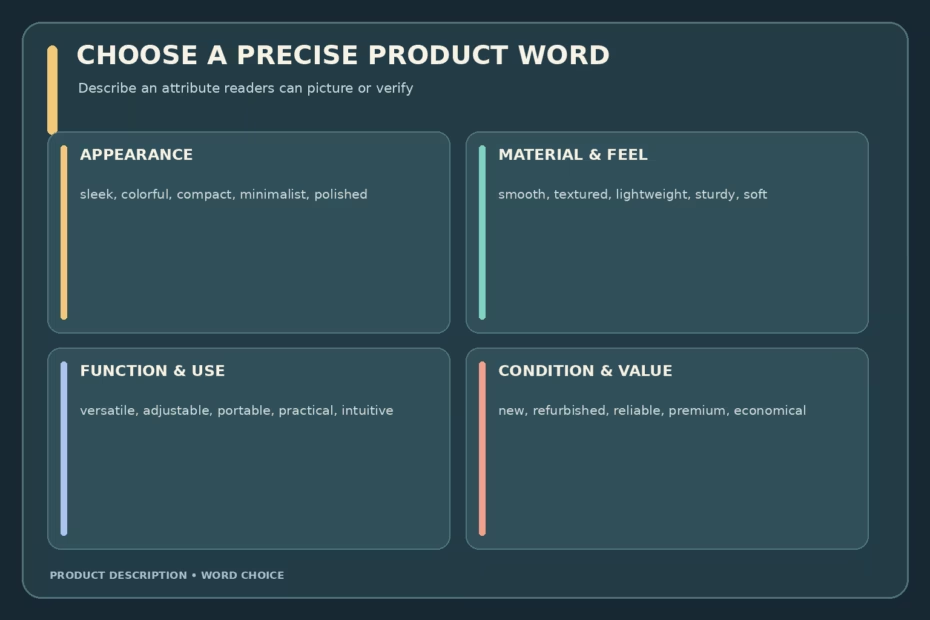
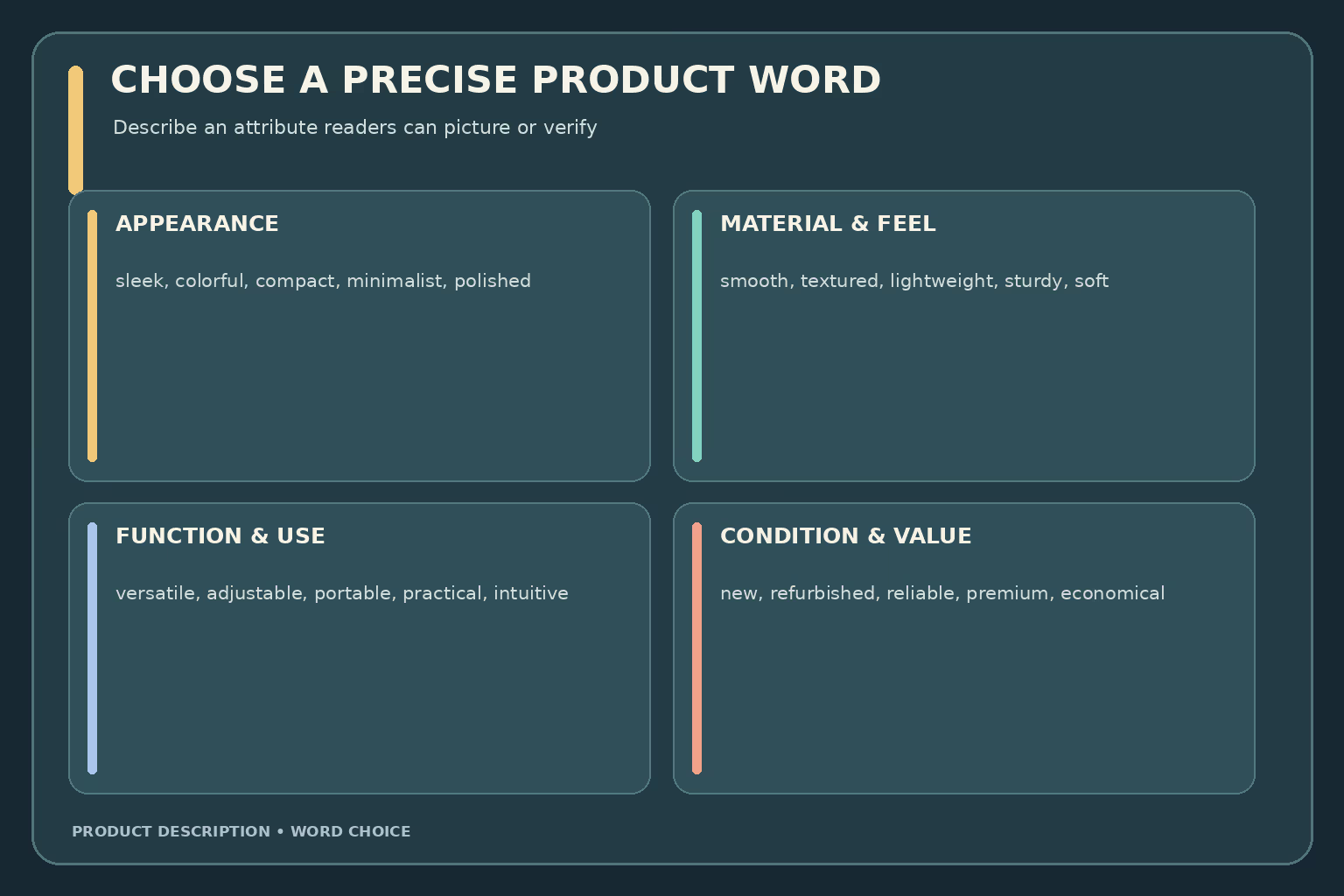
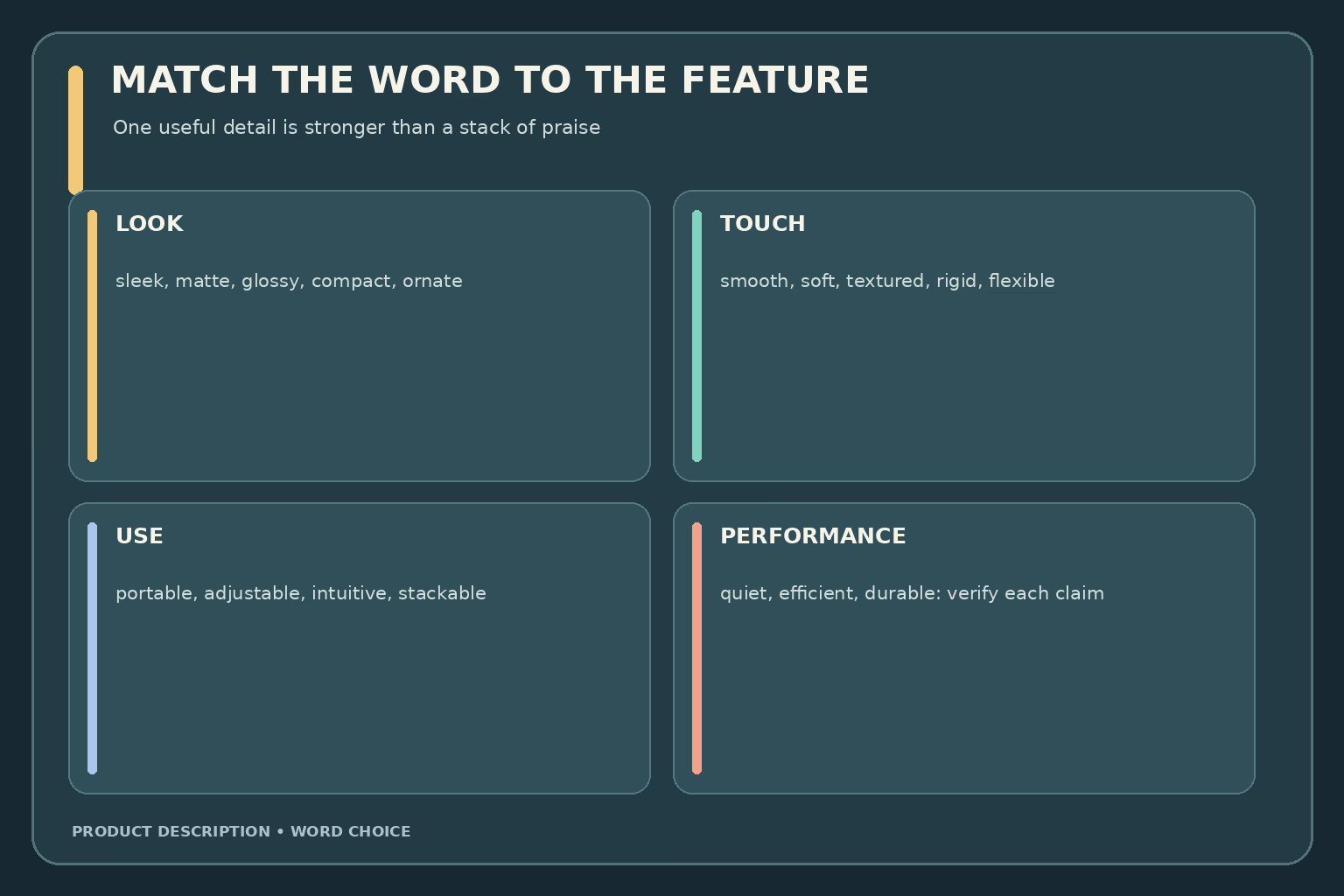
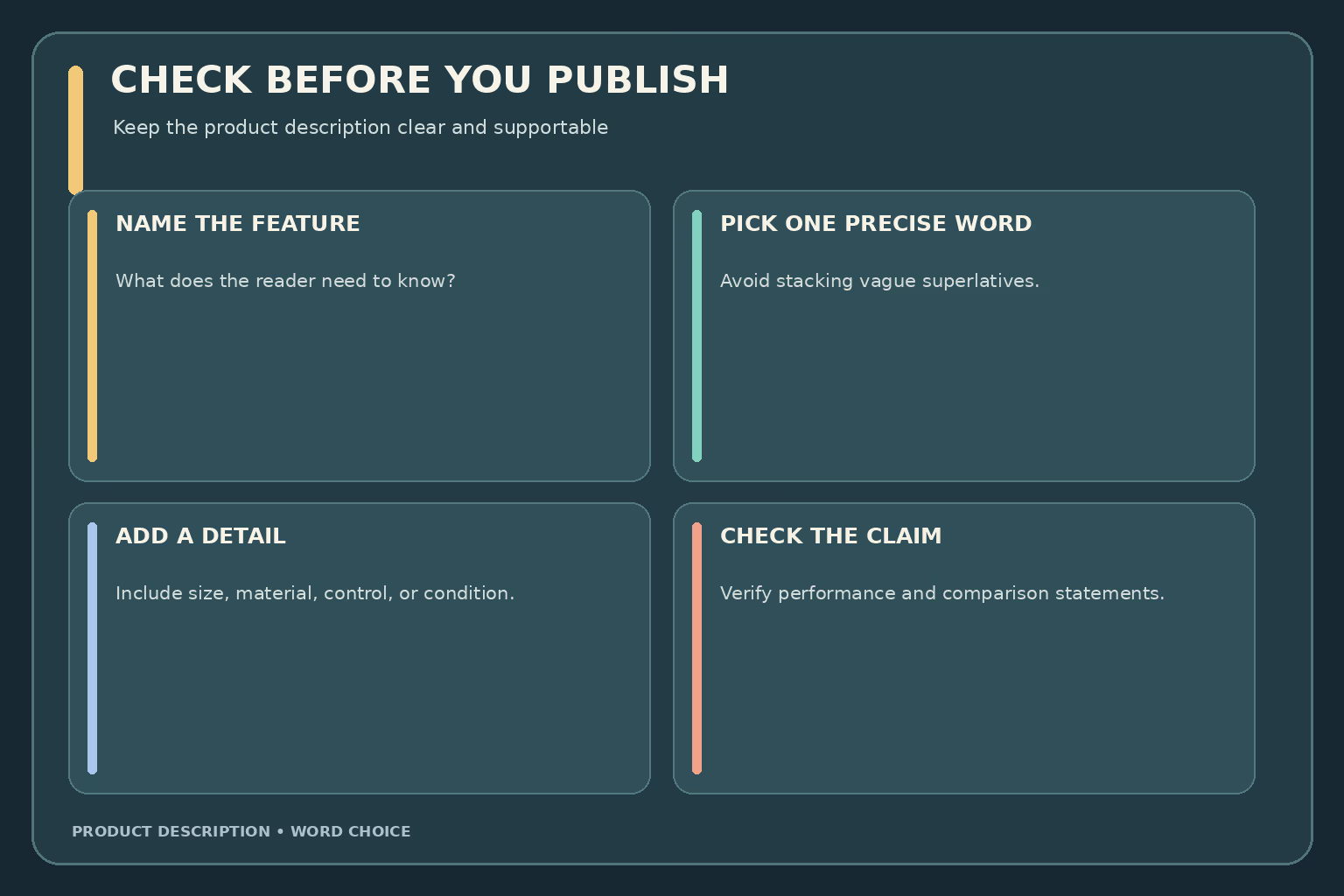
Choose adjectives by the product feature you want a reader to understand. Words such as sleek and compact describe appearance or shape; adjustable and portable describe practical features; and durable makes a claim about how well something holds up. The best choice is specific, relevant to the audience, and supported by what you can observe or verify.
Instead of calling an item “amazing,” explain what makes it useful: “a compact travel mug with a locking lid” or “a smooth ceramic bowl with a wide, shallow shape.” The added detail helps a reader picture the item and compare it with alternatives.
Product Adjectives by Attribute
Use these groups as a starting point. A word can fit more than one group, and the right choice depends on the product and the evidence available.
Appearance and design
- Sleek: smooth and streamlined in appearance. “The sleek black kettle has a simple, curved handle.”
- Compact: small in size, often relative to a larger model. “Its compact footprint leaves room on a crowded counter.”
- Minimalist: designed with few decorative elements. “A minimalist clock uses plain markings and a clean face.”
- Colorful: featuring noticeable or varied colors. “The colorful storage bins make each shelf easy to identify.”
- Polished: smooth or glossy in finish, or carefully refined in presentation. “The polished metal case has a reflective finish.”
- Distinctive: easy to recognize because of a particular feature. “A distinctive angled grip sets this tool apart visually.”
Materials and feel
- Smooth: even to the touch or eye. “The smooth glass surface wipes clean with a soft cloth.”
- Textured: having a noticeable surface pattern or feel. “A textured handle offers a different feel from a plain one.”
- Soft: yielding or pleasant to touch. “The soft cover makes the notebook comfortable to hold.”
- Rigid: firm and resistant to bending. “A rigid case helps keep the contents in shape.”
- Lightweight: low in weight compared with an expected reference. “The lightweight frame is easy to carry between rooms.”
- Sturdy: solidly made or not easily damaged in ordinary use. Use this word when construction supports it: “The sturdy legs keep the table steady on a level floor.”
Function and ease of use
- Adjustable: able to be changed to suit a need. “The adjustable strap fits several carrying positions.”
- Versatile: suitable for different tasks or settings. “A versatile tray works for serving snacks or organizing a desk.”
- Portable: easy to carry or move. “The portable charger fits in a small pocket.”
- Intuitive: straightforward to learn or operate. “Large, clearly marked buttons make the control panel intuitive.”
- Practical: useful for a particular everyday purpose. “A practical divided container keeps small supplies together.”
- Space-saving: designed to occupy less room or store compactly. “The space-saving rack folds flat when it is not in use.”
Performance, condition, and value
- Efficient: doing a task with little wasted time, effort, or resources. Explain the relevant measure when possible.
- Quiet: producing little sound in a stated setting; avoid implying it is silent unless that is accurate.
- Durable: able to withstand use over time. A test, warranty, materials information, or other evidence may support the claim.
- Reliable: performing consistently as expected. Give readers a concrete basis when making this evaluation.
- Premium: positioned as higher grade or quality. Clarify the feature or material behind this label.
- Economical: relatively low in cost or efficient in use, depending on context. State the basis of comparison.
- Refurbished: restored or prepared for resale after prior use; the exact work and warranty depend on the seller.
Before-and-After Product Description Examples
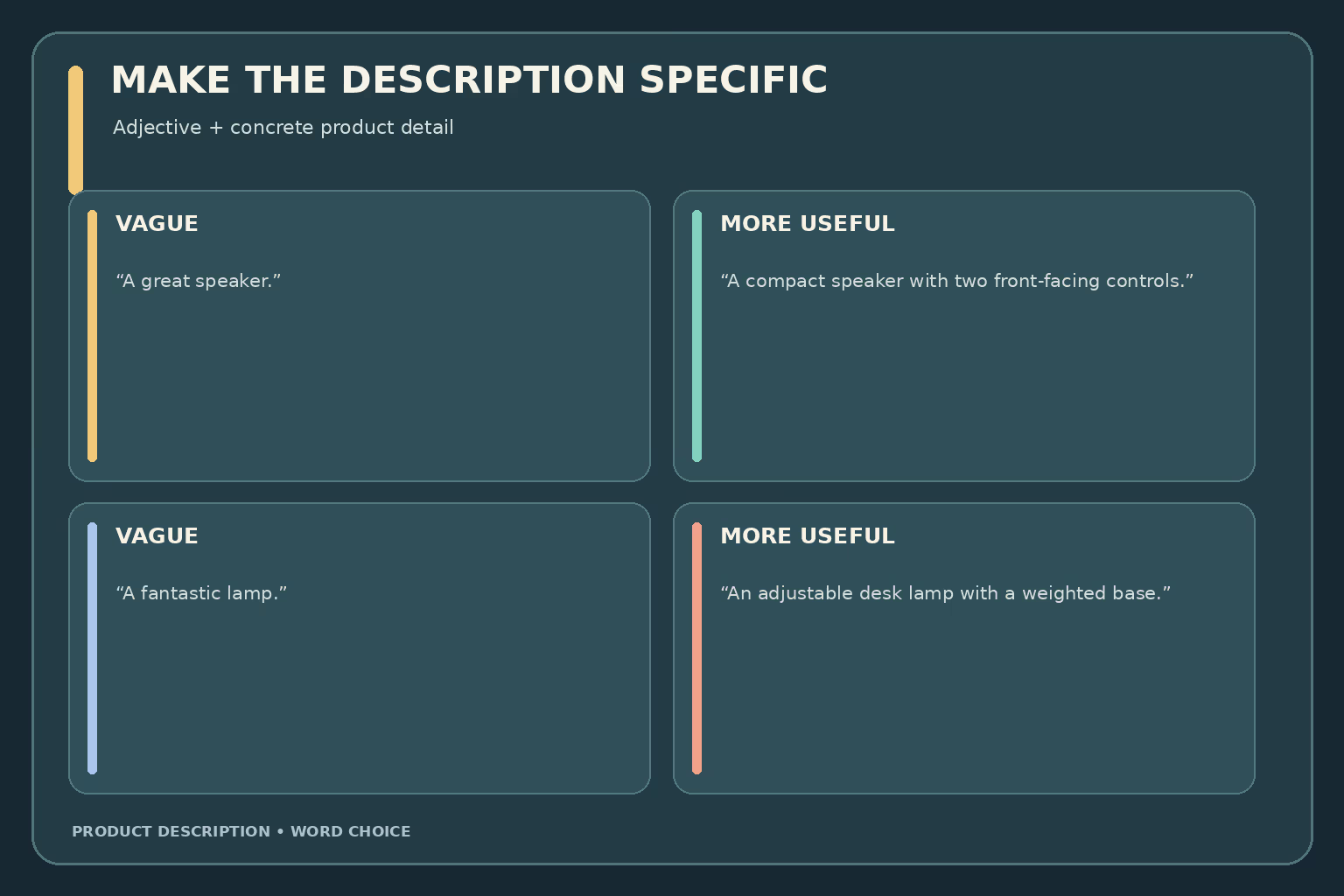
A useful description connects an adjective to a feature rather than relying on general praise. These examples show how a small amount of specific information can clarify the message:
| Broad wording | More specific wording | What the adjective adds |
|---|---|---|
| “A great backpack.” | “A lightweight backpack with a padded laptop sleeve and two side pockets.” | Lightweight describes feel; the pockets name visible features. |
| “A fantastic lamp.” | “An adjustable desk lamp with a weighted base and a flexible neck.” | Adjustable connects to a concrete mechanism. |
| “A beautiful bowl.” | “A glossy blue bowl with a wide rim and a shallow profile.” | Glossy and blue give observable details. |
| “A durable storage box.” | “A rigid plastic storage box with reinforced corners and a snap-on lid.” | The construction details explain why the durability claim might matter. |
Use Product Claims Carefully
Words such as best, safest, non-toxic, eco-friendly, waterproof, and guaranteed can imply objective facts. Use them only when you can explain and support the claim, and add relevant limits or comparison details. Terms like fast-charging or long-lasting become clearer when paired with compatible conditions or a stated measure. The Federal Trade Commission says advertising claims must be truthful, not misleading, and evidence-based. That principle is useful when choosing product adjectives: describe what the item actually does and make the basis for factual claims clear.
When a product is used, refurbished, handmade, or sold with limited accessories, mention that condition directly. An accurate phrase such as “refurbished, with a replacement charging cable” is more informative than a vague positive label. Describe what is included, what has been checked, and which details vary by model or seller.
A Simple Product Description Formula
Try this pattern: product + one or two precise adjectives + concrete feature + intended use. For example: “A compact, matte-finish desk organizer with three removable trays for sorting pens and notes.” The adjectives identify size and finish; the rest of the sentence tells the reader what the organizer contains and how it can be used. Keep only the words that help someone understand the product.
Frequently Asked Questions
What are positive adjectives for products?
Depending on the item, useful positive words include sturdy, versatile, compact, smooth, adjustable, reliable, and easy-to-use. Choose words that match the actual features instead of treating them as generic praise.
What are good adjectives for a product description?
Words tied to observable details are often most helpful: glossy for a finish, lightweight for relative weight, foldable for a design feature, or refurbished for condition. Add a short explanation when a term could mean different things.
How can I make a product sound appealing without exaggerating?
Lead with a relevant feature, describe it precisely, and explain how it helps in a specific use. Replace a broad claim such as “the ultimate bag” with details about capacity, compartments, materials, or carry style that you can verify.
Should I use more than one adjective?
Yes, if each word adds a different kind of information. “A compact, adjustable reading lamp” describes size and function; several near-synonyms such as great, amazing, fantastic, and excellent usually add little.
Source
- Federal Trade Commission: Advertising and Marketing (truthful, non-deceptive, evidence-based advertising claims).

When it comes to describing products, finding the right words can make all the difference. As a seasoned expert in the world of product reviews, I’ve learned that using the right adjectives can help paint a vivid picture of a product’s features and benefits. In this article, I’ll be sharing a comprehensive list of adjectives that you can use to describe products, along with real-life examples to inspire you. Whether you’re a content creator, a marketer, or simply someone who loves to write, these adjectives will help you craft compelling product descriptions that captivate your audience and drive sales.
From sleek and sophisticated to rugged and durable, the right adjectives can bring a product to life in the minds of your readers. In this article, I’ll be diving deep into the world of product descriptions, exploring how different adjectives can evoke specific emotions and create a strong connection with your audience. Whether you’re describing a cutting-edge gadget, a luxurious beauty product, or a practical household item, I’ll provide you with a wide range of adjectives to choose from. So, let’s get started and discover the power of words when it comes to describing products.
How to Describe products? – Different Scenarios
When it comes to describing products, the choice of adjectives can make all the difference. Depending on the scenario, you may want to highlight different aspects of a product and evoke specific emotions in your audience. Here are some examples of how to describe products in different scenarios:
- Cutting-edge Gadgets:
When describing cutting-edge gadgets, it’s important to convey a sense of innovation, technology, and excitement. Consider using adjectives like “revolutionary,” “state-of-the-art,” “high-tech,” and “innovative.” These words can help create a vivid picture of advanced features and capabilities. For example:
- “Introducing the revolutionary new smartphone with state-of-the-art facial recognition technology.”
- “Experience the power and innovation of our high-tech smartwatch.”
- Luxurious Beauty Products:
For luxury beauty products, the goal is to create a sense of indulgence, elegance, and pampering. Adjectives such as “luxurious,” “opulent,” “sumptuous,” and “exquisite” can help capture the essence of these products. Here are a couple of examples:
- “Indulge in the luxurious feel of our opulent silk pillowcase.”
- “Experience the sumptuous scent of our exquisite rose-infused body lotion.”
- Practical Household Items:
When describing practical household items, customers often look for attributes like functionality, durability, and convenience. Consider using adjectives like “reliable,” “durable,” “versatile,” and “convenient.” These words convey the usefulness and value of the product. For instance:
- “Our reliable vacuum cleaner effortlessly tackles dirt and dust, making cleaning a breeze.”
- “Experience the convenience and versatility of our durable food storage containers.”
| Cutting-edge Gadgets | Luxurious Beauty Products | Practical Household Items |
|---|---|---|
| Revolutionary | Luxurious | Reliable |
| State-of-the-art | Opulent | Durable |
| High-tech | Sumptuous | Versatile |
| Innovative | Exquisite | Convenient |
Describing Words for products in English
When it comes to describing products, using the right adjectives is crucial. The right words can evoke specific emotions and create a strong connection with the audience. Whether you’re writing product descriptions for cutting-edge gadgets, luxurious beauty products, or practical household items, here are some powerful adjectives that can captivate your readers and drive sales:
- Sleek: Use this word to describe modern and stylish products with clean lines and a sophisticated look.
- Premium: This adjective is perfect for high-end products that offer top-notch quality and luxury.
- Innovative: Highlight products that are unique and groundbreaking with this word. It conveys the idea of something new and different.
- Efficient: Use this adjective for products that are designed to save time, effort, or resources. It appeals to practicality and functionality.
- Versatile: Describe products that have multiple uses or functions with this word. It suggests adaptability and convenience.
- Glamorous: This adjective works well for beauty and fashion products that exude elegance, sophistication, and style.
- Durable: Highlight the durability and long-lasting qualities of products with this word. It reassures customers of the product’s quality and value.
- Compact: Use this term to describe products that are small, space-saving, and easy to carry or store. It appeals to convenience and portability.
Remember, the key is to use adjectives that resonate with your target audience and align with the product’s unique selling points. By carefully selecting and incorporating these descriptive words into your product descriptions, you can capture the attention of your audience and compel them to make a purchase.
Let’s take a look at some examples of how these adjectives can be used in product descriptions:
| Product Description Examples |
|---|
| “Introducing our sleek and innovative new smartphone that combines cutting-edge technology with a premium design.” |
| “Experience the glamorous and luxurious feel of our premium skincare line, formulated with the finest ingredients for ageless beauty.” |
| “Our durable and efficient kitchen appliances are designed to simplify your cooking experience, making meal preparation a breeze.” |
| “Discover the versatility of our compact and lightweight backpack, perfect for travel, outdoor adventures, and everyday use.” |
Adjectives for products
To create captivating product descriptions, it is crucial to use the right adjectives that resonate with the audience and highlight the unique selling points of the product. Here, I’ll provide you with a list of positive and negative adjectives that can be used to describe products, along with example sentences for each.
Positive Adjectives for Products
Positive adjectives create a sense of appeal, value, and desirability for products. Here are 12 examples of positive adjectives that can make your product descriptions more compelling:
| Adjective | Definition | Example Sentence |
|---|---|---|
| Sleek | Stylish and elegant | The sleek design of this smartphone is perfect for the fashion-conscious. |
| Premium | High-quality and luxurious | This premium leather handbag exudes sophistication. |
| Innovative | Cutting-edge and creative | The innovative features of this smartwatch will revolutionize your fitness routine. |
| Efficient | Time-saving and effective | This efficient blender ensures your smoothies are ready in seconds. |
| Versatile | Flexible and adaptable | The versatile functionality of this laptop makes it ideal for work and play. |
| Glamorous | Stylish and captivating | This glamorous evening gown will make you the belle of the ball. |
| Durable | Long-lasting and sturdy | The durable construction of these hiking boots ensures they can withstand any terrain. |
| Compact | Space-saving and portable | The compact design of this camera makes it easy to carry on your adventures. |
| Stylish | Fashionable and trendy | Stand out from the crowd with this stylish pair of sunglasses. |
| Reliable | Trustworthy and dependable | This reliable car will take you on many memorable road trips. |
| Eco-friendly | Environmentally conscious | Choose this eco-friendly product and reduce your carbon footprint. |
| Luxurious | Opulent and lavish | Indulge in the luxurious comfort of this velvet sofa. |
Negative Adjectives for Products
While negative adjectives might not be ideal for selling products, they can be useful in certain contexts to highlight potential drawbacks or challenges. Here are 5 examples of negative adjectives that can be used selectively when describing products:
| Adjective | Definition | Example Sentence |
|---|---|---|
| Flimsy | Weak and easily damaged | The flimsy construction of this toy may not withstand rough play. |
| Bulky | Large and cumbersome | The bulky size of this vacuum cleaner makes it difficult to store. |
| Noisy | Loud and disruptive | Be aware that this blender can be quite noisy during use. |
| Outdated | Old-fashioned and antiquated | The outdated software on this device may limit its functionality. |
| Fragile | Delicate and easily breakable | Handle with care, as this fragile vase can easily shatter. |
Remember, the key to effective product descriptions is to select adjectives that align with your target audience’s preferences and emphasize the unique benefits of the product. Choose adjectives that resonate with your potential customers and highlight the features that set your product apart from the competition.
Synonyms and Antonyms with Example Sentences
Synonyms for products
When it comes to describing products, it’s important to have a variety of adjectives at your disposal. Here are some synonyms for “products” that you can use to make your descriptions more interesting and engaging:
| Synonym | Definition |
|---|---|
| Goods | Merchandise or items that are bought or sold. |
| Items | Objects or things that are considered as commodities. |
| Articles | Objects that have been made or produced for sale. |
| Commodities | Marketable products or goods that can be traded. |
| Wares | Goods that are sold or offered for sale. |
Example sentence: This gadget is one of our top-selling articles due to its innovative features.
Antonyms for products
Sometimes, you might want to highlight the unique qualities of a product by using antonyms. By using antonyms, you can create contrast and emphasize the benefits that the product offers. Here are some examples of antonyms for “products” that you can consider:
| Antonym | Definition |
|---|---|
| Defect | A flaw or imperfection that makes something unsatisfactory. |
| Drawback | A disadvantage or negative aspect of something. |
| Shortcoming | A fault or weakness that limits the success of something. |
| Disadvantage | A condition or factor that puts someone or something at a disadvantage. |
| Limitation | A restriction or constraint that hinders or restricts something. |
Example sentence: While this product has many benefits, it’s important to consider its potential drawbacks before making a purchase.
Having a diverse range of synonyms and antonyms for describing products can greatly enhance the effectiveness of your product descriptions. By choosing the right adjectives, you can grab the attention of your target audience and emphasize the unique benefits of the product. So, the next time you’re writing a product description, be sure to consider these synonyms and antonyms to make your description more engaging and compelling.
Conclusion
In this article, we have explored the significance of using the right adjectives to describe products. By utilizing positive adjectives, we can craft compelling product descriptions that capture the attention of potential customers. Additionally, we have introduced synonyms for the word “products” to enhance the variety and richness of our descriptions. These synonyms allow us to express the unique qualities of each product, making them more appealing to consumers.
Furthermore, we have discussed the power of using antonyms to highlight the distinctive features of a product. By contrasting the product with its opposite, we can emphasize its strengths and advantages. This technique adds depth and persuasiveness to our descriptions, making them more persuasive and effective.
By incorporating a diverse range of synonyms and antonyms, we can create product descriptions that stand out from the competition. These descriptions will engage customers, evoke emotions, and ultimately drive sales. So, remember to choose your adjectives carefully and make use of synonyms and antonyms to create compelling and impactful product descriptions.


