Choose Rainforest Adjectives by What You Notice
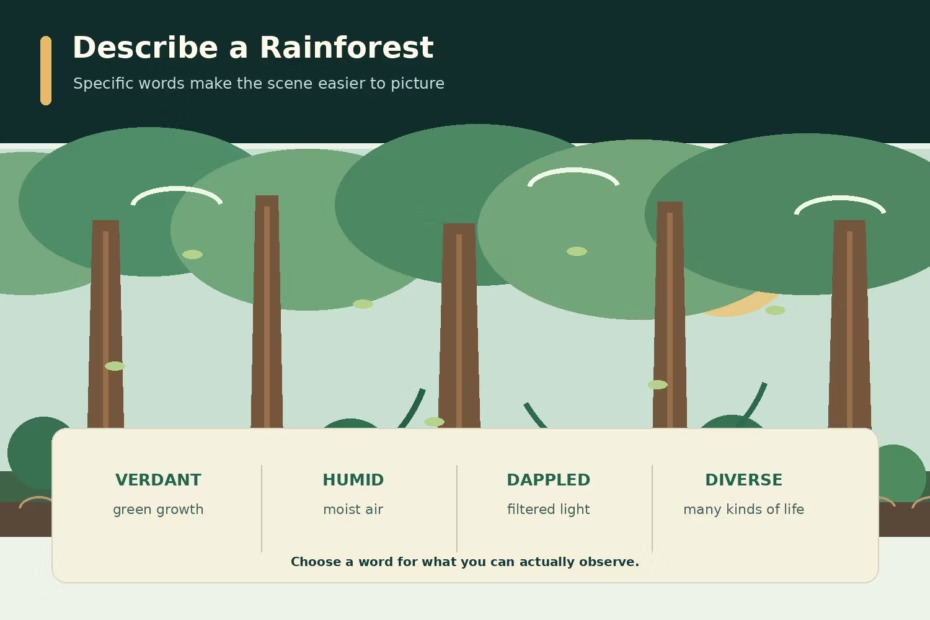
A strong rainforest description names a detail the reader can picture, hear, or feel. Instead of stacking words such as beautiful, amazing, and exotic, decide whether you are describing the plants, the air, the light, the ground, or your own reaction. The same forest can be verdant in color, humid in the air, and shadowy beneath its canopy.
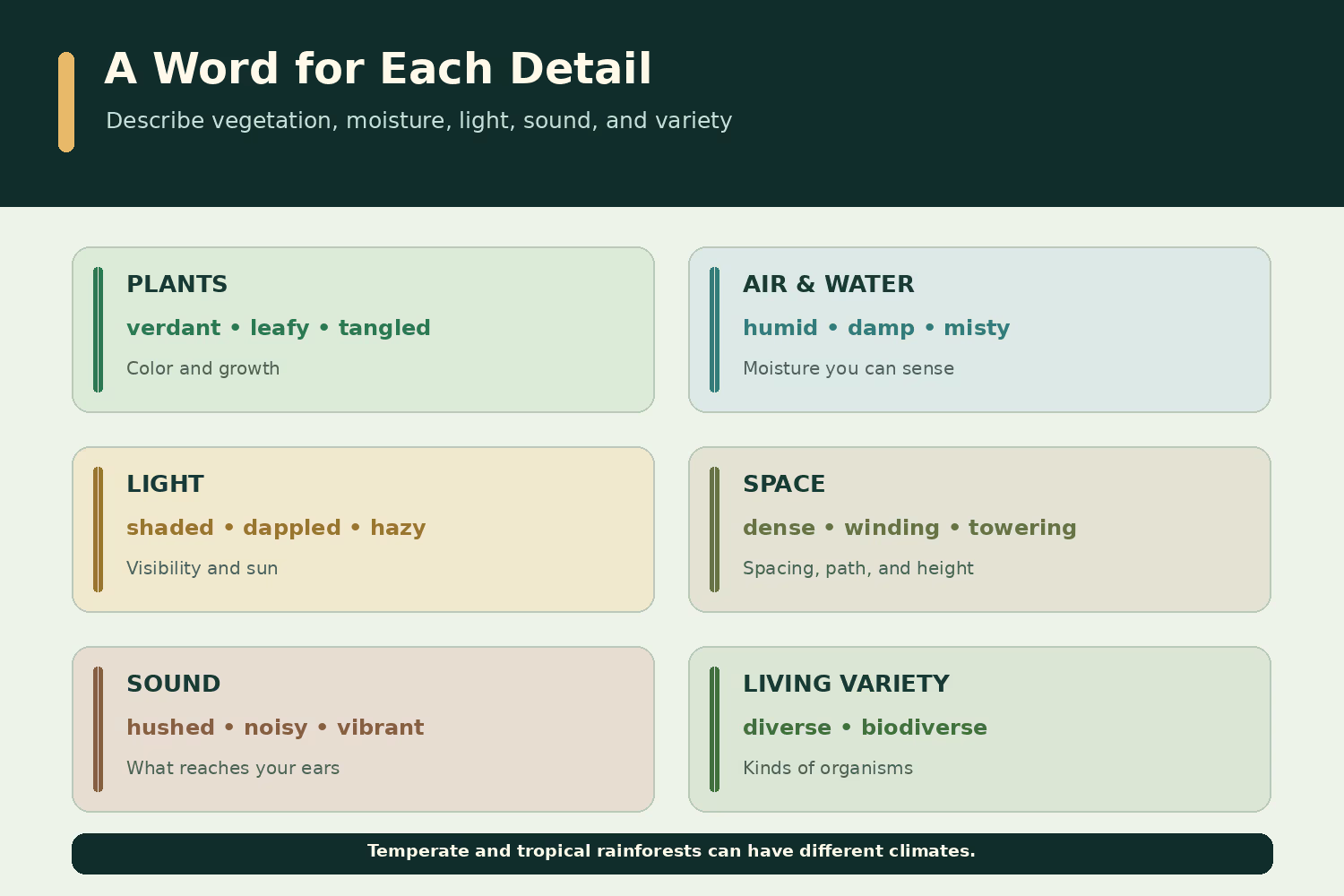
| What you observe | Useful adjectives | What the word tells the reader |
|---|---|---|
| Plant color and growth | verdant, leafy, tangled, luxuriant | Green color, abundant foliage, interwoven growth, or vigorous plant cover |
| Air and water | humid, damp, misty, rain-soaked | Moist air, wet surfaces, visible fine droplets, or recent/heavy rain |
| Light and visibility | shaded, dim, dappled, hazy | Low light, filtered sun patches, or reduced clarity in the distance |
| Space and movement | dense, winding, towering, layered | Close vegetation, a curving trail, great tree height, or distinct levels |
| Sound and feeling | noisy, hushed, vibrant, tranquil | Audible activity or a visitor’s impression; support the mood with details |
| Living variety | diverse, species-rich, biodiverse | A range of living species, rather than simply a large quantity of plants |
These are prompts rather than labels that fit every forest. Rainforests occur in tropical and temperate regions, so temperature, plant communities, and seasonal patterns differ. For example, the USDA Forest Service describes a coastal temperate rainforest in southeast Alaska with cold, wet winters and cool, wet summers. Use tropical, hot, or steamy only when the particular setting supports those details. The Forest Service’s Héen Latinee Experimental Forest profile is one example of a cool-climate rainforest.
Rainforest Layers: Words for Height, Shade, and Texture
For a tropical rainforest scene, moving from the treetops toward the ground can help you choose specific words. A common teaching model describes an emergent layer above the canopy, followed by the understory and forest floor. The layers receive different amounts of sunlight and have different conditions; this is a useful guide, not a claim that every rainforest has four sharply separated shelves.
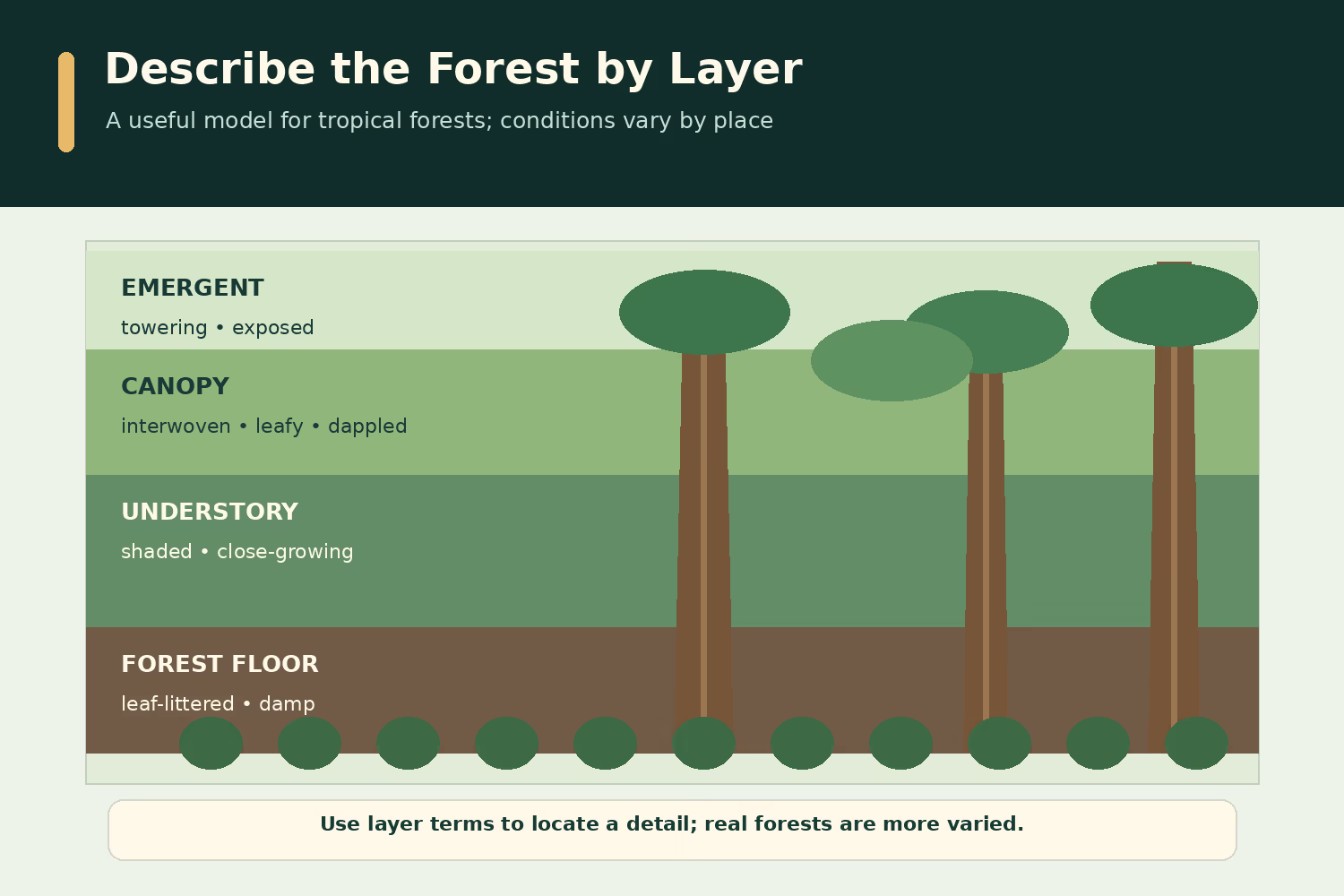
- Emergent trees: towering, exposed, or wind-swept can describe the tallest crowns rising above the canopy.
- Canopy: interwoven, leafy, or sun-dappled may fit overlapping branches, leaves, and filtered light. Epiphytes such as orchids or ferns may grow on branches, but they are not parasites simply because they use a tree for support.
- Understory: shaded, humid, and close-growing can describe lower vegetation beneath a canopy that blocks much of the light.
- Forest floor: leaf-littered, soft, or decomposing is more precise than calling every patch muddy. Ground conditions vary with slope, water, and forest type.
National Geographic Education’s rainforest overview explains this familiar four-layer model and how the canopy changes the conditions below it. Use dense when plants are packed closely together; use lush for abundant healthy growth. Neither word alone tells a reader how much light reaches a particular trail or clearing.
Close Words, Different Meanings
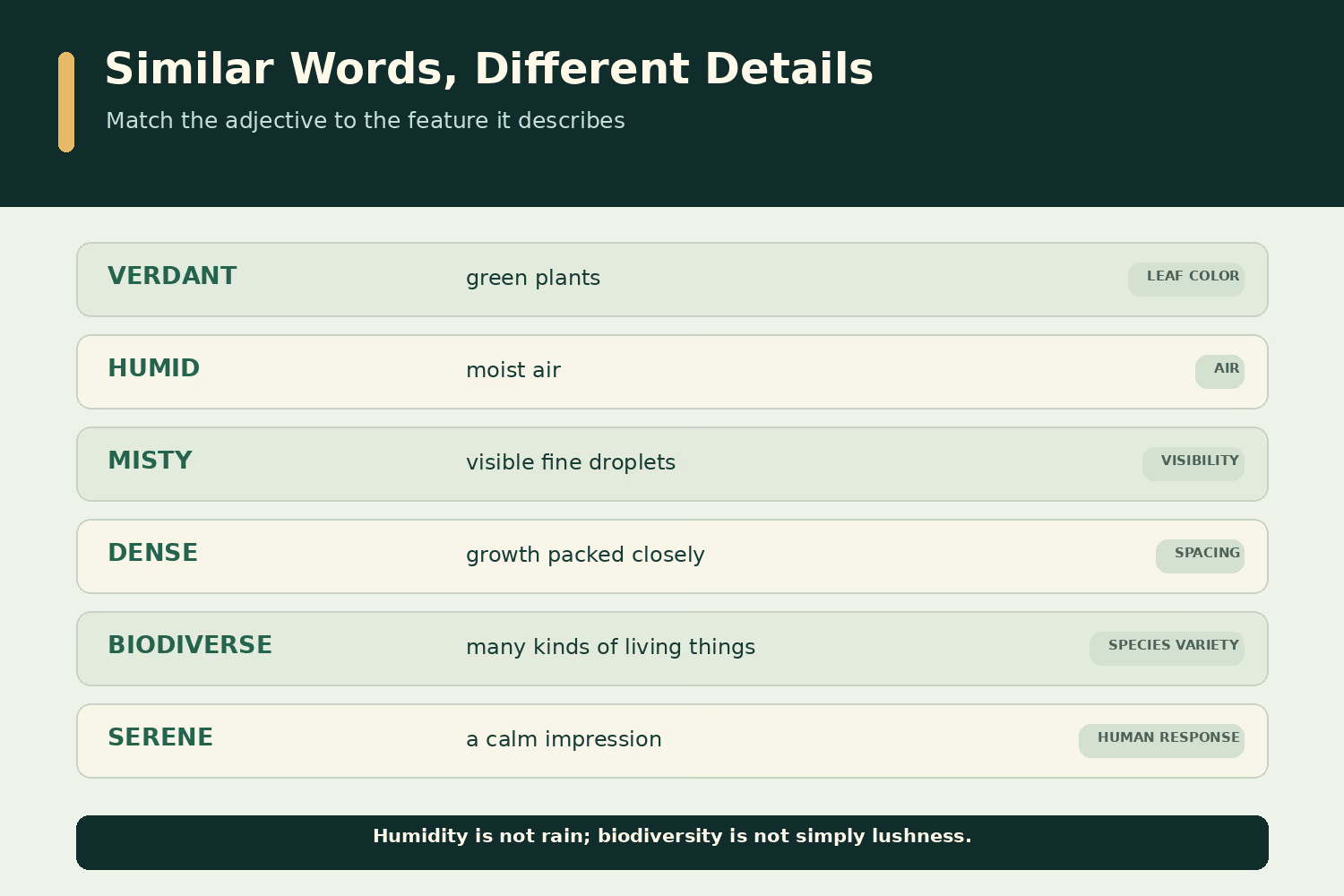
Several rainforest adjectives seem interchangeable until you ask what they actually describe. Choosing the exact word makes a sentence more vivid and less likely to overstate what is there.
| Word | Best used for | Example |
|---|---|---|
| Verdant | Green vegetation or a green landscape | “A verdant bank of ferns edged the stream.” |
| Humid | Moisture in the air | “The humid air fogged the camera lens.” |
| Misty | Fine droplets or low cloud that visibly soften the scene | “Misty air blurred the ridge beyond the trees.” |
| Dense | Vegetation or objects close together | “Dense shrubs narrowed the path.” |
| Biodiverse | A habitat with many kinds of organisms | “The biodiverse forest supports plants, insects, birds, and mammals.” |
| Serene | A calm impression or atmosphere | “The pool looked serene until frogs began calling.” |
Humid does not mean that rain is falling, and misty does not simply mean “wet.” Likewise, biodiverse describes variety among life; it is not a synonym for lush, which emphasizes abundant growth. Tropical rainforest vegetation can look lush even where much of the nutrient supply is held in plants and recycled quickly. The Smithsonian Tropical Research Institute explains this relationship in “Lush, But Fragile.”
Build a More Specific Rainforest Sentence
Start with a broad sentence and replace the general words with observable details. For instance:
General: “The rainforest was beautiful and mysterious.”
More specific: “Dappled light fell across a leaf-littered trail while mist softened the distant canopy.”
The revised sentence does not rely on a reader sharing the writer’s idea of “beautiful.” It names light, ground cover, and visibility. A mood word can still be useful, but pair it with evidence: “The shaded path felt tranquil as rain tapped on broad leaves.” If the scene is busy, the same forest may feel loud or overwhelming instead.
Try this short checklist before choosing the final adjectives:
- Name the setting: tropical or temperate, lowland or upland, trail or river edge—if you know it.
- Choose one visible detail: leaf shape, tree height, vine, flower, or opening in the canopy.
- Add one sensory detail: damp air, bird calls, rain on leaves, or filtered light.
- Separate fact from reaction: “humid” describes the air; “oppressive” describes how someone experiences it.
- Read the sentence aloud: remove repeated ideas, such as calling the same foliage both “lush” and “abundant” without adding a new detail.
Rainforests are not one uniform scene. Their species, weather, light, and ground cover shift by location and elevation. For a broad ecological perspective, National Geographic Education’s rainforest article discusses tropical and temperate forests as well as the layered structure often used to describe tropical rainforest.

Welcome to my article on adjectives for rainforest! As someone who has spent countless hours exploring the lush wonders of these magnificent ecosystems, I am thrilled to share with you a collection of descriptive words that truly capture the essence of the rainforest. From the towering trees to the diverse wildlife, the rainforest is a treasure trove of natural beauty just waiting to be explored through the power of words.
In this article, I’ll provide you with a range of adjectives that will help you paint a vivid picture of the rainforest in your mind. Whether you’re a nature enthusiast, a writer looking to add depth to your descriptions, or simply curious about the wonders of the rainforest, this article is for you. Get ready to immerse yourself in a world of vibrant colors, exotic sounds, and breathtaking scenery as we delve into the fascinating world of rainforest adjectives.
So, grab a pen and paper, or simply bookmark this page, as we embark on a journey through the rainforest, exploring the words that best capture its awe-inspiring beauty. Let’s dive in and discover the perfect adjectives to bring the rainforest to life in your imagination.
How to Describe rainforest? – Different Scenarios
When it comes to describing the rainforest, there are several scenarios that come to mind. Each scenario offers unique aspects to capture the essence of this remarkable ecosystem. Let’s explore some of these scenarios and the adjectives that are best suited to describe them.
- Lush Rainforest
Imagine stepping into a lush rainforest with towering trees, vibrant foliage, and a canopy that blocks out the sunlight. Here are some adjectives to help you paint a vivid picture:
- Verdant: The rainforest is lush and green, with vegetation covering every inch.
- Bountiful: The rainforest is teeming with life, from the plants to the animals that call it home.
- Serene: The rainforest is a tranquil haven, with the sounds of rustling leaves and chirping birds creating a peaceful atmosphere.
- Misty Rainforest
Picture yourself in a misty rainforest, where a thin veil of fog hangs in the air, adding an air of mystery. Use these adjectives to capture the ethereal beauty:
- Enchanting: The misty rainforest has a magical quality that captivates the senses.
- Mystical: The rainforest’s mist creates an otherworldly atmosphere, filled with intrigue and wonder.
- Transient: The mist drifts through the rainforest, creating an ever-changing landscape that is both ephemeral and captivating.
- Vibrant Rainforest
In a vibrant rainforest, colors burst from every corner, showcasing the rich biodiversity of this ecosystem. Consider the following adjectives:
- Exuberant: The rainforest is bursting with vibrant colors, from the vivid flowers to the colorful plumage of exotic birds.
- Kaleidoscopic: The rainforest is a swirling palette of hues, with a multitude of colors blending together harmoniously.
- Electric: The rainforest is alive with energy, its vibrant colors electrifying the senses and sparking the imagination.
- Teeming Rainforest
- Thriving: The rainforest is brimming with life, with diverse species thriving in its dense vegetation.
- Resilient: The rainforest is a symbol of resilience, with its delicate balance of life and survival in a challenging environment.
Describing Words for rainforest in English
When it comes to describing the rainforest, there are countless adjectives that can capture its beauty, diversity, and allure. In this section, I’ll share some descriptive words that will help bring the rainforest to life in your imagination.
- Verdant: The rainforest is known for its lush and verdant landscape, with vibrant greens that stretch as far as the eye can see.
- Bountiful: The rainforest is teeming with life, with an abundance of flora and fauna that create an intricate ecosystem.
- Serene: Walking through the rainforest can evoke a sense of serenity, as you are surrounded by the peaceful sounds of nature.
- Enchanting: The rainforest is truly enchanting, with its towering trees, whimsical flowers, and mysterious creatures.
- Mystical: There’s a certain air of mystery in the rainforest, with its foggy canopies and hidden corners that seem straight out of a fairy tale.
- Exuberant: The rainforest is a place of exuberance, with trees reaching for the sky and colorful birds soaring overhead.
- Kaleidoscopic: The rainforest is a kaleidoscope of colors, with vibrant flowers, iridescent butterflies, and exotic animals.
- Electric: The energy in the rainforest is electric, with the constant buzz of insects and the calls of animals echoing through the trees.
- Thriving: Life thrives in the rainforest, with a remarkable array of plants and animals adapting to its unique and demanding environment.
- Resilient: The rainforest is a testament to resilience, with its ability to withstand storms, droughts, and other challenges.
- Harmonious: The rainforest is a harmonious symphony of sounds, with the chorus of birds, the hum of insects, and the rustling of leaves all coming together.
These are just a few adjectives to describe the enchanting and diverse world of the rainforest. By using these words, you can paint a vivid picture of this extraordinary ecosystem. So, whether you’re a nature enthusiast, a writer, or simply curious about the wonders of the rainforest, I hope these adjectives help you appreciate its beauty and complexity.
Adjectives for rainforest
Positive Adjectives for Rainforest with Twelve Example Sentences
When I think about the rainforest, numerous positive adjectives come to mind. Here are twelve adjectives that vividly capture the beauty and wonder of this incredible ecosystem:
- Verdant – The rainforest is a verdant paradise, with its lush green foliage covering every inch of the forest floor.
- Bountiful – The rainforest is a bountiful source of life, teeming with a diverse array of plants and animals.
- Serene – Walking through the rainforest is a serene experience, as the peaceful sounds of nature surround you.
- Enchanting – The rainforest has a enchanting quality, with its magical atmosphere and hidden wonders waiting to be discovered.
- Mystical – With its misty canopies and ancient trees, the rainforest has a mystical aura that ignites the imagination.
- Exuberant – Life in the rainforest is exuberant, with vibrant colors and constant movement filling every corner of this ecosystem.
- Kaleidoscopic – The rainforest is a kaleidoscopic spectacle of colors, with birds, butterflies, and flowers that display a dazzling array of hues.
- Electric – The rainforest buzzes with an electric energy, as creatures big and small go about their daily activities.
- Thriving – Within the rainforest’s embrace, a thriving community of plants and animals coexist and rely on each other for survival.
- Resilient – The rainforest is a resilient ecosystem, adapting to changing conditions and recovering from disturbances.
- Harmonious – In the rainforest, there is a harmonious balance between all living things, each playing a vital role in maintaining the ecosystem’s health.
- Majestic – The rainforest’s towering trees and magnificent landscapes inspire a sense of awe and wonder, reminding us of the majestic power of nature.
Negative Adjectives for Rainforest with Five Example Sentences
While the rainforest is predominantly a place of beauty and wonder, there are also negative aspects to consider. Here are five adjectives that highlight some of the challenges faced by this ecosystem:
- Threatened – The rainforest is threatened by deforestation, which poses a significant risk to its biodiversity and delicate balance.
- Fragile – Although resilient, the rainforest is also fragile, with many species depending on specific conditions for survival.
- Inaccessible – Certain parts of the rainforest are inaccessible, making it challenging for researchers and explorers to fully understand and study this vast ecosystem.
- Vulnerable – The rainforest is vulnerable to climate change, as changes in temperature and rainfall patterns can have cascading effects on its delicate web of life.
- Endangered – Many species within the rainforest are endangered, facing the risk of extinction due to habitat loss and human activities.
As we reflect on both the positive and negative adjectives, it becomes evident that the rainforest is a complex and fascinating ecosystem. Its beauty and significance cannot be overstated, making it all the more important to appreciate and protect this natural wonder.
Tables
| Adjective | Definition |
|---|---|
| Verdant | Lush green in color; covered in vegetation |
| Bountiful | Abundantly rich; plentiful |
| Serene | Peaceful; calm |
| Enchanting | Captivating; magical |
| Mystical | Having a magical, otherworldly quality |
| Exuberant | Full of energy and excitement |
| Kaleidoscopic | Displaying a wide variety of bright colors |
Synonyms and Antonyms with Example Sentences
Synonyms for rainforest
When it comes to describing the rainforest, there are several synonyms that can be used to capture its beauty and allure. Here are some alternative words you can use:
- Lush: The rainforest is known for its lush vegetation and vibrant colors.
- Verdant: The rainforest is characterized by its verdant landscape, filled with an abundance of plants and trees.
- Teeming: The rainforest is a teeming ecosystem, with a multitude of animal and plant species.
- Exotic: The rainforest is home to many exotic creatures and plants found nowhere else on Earth.
- Majestic: The rainforest exudes a sense of majestic beauty that is awe-inspiring.
Example sentence: As I explored the depths of the rainforest, I was captivated by its verdant canopy and the teeming wildlife that surrounded me.
Antonyms for rainforest
While the rainforest is often described by its positive attributes, it’s important to acknowledge the challenges it faces. Here are some antonyms that highlight the contrasting characteristics:
- Barren: Unlike the rainforest, barren landscapes lack the lushness and abundance of life.
- Deforested: Deforestation has led to the loss of many rainforests, leaving behind deforested areas that are devoid of trees and biodiversity.
- Desolate: Instead of the thriving ecosystem found in the rainforest, desolate areas are isolated and lacking in life.
- Sterile: Unlike the rainforest, which is rich in nutrients and biodiversity, sterile environments lack the necessary components for vibrant life.
- Scarce: In contrast to the rainforest’s abundance, scarce environments have limited resources and sparse vegetation.
Example sentence: The once luscious rainforest now stood as a stark reminder of the damage caused by deforestation, with its scarce vegetation and desolate landscapes.
By using these synonyms and antonyms, you can paint a vivid picture of the rainforest, highlighting its beauty and the challenges it faces.
Conclusion
With its lush foliage, teeming wildlife, and exotic beauty, the rainforest is a captivating and awe-inspiring place. Throughout this article, we have explored a variety of descriptive words that truly capture the essence of this magnificent ecosystem.
From words like “verdant” and “majestic” that convey the vibrant and grandeur of the rainforest, to words like “barren” and “deforested” that depict the challenges faced by this delicate environment, we have delved into the contrasting realities of the rainforest.
By providing these descriptive words, the aim of this article is to help nature enthusiasts, writers, and anyone interested in the wonders of the rainforest to better appreciate its beauty and complexity. Moreover, it serves as a reminder of the need to protect this natural wonder and ensure its preservation for future generations.
Whether you are planning a trip to a rainforest, writing a nature-inspired piece, or simply seeking to expand your vocabulary, these adjectives will undoubtedly enhance your understanding and portrayal of the rainforest’s captivating allure.
So go forth and explore the rainforest, armed with a newfound appreciation for its breathtaking beauty and the importance of its conservation.


