How to Choose an Adjective for Romance
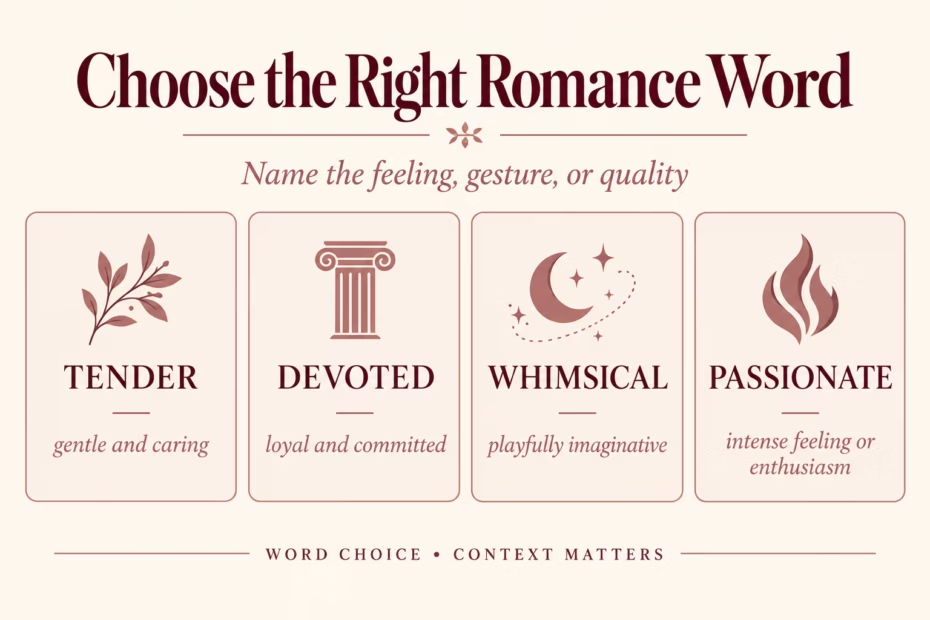
The best adjective for romance names a particular feeling, action, or quality. Tender suggests gentleness; devoted suggests steady commitment; whimsical suggests playful imagination. These words are not interchangeable, and a precise choice gives readers a clearer picture than a string of broad praise. Think about what the sentence describes: a person, a gesture, a relationship, a memory, or the setting.
Romantic Adjectives by Feeling
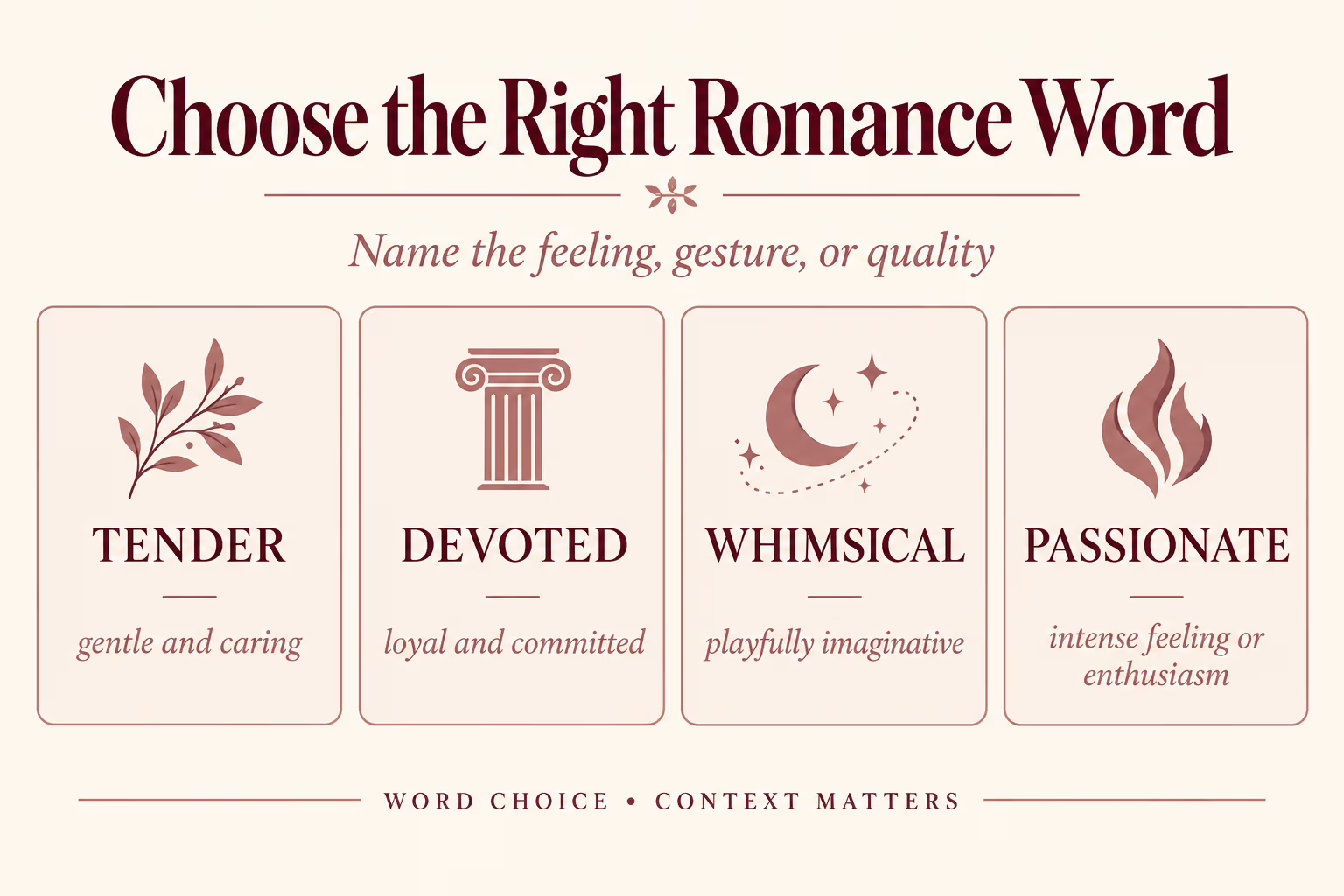
Romantic writing can describe excitement, calm, affection, uncertainty, or sadness. The adjective should fit the moment rather than imply that every relationship follows one pattern.
- Tender: gentle and caring. “He wrote a tender note to thank her for listening.”
- Affectionate: showing fondness or warmth. “Their affectionate greeting was familiar and unhurried.”
- Devoted: strongly committed or loyal. “The novel follows a devoted couple through years of change.”
- Longing: showing a strong desire for someone or something absent. “The letter carried a longing tone.”
- Content: quietly satisfied. “They shared a content silence on the train ride home.”
- Passionate: marked by intense feeling, desire, or enthusiasm. It can describe romance, an argument, or a cause, so surrounding details clarify the meaning. “She gave a passionate defense of the poem.”
- Playful: lighthearted and teasing in a friendly way. “Their playful exchange made the long wait pass quickly.”
- Yearning: filled with a deep, often persistent wish. “A yearning melody returned in the story’s final scene.”
- Heartbroken: deeply sad after a loss or disappointment. “The heartbroken narrator struggles to revisit the old photographs.”
- Unrequited: not returned or reciprocated, especially of love. “The poem describes unrequited affection without blaming either person.”
Adjectives for Gestures, Relationships, and Settings
Not every romance adjective describes an emotion. Some tell readers how a person acts, what the relationship feels like to the speaker, or what a scene looks and sounds like. Mixing these categories can make a description more concrete.
| What you are describing | Useful adjectives | Example |
|---|---|---|
| A caring action | thoughtful, considerate, attentive | “Her thoughtful message arrived before the interview.” |
| A shared connection | supportive, trusting, close | “They built a trusting friendship before they began dating.” |
| A light mood | playful, charming, whimsical | “A whimsical scavenger hunt turned an ordinary afternoon into a story.” |
| A dramatic mood | intense, ardent, fervent | “The ardent speech belonged to the character, not the narrator.” |
| A quiet mood | peaceful, gentle, serene | “A peaceful walk gave them time to talk.” |
| A setting | candlelit, secluded, moonlit | “They chose a candlelit table by the window.” |
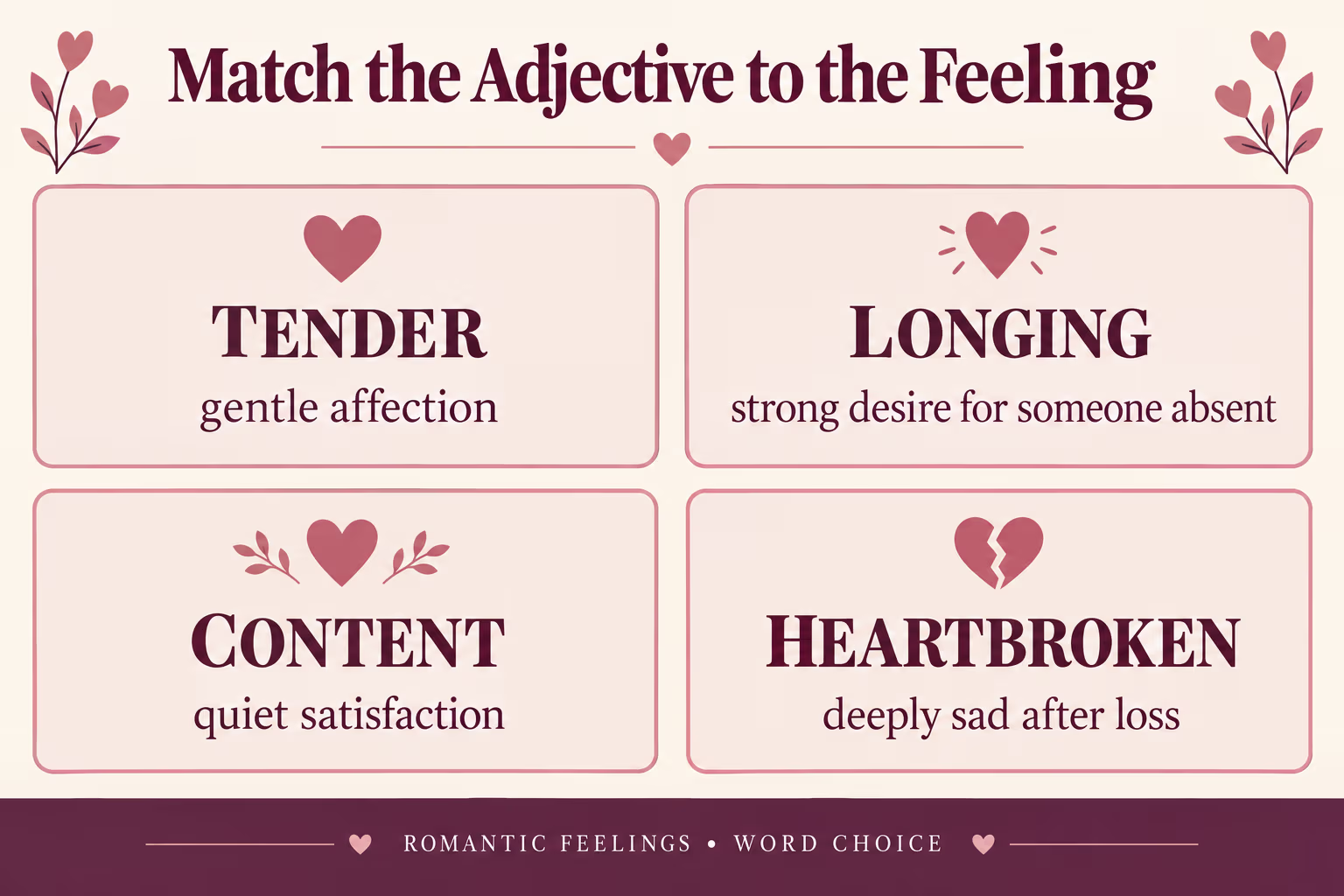
Concrete details help readers understand subjective words. “A beautiful evening” gives an overall impression; “a mild evening with music from the courtyard” shows what made it memorable to the speaker. A scene can be romantic to one person and ordinary to another, so sensory detail often does more than a universal-sounding claim.
Romance, Romantic, and Romantically
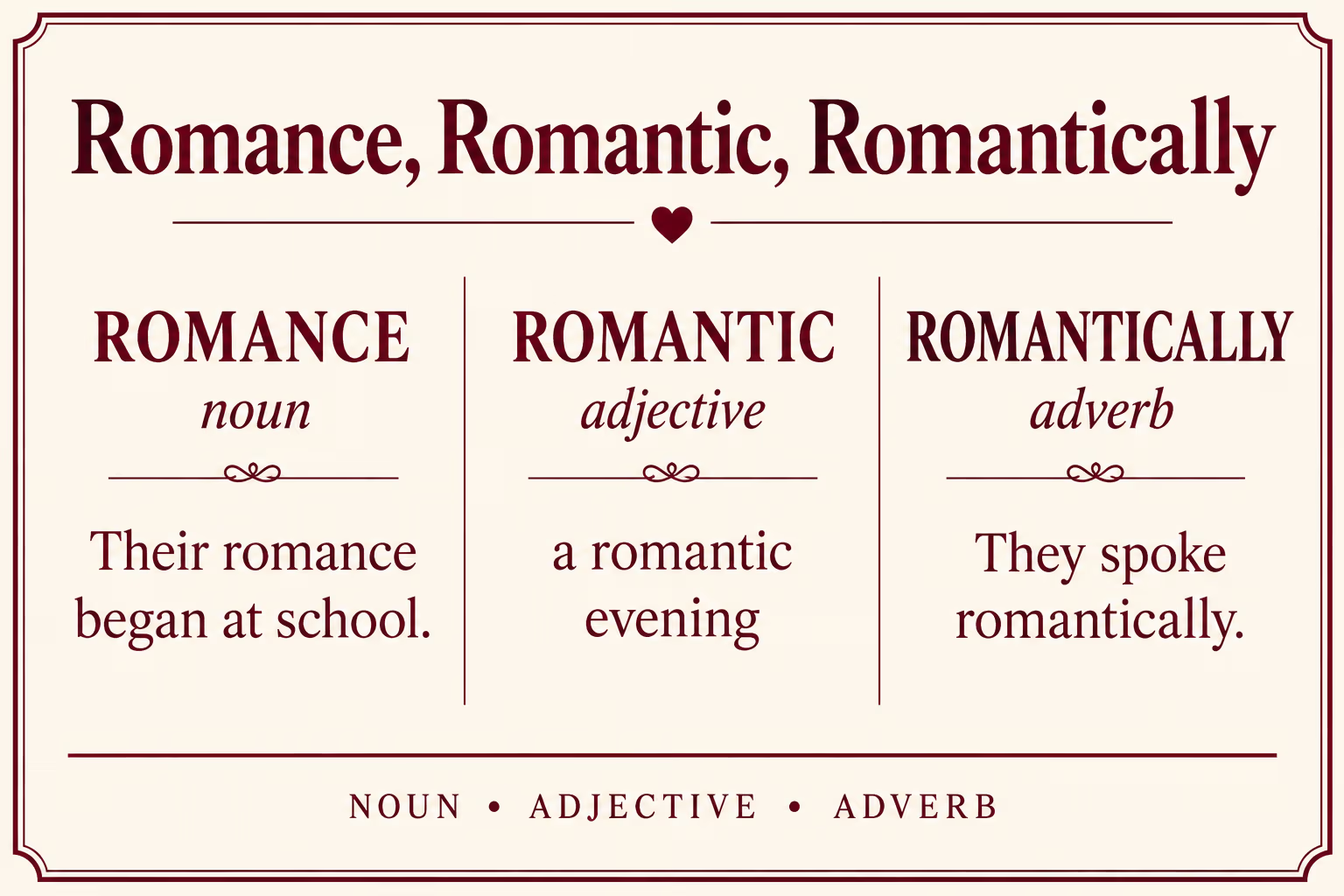
Romance is usually a noun: “Their romance began at school.” It can also name a genre or an idealized account. Romantic is the adjective: “They planned a romantic evening.” Romantically is an adverb describing how an action is done: “The scene was romantically lit.” In a different context, capitalized Romantic can refer to the late eighteenth- and early nineteenth-century artistic movement, so context matters.
Some common adjective patterns are useful when building a sentence:
- Before a noun: “a tender gesture,” “a devoted friend,” “an unrequited crush.”
- After a linking verb: “The ending felt bittersweet,” “Their reunion was joyful.”
- With a preposition: “affectionate toward one another,” “devoted to her partner,” “longing for home.”
Watch for the difference between an adjective and a related noun. Passionate describes a person, feeling, or performance; passion names the feeling itself. Affectionate describes behavior, while affection is the feeling. A quick sentence check can help: if the word describes a noun, an adjective may fit; if it names the feeling or quality, a noun may be needed.
Positive and Difficult Descriptions Need Context
Words such as supportive, considerate, and trusting describe qualities that may be shown through specific behavior. For example, “She respected his decision to spend the evening with friends” gives evidence for considerate. Avoid treating one gesture as proof of a whole relationship or using an adjective as a diagnosis.
Likewise, toxic, controlling, and manipulative are serious labels. In a story analysis, explain which actions support the description. In ordinary conversation, a concrete account such as “he kept checking her messages after she asked him to stop” is clearer than relying on a label alone. Respect, honest communication, equality, and personal boundaries are commonly named features of healthy relationships; no single adjective can establish that a relationship is healthy. People may also express care differently, and their limits deserve respect.
For writing about a difficult ending, choose the word that fits the speaker’s perspective: painful names distress, bittersweet combines sadness with a positive feeling, distant describes a lack of closeness, and disillusioned suggests lost belief or disappointment. The words describe different experiences, not a ranking of whose response is correct.
Examples: Make a Romantic Sentence More Specific
- General: “It was a romantic evening.” More specific: “They shared a candlelit dinner and talked until the restaurant closed.”
- General: “He was passionate.” More specific: “He spoke passionately about the music he had composed.”
- General: “She was supportive.” More specific: “She listened, asked what kind of help he wanted, and followed his lead.”
- General: “Their love was magical.” More specific: “They still laughed about the rainstorm that interrupted their first picnic.”
- General: “The relationship was distant.” More specific: “They had stopped sharing plans and often changed the subject when the future came up.”
Frequently Asked Questions
What are some good adjectives for romance?
Depending on the context, try tender, affectionate, devoted, playful, passionate, supportive, bittersweet, or longing. Choose the one that describes the feeling, action, or setting in your sentence.
Is “romance” an adjective?
Romance is usually a noun, as in “a story of romance.” Romantic is the adjective, as in “a romantic story,” and romantically is the adverb.
What is a stronger word than “romantic”?
There is no single best substitute. Passionate suggests intensity, tender suggests gentleness, devoted suggests commitment, and whimsical suggests playful imagination. Match the word to the meaning you intend.
What is an adjective for unreturned love?
Unrequited describes affection that is not returned. Longing describes a strong desire, while heartbroken describes deep sadness after a loss or disappointment.
Can a romantic scene be sad?
Yes. Romance writing can include longing, uncertainty, grief, or a bittersweet ending. Adjectives describe the scene’s tone; they do not have to imply that every moment is happy.
Sources and Further Reading
- Cambridge Dictionary: romantic (adjective meanings and the distinction between love-related and idealized senses).
- Cambridge Dictionary: romance (noun and other senses of the word).
- American College of Obstetricians and Gynecologists: Healthy Relationships (respect, communication, equality, independence, and boundaries).
- Planned Parenthood: How to Have a Good Relationship (respect, communication, space, and consent).

When it comes to romance, finding the right words to express our feelings can be a challenge. That’s why I’m here to help you discover a treasure trove of adjectives that will bring your romantic descriptions to life. From passionate and enchanting to tender and dreamy, these adjectives will add depth and emotion to your expressions of love. So, whether you’re writing a heartfelt love letter or trying to capture the essence of a romantic moment, these adjectives will be your secret weapon.
Imagine being able to paint a vivid picture of your love with just a few carefully chosen words. With this comprehensive list of adjectives, you’ll be able to do just that. Whether you want to describe the allure of a candlelit dinner or the intensity of a passionate embrace, these adjectives will help you create powerful and evocative descriptions that will make your readers swoon. So, get ready to discover a world of adjectives that will take your romantic writing to the next level.
How to Describe romance? – Different Scenarios
When it comes to describing romance, there are different scenarios that can evoke a range of emotions and experiences. Let’s explore some of these scenarios and the adjectives that can bring them to life:
1. First Love
Adjectives: Exciting, Innocent, Magical, Breathtaking, Nervous
The feeling of first love is like stepping into a whole new world. It’s a mix of excitement, innocence, and magic. Everything feels new and every moment is filled with anticipation. Describing first love as breathtaking captures the sense of awe and wonder that comes with discovering this powerful emotion. It can also evoke a bit of nervousness that often accompanies the beginning of a new relationship.
2. Long-Term Love
Adjectives: Comfortable, Deep, Intimate, Fulfilling, Supportive
Long-term love is built on a solid foundation of trust, understanding, and shared experiences. It’s a love that has weathered the ups and downs of life, and has grown stronger with time. Describing long-term love as comfortable and deep conveys a sense of security and familiarity. It’s a love that feels like home. Intimate and fulfilling capture the emotional connection and satisfaction that comes from being with someone who truly knows you. Supportive reflects the importance of being there for each other through thick and thin.
3. Passionate Love
Adjectives: Fiery, Intense, All-consuming, Electrifying, Sensual
Passionate love is like a burning flame that consumes everything in its path. It’s an intense and electrifying emotion that can make you feel like you’re on top of the world. Describing passionate love as fiery and all-consuming captures the raw energy and overwhelming nature of this kind of love. It’s a love that ignites your senses and takes you on a thrilling journey. Sensual adds an element of physical desire and attraction to the mix.
4. Unrequited Love
Adjectives: Painful, Heartbreaking, Longing, Unfulfilled, Torturous
Describing Words for romance in English
When it comes to romance, it’s all about the emotions, experiences, and connections that we share with someone special. Describing these feelings and moments can be a beautiful way to express the depth of our love and affection. In this section, I’ll highlight some adjectives that can bring romance to life and help you paint a vivid picture of those cherished moments.
First Love – Innocent and Exciting
First love is often a magical and unforgettable experience. It’s a time of innocence and discovery, filled with excitement and anticipation. Here are some adjectives that capture the essence of first love:
- Enchanting: The first love feels like a spellbinding adventure.
- Breathtaking: It takes your breath away and leaves you in awe.
- Blissful: There’s a pure and untroubled happiness that comes with first love.
- Thrilling: It’s an exhilarating rollercoaster ride of emotions.
Long-Term Love – Comfortable and Enduring
As love grows and matures, it transforms into a long-term commitment that withstands the tests of time. Here are some adjectives that describe the beauty of long-term love:
- Steadfast: Love that remains constant and unwavering.
- Deep: It reaches profound depths, developing a strong bond between partners.
- Nurturing: It provides a safe and supportive environment for growth.
- Intimate: A love that is deeply personal and shared on a deep emotional level.
Passionate Love – Fiery and Intense
Passionate love ignites a burning desire and intense connection between two people. Here are some adjectives that capture the fiery nature of passionate love:
- Fiery: The love burns with an intense passion and desire.
- Sensual: It awakens the senses and sparks an undeniable attraction.
- Exhilarating: The love is thrilling and electrifying.
- Consuming: It’s all-consuming, making everything else fade into the background.
- Painful: It’s a love that brings deep sadness and anguish.
Adjectives for romance
When it comes to describing romance, the right adjectives can make all the difference. They add depth and emotion to the words we use to express our feelings. In this section, I’ll explore some positive and negative adjectives for romance and provide example sentences to help you understand their usage. So, let’s dive in!
Positive Adjectives for Romance
Positive adjectives can capture the joy, warmth, and affection that come with being in love. Here are twelve examples:
| Adjective | Definition | Example Sentence |
|---|---|---|
| Blissful | Extremely happy and content | Sarah and Mark spent a blissful evening under the stars. |
| Tender | Gentle, caring, and affectionate | Their tender embrace filled the room with love. |
| Enchanting | Delightfully charming and captivating | The view from the mountaintop was absolutely enchanting. |
| Passionate | Intense and fervent | Their passionate kisses set their hearts on fire. |
| Devoted | Committed and loyal | Emma and James shared a devoted love that stood the test of time. |
| Dreamy | Characterized by a sense of fantasy and imagination | Their dreamy picnic in the park felt like a fairytale. |
| Whimsical | Playfully quaint and fanciful | Their whimsical date at the carnival was filled with laughter. |
| Electrifying | Exciting and exhilarating | The electrifying chemistry between them was undeniable. |
| Radiant | Glowing with happiness and love | Her radiant smile lit up the room whenever he walked in. |
| Breathtaking | Amazingly beautiful and awe-inspiring | The sunset over the ocean was a breathtaking sight to behold. |
| Magical | Extraordinary, as if from a fairy tale | Their wedding day was a truly magical experience. |
| Eternal | Everlasting and never-ending | Their love for each other was eternal, beyond the bounds of time. |
Negative Adjectives for Romance
While romance is often associated with positive emotions, there can be negative aspects too. Here are five example sentences with negative adjectives:
| Adjective | Definition | Example Sentence |
|---|---|---|
| Heartbreaking | Causing great sadness and grief | Their breakup was a heartbreaking experience for both of them. |
| Unrequited | Not returned or reciprocated | Sarah’s unrequited love for John left her feeling unfulfilled. |
| Disillusioned | Disappointed and no longer believing in love | After many failed relationships, Mark became disillusioned with romance. |
| Toxic | Harmful and damaging | Their toxic relationship was filled with constant arguments and negativity. |
| Distant | Emotionally detached and unengaged | They grew apart over the years and became distant from each other. |
By using these adjectives, you can vividly describe the different facets of romance. Whether it’s the euphoria of a blissful love or the pain of a heartbreaking breakup, the right adjectives can paint a picture of the emotions involved. So go ahead, explore these adjectives and let your words bring your own romantic experiences to life.
Synonyms and Antonyms with Example Sentences
Synonyms for Romance
When it comes to describing romance, there are numerous synonyms that can capture the different aspects of love and affection. Here are some synonyms for romance:
| Synonym | Definition |
|---|---|
| Love | A deep affection or strong feeling of tenderness towards someone |
| Passion | An intense and powerful emotion or enthusiasm for something |
| Affection | A gentle feeling of fondness, warmth, and tenderness towards someone or something |
| Amour | A French word for love, often associated with a romantic or passionate relationship |
| Devotion | A deep commitment and dedication to someone or something |
Example Sentences:
- I feel an overwhelming love for my partner.
- Their passion for each other is evident to everyone.
- The affection they share is heartwarming.
- Their amour was a whirlwind of romance and excitement.
- Their devotion to each other is truly inspiring.
Antonyms for Romance
While most people associate romance with positive emotions, there are also antonyms that describe the negative aspects or absence of romance. Here are some antonyms for romance:
| Antonym | Definition |
|---|---|
| Apathy | Lack of interest, enthusiasm, or emotion |
| Indifference | Lack of concern, care, or attention |
| Hostility | Negative feelings or actions towards someone or something |
| Coldness | Lack of warmth or affection |
| Disinterest | Lack of curiosity or involvement |
Example Sentences:
- Their apathy towards each other is affecting their relationship.
- The indifference in their actions shows a lack of romance.
- Hostility has replaced the love they once had.
- The coldness in their interactions is palpable.
- His disinterest in the relationship is causing strain.
By incorporating these synonyms and antonyms into our descriptions, we can create a more vivid and encompassing portrayal of romance.
Conclusion
In this article, I have explored the various adjectives that can be used to describe romance. By using a diverse range of adjectives, we can paint a more vivid and nuanced picture of love and affection. From synonyms like “love,” “passion,” and “affection,” to antonyms like “apathy” and “indifference,” these words allow us to capture the different aspects of romance.
By incorporating these adjectives into our descriptions, we can create more engaging and captivating narratives. Whether we want to express the intensity of a passionate love affair or the tenderness of a nurturing relationship, the right adjectives can bring our words to life.
Remember, adjectives are powerful tools that can enhance our writing and evoke emotions in our readers. So, the next time you want to describe romance, consider the adjectives that best capture the essence of the story you want to tell.
By expanding our vocabulary and exploring the full range of adjectives available to us, we can elevate our writing and create more compelling narratives. So, go ahead and experiment with different adjectives to add depth and richness to your descriptions of romance.


