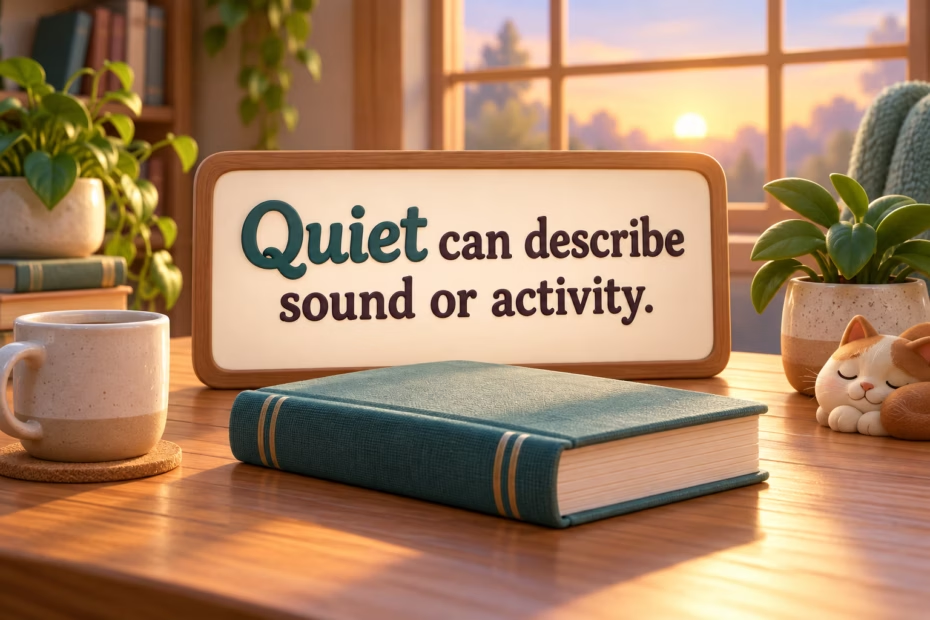
The word silence can refer to an absence of sound, a pause in conversation, or a lack of response. The best adjective depends on which sense you mean. A room may be quiet because little sound is audible; a pause may feel awkward because of the social moment; a narrator may call it eerie to convey a personal impression. These words describe different parts of a scene, so choose the one that matches the evidence in your sentence.
Silence, silent, and quiet: a quick distinction
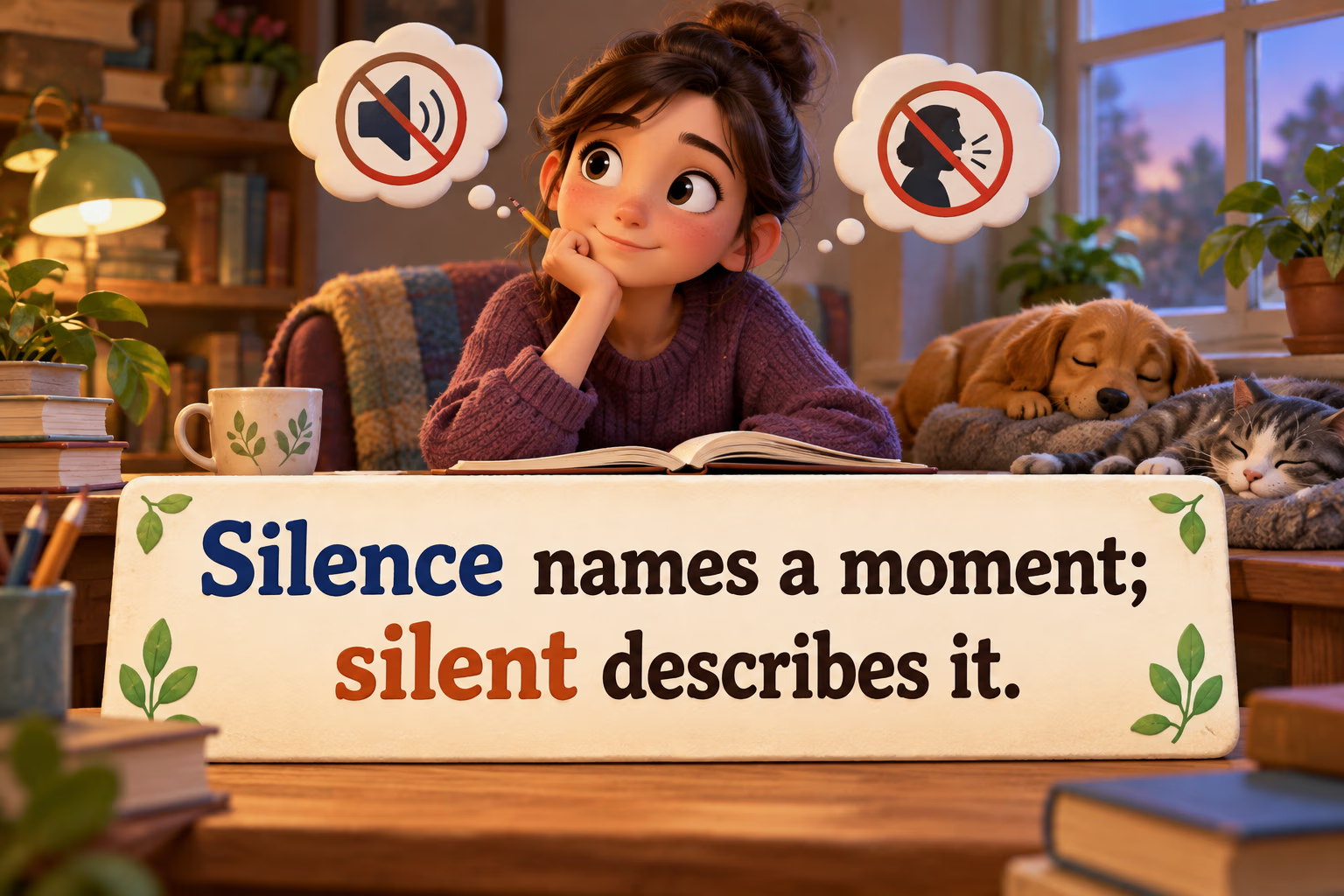
Silence is a noun: it can name a period with no sound, a period when nobody speaks, or an absence of communication. Silent is an adjective that describes a person, place, device, or event without sound or speech. Quiet can describe little noise, activity, or excitement, and it can also be a noun meaning a state of quiet. For example, “The room fell silent” describes the room; “a moment of silence” names the interval. Cambridge Dictionary lists both the no-sound and no-speaking senses of silence, and its entry for quietness includes low noise, activity, and speech.
Adjectives for silence often describe one of three things: the sound level (hushed, soundless), the scene or its pace (still, restful), or a person’s interpretation (tense, eerie). Keep those roles clear. A silent room does not by itself prove that anyone feels peaceful, frightened, or uncomfortable.
Choose an adjective that fits the scene
Begin with an observable detail: no voices, faint traffic, an unanswered question, or a pause before a performance. Then decide whether your adjective reports that detail or interprets its effect. “The library was hushed” points to low sound; “the pause felt tense” names a reaction. Words such as deafening and dead are often figurative intensifiers, not literal measurements of sound.
| What you want to describe | Useful choices | Example |
|---|---|---|
| Little or no audible sound | quiet, hushed, soundless, noiseless | “A hushed gallery let visitors focus on the paintings.” |
| A steady, peaceful setting | still, calm, restful, serene | “The still garden was quiet before sunrise.” |
| The feel or length of a pause | awkward, expectant, uncomfortable, long | “An awkward pause followed the question.” |
| A narrator’s interpretation | eerie, tense, reverent, suspenseful | “The writer described the empty corridor as eerie.” |

Note on the original word lists: The “positive” and “negative” labels describe possible reactions, not fixed qualities of silence. Some listed “adjectives,” including tranquility, are nouns; the “synonyms” group related ideas such as mood and stillness rather than interchangeable words. The “antonyms” vary by sense: noise contrasts with no sound, while speech or conversation contrasts with not speaking. Some entries describe a scene or reaction rather than a direct opposite. The source’s first-person statement about the author’s interest in silence has not been independently verified.
Silence is a powerful force that can speak volumes without uttering a single word. As a writer, I’ve always been fascinated by the different ways we can describe silence and the emotions it evokes. In this article, I’ll be exploring a variety of adjectives that can be used to paint a vivid picture of silence, along with examples to illustrate their usage.
From the tranquil hush of a peaceful morning to the deafening stillness of an abandoned room, silence can take on many forms. It can be eerie and unsettling, or it can be comforting and serene. By using the right adjectives, we can bring the essence of silence to life on the page, allowing readers to experience its power firsthand.
So, whether you’re a writer looking to enhance your descriptions or simply someone who appreciates the beauty of silence, join me as we dive into the world of adjectives for silence. Together, we’ll uncover the perfect words to capture the essence of silence and create a truly immersive reading experience.
How to Describe silence? – Different Scenarios
Silence can be described in various ways, depending on the context and the emotions it evokes. Let’s explore some different scenarios and the adjectives we can use to vividly describe silence.
1. Peaceful Silence
- In a serene forest, the silence surrounds me like a warm embrace.
- The tranquil silence of a sleeping baby fills the room with calmness.
- As I stood on the mountaintop, the silence was pure and unbroken, giving me a sense of serenity.
2. Eerie Silence
- The abandoned house was cloaked in an eerie silence, sending chills down my spine.
- In the pitch-black night, the silence was deafening, intensifying the feeling of unease.
- The eerie silence of the graveyard made me feel as if I was being watched by unseen eyes.
3. Awkward Silence
- After my embarrassing blunder, an awkward silence hung in the air, making me wish for a hole to swallow me up.
- As I sat at the dinner table with my ex, the silence between us spoke volumes, highlighting the tension between us.
- In the classroom, the silence that followed my teacher’s question filled me with anxiety as I desperately searched for an answer.
4. Anticipatory Silence
- The anticipation filled the room, and for a moment, there was a tangible silence as everyone held their breaths.
- The silence before the performance was electric, creating a sense of excitement and expectation.
- As I waited for the results, the silence was deafening, amplifying my anticipation and nerves.
5. Reverent Silence
- As the choir sang, the silence in the church was profound, a tribute to the reverence of the moment.
- The silence at the museum allowed me to truly appreciate the beauty and intricacy of the artwork.
- In the presence of nature’s majesty, the silence in the grand canyon was awe-inspiring, reminding me of my smallness in the world.
Describing silence in different scenarios can add depth and emotion to your writing. By carefully choosing the right adjectives, you can create a more immersive reading experience, allowing your readers to fully visualize and feel the silence in their minds.
Remember, silence is a powerful tool that can convey a multitude of emotions. Experiment with different adjectives and observe the impact they have on the reader.
Describing Words for silence in English
Silence can be a powerful tool in storytelling and description. Choosing the right adjectives to express silence can create a more immersive reading experience. In this section, I’ll explore a variety of adjectives that can effectively describe silence in different scenarios. Let’s take a closer look:
Peaceful Silence
- Tranquil
- Serene
- Calm
- Still
- Quiet
- Hushed
- Muted
In peaceful settings, these adjectives evoke a sense of tranquility and calmness, allowing the reader to imagine themselves in a serene environment.
Eerie Silence
- Haunting
- Spooky
- Uncanny
- Creepy
- Chilling
- Oppressive
When describing eerie silence, these adjectives create a sense of unease and foreboding, setting the stage for a suspenseful or mysterious atmosphere.
Awkward Silence
- Uncomfortable
- Tense
- Embarrassing
- Stifling
- Constricting
In social situations, these adjectives reflect the discomfort and tension that can arise during moments of awkward silence, making the reader empathize with the characters involved.
Anticipatory Silence
- Taut
- Suspenseful
- Expectant
- Nervous
- Charged
These adjectives describe the silence that builds up before something significant happens, creating a sense of anticipation and heightening the reader’s curiosity.
- Sacred
- Holy
- Reverential
- Respectful
- Devotional
When depicting solemn or sacred moments, these adjectives convey a deep sense of reverence and respect, emphasizing the importance of the silence in the scene.
Remember, choosing the right adjectives is crucial for creating an engaging and immersive reading experience. By carefully selecting descriptive words, we can bring silence to life on the page and captivate our readers. In the next section, we’ll explore more examples and scenarios where adjectives for silence can be effectively utilized.
Adjectives for silence

Positive Adjectives for silence with 12 Example Sentences
When it comes to describing silence, there are several positive adjectives that can vividly depict the quietness and serenity of a situation. Here are some examples of positive adjectives for silence:
| Adjective | Example Sentence |
|---|---|
| Peaceful | The calm lake was enveloped in peaceful silence. |
| Tranquil | The forest was filled with tranquil silence. |
| Serene | The garden was bathed in serene silence. |
| Harmonious | The choir’s voices faded into harmonious silence. |
| Calm | The ocean waves lulled me into a calm silence. |
| Soothing | The soft lullaby put the baby into a soothing silence. |
| Restful | The hammock swayed gently, creating a restful silence. |
| Meditative | The monk sat in quiet contemplation, enjoying the meditative silence. |
| Tranquility | As I closed my eyes, a sense of tranquility surrounded me in silence. |
| Hushed | The gallery was filled with a hushed silence as visitors admired the artwork. |
| Placid | The lake’s placid surface mirrored the peaceful silence around it. |
| Still | The night was still, its silence broken only by the rustle of leaves. |
Negative Adjectives for silence with 5 Example Sentences
While silence can often be comforting, there are times when it can also feel uncomfortable or unsettling. Here are some negative adjectives that can describe silence in those situations:
| Adjective | Example Sentence |
|---|---|
| Awkward | The silence between them grew awkward and tense. |
| Oppressive | The heavy silence in the room was oppressive. |
| Uncomfortable | The awkward silence made everyone feel uncomfortable. |
| Eerie | The eerie silence of the abandoned house sent shivers down my spine. |
| Tense | The tense silence hung in the air, filled with anticipation. |
Choosing the right adjectives for silence can greatly enhance the reading experience and create a more immersive environment for the readers. Whether it’s conveying peacefulness or unease, selecting the appropriate adjectives helps paint a vivid picture in the reader’s mind. By understanding the nuances of silence and utilizing the right adjectives, we can effectively captivate our readers and bring our writing to life.
Synonyms and Antonyms with Example Sentences
Synonyms for silence
When it comes to describing silence, there are several synonyms that can be used to vividly depict this concept. Here are some examples:
- Quietness – The quietness of the room was unnerving.
- Stillness – I could hear nothing but the stillness of the night.
- Hush – The hush that fell over the crowd was deafening.
- Serenity – The serenity of the empty beach was soothing.
- Peace – The moment was filled with a sense of peace and tranquility.
Antonyms for silence
On the other hand, if you want to convey the opposite of silence, there are antonyms that can be used to add contrast to your writing. Consider these examples:
- Noise – The noise of the city drowned out any chance of silence.
- Commotion – The commotion in the classroom made it impossible to concentrate.
- Chatter – The chatter of the birds filled the air with life.
- Racket – The racket from the construction site was unbearable.
- Bustle – The bustle of the busy street never ceased.
By using these synonyms and antonyms for silence, you can add depth and nuance to your descriptions. Remember to choose the right word depending on the context and the atmosphere you want to create.
| Synonym | Example Sentence |
|---|---|
| Quietness | The quietness of the library allowed me to focus on my reading. |
| Stillness | In the stillness of the forest, I could hear the rustling of leaves under my feet. |
| Hush | The baby fell asleep to the gentle hush of his mother’s voice. |
| Serenity | Walking by the lake brought me a sense of serenity and peace. |
| Peace | The professor’s calming voice created an atmosphere of peace during the lecture. |
| Antonym | Example Sentence |
|---|---|
| Noise | The loud noise from the construction site disrupted my concentration. |
| Commotion | The children’s commotion in the classroom made it difficult to teach. |
| Chatter | The pleasant chatter of the coffee shop added to the cozy ambiance. |
| Racket | The neighbor’s party created a constant racket late into the night. |
| Bustle | The bustle of the market delighted my senses with its vibrant energy. |
Conclusion
Describing silence can be a powerful tool in writing, allowing us to create vivid and immersive experiences for our readers. Throughout this article, we have explored the impact that different adjectives can have on our descriptions of silence.
By carefully selecting positive and negative adjectives, we can add depth and nuance to our writing. Whether we choose to use words like “serene” and “tranquil” to evoke a sense of peace, or words like “oppressive” and “deafening” to convey a feeling of tension, the right adjectives can bring our descriptions to life.
Understanding the nuances of silence and utilizing the appropriate adjectives can captivate readers and transport them into the world we have created. It allows us to paint a more vivid picture, engaging their senses and emotions.
So, the next time you find yourself trying to describe silence, remember the power of adjectives. Choose them wisely, and watch as your writing comes alive, leaving a lasting impact on your readers.
Are these words true synonyms and antonyms?
Some words in the source lists overlap with silence, but they are not interchangeable in every sentence. Hush can name a quiet state or a request to be quiet; stillness may emphasize a lack of movement as well as sound; serenity adds a sense of calm. Treat these as context-dependent alternatives, not exact replacements. The Cambridge Thesaurus groups terms such as quiet, stillness, and hush near silence, while also listing words connected to speech and reserve.
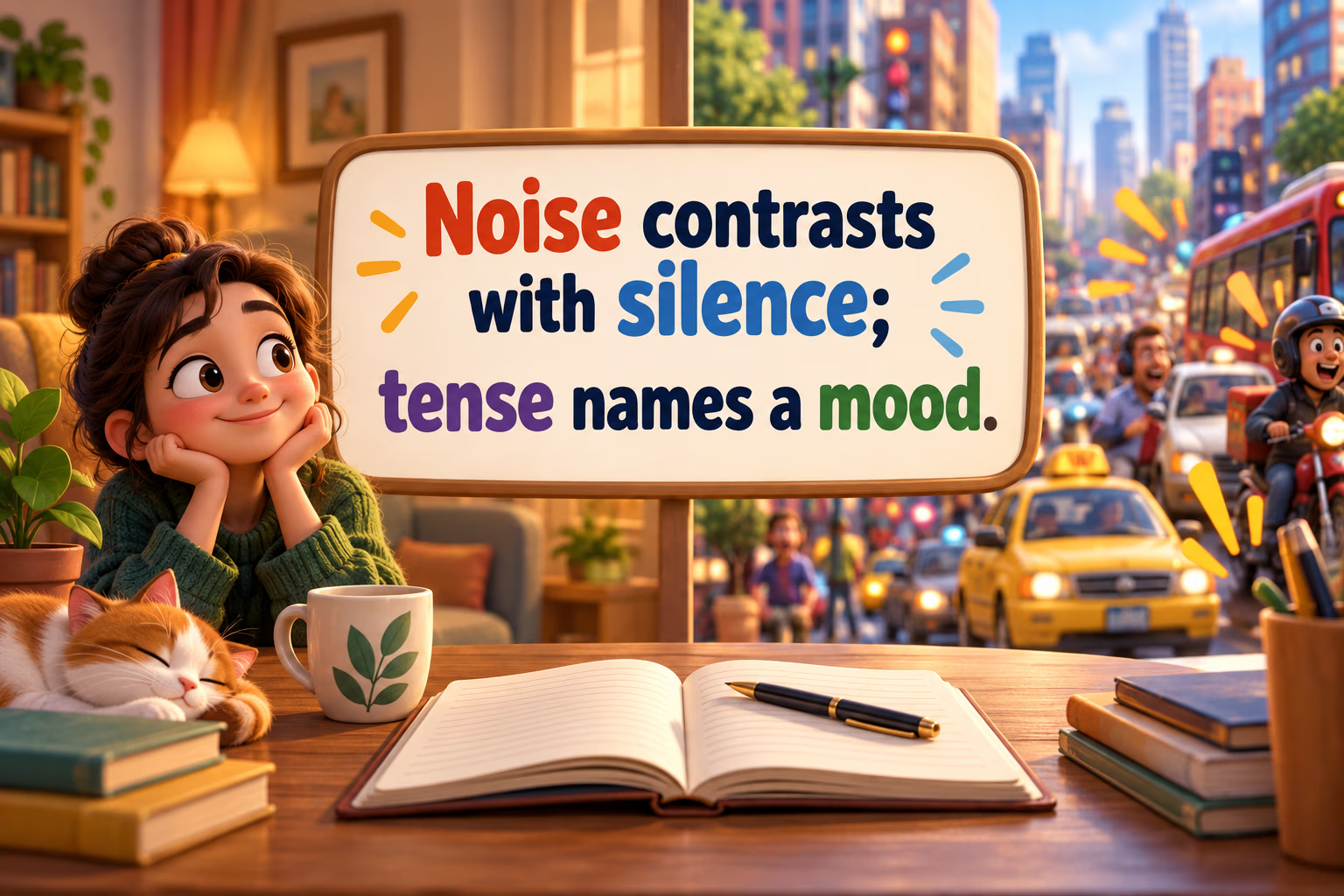
For the absence-of-sound sense, noise and sound are clear contrasts. For the no-speaking sense, speech or conversation may be the relevant opposite. Tense, awkward, and eerie are not antonyms of silence; they describe a mood or response that a silent moment might create. Likewise, words like peaceful and restful express an interpretation rather than an acoustic measurement.
Sources and further reading
- Cambridge Dictionary: silence (no-sound, no-speaking, and communication senses).
- Cambridge Dictionary: quietness (low noise, activity, or speech).
- Cambridge Thesaurus: silence (related words and context-dependent contrasts).
- Cambridge Dictionary: quiet (adjective and noun uses).


