Speech adjectives work best when they name what you mean: the sound and delivery, the message and its structure, or a listener’s impression. “Measured delivery,” “analytical argument,” and “engaging to the audience” describe different things. Accent and dialect are language varieties, not defects.
What Does a Speech Adjective Describe?
Before choosing an adjective, identify its target. Some words describe audible delivery; others evaluate what a speaker says, how the ideas are organized, or how an audience responds. This distinction makes a description more specific and avoids treating an opinion about a speaker as an objective fact.
| Target | Useful adjectives | Example |
|---|---|---|
| Audible delivery | measured, rapid, soft-spoken, resonant, monotone, clear | “She used a measured pace and paused after each key point.” |
| Message or reasoning | analytical, concise, persuasive, evidence-based, misleading | “The persuasive argument cited survey results and addressed a likely objection.” |
| Organization | well-structured, focused, repetitive, rambling | “The talk felt rambling because it returned to the same point without signaling a transition.” |
| Audience response or impression | engaging, dull, moving, inspiring, authoritative | “Several audience members described the personal story as moving.” |
These categories can overlap, but they are not interchangeable. A confident-sounding delivery does not prove that a claim is true; a persuasive structure does not mean every listener will be persuaded. When using impression words such as engaging, dull, or inspiring, name whose response you are reporting and, when useful, what prompted it.

Describe Delivery With Observable Features
For a speech or presentation, you can describe speaking rate, pauses, volume, pitch variation, articulation, and the flow of speech. For example, rapid describes speed, soft-spoken describes relative volume, and monotone describes limited variation in pitch. A pause can be deliberate, so it should not automatically be called hesitant. The right choice depends on the situation: a quiet voice may fit a small room, while a larger room may call for more projection.
“Clear” should also identify what was clear and to whom: a speaker may articulate carefully, while a particular listener may still need a different format, sound level, pace, or context. Describe the observed feature or communication need instead of making a broad judgment about a person.
Separate the Message From Its Sound
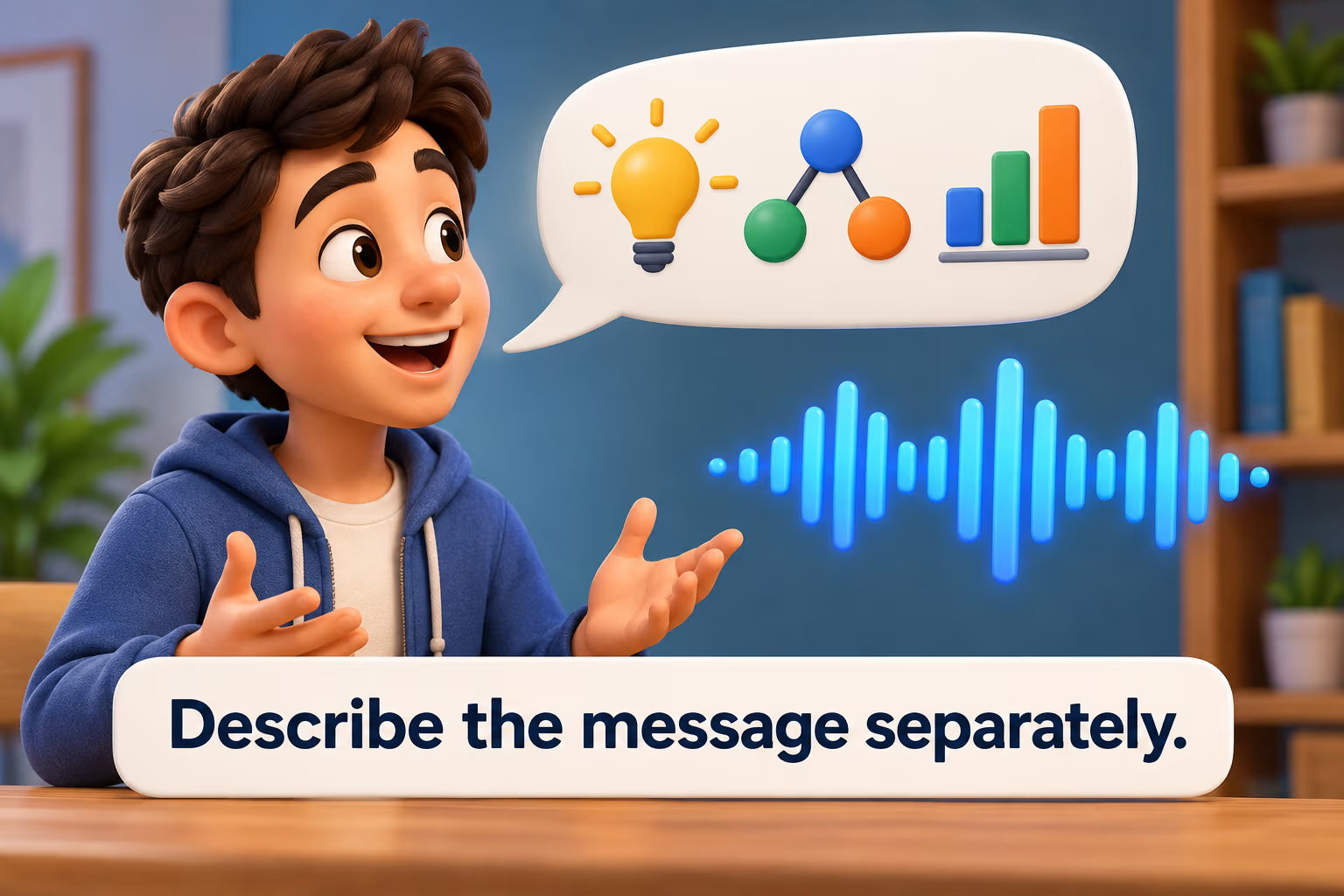
Words such as analytical, thought-provoking, and persuasive usually describe ideas, reasoning, or an intended effect. Factual and misleading concern claims and evidence: call a statement misleading only when you can explain the relevant omission, error, or framing. Rambling usually evaluates organization—for example, repetition or unclear transitions—rather than volume or accent. A useful description can name both dimensions: “The speaker used a calm delivery, but the explanation omitted the study’s limitations.”
Use Audience Impressions With Care
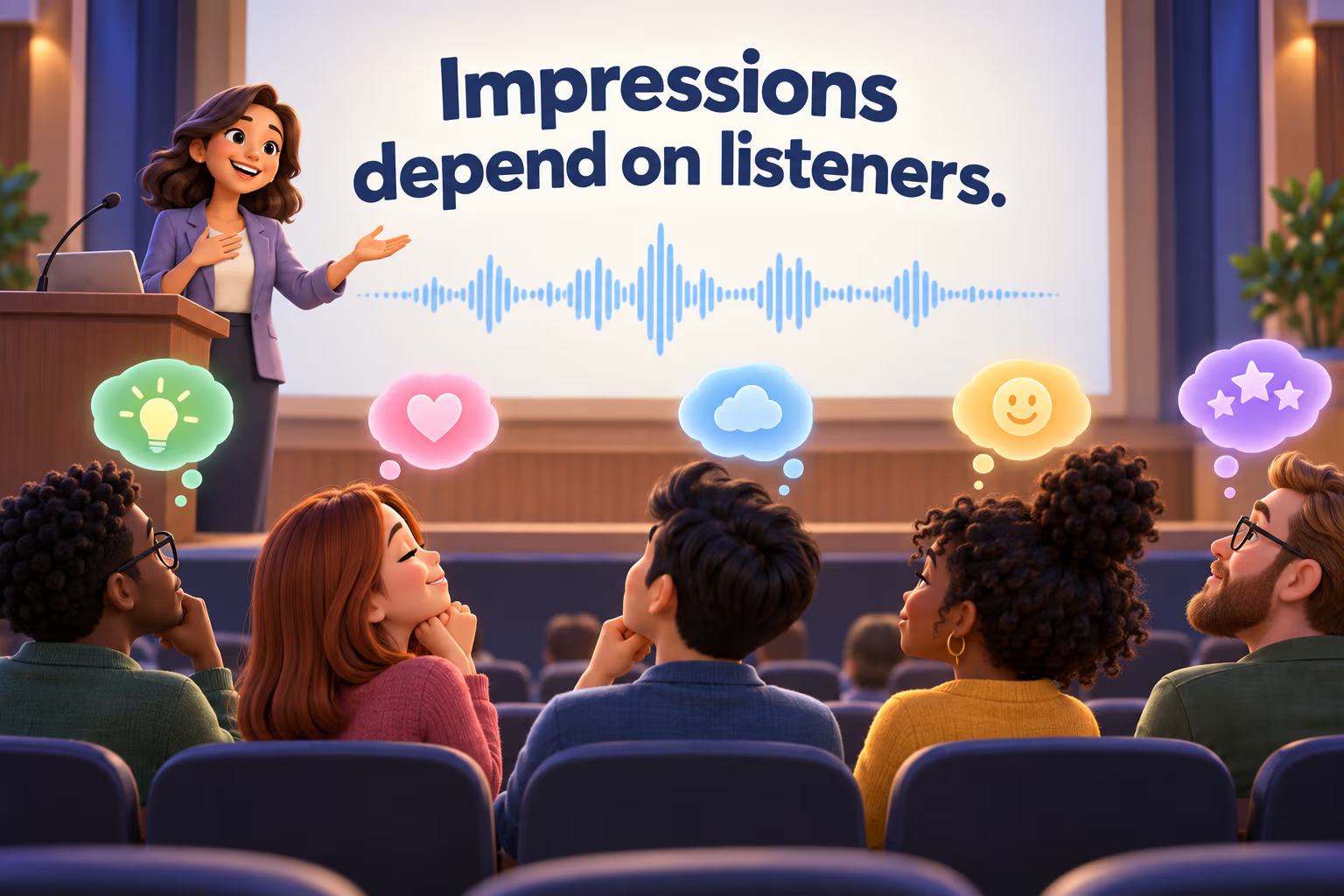
Engaging, dull, inspiring, charismatic, and authoritative often express how one or more listeners interpret a talk. Reactions differ with audience, purpose, topic, setting, and personal experience. Ground a judgment in a response (“the audience asked follow-up questions”) or attribute it (“some listeners found the story inspiring”) instead of presenting it as a universal trait of the speaker.
Accent and Dialect Are Not Speech Defects
Every speaker has an accent, and dialects are systematic language varieties associated with communities and histories. A regional or social dialect is not inherently incorrect, and an accent or dialect that is unfamiliar to a listener is not, by itself, evidence of a speech or language disorder. Avoid using labels such as bad, broken, or defective for a person’s accent or dialect. If a specific communication context calls for discussion of intelligibility, describe the listener’s particular difficulty and setting; do not treat a language variety or identity as the problem. The American Speech-Language-Hearing Association explains these distinctions in its guidance on accent modification and American English dialects.
Are “Silence,” “Mumble,” and “Stutter” Antonyms of Speech?
Not exactly. The original section below calls these words “antonyms for speech,” but they are contrasts or related terms rather than direct antonyms of the noun speech. Silence can mean the absence of spoken sound in a particular moment; mumble and mutter describe ways of speaking; and stutter and stammer refer to speech patterns or disfluency. They do not mean the same thing as “the opposite of speech.” Use speech synonyms such as address, discourse, talk, or lecture when you mean a spoken presentation.
The source’s “negative adjectives” also describe different targets: deceptive evaluates the message, dull reports an impression, and muddled or incoherent may refer to ideas that are hard to follow. Keep these labels tied to specific evidence and avoid turning criticism of one speech into a judgment about the speaker’s identity or worth.
Quick Questions About Speech Adjectives
What adjectives describe the way a person speaks?
For observable delivery, try measured, rapid, soft-spoken, resonant, or monotone, and explain the feature you noticed. Choose a word that fits the context rather than ranking every voice against one preferred style.
Is “persuasive” an adjective for speech or content?
It most often describes the argument’s intended effect or how an audience responds, rather than a measurable sound quality. A speaker can deliver a persuasive message in many different vocal styles.
Can I call an accent incorrect or poor?
Do not use those labels for accent or dialect. If a particular listener had difficulty understanding a particular word in a particular setting, report that specific communication event without treating the speaker’s language variety as defective.
Are mumble and stutter antonyms of speech?
No. They refer to ways speech may be produced; silence can describe an absence of spoken sound. They contrast with speaking in some contexts but are not direct opposites of the noun speech.
Have you ever struggled to find the right words to describe someone’s speech? Whether you’re a writer, a public speaker, or just someone who appreciates the power of language, having a diverse vocabulary to describe speech can make all the difference. In this article, I’ll be sharing a comprehensive list of adjectives that you can use to describe different types of speech, along with examples to help you understand how to use them effectively. From passionate and persuasive to hesitant and monotonous, the way we speak can convey a wide range of emotions and characteristics. By using descriptive adjectives, you can paint a vivid picture of someone’s speech, capturing its nuances and impact. Whether you’re looking to add depth to your writing or simply want to be more articulate in your conversations, these adjectives will prove to be invaluable tools in your linguistic arsenal. So, if you’re ready to elevate your descriptive skills and bring your descriptions of speech to life, let’s dive into the world of adjectives for speech and explore the various ways we can capture the essence of communication.How to Describe speech? – Different Scenarios
Describing speech is an important skill that allows us to effectively convey the nuances and impact of someone’s words. By using descriptive adjectives, we can paint a vivid picture of how someone speaks in various scenarios. Let’s explore different scenarios and the adjectives that can be used to describe speech in each context:- Casual Conversations:
- Formal Presentations:
- Emotional Discussions:
- Intellectual Debates:
- Inspirational Speeches:
Describing Words for speech in English
As a language expert, I believe that having a diverse vocabulary is crucial when it comes to describing speech. It enables us to capture the nuances, tone, and impact of the words being spoken. Whether it’s casual conversations, formal presentations, emotional discussions, intellectual debates, or inspirational speeches, using the right adjectives can enhance our ability to effectively convey someone’s speech.| Words for Casual Conversations | Examples |
|---|---|
| Friendly | “Her speech was friendly and warm.” |
| Laid-back | “He spoke in a laid-back manner, making everyone feel at ease.” |
| Upbeat | “The conversation was filled with upbeat and energetic words.” |
| Words for Formal Presentations | Examples |
|---|---|
| Professional | “His presentation was professional and polished.” |
| Articulate | “She delivered a speech with articulate precision.” |
| Authoritative | “His voice carried an authoritative tone throughout the presentation.” |
| Words for Emotional Discussions | Examples |
|---|---|
| Passionate | “She spoke passionately about the cause close to her heart.” |
| Empathetic | “His words were empathetic, bringing comfort to those in need.” |
| Intense | “The discussion became intense as emotions ran high.” |
| Words for Intellectual Debates | Examples |
|---|---|
| Cerebral | “The debate was filled with cerebral arguments and insightful points.” |
| Thought-provoking | “His speech was thought-provoking, challenging our preconceived notions.” |
| Analytical | “They approached the debate with an analytical mindset, dissecting every argument.” |
| Words for Inspirational Speeches | Examples |
|---|---|
| Motivational | “His inspiring speech was motivational, urging everyone to pursue their dreams.” |
| Uplifting | “Her words were uplifting and instilled a sense of hope in the audience.” |
| Empowering | “He delivered an empowering speech, encouraging people to believe in their abilities.” |
Adjectives for speech
Speech is a powerful and versatile tool for communication. The choice of words and the tone we use can greatly impact how our message is received. As a writer and communicator, I understand the importance of using descriptive adjectives to accurately portray speech in various situations. In this section, I will explore positive and negative adjectives that are commonly used to describe speech, along with example sentences.Positive Adjectives for Speech
When it comes to describing speech in a positive light, we have a range of adjectives that can be used. These adjectives not only highlight the speaker’s effectiveness but also convey a sense of enthusiasm, passion, and confidence. Here are some examples:| Adjective | Example Sentence |
|---|---|
| Inspiring | His speech at the conference was truly inspiring, leaving the audience motivated and full of hope. |
| Eloquent | She effortlessly wove together words, captivating the room with her eloquent speech. |
| Charismatic | His charismatic speech had everyone hanging onto his every word, mesmerized by his charm. |
| Persuasive | The speaker’s persuasive speech managed to sway the opinions of even the most skeptical listeners. |
| Engaging | With his dynamic storytelling, he created an engaging speech that had everyone on the edge of their seats. |
| Empowering | Her empowering speech empowered individuals to take action and make a positive change. |
Negative Adjectives for Speech
In some situations, it may be necessary to describe speech in a negative light. These adjectives help to convey a sense of disappointment, lack of clarity, or even deception in someone’s speech. Here are some examples:| Adjective | Example Sentence |
|---|---|
| Muddled | His speech was muddled, making it difficult for anyone to understand his main points. |
| Incoherent | The speaker’s incoherent speech left the audience confused and struggling to piece together his ideas. |
| Deceptive | His deceptive speech was filled with false promises and misleading information. |
| Dull | The speaker delivered a dull speech, causing many in the room to lose interest and become bored. |
| Rambling | Her speech was rambling and lacked a clear structure, making it hard for the audience to follow her train of thought. |
Synonyms and Antonyms with Example Sentences
Synonyms for speech
When it comes to describing speech, there are several synonyms that can be used to add variety and depth to our language. Here are some synonyms for “speech” along with example sentences:| Synonym | Example Sentence |
|---|---|
| Address | The president gave an inspiring address. |
| Discourse | The professor delivered a stimulating discourse. |
| Talk | She delivered a persuasive talk on climate change |
| Lecture | The expert gave an informative lecture. |
| Presentation | He gave an engaging presentation on technology. |
Antonyms for speech
On the other hand, we may also want to describe speech using antonyms, which provide a contrast to the positive aspects. Here are some antonyms for “speech” along with example sentences:| Antonym | Example Sentence |
|---|---|
| Silence | The room was filled with an uncomfortable silence. |
| Mumble | He mumbled his response, making it difficult to hear. |
| Stutter | She had a slight stutter that she overcame with therapy. |
| Stammer | He stammered nervously during his presentation. |
| Mutter | He muttered his dissatisfaction under his breath. |


