
Adjectives for Support: 30+ Words & Examples
Adjectives for support describe how help is offered, how it feels, or how useful and consistent it is. Words such as encouraging, reliable, empathetic, and practical name different qualities, while dismissive and overbearing can describe support that misses the other person’s needs. Choose a word that fits the action and the context.

At a glance
- Encouraging describes words or actions that give confidence or hope.
- Reliable describes help people can count on consistently.
- Empathetic describes an effort to understand another person’s perspective.
- Practical describes assistance that helps with a concrete need.
- Useful support respects a person’s agency; ask what kind of help they want instead of assuming.
How Do You Choose an Adjective for Support?
Choose an adjective by first naming what the support does: encourage, listen, provide hands-on help, collaborate, or follow through. Then add a specific example. “Rina offered reliable support by checking in each Friday” is more precise than “Rina is supportive,” because the sentence identifies the quality and the behavior behind it.

Support can mean emotional reassurance, information, access, advocacy, practical assistance, or shared work. These kinds may overlap, but they are not interchangeable: empathetic describes understanding, resourceful describes finding useful options, and dependable describes consistency. When describing a person, focus on the action rather than assuming that someone who receives support is helpless or dependent.
What Adjectives Describe Different Kinds of Support?
| Quality | Useful adjectives | Example |
|---|---|---|
| Confidence and hope | encouraging, motivating, uplifting | Her encouraging note helped the new volunteer keep going. |
| Understanding | empathetic, compassionate, considerate | His considerate response gave Maya room to explain. |
| Consistency | reliable, dependable, steadfast | The dependable team followed through on its weekly visits. |
| Useful action | practical, helpful, resourceful | A practical checklist made the next step clear. |
| Shared effort | collaborative, cooperative, responsive | The collaborative plan reflected each person’s priorities. |
| Appreciation | appreciative, affirming, respectful | Her affirming feedback named the intern’s specific contribution. |
| Unhelpful response | dismissive, judgmental, intrusive, inconsistent | The unsolicited, intrusive advice ignored the boundary he had stated. |
How Can You Make Encouragement Specific?
Specific encouragement names an action, effort, decision, or skill rather than making a vague promise about the outcome. “You organized the evidence clearly” gives more usable feedback than “You’re amazing,” and “I can help you review the first page if you want” offers concrete assistance without taking over.
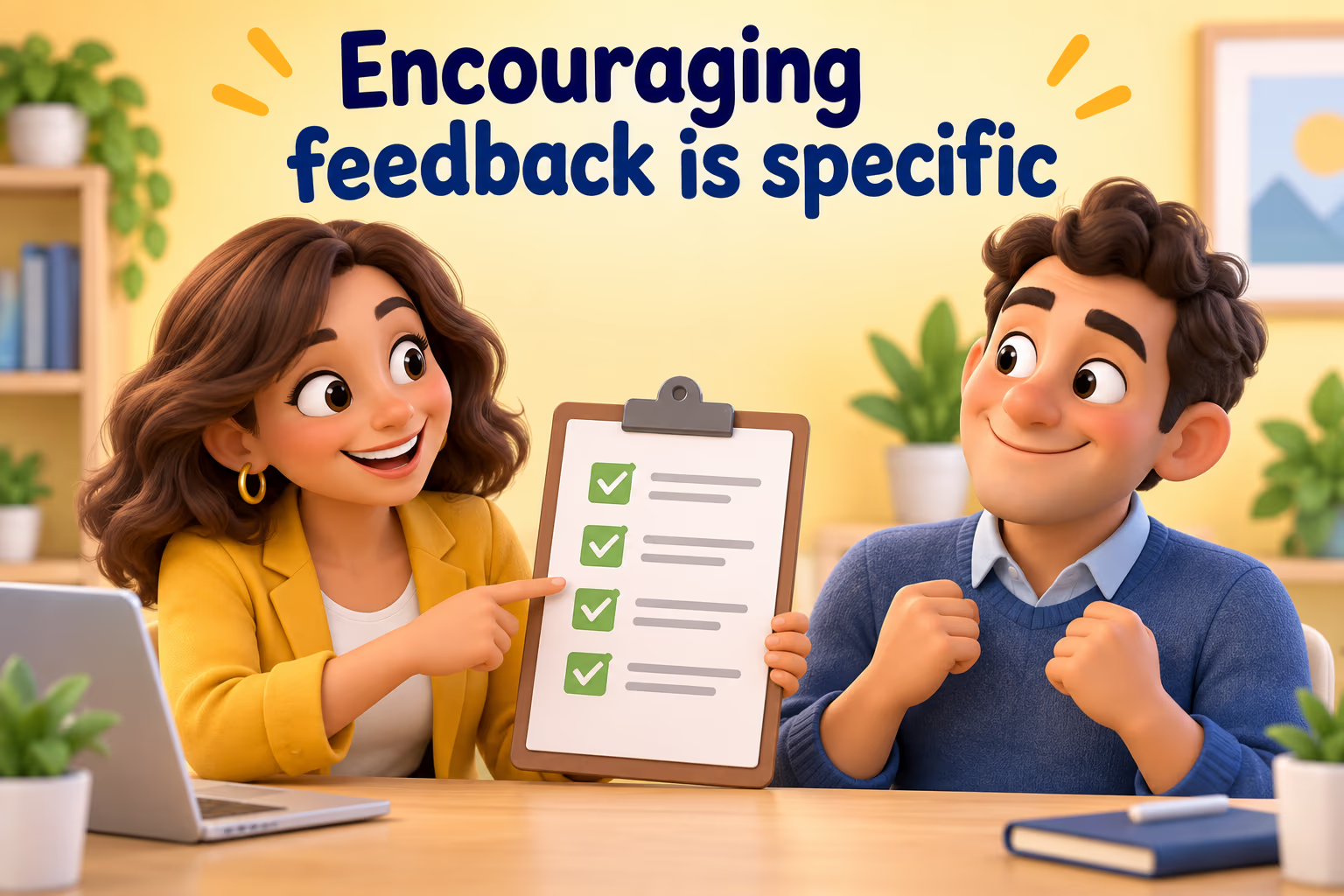
Adjectives such as affirming, constructive, and motivating can describe feedback that is both kind and useful. Avoid guaranteeing success when you cannot know the result. A truthful, encouraging sentence can recognize uncertainty while still expressing confidence in a next step: “This is a difficult revision, and your outline gives us a solid place to start.”
How Do You Describe Support Respectfully?
Describe what the helper did and, when relevant, what the other person said they needed. “The coordinator offered flexible, practical help after asking which tasks mattered most” is more respectful and informative than assigning a label such as “needy” to the recipient. People may welcome support in one situation and prefer independence in another.

When writing about disability, culture, identity, or health, use appropriately specific terms and respect how a person or community describes itself. Person-first and identity-first wording can both be appropriate; the person’s or community’s preference matters. The American Psychological Association’s language guidance emphasizes specificity and self-identification, while SAMHSA’s trauma-informed principles include collaboration, empowerment, voice, and choice. These are useful editorial guides for preserving agency; they do not replace a person’s stated preference.
Supportive does not mean agreeing with every request or decision. A person can be respectful and clear about a limit: “I support your goal, and I cannot take on that task this week.” Likewise, overbearing or intrusive can accurately describe behavior when help is imposed after a boundary is expressed. Use these evaluative adjectives for observable conduct, not as clinical or permanent diagnoses of someone’s character.
Supportive vs. Supporting: What Is the Difference?
Supportive is an adjective meaning helpful or encouraging: “The manager was supportive during the transition.” Supporting is the present participle of support and can also modify a noun: “The supporting documents explain the decision.” Use supportive of before a cause or plan (“supportive of the proposal”); use supporting when describing the act of providing support or an item that backs a claim.
For example, “She gave supportive feedback” describes the feedback’s quality; “She is supporting the project” describes an action in progress; and “supporting evidence” means evidence that helps establish a claim. The forms are related but do different grammatical work.
When Are Negative Adjectives Useful?
Negative adjectives can be useful when they describe a specific response that failed to provide support. Dismissive fits a reply that brushes off a concern; judgmental fits criticism that condemns rather than helps; inconsistent fits promised help that repeatedly does not arrive. They are not automatically forbidden—the key is to make the description accurate and behavior-based.
- Instead of “Lee is unsympathetic,” describe the moment: “Lee gave an unsympathetic reply and changed the subject before Pat finished.”
- Instead of calling a recipient “dependent,” say what assistance is involved: “Morgan receives daily transportation support while recovering.”
- Instead of labeling every disagreement “unsupportive,” say whether the person listened, respected the choice, and offered a reasoned alternative.
The original source list of negative adjectives appears below in full. Treat its examples as language describing a response or interaction, not a label for the person receiving help.
Original Adjectives and Examples
The original article content is preserved word for word below, including its headings, lists, example sentences, and all four tables.
When it comes to expressing support, words can make all the difference. Whether you’re offering encouragement, providing assistance, or showing solidarity, the right adjectives can enhance your message and convey your intentions with precision. In this article, I’ll be sharing a range of adjectives that can be used to describe support, along with examples to help you understand their usage in context. From words that convey unwavering loyalty to those that express empathy and understanding, we’ll explore a variety of descriptive terms that can elevate your expressions of support to new heights.
Support can take many forms, and the adjectives we use to describe it can help paint a vivid picture of the kind of support we offer. From steadfast and dependable to encouraging and uplifting, these adjectives not only enhance our language but also reflect the depth of our commitment to those we support. Whether you’re writing a heartfelt message, delivering a speech, or simply want to express your support in everyday conversations, having a diverse repertoire of adjectives at your disposal can make your words resonate more powerfully. So, let’s dive in and explore the world of adjectives for support, and discover how they can elevate your expressions of solidarity and encouragement.
How to Describe support? – Different Scenarios
When it comes to describing support, the right choice of adjectives can make all the difference. Understanding how to describe support in different scenarios allows us to convey our intentions more precisely and effectively. Here, I’ll discuss various scenarios and provide examples of adjectives that can be used to describe support in each situation:
- Encouraging a Friend
- Offering Sympathy
- Showing Solidarity
- Promoting Teamwork
- Acknowledging Efforts
By using the appropriate adjectives in different support scenarios, we can amplify our words and make them resonate more powerfully. Remember, a diverse repertoire of adjectives is key to expressing solidarity and encouragement effectively.
Describing Words for support in English
As a writer, I understand the power of using the right adjectives to convey support and encouragement in various scenarios. The choice of words can make a significant difference in how our message is received and understood. In this section, I will provide you with a range of adjectives that can help describe support in English.
Positive Adjectives:
- Encouraging: to inspire and uplift others, e.g., “You’re doing great! Keep going!”
- Motivating: to provide the push someone needs, e.g., “I believe in you! You can do it!”
- Inspiring: to stir enthusiasm and ignite passion, e.g., “Your hard work is truly inspiring!”
Empathetic Adjectives:
- Comforting: to provide solace and alleviate distress, e.g., “I’m here for you. You’re not alone.”
- Understanding: to show empathy and comprehension, e.g., “I understand how you feel. It’s tough.”
Supportive Adjectives:
- Helpful: to offer assistance and aid, e.g., “How can I help you? Let me know.”
- Reliable: to assure someone of your trustworthiness, e.g., “You can count on me. I’ll always be there for you.”
- Steadfast: to express unwavering support, e.g., “I’ll stand by your side no matter what.”
Collaborative Adjectives:
- Team-oriented: to emphasize the importance of teamwork, e.g., “Let’s work together to achieve our goals.”
- Cooperative: to highlight willingness to contribute, e.g., “I’m open to your ideas. Let’s collaborate.”
Appreciative Adjectives:
- Grateful: to express gratitude and appreciation, e.g., “I’m grateful for your unwavering support.”
- Valued: to make someone feel important and appreciated, e.g., “Your contributions are highly valued.”
Using these adjectives, we can amplify our words and make them resonate more powerfully when expressing support, encouragement, and solidarity. Remember, the right adjective can make all the difference in how our message is received.
Adjectives for support
Positive Adjectives for Support with 12 Example Sentences
When it comes to offering support and encouragement, using the right adjectives can make all the difference. These positive adjectives not only convey a sense of support but also uplift and inspire. Here are 12 examples of positive adjectives that can be used to describe support:
| Adjective | Definition | Example Sentence |
|---|---|---|
| Encouraging | Giving hope and motivation | “You can do it! I believe in you!” |
| Caring | Showing kindness and concern | “I’m here for you, no matter what.” |
| Empowering | Instilling confidence and strength | “You have the power to overcome any challenge.” |
| Inspiring | Fostering motivation and creativity | “Your ideas are truly inspiring.” |
| Reassuring | Providing comfort and peace of mind | “Everything will be okay. You’re not alone.” |
| Motivating | Spurring action and determination | “Your hard work and dedication are paying off.” |
| Supportive | Offering assistance and understanding | “I’m here to support you every step of the way.” |
| Compassionate | Showing empathy and compassion | “I understand what you’re going through, and I’m here for you.” |
| Appreciative | Expressing gratitude and admiration | “I truly appreciate your effort and dedication.” |
| Understanding | Being empathetic and tolerant | “I understand your perspective and will stand by you.” |
| Collaborative | Working together towards a common goal | “Let’s join forces and accomplish great things together.” |
| Resilient | Having the ability to bounce back from adversity | “You’ve proven time and time again how resilient you are.” |
By using these positive adjectives, we can amplify our words and make them resonate more powerfully when expressing support, encouragement, and solidarity.
Negative Adjectives for Support with 5 Example Sentences
While positive adjectives can bring comfort and motivation, it’s worth acknowledging that negative adjectives can undermine support and discourage others. Here are 5 examples of negative adjectives that should be avoided when describing support:
| Adjective | Definition | Example Sentence |
|---|---|---|
| Dismissive | Showing a lack of interest or regard | “Your feelings are not important.” |
| Judgmental | Criticizing and expressing disapproval | “You should have known better.” |
| Discouraging | Dampening enthusiasm and optimism | “You’ll never be able to achieve that.” |
| Inconsiderate | Lacking thoughtfulness and empathy | “I don’t care about your problems.” |
| Unsympathetic | Lacking understanding and compassion | “I can’t relate to what you’re going through.” |
It’s important to remember that our choice of words can have a profound impact on others’ well-being. By avoiding these negative adjectives and opting for positive, supportive language, we can uplift and empower those around us.
Synonyms and Antonyms with Example Sentences
Synonyms for Support
When it comes to describing support, there are several synonyms that can convey encouragement, caring, empowerment, and inspiration. Using these adjectives can help uplift and motivate others. Here are some examples of synonyms for support:
| Synonym | Definition |
|---|---|
| Encouraging | Giving support, confidence, and hope to others |
| Caring | Showing concern and kindness towards others |
| Empowering | Giving power, authority, and confidence to others |
| Inspiring | Filling others with the desire or urge to do something great |
| Motivating | Providing someone with a reason or incentive to take action |
| Uplifting | Raising one’s spirits or mood |
Example Sentences:
- I always find her words encouraging as she supports me in my endeavors.
- She has a caring nature and is always there when someone needs support.
- The coach’s empowering speech motivated the team to give their best on the field.
- Her story was truly inspiring, making others want to pursue their dreams.
- The motivational speaker’s words sparked a fire in everyone’s hearts.
- His uplifting message brought a smile to my face and renewed my enthusiasm.
Antonyms for Support
On the other hand, certain adjectives can undermine support and discourage others. It’s important to steer clear of these when describing support. Here are some antonyms for support:
| Antonym | Definition |
|---|---|
| Disheartening | Causing someone to lose hope or enthusiasm |
| Discouraging | Dampening one’s confidence or motivation |
| Unsupportive | Lacking support or not showing care towards others |
| Demoralizing | Making others feel disheartened or less confident |
Example Sentences:
- His disheartening words shattered my confidence and left me feeling hopeless.
- The discouraging feedback dampened my enthusiasm for the project.
- She was unsupportive and indifferent to my struggles, which made it even harder.
- The demoralizing comments made me question my abilities and worth.
Remember, choosing the right words is crucial when describing support. By using positive adjectives, we can empower and inspire others. Avoiding negative adjectives ensures that our support remains uplifting and encouraging. So, let’s use the power of words to make a positive impact on those around us.
Conclusion
Choosing the right adjectives to describe support is crucial in conveying encouragement and empowerment. Throughout this article, we have explored various positive adjectives that can be used to express support, such as encouraging, caring, empowering, inspiring, and more. These words have the power to uplift and motivate those around us.
On the other hand, it is important to avoid using negative adjectives when describing support, as they can undermine the intended message and discourage others. Instead, we should focus on using positive, supportive language that instills confidence and fosters growth.
By carefully selecting our words, we can create a supportive environment that inspires and empowers others. Synonyms and antonyms for support have also been provided, along with example sentences, to further enhance our understanding of how to effectively convey support.
The power of adjectives in describing support should not be underestimated. Let us choose our words wisely, using positive adjectives that uplift and inspire, to create a supportive atmosphere that encourages growth and success.
Frequently Asked Questions About Adjectives for Support
What are good adjectives to describe support?
Useful choices include encouraging, empathetic, reliable, practical, collaborative, and respectful. Pick the word that describes the specific quality you mean, then provide a behavior or example. “Reliable support” might mean someone followed through at an agreed time.
What is a word for someone who gives support?
Supportive, helpful, dependable, and compassionate can describe a person’s approach. A concrete phrase is often clearer: “a dependable neighbor who brings groceries each week.” Avoid turning a temporary role into a fixed label if the situation does not support it.
Can support be practical and emotional?
Yes. A person may offer practical help, such as arranging a ride, and emotional support, such as listening without rushing to solve the problem. Use practical for action that addresses a concrete need and empathetic or comforting for a response that acknowledges feelings.
Does supportive mean agreeing with someone?
No. Supportive behavior can include listening, giving accurate information, respecting a choice, or offering help within honest limits. You can support a person while disagreeing with a plan, provided you state your view respectfully and do not misrepresent your level of agreement.
How can I describe support without sounding patronizing?
Name the specific action and respect the recipient’s agency. “I offered to proofread if she wanted help” avoids assuming that she needed or accepted it. If writing about identity or disability, use the person’s or community’s preferred wording rather than imposing a single style.
Sources and Further Reading
- Cambridge Dictionary: supportive
- SAMHSA: Trauma-Informed Approaches and Programs
- American Psychological Association: Inclusive Language Guidelines
- American Psychological Association: Choosing Words for Talking About Disability
Conclusion
Adjectives for support identify how help is offered and received: encouraging words build confidence, reliable help follows through, and practical support addresses a concrete need. Describe behavior with specific examples, respect the other person’s preferences and agency, and use negative adjectives only when they accurately describe an unhelpful response.


