Adjectives for Thursday: 25 Words & Examples
Adjectives for Thursday describe the schedule, atmosphere, results, or a person’s reaction to one particular day. Words such as busy, quiet, productive, and stressful can all fit different Thursdays, but none is an inherent quality of the weekday. Explain the evidence or perspective so readers know what you mean.

Quick answer
- Thursday is a capitalized noun: the weekday after Wednesday and before Friday.
- In a busy Thursday, busy is the adjective and Thursday is the noun.
- Choose a word for the feature you mean: activity, pace, outcome, or personal response.
- A weekday name has no direct synonym or antonym; descriptive adjectives are not synonyms for Thursday.
How to Describe a Particular Thursday
First decide what the sentence should tell the reader. Busy describes the amount of activity, calm describes a quiet or peaceful atmosphere, productive evaluates useful results, and stressful reports experienced pressure. These words can describe different aspects of the same day, so they are not interchangeable.

For example, “It was a busy Thursday” tells us that many things were happening, but not whether they went well. “It was a productive Thursday” claims that useful work was completed; name an outcome if the evaluation matters. “I found Thursday stressful” makes the speaker’s perspective explicit rather than presenting stress as an objective quality of the date.
25 Adjectives for Thursday by Meaning
Use the following words when they fit the events or viewpoint in your sentence. “Positive” and “negative” depend on context: a packed day may be satisfying to one person and exhausting to another.
| What you want to describe | Adjectives | Example |
|---|---|---|
| Amount of activity | busy, hectic, lively, eventful | “A lively Thursday market filled the square with music and conversation.” |
| Pace or atmosphere | calm, peaceful, quiet, monotonous, boring | “The quiet Thursday afternoon gave me time to read.” |
| Work and results | productive, efficient, successful, promising, progressive | “It was a productive Thursday: our team finished and reviewed the draft.” |
| Energy and interest | vibrant, energetic, invigorating, inspiring, dynamic | “An inspiring Thursday lecture changed how I approached the project.” |
| Personal response | exciting, refreshing, motivating, exhausting, disappointing, frustrating, satisfying | “The delayed train made Thursday frustrating for our group.” |
Several words need an identified subject to sound precise. A meeting can be inspiring; a person can feel energetic; a plan can be promising. “An inspiring Thursday” is understandable shorthand, but “Thursday’s lecture was inspiring” names what created that reaction. Similarly, a forecast can be sunny or rainy; Thursday itself is not weather.
Are Positive and Negative Descriptions Objective?
No. Adjectives such as exciting, boring, refreshing, and disappointing often express a person’s response. Busy and eventful can be supported by observable activity, while productive and successful require a goal or result for comparison.
- Possible positive descriptions: productive, satisfying, promising, inspiring, refreshing.
- Possible difficult descriptions: exhausting, monotonous, disappointing, frustrating, stressful.
- More neutral starting points: busy, quiet, eventful, routine, early, late.
Use evidence when making an evaluation: “By Thursday evening, the team had completed the test run and fixed two launch-blocking errors” explains why the day was productive. If you are describing a personal reaction, “I found Thursday exhausting” is clearer than implying everyone experienced it the same way.
Is Thursday a Noun or an Adjective?
Thursday is a noun, and weekday names are capitalized. In a calm Thursday, calm is the adjective modifying the noun. Adjectives can also follow a linking verb: “Thursday was calm.” The Government of Canada’s Language Portal explains adjective placement, while Cambridge labels Thursday a noun and gives patterns such as Thursday morning and on Thursdays.
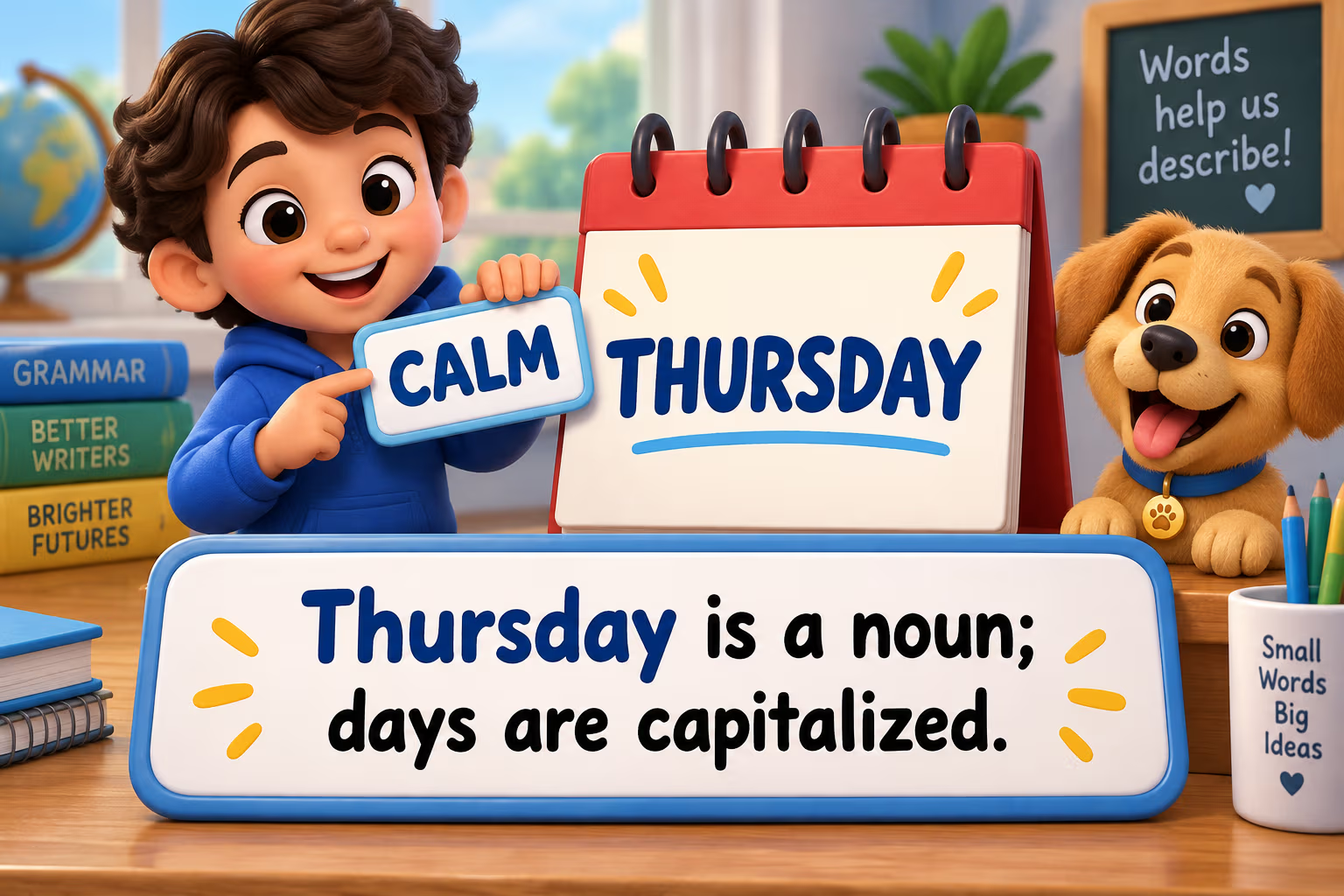
In Thursday meeting, Thursday comes before another noun to specify which meeting. It remains a noun used as a modifier; its position does not make it an adjective. In Thursday’s meeting, the possessive noun also identifies the meeting. Use Thursdays for a repeated routine (“The class meets on Thursdays”), and capitalize the weekday in both singular and plural forms.
Cambridge Dictionary’s Thursday entry shows several useful forms: on Thursday for a specific date, on Thursdays for a recurring event, and next Thursday or last Thursday for nearby dates. The Australian Government Style Manual explains that weekday names begin with a capital because they are proper nouns.
Does Thursday Have Synonyms or Antonyms?
In ordinary calendar use, Thursday has no direct synonym or antonym. It names one weekday, not a quality that can have an opposite. Friday is a different weekday, not an antonym. Words such as calm or productive describe a possible Thursday; they do not mean “Thursday.”
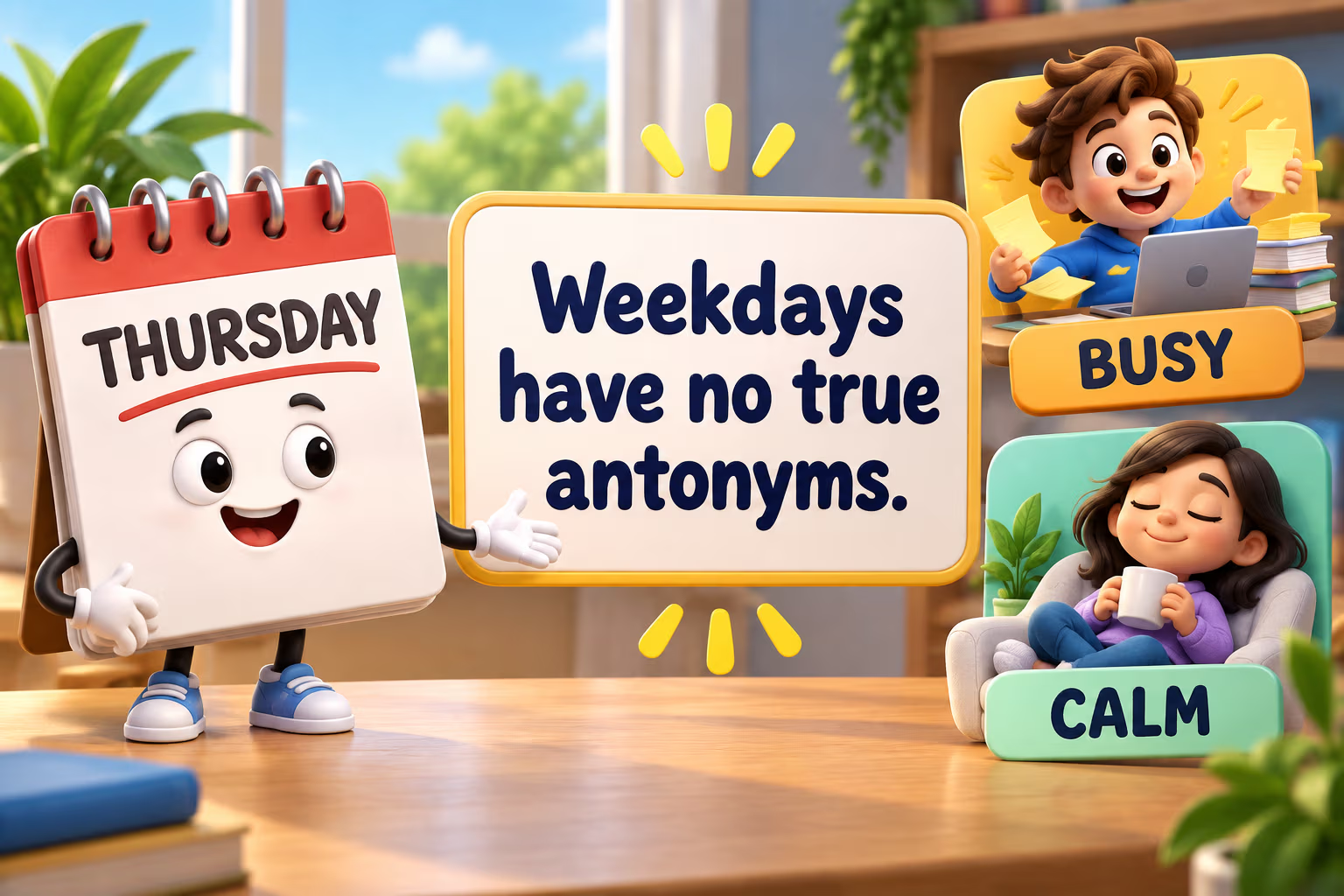
Some descriptive adjectives contrast within a specific dimension. A workday may be productive or unproductive depending on results, or calm or hectic in its pace. Those word pairs can help express a contrast, but they are not opposites of the weekday name, and one day may be both demanding and satisfying.
Example Sentences with Thursday Adjectives
- We had a busy Thursday, with three client calls and a planning session.
- It was a quiet Thursday at the library, so I finished my reading.
- The team had a productive Thursday and completed the first draft.
- The long shift made Thursday an exhausting day for the nurses.
- A surprise concert turned an ordinary Thursday into an enjoyable one.
- Our challenging Thursday ended with the problem finally solved.
- The new process made Thursday more efficient for the support team.
- I found Thursday stressful because two deadlines fell on the same afternoon.
- We planned an early Thursday start to avoid traffic.
- The eventful Thursday included a power outage and a delayed train.
How to Choose the Right Adjective
- Name the subject. Decide whether the adjective describes Thursday, the schedule, a meeting, a person’s mood, or the result.
- Choose one dimension. Use busy for activity, productive for useful output, efficient for effective use of time, and stressful for experienced pressure.
- Give context. State what happened or mark a personal view with “for me” or “I found.”
- Check the grammar. In “Thursday was hectic,” hectic is the adjective; in “Thursday meeting,” Thursday is a noun modifier.
Frequently Asked Questions
What is a good adjective for Thursday?
There is no single best choice. Busy, quiet, productive, or stressful may fit, depending on the events and viewpoint. Add one concrete detail to show why the word applies, such as a full schedule, a finished project, or a difficult deadline.
What are positive adjectives for Thursday?
Productive, satisfying, enjoyable, and encouraging can describe a positive experience. They do not describe every Thursday in the same way. Give the reason for the evaluation—for example, “Thursday was satisfying because I completed the report before the deadline,” in a particular situation.
What are negative adjectives for Thursday?
Stressful, tiring, hectic, and monotonous can describe a difficult day. Some report observable pace, while others express a personal response. A sentence such as “I found the hectic Thursday tiring” distinguishes workload from the writer’s reaction, which can vary with expectations.
What is the opposite of Thursday?
Thursday has no lexical opposite in the calendar. Friday and Wednesday are neighboring weekdays, not antonyms. Words such as productive and unproductive can contrast when discussing outcomes, but they describe a particular day’s results rather than the meaning of Thursday.
Can Thursday be used as an adjective?
Thursday is a noun. In a phrase such as Thursday meeting, it modifies another noun but remains a noun modifier. In busy Thursday, busy is the adjective. In Thursday was busy, the adjective follows the linking verb, so sentence structure identifies each word’s role.
Conclusion
Adjectives for Thursday describe the activity, pace, result, or personal experience of a particular day. Choose a word that matches the evidence and explain whose perspective it represents. Thursday is a capitalized noun with no direct synonyms or antonyms; descriptive words and their contrasts belong to the context of a specific day.
Original article (retained verbatim)
The original article block below is preserved exactly, including its four source tables, examples, and original “synonyms” and “antonyms” labels. Those labels are retained as source material; the corrected explanation above clarifies that its listed words describe possible experiences and are not lexical synonyms or antonyms of Thursday.
View the original Thursday adjective lists and examples
Welcome to my blog! Today, I want to take a closer look at the wonderful world of adjectives and how they can be used to describe Thursdays. Yes, you heard that right – Thursdays! Often overlooked, Thursdays have their own unique vibe and energy, and what better way to capture that than with the perfect adjectives?
In this article, I’ll be sharing a list of adjectives that can be used to describe Thursdays, along with examples to help you understand how they can be used in context. From the calm and peaceful to the vibrant and energetic, we’ll explore a wide range of adjectives that will bring Thursdays to life in your writing.
How to Describe thursday? – Different Scenarios
As an expert blogger, I’m here to help you describe Thursdays in different scenarios. By using the right adjectives, you can capture the unique vibe and energy of this day. Let’s dive in and explore the various ways to describe Thursdays:
- Calm and Peaceful: On some Thursdays, you might want to convey a sense of tranquility. Here are a few adjectives that can help you paint that picture:
- Vibrant and Energetic: Thursdays are often associated with a burst of energy as the weekend approaches. To convey this liveliness, try using these adjectives:
- Anticipation and Excitement: Thursdays can also evoke a sense of anticipation for the upcoming weekend. These adjectives can help portray that feeling:
- Productivity and Progress: Thursdays are often seen as a day to catch up on work and make progress. Use these adjectives to capture that productive spirit:
Remember, the choice of adjectives will depend on the specific scenario you are describing. Feel free to mix and match to create the desired effect. Experiment and have fun bringing Thursdays to life in your writing!
Describing Words for thursday in English
As an expert in writing with a variety of adjectives, I want to provide you with some amazing options for describing Thursdays. So let’s dive right in and explore the different words that can capture the unique vibe and energy of this special day.
- Calm and Peaceful: Thursdays can have a serene and tranquil feel, as the week is winding down and people are starting to relax. It’s a great day to describe as calm and peaceful, where everything moves at a gentle pace.
- Vibrant and Energetic: On the other hand, if you want to convey the excitement and liveliness of Thursdays, you can use adjectives like vibrant and energetic. This is the day when people are buzzing with energy, ready to tackle the last tasks before the weekend.
- Anticipation and Excitement: Thursday is often associated with the anticipation of what’s to come. It’s a day filled with hope and excitement as the weekend is just around the corner. So, describing Thursdays as a day of anticipation and excitement perfectly captures the spirit of this day.
- Productivity and Progress: Thursdays are known for being productive days, where people make significant progress on their tasks and projects. Use adjectives like productive and progressive to highlight the dedicated work happening on this day.
Remember, the choice of words will depend on the specific scenario you want to describe. Don’t be afraid to experiment and have fun bringing Thursdays to life in your writing. Whether it’s through calm and peaceful imagery or vibrant and energetic descriptions, let your words paint a vivid picture of this unique day.
Now that we’ve explored these describing words for Thursday, it’s time to put them into action. Let’s take a look at some examples to see how these adjectives can be used effectively:
| Scenario | Describing Words |
|---|---|
| A relaxing Thursday afternoon | Calm, Peaceful |
| The bustling atmosphere of Thursday mornings | Vibrant, Energetic |
| The anticipation building towards the weekend | Anticipation, Excitement |
| The productive work happening on Thursdays | Productivity, Progress |
By selecting the right adjectives, you can bring your writing to life and create a vivid portrayal of the unique characteristics of Thursdays.
Adjectives for thursday
Positive Adjectives for Thursday with 12 Example Sentences
When it comes to describing Thursdays, there are a wide variety of positive adjectives that can capture the unique essence of this day. Whether you’re looking to convey a sense of tranquility, energy, anticipation, or productivity, there’s an adjective that can perfectly describe Thursdays. Here are 12 examples of positive adjectives to enhance your writing:
| Adjective | Example Sentence |
|---|---|
| Calm | Thursday morning was calm and peaceful. |
| Vibrant | The city streets on Thursday were vibrant and lively. |
| Invigorating | Walking in the fresh air on Thursday felt invigorating. |
| Promising | The start of Thursday brought with it promising opportunities. |
| Inspiring | The Thursday sunrise was inspiring and breathtaking. |
| Productive | Thursday afternoon was incredibly productive. |
| Energetic | The office buzzed with energy on Thursday. |
| Optimistic | The Thursday forecast looked optimistic and sunny. |
| Refreshing | A cool breeze made Thursday afternoon refreshing. |
| Motivating | Thursday’s goals were motivating and achievable. |
| Exciting | There was an air of excitement on Thursday evening. |
| Dynamic | Thursday’s events showcased a dynamic mix of talent. |
Negative Adjectives for Thursday with 5 example sentences
While Thursdays are often associated with positive energy, there may be times when you want to convey a less favorable tone. Here are 5 examples of negative adjectives that can reflect a different side of the day:
| Adjective | Example Sentence |
|---|---|
| Monotonous | Thursday dragged on with a monotonous routine. |
| Exhausting | The long workday on Thursday was exhausting. |
| Disappointing | Thursday’s outcome was disappointing. |
| Frustrating | Technical issues made Thursday frustrating. |
| Boring | The Thursday lecture was long and boring. |
When describing Thursdays, the choice of adjectives depends on the specific context and the emotions you want to convey. Whether you’re capturing the positive energy and excitement of the day or highlighting the challenges and monotony that may arise, using descriptive adjectives can bring your writing to life. Experiment with different adjectives and have fun creating vivid descriptions of Thursdays in your writing.
Synonyms and Antonyms with Example Sentences
Synonyms for Thursday
When it comes to describing Thursdays, there are several synonyms that can accurately capture the essence of this day. Here are some alternative words you can use:
| Synonym | Definition | Example Sentence |
|---|---|---|
| Calm | Peaceful and serene | Thursday is a calm day when I can relax and unwind. |
| Vibrant | Full of energy and excitement | Thursdays in the city are always vibrant and alive. |
| Invigorating | Refreshing and stimulating | A walk in the park on a Thursday morning is invigorating. |
| Promising | Indicating potential success or happiness | A Thursday filled with opportunities and promising prospects. |
| Inspiring | Motivating and encouraging | I always find myself inspired to create on Thursdays. |
| Productive | Providing results and accomplishments | Thursdays are my most productive days for getting work done. |
| Energetic | Full of vitality and enthusiasm | I start my day with an energetic workout every Thursday. |
| Optimistic | Hopeful and positive | Thursdays always fill me with optimism for the weekend. |
| Refreshing | Rejuvenating and revitalizing | A Thursday rain shower is refreshing and uplifting. |
| Motivating | Encouraging and inspiring | The thought of Friday motivates me to work hard on Thursdays. |
| Exciting | Thrilling and full of anticipation | Thursday nights are always exciting with plans for the weekend. |
| Dynamic | Changing and evolving | Thursday meetings are always dynamic and thought-provoking. |
Antonyms for Thursday
On the flip side, if you want to convey a different mood or atmosphere for Thursdays, you can use the following antonyms:
- Monotonous
- Exhausting
- Disappointing
- Frustrating
- Boring
Remember that the choice of adjectives depends on the specific context and emotions you want to convey in your writing. Feel free to experiment with different adjectives and have fun creating vivid descriptions of Thursdays.
By using an array of synonyms and antonyms, you can paint a detailed picture of Thursdays, capturing both the positive and negative aspects of the day without resorting to repetitive or monotonous language.
Conclusion
Describing Thursdays can be a creative and exciting endeavor. Throughout this article, we have explored a range of adjectives that can be used to paint a vivid picture of this day. From the calm and vibrant to the invigorating and promising, there are plenty of options to choose from.
By experimenting with different adjectives, we can capture the unique essence of Thursdays and convey the desired emotions in our writing. Whether it’s a productive and energetic day or one filled with optimism and refreshment, the choice of adjectives depends on the specific context.
Remember, Thursdays can be anything but monotonous, exhausting, disappointing, frustrating, or boring. With the right adjectives, we can transform this day into something dynamic and exciting.
So, the next time you sit down to write about Thursdays, don’t be afraid to explore the vast array of adjectives available. Let your creativity flow and have fun creating vivid descriptions that bring this day to life. Happy writing!