How to Choose the Right Adjectives for a University
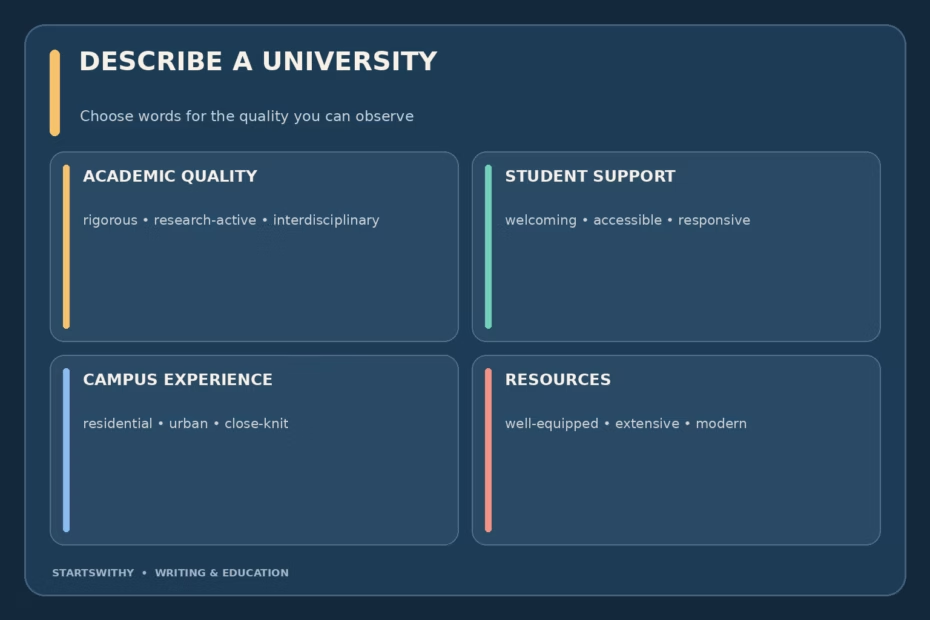
“University” can refer to the institution as a whole, its teaching, its campus, or the experience of a particular student. Before choosing an adjective, decide which of those you mean. Words such as rigorous, supportive, and urban describe different things; piling them together without context makes a description less informative.
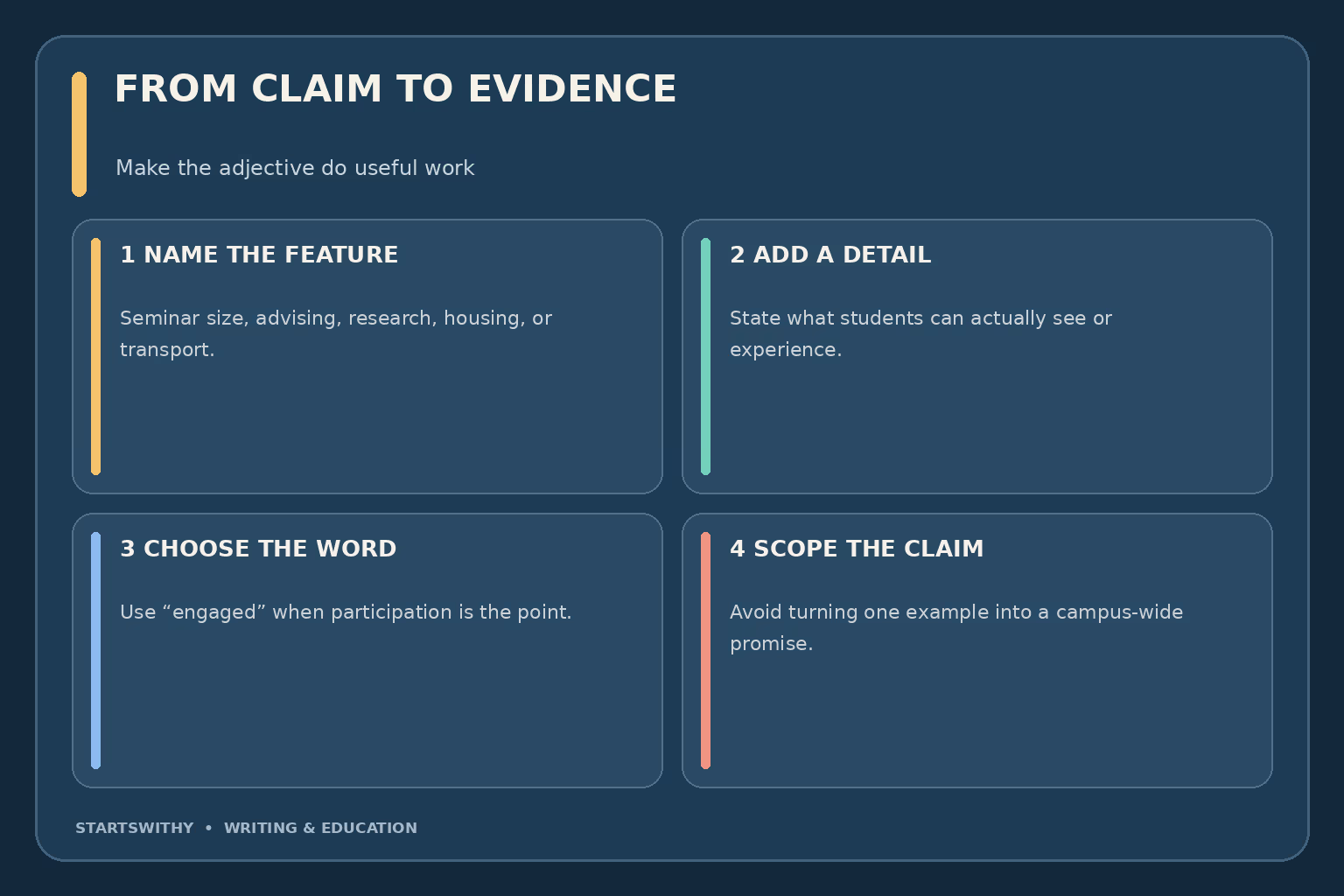
A useful description pairs a word with a concrete detail: “The university offers small seminars in the first-year writing program” is more specific than “The university is engaging.” A prospective student can then judge whether the detail matters to them. The right adjective describes a real feature without promising the same experience for every person or program.
Adjectives for Different Aspects of University
Academic quality and learning
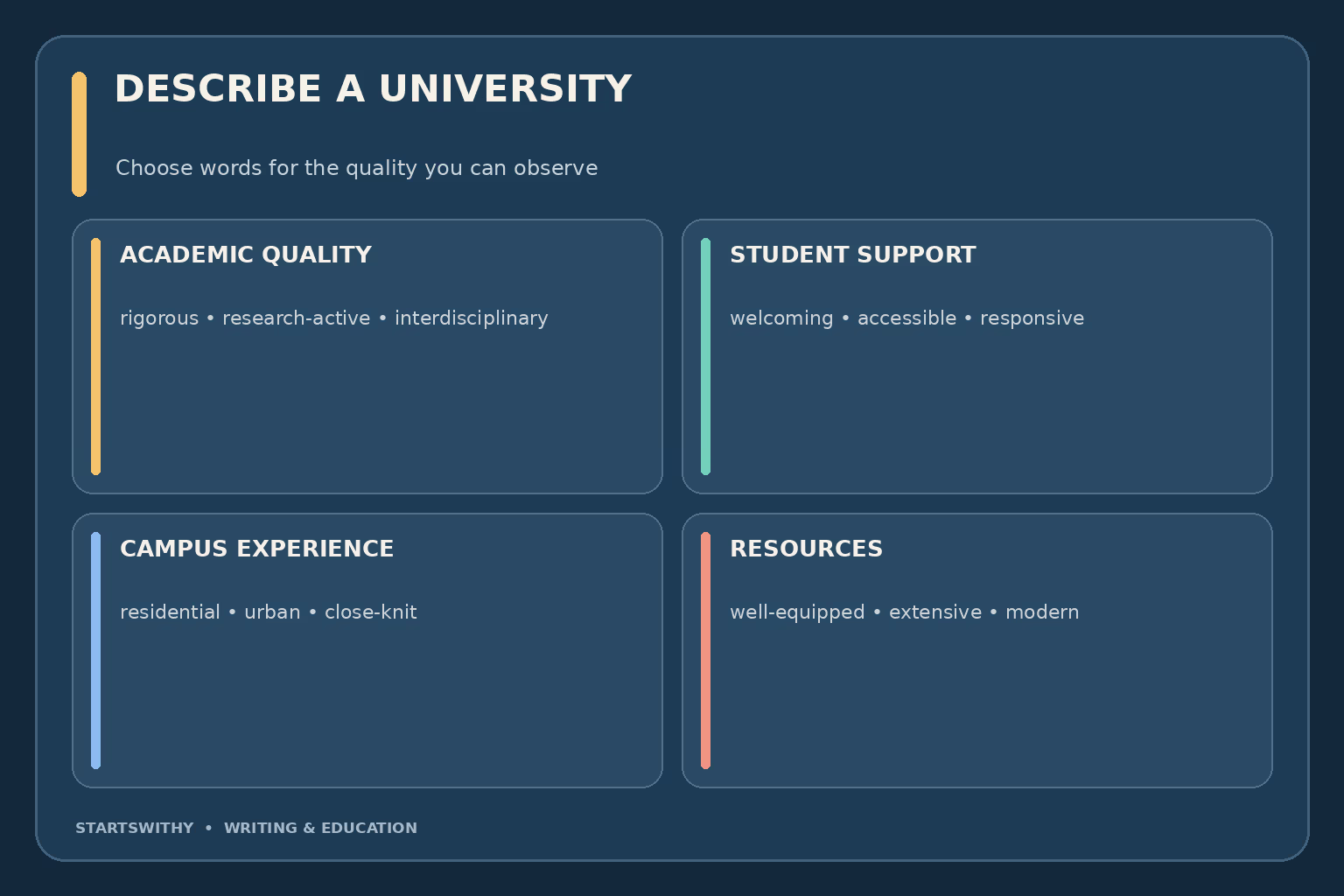
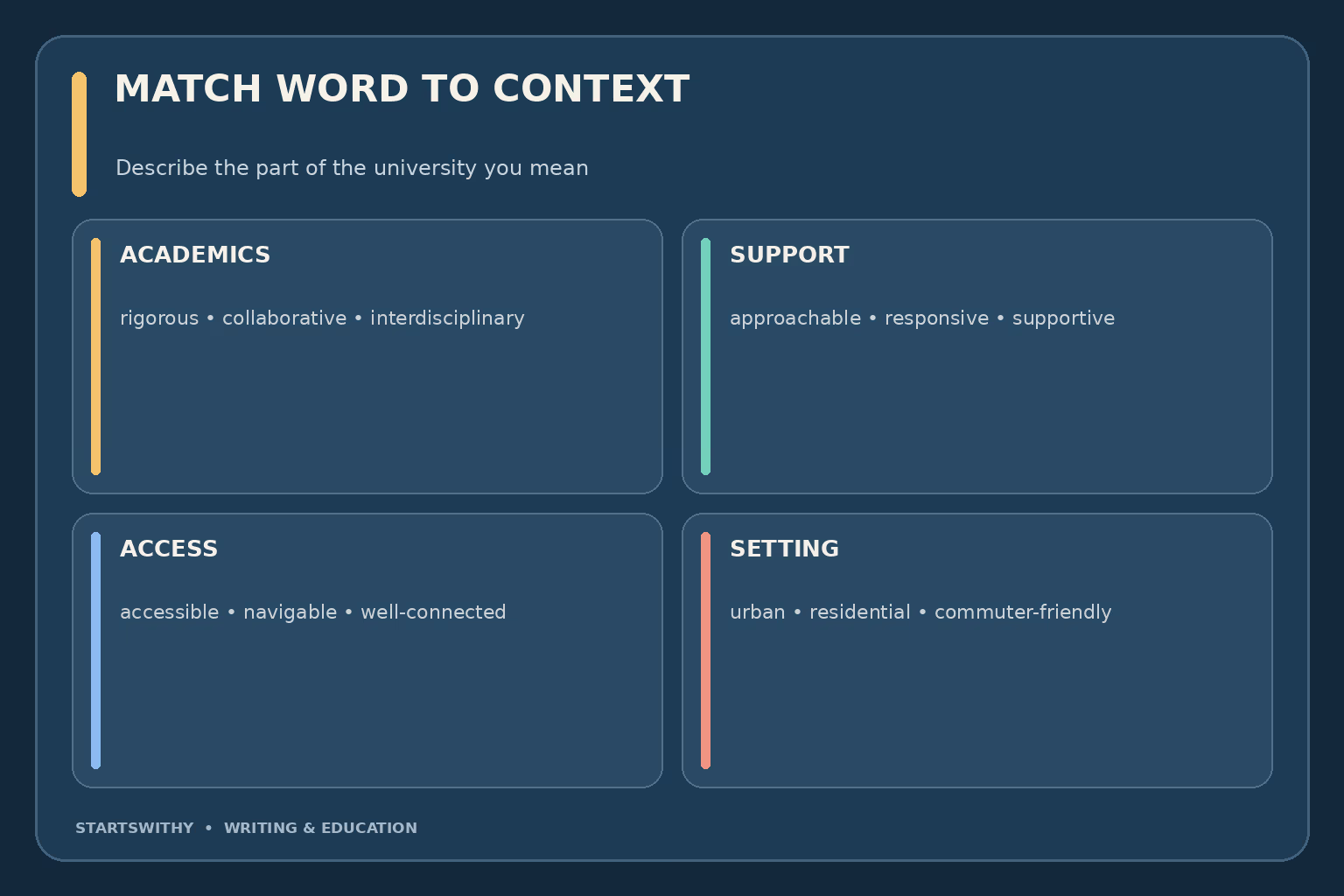
Rigorous suggests demanding study and sustained effort. It should describe a course or program whose workload and expectations support that claim, rather than functioning as an automatic synonym for “good.” Research-active describes a visible emphasis on research; it does not, by itself, tell a reader how much undergraduate teaching is research-led. Interdisciplinary fits a course or project that brings methods or ideas from more than one field together. Collaborative points to learning that depends on discussion, shared projects, or peer work. Well-rounded is broad, so clarify the range of subjects or experiences that makes the description apt.
Student support and teaching
Supportive is strongest when connected to something practical, such as advising access, writing help, tutoring, or clear routes to assistance. Approachable describes how easy it feels to ask a question; a specific example might be regular office hours or a named contact. Responsive suggests that questions or concerns receive a timely, relevant reply. Inclusive should refer to identifiable practices that help students participate and belong, not serve as a general compliment. A student’s experience can vary by department, course, and support need, so qualify broad claims when necessary.
Campus setting and student life
Residential is useful when many students live in university housing or the campus has a strong residential character. Commuter-friendly can describe practical features such as transit connections, schedule options, or services available beyond standard class hours. Urban, suburban, and rural describe location; they do not automatically imply that a campus is lively, quiet, or isolated. Close-knit is an impression of community and works best with a reason, such as small cohort size or frequent shared activities. Vibrant can describe active campus life, but adding an example—clubs, performances, or public events—makes it clearer.
Facilities, access, and resources
Well-equipped can fit a laboratory, studio, library, or athletic facility when you name the equipment or service. Extensive describes range or scale, such as a substantial collection or a wide selection of student services. Accessible is a meaningful claim about whether people can use a building, website, course material, or service; explain which feature you mean instead of using it as a vague synonym for “available.” Modern is time-dependent, so a concrete description of recently updated facilities or current technology is more useful. Avoid assuming that a new building is automatically accessible or that every student can use every resource in the same way.
Positive, Neutral, and Critical Words
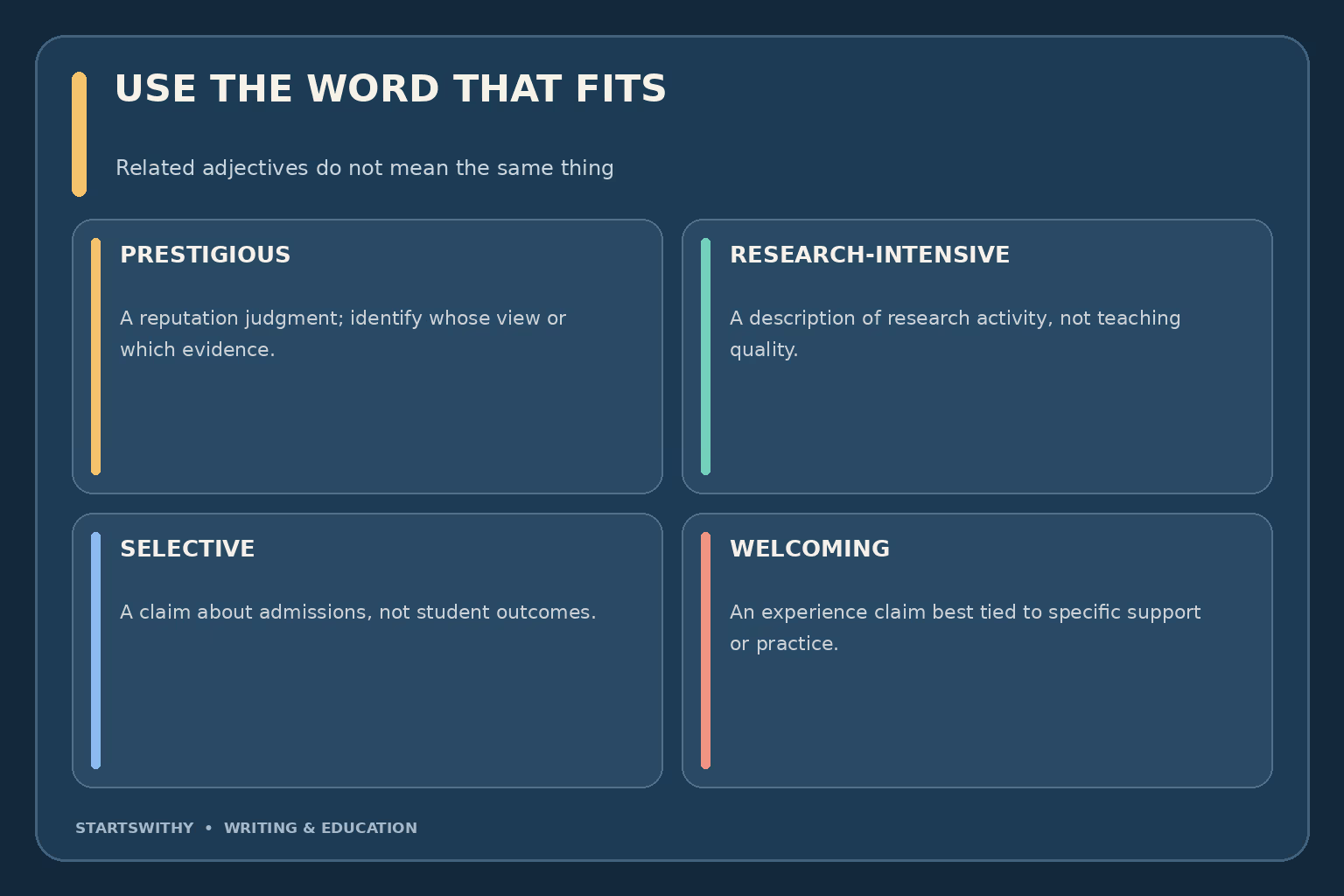
Not every adjective needs to praise or criticize. Public, private, residential, urban, and research-focused are primarily descriptive labels when used accurately. Prestigious expresses a judgment about reputation, so a careful writer should explain whose view or which evidence supports it. Selective describes admissions patterns, not teaching quality or the value of a student’s education. Expensive should specify what cost is being discussed, such as tuition, housing, or total attendance costs, and for which student category.
Critical terms also benefit from precision. Overcrowded may describe a particular class, residence hall, or shared facility; it should not be applied to an entire university based on a single example. Disorganized is more helpful when attached to a process, such as registration or advising communication. Inaccessible can refer to physical access, digital content, scheduling, or affordability, which are distinct concerns. Naming the issue helps readers understand both the observation and its limits.
How to Describe a University in an Essay or Review
- Pick one focus. Decide whether you are describing teaching, research, student services, campus life, location, or facilities.
- Choose a fitting adjective. Use a word with a clear meaning, such as “interdisciplinary” for work spanning fields or “commuter-friendly” for practical support for students who travel to campus.
- Give evidence. Add an example from a course, published program information, a campus visit, or your own experience. Distinguish what you observed from what you inferred.
- Keep the scope fair. “My introductory biology lab was crowded” is more precise than “The university is overcrowded.” An individual experience may not represent every department or student.
- Consider the audience. A college essay can be personal and reflective; a guide for prospective students should be concrete and balanced; a formal report may need measurable evidence and a stated time frame.
For example, instead of writing “It is a prestigious and amazing university,” a student might say, “The university’s environmental studies program is interdisciplinary: my planned course sequence combines ecology, public policy, and field research.” The second sentence names a feature and explains why the chosen adjective fits. If a reputation claim matters, support it separately rather than using “prestigious” as a substitute for evidence.

Frequently Asked Questions
What is a good adjective to describe a university?
Choose a word that matches the feature you mean. “Rigorous” may describe demanding coursework, “supportive” may describe accessible advising, and “residential” may describe campus life. A brief example makes any of these more useful.
How can I describe a university positively without sounding vague?
Pair one accurate adjective with a concrete detail. Instead of calling a university “excellent,” describe a course, resource, or experience that mattered to you and explain what made it effective.
Is “prestigious” the same as “high-quality”?
No. “Prestigious” refers to reputation or perceived status. “High-quality” is also a broad evaluation, but it should be tied to the quality dimension being discussed, such as teaching, facilities, or a specific program.
What is a neutral adjective for a university?
Words such as “public,” “private,” “urban,” “residential,” and “research-focused” can be neutral when they accurately describe the institution or program. Their meaning depends on the context and the feature being described.
Sources and Further Reading
- Cambridge Dictionary: university (general definition and usage examples).
- U.S. Department of Education: Accreditation in the U.S. (distinguishes institutional and programmatic accreditation).
- U.S. Department of Education: College Accreditation (overview of accreditation and its quality-assurance purpose).
When it comes to describing universities, there is a plethora of adjectives that can be used to capture their unique characteristics. From prestigious and innovative to diverse and inclusive, these adjectives paint a vivid picture of what a university has to offer. In this article, I’ll be exploring some of the most commonly used adjectives to describe universities, along with examples that showcase their meanings in context.
Universities are often known for their academic excellence and the quality of education they provide. Words like renowned, esteemed, and top-ranked come to mind when describing universities that have a strong reputation for their academic programs and faculty. For example, “Harvard University is renowned for its rigorous curriculum and world-class professors.” These adjectives not only highlight the university’s standing in the academic world but also convey a sense of prestige and distinction.
In addition to academic prowess, universities are also known for their vibrant campus life and extracurricular activities. Adjectives like lively, vibrant, and dynamic can be used to describe universities that offer a wide range of clubs, organizations, and events that cater to diverse interests. For instance, “The University of California, Berkeley is known for its lively campus atmosphere, with numerous student clubs and organizations that cater to a variety of interests.” These adjectives capture the energetic and engaging nature of the university’s campus life.
In this article, we will delve deeper into the world of adjectives that aptly describe universities, showcasing their unique qualities and what sets them apart. Whether you’re a prospective student looking for the right fit or simply curious about the different aspects of university life, this article will provide you with a comprehensive list of adjectives that will help you better understand and appreciate the diverse world of higher education.
How to Describe university? – Different Scenarios
When it comes to describing a university, there are various scenarios in which different adjectives can be used. Each scenario highlights specific aspects of the university experience, ranging from academic excellence to campus life. Here are some examples:
- Academic Excellence:
- Campus Life:
- Facilities and Resources:
- Global Perspective:
- Career Opportunities:
These are just a few examples of the adjectives that can be used to describe universities in different scenarios. Each university has its unique characteristics and strengths, making it essential to use the appropriate adjectives to accurately depict its qualities. By understanding and using these descriptive words, we can better appreciate the diverse and enriching world of higher education.
Describing Words for university in English
As an expert blogger, I have years of experience writing high-quality articles, and today I’m going to share with you a list of adjectives that can be used to describe universities. These descriptive words will help you accurately depict the unique characteristics and strengths of each university, whether you’re a student, instructor, or simply someone curious about higher education.
When it comes to describing universities, there are several aspects that can be highlighted. Let’s explore some key areas and the adjectives that can be used to effectively describe them:
Academic Excellence
- Prestigious: I’ll start with a common term that represents high academic standards and recognition.
- Intellectual: This adjective emphasizes the focus on critical thinking and academic rigor.
- Innovative: This word highlights universities that are at the forefront of new ideas and approaches.
Campus Life
- Vibrant: This adjective captures the energetic and lively atmosphere on campus.
- Inclusive: Universities that embrace diversity and foster a sense of belonging can be described this way.
- Engaging: This term implies a wide range of extracurricular activities and opportunities for personal growth.
Facilities and Resources
- State-of-the-art: This adjective indicates that a university has modern, cutting-edge facilities and resources.
- Extensive: Universities with a wide array of resources, such as libraries and research centers, can be described as such.
- Accessible: Describes universities that prioritize providing resources and facilities that are easily available to all.
Global Perspective
- International: Universities that attract students from around the world and offer global learning experiences can be described this way.
- Multicultural: This term highlights the diversity and inclusion of different cultures and perspectives on campus.
- Global-minded: This adjective emphasizes a university’s commitment to preparing students for a globalized world.
- Promising: Describes universities that are known for providing abundant career opportunities for their graduates.
- Industry-focused: This term highlights a university’s emphasis on preparing students for specific industries or professions.
- Networking: Universities with strong alumni networks and career services can be described as such.
Remember, using the right adjectives when describing universities can help paint an accurate picture of what makes each institution unique. By considering these descriptive words, you can better appreciate the diverse world of higher education.
Adjectives for university
When it comes to describing universities, it’s important to use adjectives that accurately depict their unique characteristics and strengths. Whether you’re talking about academic excellence, campus life, facilities and resources, global perspective, or career opportunities, choosing the right adjectives can make all the difference. Let’s explore some positive and negative adjectives that can be used to describe universities, along with example sentences.
Positive Adjectives for University
- Respected: The university is highly respected in the field of research.
- Innovative: The university is known for its innovative teaching methods.
- Welcoming: The university has a warm and welcoming atmosphere for students.
- Diverse: The university boasts a diverse student population from around the world.
- Supportive: The university provides a supportive environment for students.
- Empowering: The university empowers students to pursue their passions.
- Collaborative: The university fosters a collaborative learning environment.
- Reputable: The university has a reputable faculty with expertise in their fields.
- Engaging: The university offers a variety of engaging extracurricular activities.
- Cutting-edge: The university is at the forefront of cutting-edge research.
- Inspiring: The university’s professors are inspiring and passionate about their subjects.
- Transformative: The university offers transformative experiences for students.
- Unorganized: The university’s administration is often unorganized.
- Lacking: The university’s facilities are lacking in resources.
- Disorganized: The university’s curriculum is often disorganized.
- Inaccessible: The university’s campus is not easily accessible for students with disabilities.
- Overcrowded: The university’s classes are overcrowded, making it challenging to get individual attention.
Remember, it’s important to choose adjectives that accurately represent the university you’re describing. Whether you’re highlighting the positive aspects or pointing out the negatives, be sure to use precise adjectives that provide an accurate portrayal. By considering these adjectives, readers can gain a better appreciation for the diverse world of higher education.
Synonyms and Antonyms with Example Sentences
Synonyms for university
When it comes to describing universities, it’s important to have a variety of adjectives at your disposal. Here are some synonyms that can be used to paint a vivid picture of a university:
Synonyms for University
- Respected
- Innovative
- Welcoming
- Diverse
- Supportive
- Empowering
- Collaborative
- Reputable
- Engaging
- Cutting-edge
- Inspiring
- Transformative
Let’s take a look at some example sentences using these synonyms:
- The university is respected for its rigorous academic programs and distinguished faculty.
- This university is known for its innovative research initiatives and groundbreaking discoveries.
- With its friendly campus atmosphere, this university is incredibly welcoming to students from all backgrounds.
- The university prides itself on its commitment to creating a diverse and inclusive community.
- Students at this university benefit from a supportive and empowering environment that encourages personal growth.
Antonyms for university
On the other hand, there may be times when it’s necessary to describe universities using antonyms or words that convey a negative aspect. Here are some antonyms that can be used to provide a balanced view:
Antonyms for University
- Unorganized
- Lacking
- Disorganized
- Inaccessible
- Overcrowded
Here are a few example sentences using these antonyms:
- The university’s administration is often criticized for being unorganized and inefficient.
- Despite its strengths, this university is lacking in extracurricular opportunities for students.
- The university’s registration process is notoriously disorganized, causing frustration among students.
- The campus is unfortunately inaccessible for individuals with disabilities, limiting their participation.
- Due to limited resources, some classes at this university tend to be overcrowded, making it harder for students to interact with professors.
By using these synonyms and antonyms, you can accurately capture the essence of a university, whether it be highlighting its positive aspects or pointing out its challenges.
Conclusion
Describing universities accurately is crucial when trying to convey their unique qualities. Throughout this article, I have provided a comprehensive list of adjectives that can be used to describe universities. These adjectives range from positive attributes like respected, innovative, and welcoming, to negative aspects such as unorganized and overcrowded.
By carefully selecting the right adjectives, readers can paint a vivid picture of the university they are describing. Whether it’s showcasing a university’s cutting-edge research or highlighting its supportive and empowering environment, the adjectives chosen play a significant role in capturing the essence of the institution.
Furthermore, I have also included synonyms and antonyms for the word “university” to help readers expand their vocabulary and express their thoughts more precisely. The example sentences provided demonstrate how these adjectives can be used effectively in context.
Using accurate and appropriate adjectives is essential when describing universities. It allows us to communicate effectively and paint a true picture of the diverse world of higher education. So, whether you’re a student, a parent, or an educator, remember to choose your adjectives wisely to accurately represent the university you’re describing.


