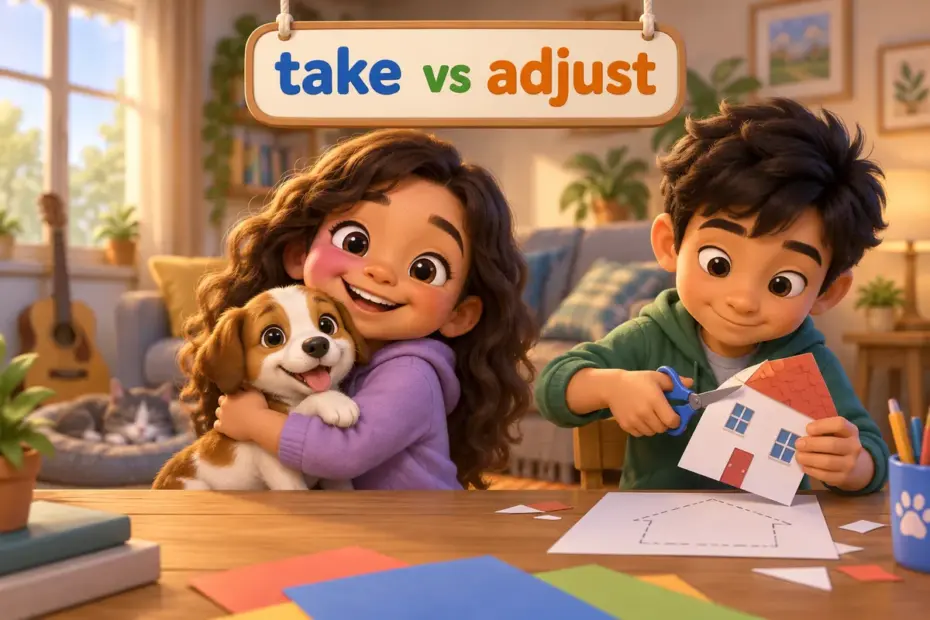
Adopt vs adapt is a pair that both suggest change, but adopt means to take something as your own, while adapt means to adjust it so it fits. “The firm adopted a new policy” takes it whole; “the recipe adapts to a smaller pan” changes it.
Adopt vs Adapt at a glance
- Adopt and adapt are both verbs that describe how something changes hands or shape.
- Adopt means to take something as your own, such as a policy, an idea, or a child.
- Adapt means to change something, or to change yourself, to fit new conditions.
- Adoption and adaptation are the matching nouns.
- The commonest error is writing adapt where the meaning is take as your own.
What does adopt mean and what does adapt mean?
Adopt is a verb meaning to take something as your own or to accept it formally; adapt is a verb meaning to change something to fit a new use or condition. The Cambridge entry for adopt and the Cambridge entry for adapt mark this split, and one line shows it: “the board adopted the plan” takes it whole, while “the team adapted the plan for winter” changes it to fit.
| Sense | Word | Plain meaning | Example |
|---|---|---|---|
| Take up as your own | adopt | Accept and start using | The school adopted a new timetable. |
| Become a legal parent | adopt | Take a child into your family | They adopted a baby last year. |
| Adjust to fit a use | adapt | Change to suit a purpose | We adapted the recipe for six people. |
| Get used to change | adapt | Change your habits | She adapted quickly to the new job. |
| Rewrite for a medium | adapt | Turn into a film or play | The novel was adapted for radio. |
What is the difference between adopt and adapt?
The difference is whether the thing itself changes: adopt keeps the thing as it is and makes it yours, while adapt reshapes the thing or the person to fit new conditions. A familiar mix-up such as addition vs edition is resolved the same way, by asking what the sentence is really doing.
| Test | Adopt | Adapt |
|---|---|---|
| Core meaning | take as your own | change to fit |
| What happens to the thing | it stays the same | it changes |
| Typical object | a policy, a plan, a child | a method, a text, a routine |
| Common pattern | adopt plus a noun | adapt to plus a noun |
| Does the subject change | no | often yes |
| Quick test | if you mean take up, use adopt | if you mean adjust, use adapt |
Choose adopt when nothing about the thing changes, and adapt when the fit is the whole point.
How do you use adopt and adapt in a sentence?
Both verbs follow fixed patterns, and the pattern is a faster test than the meaning; to watch adopt take an object, read sentences that use adopt.
| Pattern | Example | What it signals |
|---|---|---|
| adopt + noun | The committee adopted the proposal. | taking something as your own |
| adopt + noun + as + noun | They adopted the hall as their base. | choosing it officially |
| adapt to + noun | Plants adapt to dry weather. | adjusting to conditions |
| adapt + noun + for + noun | She adapted the course for adults. | tailoring for a group |
| adapt + noun + from + noun | The play adapts from a short story. | a source for a new work |
| be adapted to + noun | The tool is adapted to small hands. | designed for a purpose |
Adopt and adapt in a sentence: examples across contexts
Reading the pair in different registers makes the choice automatic, and more frames for the adjustment sense sit in sentences with adapt to.
| Context | Example sentence | Why this works |
|---|---|---|
| Classroom | The class adopted a rule about turning work in early. | adopt takes a rule whole |
| Workplace email | We will adapt the schedule around the new deadline. | adapt reshapes the plan |
| News report | The council adopted the budget after a long debate. | adopt marks a formal decision |
| Science writing | Desert animals have adapted to extreme heat. | adapt to describes long change |
| Everyday speech | They adopted a rescue dog last summer. | adopt means take into your family |
| Academic writing | Researchers adapted the survey for younger readers. | adapt for tailors a method |
| Film review | The series adapts from a popular children’s book. | adapt from names a source |
| Business | Small shops adapt faster than large chains. | adapt shows flexible change |
| Personal finance | She adopted a strict saving habit in January. | adopt starts a new custom |
| Sport | The coach adapted the drill to a smaller pitch. | adapt to changes the fit |
Which should you use?
Match the verb to what the sentence does: if the thing is taken up unchanged, use adopt; if it is reshaped to fit, use adapt.
| Situation | Use | Example |
|---|---|---|
| Starting to use a rule | adopt | We adopted a no-phone policy. |
| Making a plan fit | adapt | We adapted the plan for one team. |
| Becoming a legal parent | adopt | They adopted two brothers. |
| Getting used to a place | adapt | He adapted to the colder climate. |
Register is the second test. Adopt belongs to decisions and family life, from a nursery note to a board minute, while adapt suits science, teaching and travel, where conditions change. Neither word replaces the other, so the honest limit is this: a sentence about taking something up unchanged cannot use adapt, and a sentence about reshaping cannot use adopt.
Word forms and grammar of adopt and adapt
The two families keep separate nouns, and the reshaping sense on its own appears in sentences using adapt.
| Form | Part of speech | Example |
|---|---|---|
| adopt | verb | They adopt new habits each term. |
| adopts | verb, third person | She adopts a calm tone. |
| adopted | verb, past | The club adopted the colours in 1990. |
| adoption | noun | The adoption of the rule was unanimous. |
| adapt | verb | They adapt the lesson each year. |
| adapted | verb, past | The hut was adapted for winter. |
| adaptation | noun | The film is an adaptation of a memoir. |
| adaptable | adjective | An adaptable worker learns fast. |
Common mistakes with adopt and adapt
Mistake 1: adapt for taking up a policy. Incorrect: The board adapted a new safety rule. Correct: The board adopted a new safety rule. Rule: taking something up unchanged takes adopt.
Mistake 2: adopt to for adjusting. Incorrect: The team adopted to the new hours slowly. Correct: The team adapted to the new hours slowly. Rule: adjusting to conditions takes adapt to.
Mistake 3: adapt a child. Incorrect: They adapted a baby from overseas. Correct: They adopted a baby from overseas. Rule: becoming a legal parent takes adopt.
Mistake 4: adapt without to, for or from. Incorrect: The course adapts adult learners. Correct: The course adapts to adult learners. Rule: adapt needs to, for or from before the noun it fits.
Mistake 5: mixing the nouns. Incorrect: The film adoption of the novel was praised. Correct: The film adaptation of the novel was praised. Rule: a reshaped work takes adaptation; taking something up takes adoption.
Practice using adopt and adapt
- Fill in the blank: The council ___ a new recycling plan last month.
- Choose the better word: Migrating birds (adopt / adapt) to warmer weather each spring.
- Correct the error: The school adapted a strict uniform rule.
- Build a sentence: use adapt to describe a recipe changed for fewer people.
- Spot the register: which line suits a film review, (a) They changed the book into a show, or (b) The show is adapted from the book?
- Fill in the blank: New staff soon ___ to the office routine.
Answers
- adopted, because the plan is taken up unchanged.
- adapt, because the birds change to suit the weather.
- The school adopted a strict uniform rule; taking a rule up takes adopt.
- We adapted the recipe to feed four instead of eight.
- (b), because the phrase adapted from suits a review.
- adapt, because they adjust to the routine.
The bottom line
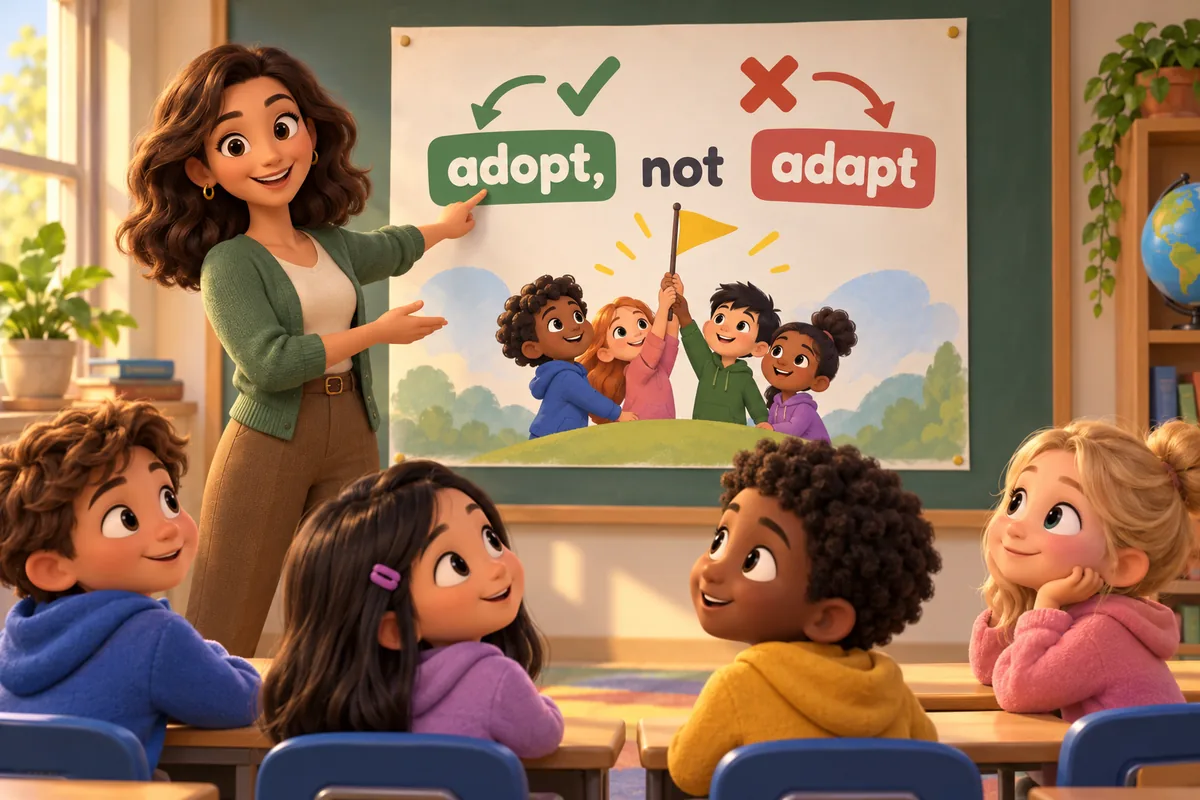
The adopt vs adapt pair turns on one question: does the thing change? Adopt takes something as your own and leaves it as it is, while adapt changes it, or changes you, to fit a new condition. Watch the pattern, since adopt takes an object directly and adapt takes to, for or from, and the two nouns adoption and adaptation keep the same distinction.
Frequently asked questions about adopt and adapt
Is adopt the same as adapt?
No. Adopt means to take something as your own, such as a policy or a child, and the thing does not change. Adapt means to change something, or to change yourself, to fit new conditions. The two verbs describe different actions, so they are not interchangeable.
Why do people mix up adopt and adapt?
The two words differ by one letter and one vowel sound, so they look alike on the page and run together in fast speech. Because both concern change, the wrong one can slip through spell-check, and only meaning and the following preposition reveal the error.
What preposition follows adapt?
Adapt takes to before the condition, as in adapt to a new job. It takes for before the person or group a thing is tailored to, as in adapt the text for beginners, and from before a source, as in adapt from a novel. Adopt needs no preposition before its object.
What are the nouns from adopt and adapt?
The noun from adopt is adoption, meaning the act of taking something up or taking a child into a family. The noun from adapt is adaptation, meaning the act of changing to fit or a rewritten work. Keeping the two nouns apart mirrors the verbs.