
Advocate means to publicly support a cause, and as a noun it names the person who does so. To use advocate in a sentence, decide first whether you need the verb, as in “She advocates for smaller classes,” or the noun, as in “He is a tireless advocate.” The two forms take different grammar.
Advocate at a glance
- Advocate is both a verb and a countable noun, and the two forms stress the word differently.
- As a verb it means to argue publicly for something, and it takes an object or the preposition for.
- As a noun it means a person who speaks up for a cause, as in an advocate for tenants.
- The usual objects are a cause, a policy, a reform or a group of people.
- The commonest error is mixing the forms, as in an advocate to change rather than an advocate of change.
What does advocate mean?
Advocate is a verb meaning to publicly support a cause or recommend a course of action, and a noun meaning a person who gives that support. The Cambridge entry for advocate records both parts of speech, and the grammar changes with them: the verb takes an object, while the noun takes of or for. A close formal verb is espouse, which adds the idea of adopting a belief rather than campaigning for it.
| Sense | Plain meaning | Example sentence |
|---|---|---|
| Verb: argue for | Publicly support a cause or group | She advocates for free school meals. |
| Verb: recommend | Put forward a course of action | The report advocates a shorter working week. |
| Noun: supporter | A person who speaks up for something | He is a lifelong advocate of clean air. |
One limitation is worth stating plainly. Advocate does not mean merely agree with something; it means to speak up for it in public. Somebody who quietly holds the same view is a supporter, not an advocate. When the support is a private opinion rather than public action, support is the safer word.
How do you use advocate in a sentence?
The patterns divide by part of speech. As a verb, advocate is transitive and takes a noun or a gerund, with for when the cause is a group of people. As a noun, it takes of or for before the thing supported, and it behaves like any other countable noun.
| Pattern | Example | What it signals |
|---|---|---|
| advocate + noun | The charity advocates reform of the law. | The direct object is the cause itself. |
| advocate + gerund | They advocate teaching coding earlier. | A gerund works where a that-clause would be clumsy. |
| advocate for + group | She advocates for rural patients. | For introduces the people the campaign serves. |
| be an advocate of / for | He is an advocate of open data. | The noun form, common in profiles and reports. |
| a leading / strong advocate | She became a leading advocate for change. | Adjectives that rank the person’s commitment. |
Advocate in a sentence: examples across contexts
Advocate keeps its meaning while the setting changes. The ten sentences below move from a classroom to a health campaign, and each one shows which part of speech is at work.
| Context | Example sentence | Why this works |
|---|---|---|
| Classroom | The debate captain advocates keeping the school library open at lunch. | A gerund object keeps the sentence smooth and clear. |
| Workplace email | Our team advocates for flexible hours in the new contract. | The for-phrase names the beneficiary group. |
| News report | The mayor has advocated a congestion charge for two years. | The present perfect shows a sustained public campaign. |
| Legal writing | Counsel advocated that the appeal should be heard quickly. | The that-clause follows advocate in formal prose. |
| Health campaign | Doctors advocate earlier screening for the disease. | The object is the action recommended, not the people. |
| Environmental group | The charity advocates for cleaner rivers. | For introduces the cause treated as an affected interest. |
| Opinion column | The writer advocates a return to local markets. | A noun phrase keeps the recommendation concrete. |
| Academic prose | Scholars advocate a mixed method of assessment. | The neutral present tense suits academic argument. |
| Conversation | I would advocate booking early if you want a seat. | The conditional softens a recommendation in speech. |
| Profile piece | She is a tireless advocate for carers. | The noun form describes the person rather than an action. |
Advocate vs support
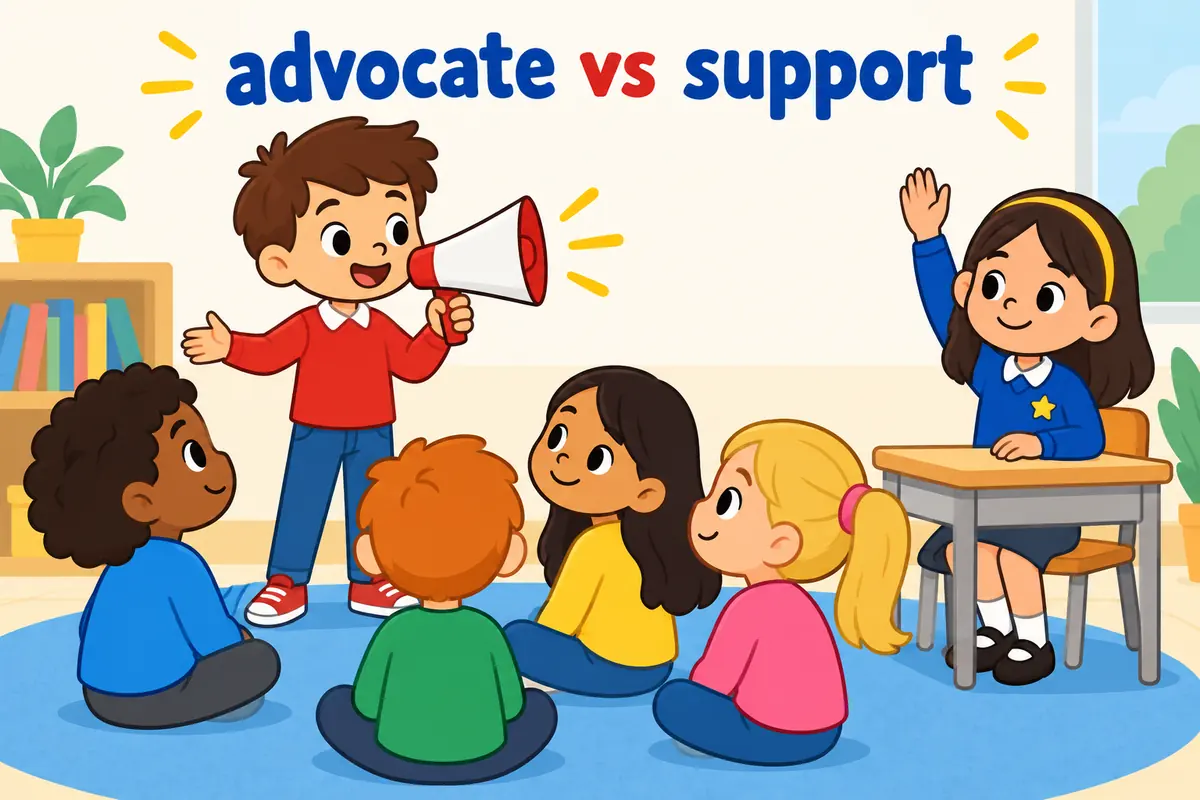
Advocate and support overlap, and the difference is how loudly each one acts. To advocate is to speak up in public for something; to support is to back it without necessarily campaigning. An advocate usually has a cause, while a supporter may simply prefer one option to another.
| Attribute | advocate | support |
|---|---|---|
| Core job | Speak up publicly for a cause | Back or favour something |
| Typical grammar | Verb with an object, or a noun with of | Verb, usually transitive |
| Public or private | Usually public and active | Can be private and passive |
| Typical subject | A campaigner, doctor, charity or report | A person, group or evidence |
| What it implies | Visible effort to persuade others | Approval without the campaigning |
Verdict: choose advocate when somebody campaigns in public for a cause, and support when they merely back it.
Word forms and grammar of advocate
Advocate keeps regular inflections in both parts of speech. The noun for the activity is advocacy, and proponent is a useful noun for a person who argues in favour of an idea. The table also marks the rare derived form.
| Form | Part of speech | Example |
|---|---|---|
| advocate | verb, base form | The panel will advocate a new approach. |
| advocates | verb, third person singular | The doctor advocates earlier testing. |
| advocated | verb, past and past participle | Residents advocated a crossing for years. |
| advocating | verb, present participle | She is advocating for better lighting. |
| advocate | noun, a person | He is a respected advocate of reform. |
| advocacy | noun, the activity | Their advocacy changed the policy. |
Watch the stress, because it separates the parts of speech. The verb ends with the sound of eight, while the noun ends with the sound of it. Saying the verb as though it were the noun is the pronunciation slip that marks a learner.
Common mistakes with advocate
- Incorrect:
She advocates about smaller classes.Correct: She advocates smaller classes. Rule: Advocate is transitive and takes no about when the cause is a thing. - Incorrect:
He is a strong advocate for to reduce waste.Correct: He is a strong advocate of reducing waste. Rule: The noun takes of or for plus a noun or gerund, never a for-infinitive. - Incorrect:
I advocate you to apply early.Correct: I advocate applying early. Rule: Advocate does not take an object plus infinitive; use a gerund or recommend instead. - Incorrect:
The minister advocated the law should change.Correct: The minister advocated that the law should change. Rule: A full clause needs the connector that after the verb. - Incorrect:
The board allocated for the new rule.Correct: The board advocated for the new rule. Rule: allocate hands out resources; advocate argues for a cause.
Practice using advocate
Work through the six items, then read the reasons rather than only the answers.
- Fill the gap: The charity ______ for cleaner air in the city.
- Choose the better word: The witness was asked to (advocate / allocate) the funds fairly.
- Correct the error: She is an advocate for to change the rules.
- Build a sentence: use advocate + gerund about a change to school hours.
- Spot the register: which belongs in a formal report — the panel advocates reform, or the panel is really into reform?
- Rewrite with the noun: He advocates for tenants. Use advocate as a person.
Answers
- advocates — the verb takes for before the group or cause it serves.
- allocate — the sentence is about sharing funds, which is allocate, not arguing for a cause.
- She is an advocate of changing the rules — the noun takes of plus a gerund.
- Model answer: The council advocates starting lessons later in the morning.
- The panel advocates reform — formal writing keeps the precise verb and object.
- Model answer: He is a strong advocate for tenants.
The bottom line
Use advocate in a sentence to describe public support for a cause, and match the grammar to the part of speech you choose. The two details that decide most sentences are these: the verb is transitive and takes a noun or gerund, while the noun takes of or for, and the word implies visible campaigning rather than private agreement. Where somebody backs a plan without speaking up, endorse or support is the plainer choice.
Frequently asked questions about advocate
Is advocate a verb or a noun?
It is both, and the grammar changes with the role. As a verb it takes an object, as in she advocates reform. As a noun it names a person and takes of or for, as in an advocate of reform. The two forms also sound slightly different at the end, which helps listeners tell them apart.
Do you say advocate or advocate for?
Both appear, with a small difference in focus. Advocate smaller classes treats the reform itself as the object; advocate for smaller classes often treats the cause as a group or interest being served, as in advocate for patients. American news writing uses the for-form freely, and British writers accept both.
What is the difference between advocate and support?
Advocate means to campaign publicly for a cause, while support means to back something without necessarily speaking up. A doctor who writes to a newspaper advocates screening; a neighbour who quietly agrees supports it. The first implies visible effort to persuade, and the second implies approval alone.
What is the noun for someone who advocates?
The noun is advocate itself, as in she is an advocate for carers. The activity is advocacy, as in their advocacy changed the law. When the sense is a person who argues for an idea rather than a group, champion and proponent are also common.
Do you often find yourself championing a cause or belief? If so, you may very well be an advocate. An advocate is someone who actively supports or promotes a particular cause, policy, or belief.
Advocates can be found in various areas such as social justice, environmental issues, healthcare, education, and more. They work to bring about change, raise awareness, and influence decision-makers. In essence, advocates are passionate individuals who dedicate their time and effort to making a positive impact on the world around them.
7 Examples Of Advocate Used In a Sentence For Kids
- Advocate for kindness and help your friends.
- Let’s advocate for keeping our environment clean.
- We should advocate for sharing and caring in our school.
- It’s important to advocate for speaking up against bullying.
- We can advocate for helping those in need.
- Always advocate for being respectful to everyone.
- We must advocate for following rules and staying safe.
14 Sentences with Advocate Examples
- Advocate for better mental health resources on campus by joining student committees dedicated to promoting awareness and well-being.
- As a student leader, you can advocate for changes that benefit your peers by running for a position in the Student Government Association.
- Utilize social media platforms to advocate for social justice issues that are important to you and your college community.
- Join clubs and organizations that advocate for sustainable practices on campus to promote eco-friendly initiatives.
- As a student journalist, you can advocate for transparency and accountability within your college administration through investigative reporting.
- Attend public forums and town hall meetings to advocate for policies that address student concerns and improve the overall college experience.
- Collaborate with faculty members to advocate for inclusive curriculum and diverse perspectives in academic courses.
- Engage in peaceful protests and demonstrations to advocate for changes in college policies that negatively impact the student body.
- Use your voice and platforms to advocate for gender equality and empowerment in campus discussions and events.
- Organize fundraisers and awareness campaigns to advocate for underprivileged students and access to quality education.
- Create petitions and collect signatures to advocate for necessary upgrades and improvements in college facilities.
- Advocate for financial aid and scholarships for students who face economic challenges but are still dedicated to pursuing higher education.
- Use your academic research to advocate for evidence-based policies and practices in different fields of study within your college.
- Encourage peer involvement and activism to advocate for student rights and interests in collaborative efforts.
How To Use Advocate in Sentences?
Advocate in a sentence for beginners:
When using the word advocate in a sentence, it is important to remember that it is a noun that refers to a person who publicly supports or recommends a particular cause or policy.
Here are some examples of how to use advocate in a sentence:
- “She is a strong advocate for animal rights and actively volunteers at the local shelter.”
- “The organization has hired a skilled advocate to help raise awareness for their campaign.”
- “As an advocate for gender equality, he speaks at conferences and events to promote the cause.”
- “The senator is known for being a vocal advocate for healthcare reform in the country.”
- “I have always been an advocate for sustainable living practices and try to implement them in my daily life.”
Remember to use advocate when describing someone who actively supports or promotes a cause, idea, or policy. By incorporating it into your sentences, you can effectively convey the message of support or recommendation for a particular issue.
Conclusion
In conclusion, the examples of sentences featuring the keyword “advocate” illustrate a variety of contexts in which individuals promote, support, or defend a particular cause or belief. It is clear that advocates play a crucial role in raising awareness, inspiring action, and effecting change on issues ranging from social justice to environmental conservation. These sentences demonstrate how advocates passionately champion their causes, urging others to join in their efforts and make a positive impact on the world.
Overall, the use of the term “advocate” in these sentences underscores the importance of individuals standing up for what they believe in and actively working towards creating a more just and sustainable future. By advocating for change and speaking out against injustice, advocates can inspire others to take a stand and contribute to making the world a better place for all.


