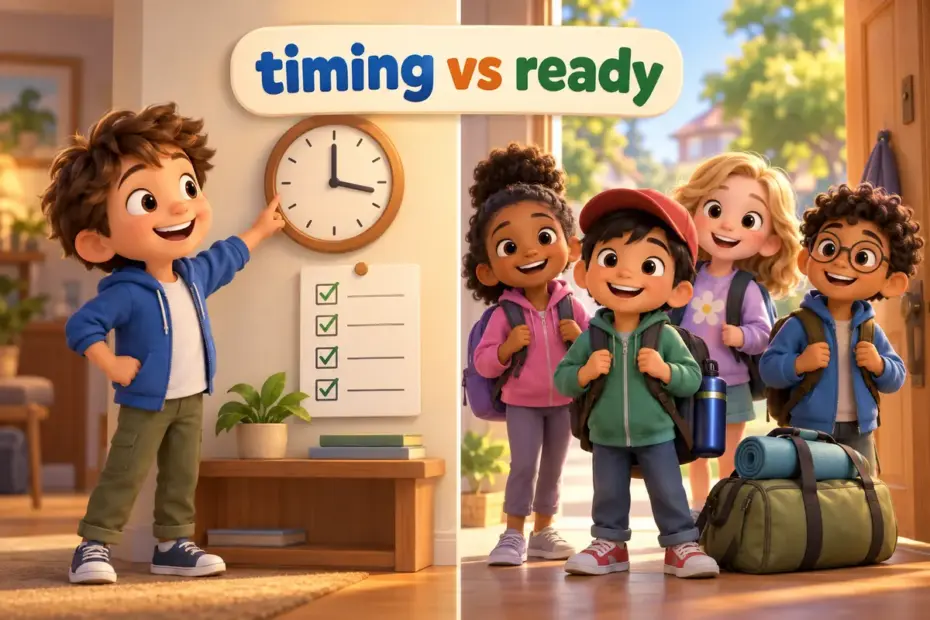
Already vs all ready share a sound but not a job: already is an adverb meaning before now, while all ready is the two words all and ready, meaning everyone or everything is prepared. “She has already left” marks time; “we are all ready to go” marks readiness.
Already vs All Ready at a glance
- Already is one word and an adverb of time.
- All ready is two words, the quantifier all plus the adjective ready.
- Already means before now or sooner than expected.
- All ready means everyone or everything is prepared.
- The commonest error is writing all ready where the sentence means by now.
What does already mean and what does all ready mean?
Already is an adverb meaning before now or earlier than expected; all ready is the phrase formed by all and ready, meaning that everyone or everything is prepared. The Cambridge entry for already and the Cambridge entry for all mark this split, and one line shows it: “the bus has already gone” is about timing, while “the children are all ready” is about a state of preparation.
| Sense | Word | Plain meaning | Example |
|---|---|---|---|
| Before now | already | Time adverb | She has already eaten. |
| Sooner than expected | already | Surprise at timing | You are already finished? |
| Everyone prepared | all ready | all plus ready | The team is all ready. |
| Everything in place | all ready | all plus ready | The boxes are all ready. |
| By a past point | already | Past perfect timing | By noon we had already left. |
What is the difference between already and all ready?
The difference is number of words and part of speech: already is a single adverb of time, while all ready is a quantifier and an adjective that together describe a group that is prepared. A familiar look-alike pair such as ad vs add is decided the same way, by asking what the sentence is really saying.
| Test | Already | All ready |
|---|---|---|
| Number of words | one | two |
| Part of speech | adverb | quantifier plus adjective |
| Core meaning | before now | everyone prepared |
| Can replace with | by now, so soon | all set |
| Typical frame | has already done | be all ready to do |
| Quick test | if it answers when, use already | if it answers who is prepared, use all ready |
Choose already when you could replace the word with by now, and all ready when you could replace it with all set.
How do you use already and all ready in a sentence?
Each form fits fixed frames, and the frame is a faster test than the sound; to watch the adverb mark time, read sentences using already.
| Pattern | Example | What it signals |
|---|---|---|
| have already + past participle | They have already gone. | timing before now |
| already before the verb | She already knows. | emphasis on the timing |
| be already + adjective | The gate is already open. | a state reached early |
| already at the end | I have told him already. | plain timing |
| be all ready to + verb | We are all ready to start. | everyone prepared |
| get all ready | The children got all ready. | the act of preparing |

Already and all ready in a sentence: examples across contexts
Reading the pair in different registers makes the choice automatic, and more letter-based traps sit in abel vs able.
| Context | Example sentence | Why this works |
|---|---|---|
| Classroom | The class has already handed in the projects. | already marks completed timing |
| Workplace email | The report is already on your desk. | already shows a completed action |
| News report | Prices had already risen before the vote. | already anchors a past point |
| Sports coaching | The players are all ready for the final. | all ready describes a prepared group |
| Everyday speech | Are you all ready to leave? | all ready asks about preparation |
| Storytelling | By sunrise the village was already awake. | already marks early timing |
| Travel | We are all ready with our tickets. | all ready plus a ready object |
| Teaching | The teacher asked if everyone was all ready. | all ready for a whole group |
| Planning | The venue is already booked for June. | already shows a done deal |
| Family life | The kids were all ready an hour early. | all ready as two words |
Which should you use?
Match the form to the question it answers: if the sentence asks when, use already; if it asks who is prepared, use all ready.
| Situation | Use | Example |
|---|---|---|
| Saying something happened early | already | The shop is already closed. |
| Saying a group is set | all ready | The team is all ready. |
| Stressing that a task is done | already | I have already checked it. |
| Preparing to start | all ready | We are all ready to begin. |
Register is the second test. Already belongs to timing in any style, from a text message to a news report, while all ready describes a group of people or things and usually follows the verb be. Neither replaces the other, so the honest limit is this: a sentence about preparation needs two words, and a sentence about timing needs one.
Word forms and grammar of already and all ready
The adverb has no forms of its own, while all and ready belong to other word classes, and another one-letter mix-up, addition vs edition, is caught the same way once the meaning is clear.
| Form | Part of speech | Example |
|---|---|---|
| already | adverb, one word | He has already called. |
| all | quantifier | They all arrived together. |
| ready | adjective | Dinner is ready. |
| all ready | two words | The choir is all ready. |
| ready | verb, informal | She readied the room quickly. |
| readily | adverb | He readily agreed. |
Common mistakes with already and all ready
Mistake 1: all ready for timing. Incorrect: She has all ready finished. Correct: She has already finished. Rule: timing before now takes the single adverb already.
Mistake 2: already for preparation. Incorrect: The crew is already to sail. Correct: The crew is all ready to sail. Rule: a prepared group takes the two words all ready.
Mistake 3: splitting the adverb. Incorrect: She has all already ready left. Correct: She has already left. Rule: already is a single word and stays whole.
Mistake 4: already with no time sense. Incorrect: The guests are already with coats. Correct: The guests are all ready with coats. Rule: if nothing happened before now, the word is all ready.
Mistake 5: dropping all. Incorrect: The bags are already packed. Correct: The bags are all ready and packed. Rule: talking about every item prepared needs all plus ready.
Practice using already and all ready
- Fill in the blank: The train has ___ left the platform.
- Choose the better word: The choir is (already / all ready) to sing.
- Correct the error: The players were all ready tired before halftime.
- Build a sentence: use all ready to say a group of hikers has prepared its gear.
- Spot the register: which line suits a news report, (a) It has already rained a lot, or (b) Loads of rain fell before?
- Fill in the blank: By the time we arrived, the doors were ___ closed.
Answers
- already, because it marks timing before now.
- all ready, because it describes a prepared group.
- The players were already tired before halftime; timing takes the single adverb.
- The hikers are all ready to set off.
- (a), because the adverb already suits a formal report.
- already, because it marks a state reached before our arrival.
The bottom line
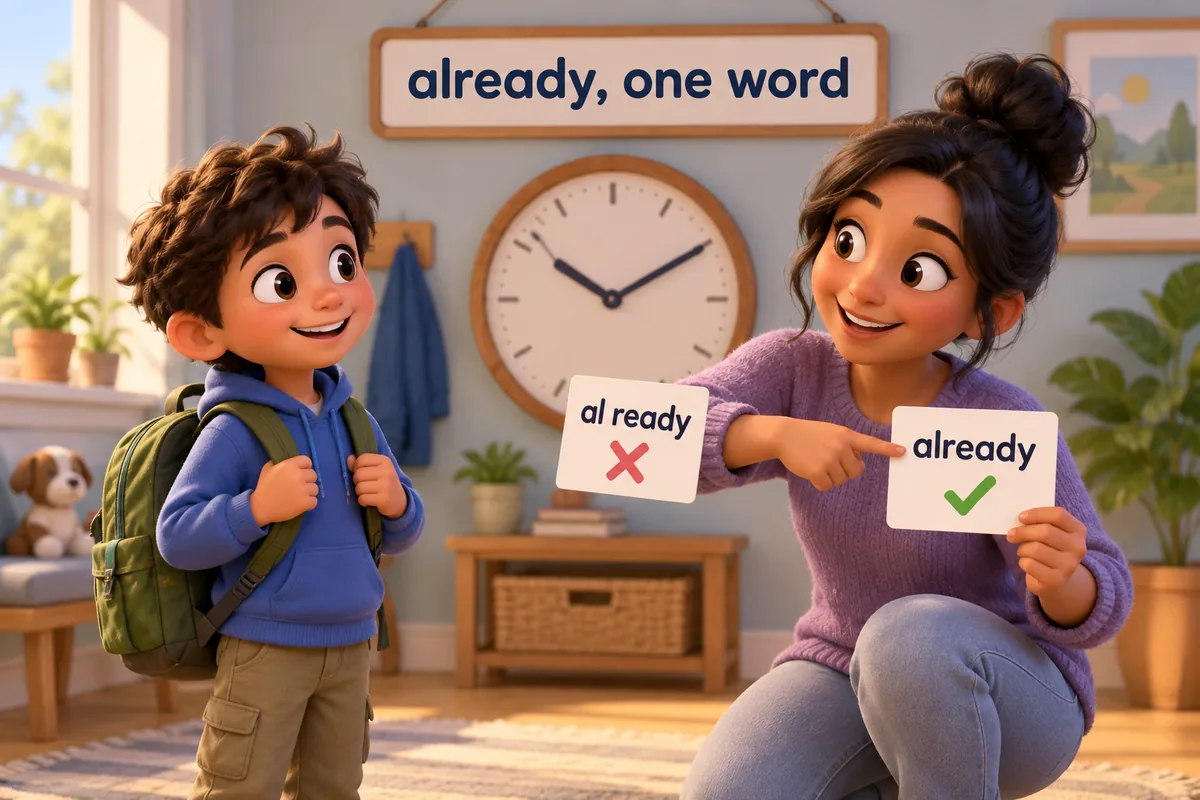
The already vs all ready choice comes down to number of words and meaning: already is one adverb that answers when, and all ready is two words that answer who is prepared. Use the replacement test, since by now points to already and all set points to all ready. The pairs sound identical, so a quick scan for the wrong number of words catches most errors on the page.
Frequently asked questions about already and all ready
Is all ready always two words?
Yes, when it means everyone or everything is ready. It is the quantifier all followed by the adjective ready, so it stays open as two words. The single word already is a different part of speech, an adverb of time, and never means prepared.
How can I tell already from all ready in writing?
Replace the word with a phrase. If by now or so soon fits, use the one-word adverb already. If all set or everyone prepared fits, use the two words all ready. The replacement test works because the two forms never share a meaning.
Does already ever mean everyone?
No. Already only concerns time, meaning before now or sooner than expected. The sense of everyone comes from all, which is a separate word in the phrase all ready. Confusing the two is what produces the commonest mistake with this pair.
Where does already go in a sentence?
Already usually sits between the auxiliary and the main verb, as in she has already left, or just before the main verb, as in she already knows. It can also end a sentence for plain emphasis, as in I have told him already. It never fills the adjective slot that ready uses.