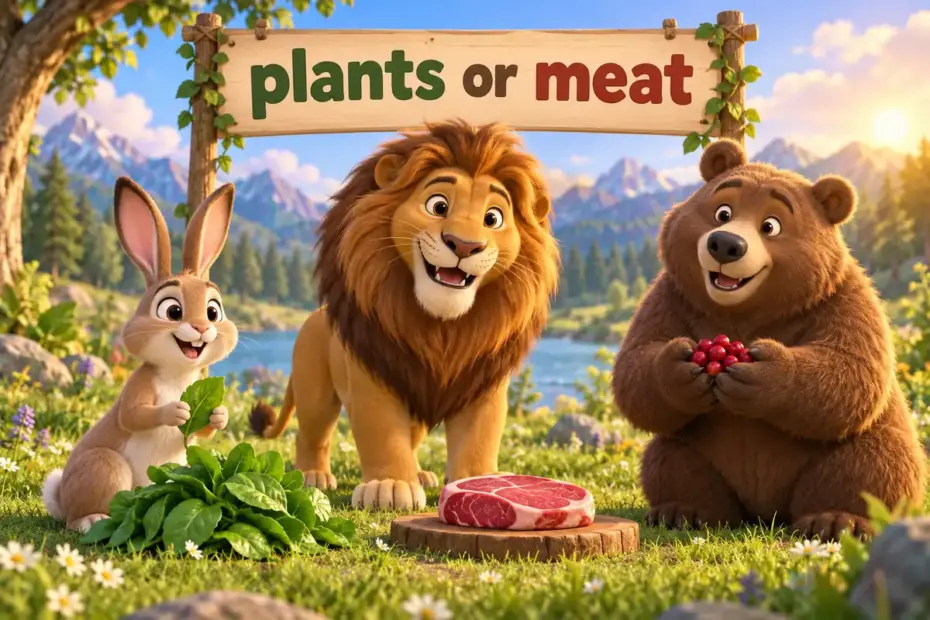
Animals and their food names split into three big groups: herbivores eat plants, carnivores eat other animals and omnivores eat both. The food itself has its own words too, so deer browse leaves, lions hunt meat and bears forage for berries, and each verb tells you how the animal eats.
Animals and their food names at a glance
- Herbivores eat plants; carnivores eat meat; omnivores eat both.
- Animal food has its own nouns, such as grass, carrion and nectar.
- The verb of eating differs by animal, as in graze, hunt and forage.
- Some animals are scavengers and eat dead animals.
- The commonest error is calling an omnivore a carnivore.
What are the groups for animals and their food?
Biologists sort animals by diet, and the three everyday English words are herbivore, carnivore and omnivore. A fourth useful word is scavenger, for animals that mainly eat dead animals rather than hunting or grazing. For a wide survey of species, the list of animals that start with A to Z shows how many diets the terms must cover.
| Group | Food eaten | Typical animals |
|---|---|---|
| Herbivore | plants, leaves, grass, seeds | deer, rabbits, cows, elephants |
| Carnivore | the flesh of other animals | lions, eagles, wolves, sharks |
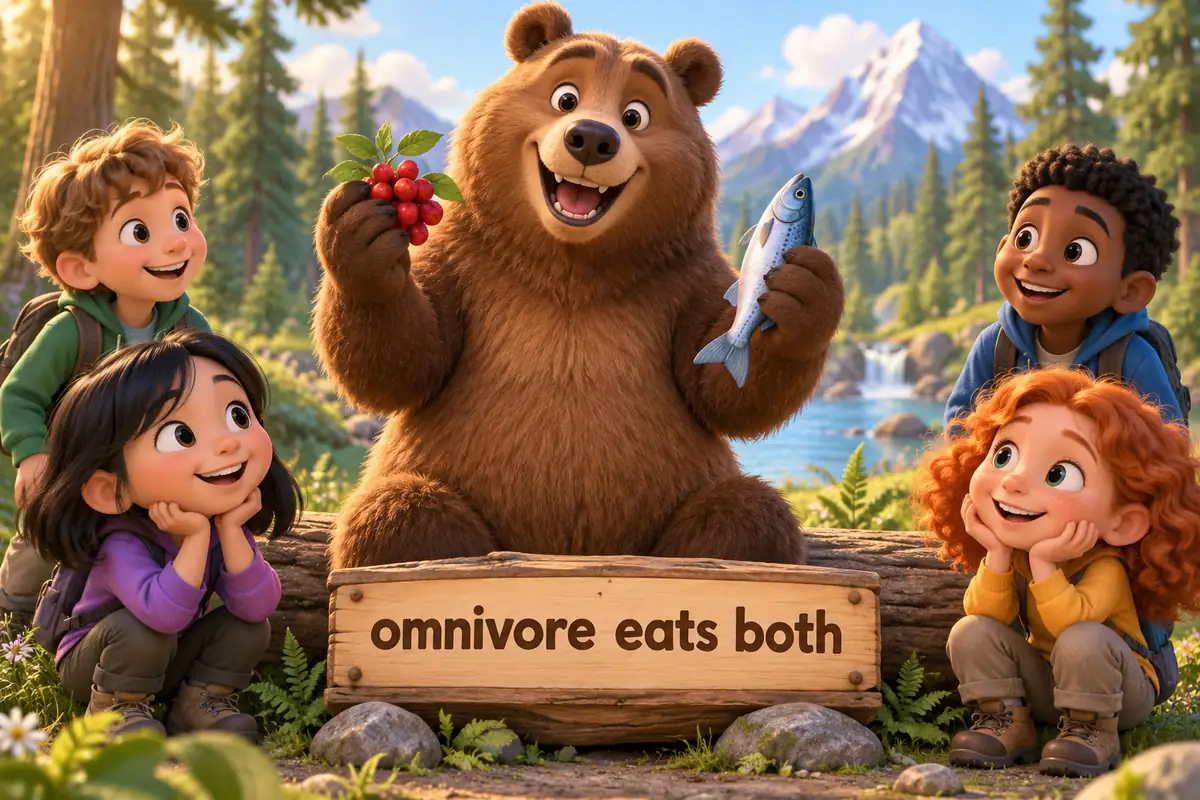
| Omnivore | both plants and animals | bears, pigs, humans, crows |
| Scavenger | dead animals and waste | vultures, hyenas, crabs |
| Nectar feeder | nectar from flowers | bees, hummingbirds, butterflies |
| Filter feeder | plankton from the water | whales, oysters, flamingos |
Two further words describe how an animal eats rather than what it eats. A predator hunts and kills its food, and a grazer eats plants where they grow. That is why a lion is both a carnivore and a predator, while a cow is a herbivore and a grazer but never a predator.
How do we talk about animal food in a sentence?
The diet words behave like ordinary nouns, and the verbs of eating follow the animal, so a cow grazes while a lion hunts.
| Pattern | Example | What it signals |
|---|---|---|
| a + group + eats + food | A herbivore eats only plants. | the diet in one line |
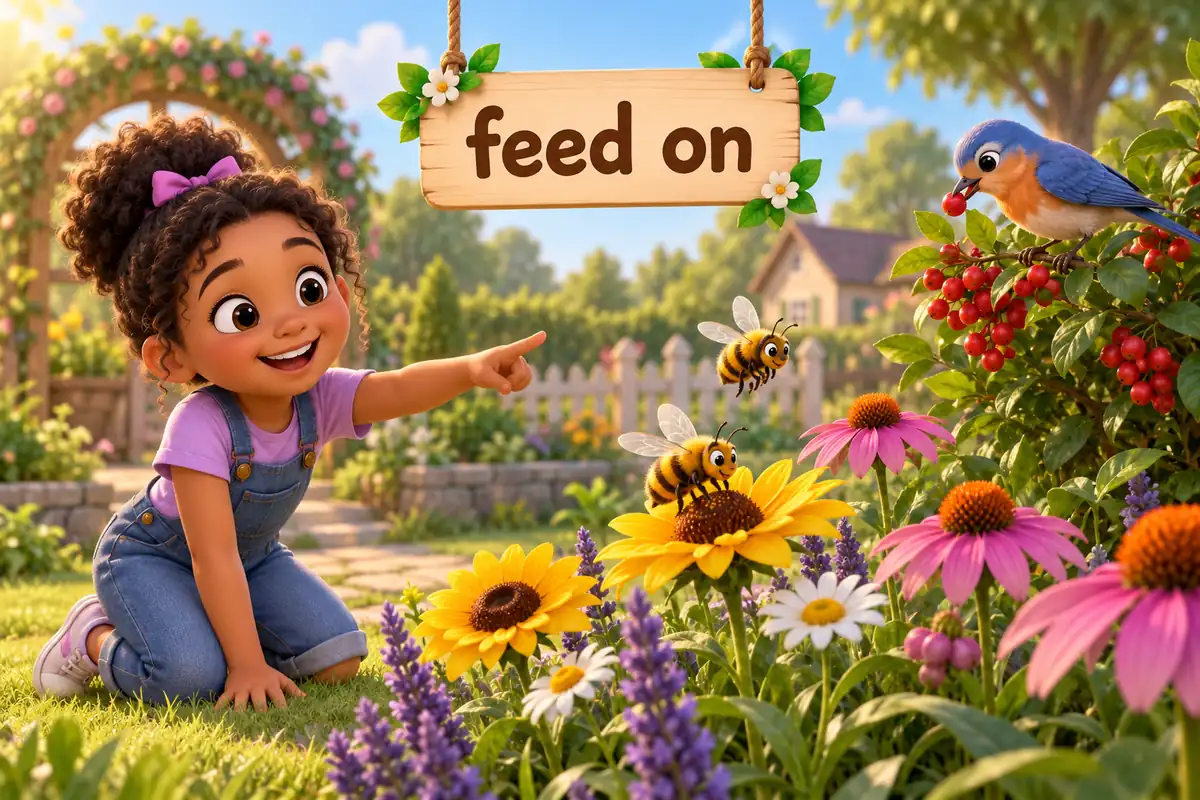
| animal + feed on + food | Bees feed on nectar. | what the animal eats |
| animal + graze on + food | Cattle graze on grass. | eating plants on the ground |
| animal + hunt + prey | Owls hunt small mice. | killing to eat |
| animal + scavenge for + food | Crows scavenge for scraps. | eating what is found |
| the diet of + animal | the diet of a fox | the food of one species |
Animals and their food names in sentences across contexts
The terms appear in science lessons, nature writing and food discussions, and every register keeps the three diet groups at its centre. Words such as fresh, ripe and rich appear in adjectives for food, which describe the meals these animals share with us.
| Context | Example sentence | Why this works |
|---|---|---|
| Classroom | A rabbit is a herbivore that eats grass. | names the group and the food |
| Science report | Wolves feed on deer and smaller mammals. | uses feed on for a carnivore |
| Nature writing | The bear forages for berries before winter. | an omnivore and its mixed diet |
| Farm note | The cattle graze on the lower field. | the verb for grass eating |
| Zoo sign | Vultures are scavengers of the plain. | names a diet group |
| Everyday speech | Our dog eats both meat and vegetables. | a simple omnivore example |
| Poem | Bees sip nectar from every bloom. | a small, vivid food verb |
| Food lesson | Honey comes from the nectar of flowers. | links animal food to human food |
| Academic writing | Diet shapes the teeth of every species. | a general, factual claim |
| Story | The hungry fox hunted mice in the dark. | the verb hunt drives the action |
| Garden note | Lacewings prey on tiny insects. | an insect carnivore |
| Travel writing | Flamingos filter plankton from the lake. | a filter feeder in a place |
The register decides between the technical word and the plain one. A textbook says herbivore, a farm note says grazer, and everyday speech says the cows eat grass. Use the technical term when the diet group matters and the plain verb when the action is the point.
Which word: herbivore, carnivore, or omnivore?
The three diet words look alike but describe opposite menus, so the food decides and the suffix helps you remember. Human eating habits sit in fast food in a sentence, a useful contrast with the natural diets above.
| Question | herbivore | carnivore | omnivore |
|---|---|---|---|
| Eats | plants only | animals only | plants and animals |
| Suffix clue | -vore means eater | -carni- means flesh | -omni- means all |
| Example | cow, elephant | lion, wolf | bear, pig |
| Typical teeth | flat grinding | sharp tearing | mixed |
| Common phrase | a strict herbivore | a top carnivore | a true omnivore |
| Everyday use | common | common | less common |
The suffix is the fastest clue. The ending -vore means eater, -carni- means flesh and -omni- means all, so the words almost explain themselves. Read the suffix and the menu appears, which is why omnivore and carnivore are so easily confused under time pressure.
Word forms and grammar of diet words
The diet nouns build a family from the root -vore, and the matching verbs and adjectives appear in science writing. Descriptive words such as wild and tame come from adjectives for animals and pair with the diet nouns here.
| Form | Part of speech | Example |
|---|---|---|
| herbivore | noun | A deer is a herbivore. |
| herbivorous | adjective | Herbivorous animals eat plants. |
| carnivore | noun | The lion is a carnivore. |
| carnivorous | adjective | Carnivorous plants trap insects. |
| omnivore | noun | A bear is an omnivore. |
| omnivorous | adjective | Pigs are omnivorous. |
| graze | verb | The sheep graze at dusk. |
The adjective forms end in -ous, so a plant-eating animal is herbivorous and a meat-eating one is carnivorous. The verb feed is irregular in meaning rather than form, because feed on signals a diet while feed alone signals giving food, as in she fed the cat.
Common mistakes with animal food words
Mistake 1: carnivore for an omnivore. Incorrect: A bear is a Correct: A bear is an omnivore that eats berries. Rule: an animal that eats plants too is an omnivore.carnivore that eats berries.
Mistake 2: herbivore with the wrong article. Incorrect: A cow is Correct: A cow is a herbivore. Rule: a singular noun needs a or an.herbivore.
Mistake 3: feed with a direct object wrong form. Incorrect: The bees Correct: The bees feed on nectar. Rule: feed on is the fixed phrase for an animal diet.feed nectar.
Mistake 4: hunt used for plants. Incorrect: The cow Correct: The cow grazes on grass in the field. Rule: hunt means chasing prey, not eating plants.hunts grass in the field.
Mistake 5: diet used for the animal. Incorrect: The Correct: The bear sleeps all winter. Rule: diet names the food, not the animal.diet sleeps all winter.
Practice using animal food words
- Fill in the blank: A lion is a ___ that hunts other animals.
- Choose the better word: A bear is an (herbivore / omnivore) because it eats berries and fish.
- Correct the error: The bees feed nectar.
- Build a sentence: use the pattern graze on about cows in a field.
- Spot the register: which suits a science report, (a) The fox munches stuff, or (b) The fox feeds on small mammals?
- Fill in the blank: Vultures are ___ that eat dead animals.
Answers
- carnivore, because a lion eats only the flesh of other animals.
- omnivore, because a bear eats both plants and animals.
- The bees feed on nectar; feed on is the fixed phrase.
- The cows graze on grass in the lower field all summer.
- (b), because feed on is the precise verb a report uses.
- scavengers, because scavengers eat dead animals and waste.
The bottom line
Animals and their food names organise into three diet groups, and the group tells you the whole menu. Herbivores eat plants, carnivores eat flesh and omnivores eat both, while scavengers live on dead animals. Match the group to the food and the verb of eating follows naturally.
Frequently asked questions about animal food names
What is the difference between a herbivore and an omnivore?
A herbivore eats only plants, while an omnivore eats both plants and animals. A rabbit is a herbivore because its diet is entirely plant material, and a bear is an omnivore because it eats berries, roots and fish. The test is whether any animal food is in the diet.
Are humans herbivores or omnivores?
Humans are omnivores, because a normal human diet includes both plant foods and animal foods. The term describes what the species can and does eat, not a rule about what any person must eat. Someone who chooses a plant-only diet is still a member of an omnivorous species.
What do we call an animal that eats dead animals?
An animal that mainly eats dead animals is a scavenger, such as a vulture, a hyena or a crab. Scavengers help clear remains and return nutrients to the soil. The word is separate from carnivore, which names an animal that hunts and kills its own prey.
Which verb describes how a cow eats?
A cow grazes, which means it eats grass and plants directly from the ground. The related noun is a grazer, used for animals such as cattle and sheep. Use graze on for the food, as in the cows graze on the meadow, and never hunt, which belongs to predators.