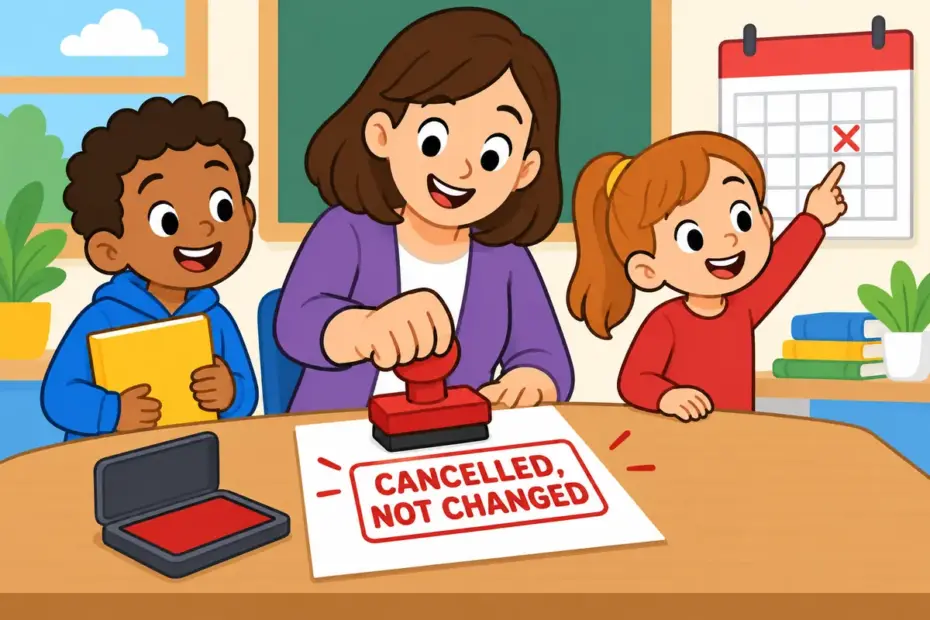
Annul means to cancel a law, marriage or agreement officially, so that it is treated as though it had never existed. To use annul in a sentence, put the authority first and the thing cancelled second: “The court annulled the contract.” The verb is transitive, so it always needs a law, marriage, contract or result as its object.
Annul at a glance
- Annul is a transitive verb; its forms are annuls, annulled, annulling and annulment.
- Annul means to cancel a law, marriage, contract or result so that it no longer counts.
- The subject is usually an official body: a court, a parliament, a tribunal or a regulator.
- Annul belongs to legal, formal and news writing rather than relaxed conversation.
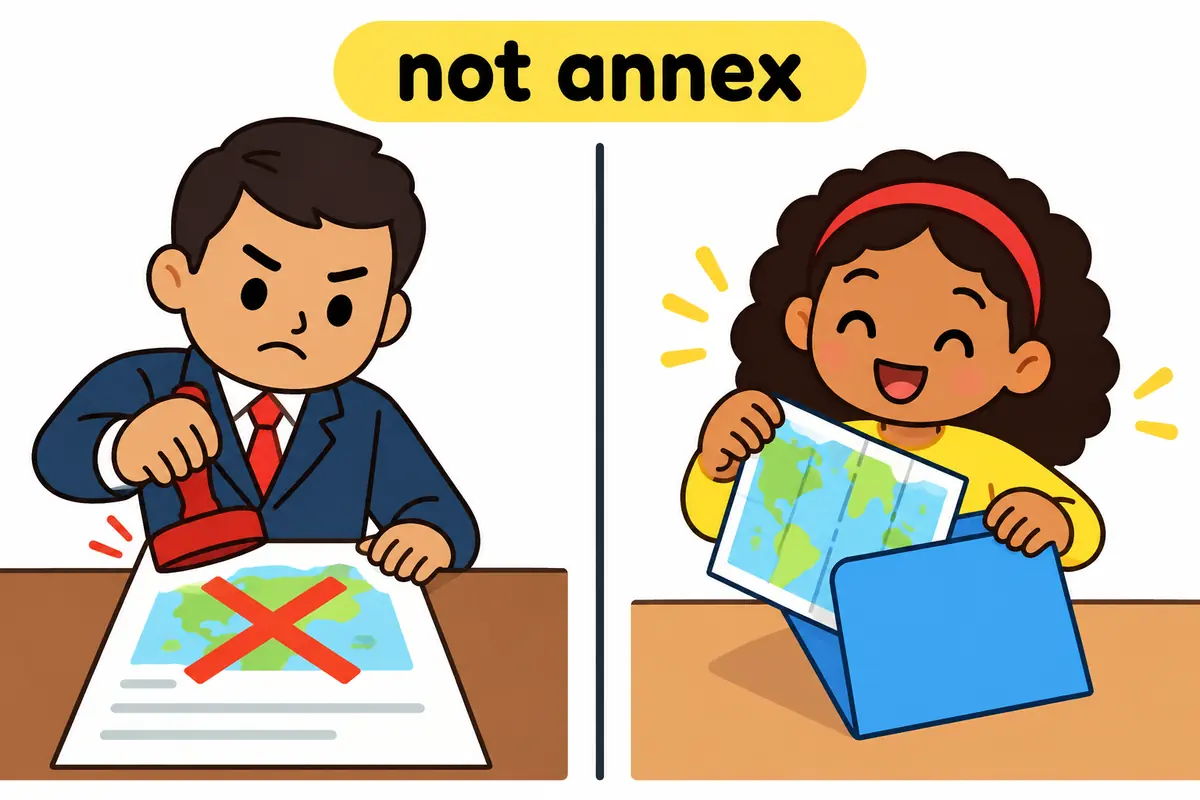
- The commonest error is spelling: annulled doubles the l, and annul is not annex.
What does annul mean?
Annul is a transitive verb meaning to cancel a law, marriage, contract or result officially, so that it is treated as invalid from the start. The Cambridge entry for annul records this sense of declaring something no longer valid, and the key point is that annul erases rather than repairs. Where a rule is only loosened, abolish a rule may fit better, because abolish ends a practice while annul wipes out one particular act.
| Sense | Plain meaning | Example sentence |
|---|---|---|
| Cancel a law or order | End a rule so that it no longer applies | Parliament annulled the emergency decree. |
| Declare a marriage void | Rule that a marriage never legally existed | The tribunal annulled the marriage after eight weeks. |
| Cancel a contract or result | Remove the legal force of an agreement or score | The referee annulled the goal for offside. |
| Wipe out a vote | Declare a ballot invalid | Judges annulled the election result in three districts. |
One limitation matters. Annul is not a general word for change or delay: a postponed wedding is not annulled, and a corrected invoice is not annulled either. The verb normally needs an authority with the power to declare the thing void, which is why sentences about private wishes rarely reach for it. A useful test is to ask whether the thing could be said never to have existed: if it can, annul is available, and if it merely stops from today, rescind or cancel is the honest choice.
How do you use annul in a sentence?
Put the deciding authority first and the cancelled item second: a court annuls a marriage, a parliament annuls a decree. Five patterns cover almost every real sentence, and the passive appears whenever the decision matters more than the body that made it.
| Pattern | Example | What it signals |
|---|---|---|
| court + annul + marriage | The court annulled the marriage. | An authority with power erases a legal status. |
| parliament + annul + law | Parliament annulled the old decree. | A rule stops applying from the day it was made. |
| be annulled | The vote was annulled after a recount. | Passive voice, used when the decision matters more than the body. |
| annul + a contract | The agency annulled the licence. | A formal permission is withdrawn completely. |
| annul + a result | Officials annulled the race result. | A recorded outcome is struck out rather than adjusted. |
Writers who want to remove a future obligation often choose rescind a ruling, which cancels something going forward, while annul reaches back and treats the act as never valid.
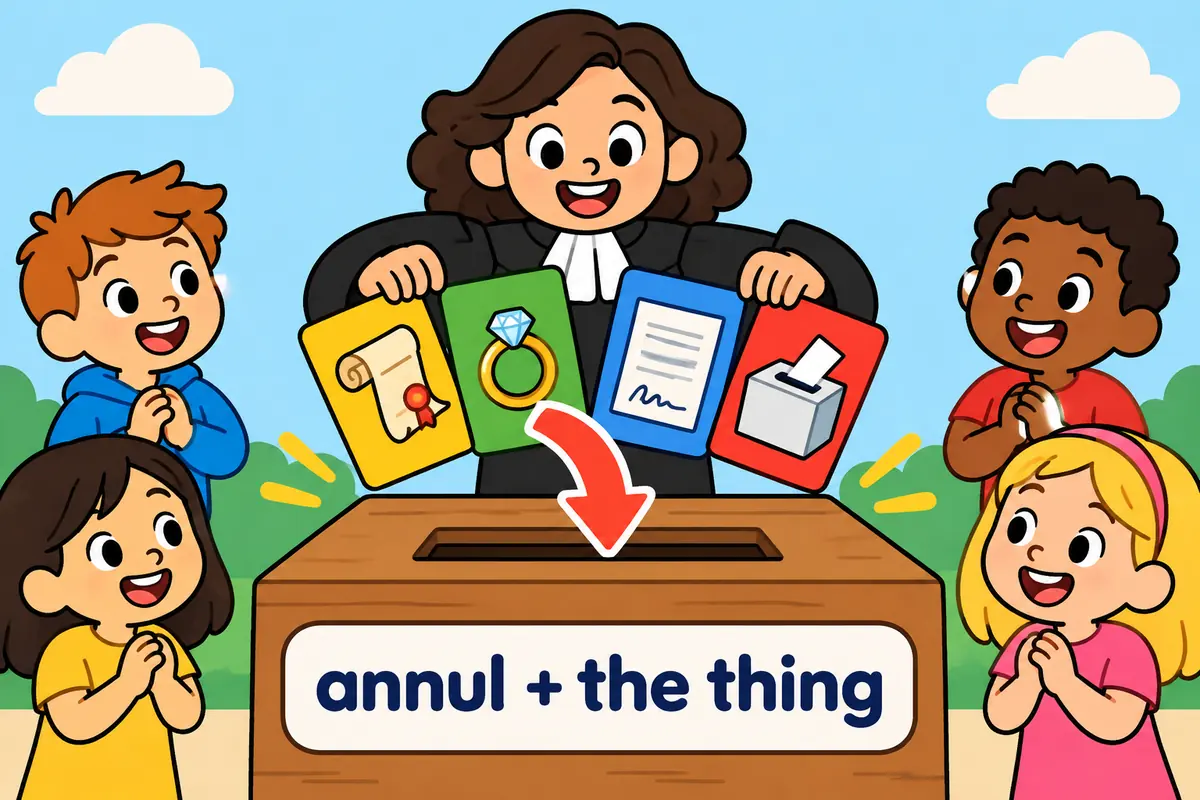
Annul in a sentence: examples across contexts
Annul keeps one meaning and shifts register from a classroom to a courtroom. The ten sentences below each name the authority doing the cancelling and the thing that stops counting.
| Context | Example sentence | Why this works |
|---|---|---|
| Classroom | The teacher annulled the quiz score after spotting a misprint. | A small official correction shows the erase-not-change sense. |
| Workplace email | The board annulled the earlier approval and asked for a fresh review. | Names the body and the decision, the natural formal pattern. |
| News report | The high court annulled the licence held by the broadcaster. | Pairs an authority with the thing it cancels, as reporting requires. |
| Legal writing | The tribunal annulled the marriage on the ground of non-disclosure. | Uses the marriage sense with a formal reason clause. |
| Contract drafting | Either party may annul the agreement if the deposit is unpaid. | Shows annul used for agreements rather than laws. |
| Political reporting | Lawmakers moved to annul the decree before it took effect. | Keeps the law sense and adds a time condition. |
| Sports report | The referee annulled the goal after consulting the video assistant. | A result sense that readers meet every weekend. |
| Academic prose | The committee annulled the earlier ballot and held a second vote. | Uses the vote sense in an impersonal register. |
| Business writing | The regulator annulled the merger approval it had granted in March. | Reaches back to undo a past official act. |
| Conversation | The club annulled the match once the pitch froze. | A plain everyday use of the cancel-a-result sense. |
Notice how often the passive carries the sentence. The vote was annulled and the marriage was annulled keep the cancelled act in the reader’s mind, while the authority slides to the end or disappears. Active sentences, by contrast, name the court or parliament because the question is who had the power to decide.
Annul vs nullify
Annul and nullify both cancel, but they differ in how complete the cancellation feels. nullify a result often means to remove the practical effect of something, while annul declares the thing itself invalid, as if it had never existed.
| Attribute | annul | nullify |
|---|---|---|
| Core job | Declare something invalid from the start | Remove the force or effect of something |
| Direction in time | Reaches back to the moment it began | Usually acts going forward |
| Typical object | A marriage, law, contract or vote | A result, effect, threat or advantage |
| Typical subject | A court, parliament or tribunal | A court, a rule or a counter-move |
| What it implies | The act never counted at all | The act stops counting now |
Verdict: choose annul when an authority declares a marriage, law or result invalid from the outset, and nullify when one thing cancels the practical force of another.
Word forms and grammar of annul
Annul doubles the l in every inflected form except the base, and its noun annulment compresses a whole official process into one word. The table also lists the spelling that learners produce by mistake.
| Form | Part of speech | Example |
|---|---|---|
| annul | verb, base form | The court will annul the licence. |
| annuls | verb, third person singular | The regulator annuls the permit each January. |
| annulled | verb, past and past participle | Parliament annulled the decree in 1998. |
| annulling | verb, present participle | The tribunal is annulling the earlier decision. |
| annulment | noun | The annulment took effect in June. |
| annuled | non-standard spelling | Write annulled, never annuled. |
Annulment and divorce are not the same remedy. A divorce ends a valid marriage, while an annulment declares that the marriage was never valid, which is why the two words appear in different sentences even when they describe the end of the same relationship. Keeping that distinction clear is the single most useful habit for a formal writer.
Common mistakes with annul
- Incorrect:
The government annuled the treaty.Correct: The government annulled the treaty. Rule: Annul doubles the l before -ed, so the past form is annulled. - Incorrect:
They decided to annul the meeting until Friday.Correct: They decided to postpone the meeting until Friday. Rule: Annul cancels completely; it never means to delay. - Incorrect:
The country annulled the neighbouring province.Correct: The country annexed the neighbouring province. Rule: annex territory means to take land, while annul means to cancel a rule. - Incorrect:
She annulled that the results were wrong.Correct: She had the results annulled. Rule: Annul takes a noun object, never a that-clause. - Incorrect:
The shop annulled its prices for the sale.Correct: The shop reduced its prices for the sale. Rule: Annul removes legal force, not value or price.
Practice using annul
Work through the six items, then read the reason beside each answer rather than only the key.
- Fill the gap: The court ______ the marriage after only three months.
- Choose the better word: The referee (annulled / annexed) the goal for offside.
- Correct the error: The judge annuled the earlier ruling.
- Build a sentence: use be annulled about a class vote that a recount overturns.
- Spot the register: which belongs in a legal letter — the tribunal annulled the licence, or they scrapped the licence?
- Rewrite with the noun: The court annulled the contract. Use annulment instead.
- Explain the difference: use annulment and divorce in one sentence about a marriage.
Answers
- annulled — the court is the authority and the marriage is the object, in the past tense.
- annulled — a goal is cancelled, while annexed would mean land was seized.
- The judge annulled the earlier ruling — the past tense doubles the l.
- Model answer: The class vote was annulled after the recount changed the total.
- The tribunal annulled the licence — a legal letter keeps the formal verb and avoids scrapped.
- The court ordered the annulment of the contract — the noun needs an article and a preposition.
- Model answer: The couple sought an annulment rather than a divorce because the marriage had never been valid — an annulment erases, a divorce ends.
The bottom line
Use annul in a sentence when an authority declares a marriage, law, contract or result invalid from the start. Two nuances decide most sentences: annul is transitive, so something must always be annulled, and it means erase rather than delay, so a postponed event is never annulled. When one thing simply removes the force of another, invalidate a vote or nullify is the sharper choice.
Frequently asked questions about annul
Is annul the same as cancel?
Annul is narrower than cancel. It means an official body declares a marriage, law or result invalid from the start, so the act never counted. Cancel is the everyday word for stopping a booking, a meeting or a plan, and it says nothing about whether the thing ever had legal force.
What is the noun form of annul?
The noun is annulment. It names the act or the resulting state, as in the annulment of the marriage took effect in June. Annulment often appears in legal and news writing because it compresses a whole official process into one word, while the verb annul is used when you want to name the authority doing the cancelling.
Does annul always mean a marriage is void?
No. A marriage is only one of the things a court can annul. Parliaments annul laws, regulators annul licences, and officials annul election results. The shared idea is that an authority declares something invalid from the start, so the meaning stays the same even when the object changes completely.
Can a person annul a contract alone?
Usually not. Annulment is an official act, so a single person cannot simply declare a contract void. A court, tribunal or regulator normally does the annulling after a challenge or a review. If two parties agree to end a contract privately, they cancel or terminate it rather than annul it.