Appease is a verb meaning to calm someone by giving in to what they want. To use appease in a sentence, name the person and the concession: “The manager appeased the crowd with a short delay.” The verb is transitive, and it often carries a hint of criticism.
Appease at a glance
- Appease is a transitive verb; its forms are appeases, appeased and appeasing, and its noun is appeasement.
- The core pattern is appease plus a person, as in appease the customer.
- A gift or concession usually follows with, as in appease the crowd with free tickets.
- The verb often implies that the calm was bought rather than earned.
- The commonest error is confusing appease with apprise, which means to inform.
What does appease mean?
Appease is a verb meaning to make someone calm or quiet by giving them what they want, often at some cost. The Cambridge entry for appease records the sense of pacifying a person by meeting their demands. The word carries a note of judgement: an appeased crowd may be settled, but the writer hints that the concession was slightly shameful. Where the goal is simply to ease a strong feeling, assuage the fear is the gentler and less political verb.
| Sense | Plain meaning | Example sentence |
|---|---|---|
| Calm a person | Soothe someone’s anger by giving in | The waiter appeased the diner with a free dessert. |
| Meet a demand | Give enough to end a complaint | The council appeased the residents by delaying the work. |
| Relieve a feeling | Ease an appetite or emotion | A short rest appeased his hunger for a while. |
Appease is not a compliment in most modern writing. It suggests a weak or short-sighted concession, so a leader who answers a reasonable request is better described as responding than as appeasing.
How do you use appease in a sentence?
Appease always needs an object, and the usual shape puts the person first and the concession second.
| Pattern | Example | What it signals |
|---|---|---|
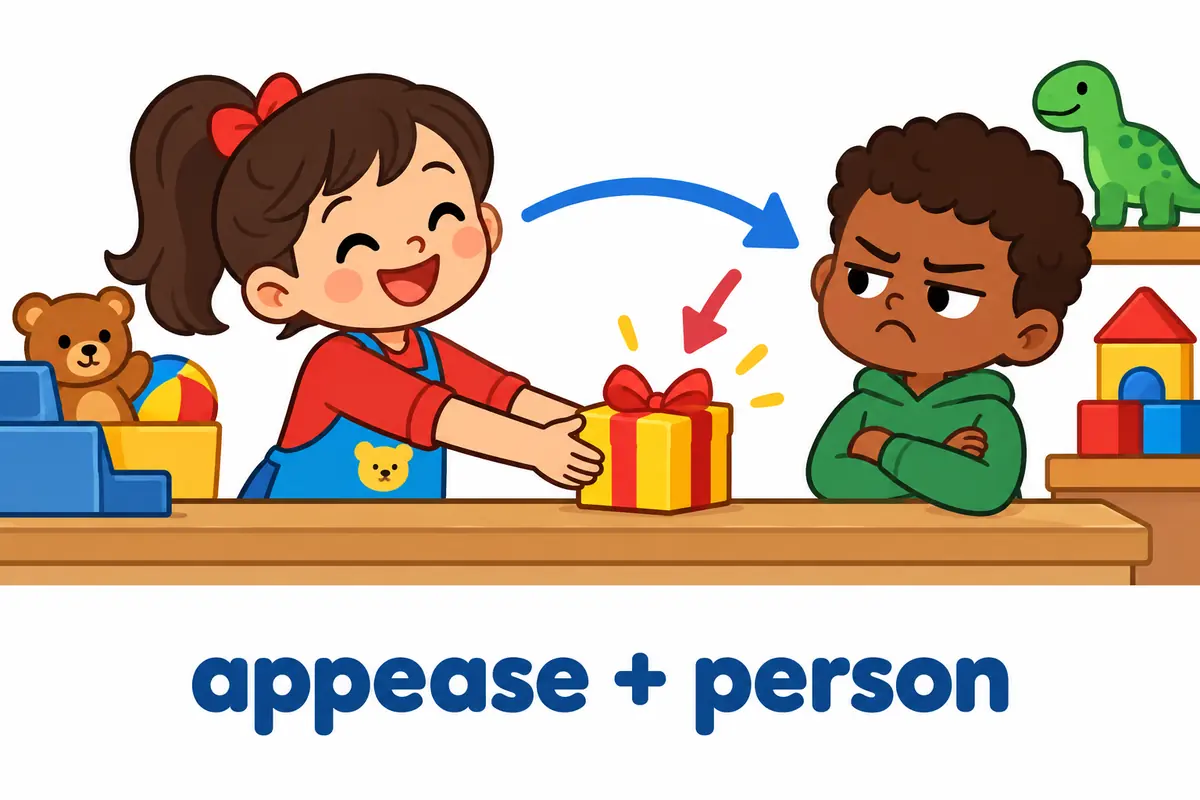
| appease plus person | The teacher appeased the class. | A person whose mood is settled |
| appease plus person plus with plus thing | She appeased the child with a story. | The concession that bought calm |
| appease plus appetite or demand | A snack appeased his hunger. | Something relieved rather than settled |
| passive voice | The protesters were appeased by a promise. | A concession described without blame |
| appease plus by plus action | He appeased them by lowering the fee. | The action that ended the complaint |
Appease in a sentence: examples across contexts
| Context | Example sentence | Why this works |
|---|---|---|
| Classroom | The teacher appeased the restless class with five extra minutes of play. | Shows the concession pattern in a school setting. |
| Workplace email | We appeased the client by promising an earlier delivery. | Names the action after by. |
| News report | The government tried to appease voters with a tax cut. | Carries the political, critical tone. |
| Parenting | She appeased the toddler with his favourite toy. | Everyday, physical object as concession. |
| Customer service | The airline appeased the stranded passengers with hotel vouchers. | Shows the cost borne by the giver. |
| Historical writing | The treaty was meant to appease the invading army. | The classic negative use. |
| Negotiation | Both sides appeased each other by dropping small claims. | Mutual concessions in one line. |
| Sports report | The coach appeased the substitute with a starting place. | Shows a strategic concession. |
| Restaurant review | The kitchen appeased complaining diners with a free dessert. | Concrete, sensory detail. |
| Political commentary | Handing out favours only appeased the crowd for a week. | Shows how temporary the calm is. |
A warm drink can soothe a crying child long before any gift is offered, and a mediator tries to conciliate both sides before tempers rise.
Appease vs placate
Appease and placate both describe handling an angry person, but they settle different things.
| Attribute | Appease | Placate |
|---|---|---|
| Core meaning | End a demand by giving in | Reduce someone’s anger |
| How it works | Give the person what they asked for | Calm the emotion, not the demand |
| Feeling | Wary and slightly critical | Neutral and tactical |
| Typical subject | Crowds, voters, angry groups | An annoyed individual |
| What it implies | Weakness or a short-term fix | Soothing a passing mood |
When only the emotion needs soothing, placate a customer is more neutral, and a well-chosen apology can mollify an editor without surrendering anything. By contrast, troops may pacify a district by force rather than concession. Choose appease when something real is given away, and placate when only the temper is managed.
Word forms and grammar of appease
| Form | Part of speech | Example |
|---|---|---|
| appease | base verb | Do not appease a bully. |
| appeases | third-person singular | He appeases his critics. |
| appeased | past tense | The gift appeased the child. |
| appeasing | present participle | They are appeasing the crowd now. |
| appeasement | noun | Appeasement rarely keeps the peace. |
| appeaser | noun for a person | The press called him an appeaser. |
| appease to | non-standard | Write appease the crowd, never appease to the crowd. |
Its noun appeasement is most familiar from political history, where it names a concession made to avoid a greater conflict.
Common mistakes with appease
- Incorrect:
Please appease me of any change.Correct: Please apprise me of any change. Rule: do not confuse appease with apprise, which means to inform. - Incorrect:
She appeased at the joke.Correct: She laughed at the joke. Rule: appease is transitive and needs an object. - Incorrect:
He appeased to the angry crowd.Correct: He appeased the angry crowd. Rule: appease takes a direct object without to. - Incorrect:
He appeased the complaint with a refund.Correct: He appeased the customer with a refund. Rule: a person is appeased, not a complaint. - Incorrect:
A snack appeased him of his hunger.Correct: A snack appeased his hunger. Rule: appease does not take of after its object.
Practice using appease
- Fill in the blank: The waiter ______ the diner with a free dessert.
- Choose the better word: The manager had to (appease / apprise) the angry customer with a refund.
- Correct the error: The council appeased to the residents.
- Build a sentence: use appease with a concession about a delayed train.
- Spot the register: which line belongs in a news report? (A) The minister appeased voters with a modest tax cut. (B) The minister gave the voters a nice little present.
- Fill in the blank: A short break ______ his hunger for an hour.
- Choose the better word: A calm apology may (placate / appease) an annoyed editor without giving anything up.
Answers
- appeased, because the diner is the object and the dessert follows with.
- appease, because a refund is a concession that calms the customer.
- The council appeased the residents, because appease takes no to.
- The station appeased the waiting passengers with free drinks, naming the person and the concession.
- A, because the neutral, formal register suits a news report.
- appeased, because hunger is the thing relieved.
- placate, because nothing is given away, only the mood is soothed.
The bottom line
Appease in a sentence usually puts a person straight after the verb and the concession after with, as in appease the crowd with free tickets. The word hints that calm was bought, which is why placate sounds more neutral and appease can sound critical. Use it deliberately, and the sentence will read as judgement rather than description.
Frequently asked questions about appease
Is appease always negative?
It is usually critical, because it implies that calm was bought with a concession rather than earned through argument. In news and history writing the negative tint is strong, as in a policy that appeases a dictator. The word can sound neutral when the demand is minor, but a careful writer often prefers satisfy or placate.
What is the noun form of appease?
The noun is appeasement, and it names the act of giving in to keep the peace. It is most familiar from political history, where it suggests a short-sighted concession. The related noun appeaser names the person who makes the concession, and both forms keep the slightly critical tone of the verb.
Can appease take a thing as its object?
Appease can take an appetite or a demand, as in appease his hunger or appease the request, but its most natural object is a person or an angry group. When the object is a feeling, the verb means to relieve it; when the object is a person, it means to calm them with a concession.
How is appease different from satisfy?
Satisfy simply means to meet a need or a standard, and it carries no judgement. Appease goes further by implying that the person was demanding and that the giver gave in. A product satisfies a customer, while a manager appeases a difficult crowd.
Do you know what it means to “appease” someone? In simple terms, to appease means to satisfy or pacify someone by giving in to their demands or wishes. This action is often done in an effort to avoid conflict or to make peace with the other party.
When you appease someone, you are essentially trying to keep them happy or calm by meeting their expectations or desires. This could involve compromising, offering concessions, or making gestures to alleviate any tension or disagreement.
7 Examples Of Appease Used In a Sentence For Kids
- Please share your toys to appease your friend.
- Let’s make a card to appease our teacher.
- We can sing a song to appease your little sister.
- Offering a cookie can appease your brother.
- Drawing a picture can appease your parents.
- Saying sorry can appease your friend.
- Sharing a story can appease your classmates.
14 Sentences with Appease Examples
- Appease your professors by submitting your assignments on time.
- Make sure to appease your parents by calling them regularly and updating them about your academic progress.
- It’s important to appease your roommates by respecting their boundaries and keeping the shared spaces clean.
- Don’t forget to appease your hunger by eating a nutritious meal before heading to class.
- Appease your thirst by carrying a water bottle with you to stay hydrated throughout the day.
- Remember to appease your curiosity by exploring new subjects and extracurricular activities.
- Appease your need for relaxation by taking short breaks between study sessions.
- You can appease your concerns about exams by creating a study schedule and sticking to it.
- Appease your desire for social interaction by joining clubs and participating in campus events.
- Don’t forget to appease your craving for knowledge by attending lectures and seeking out additional resources.
- It’s important to appease your financial concerns by budgeting wisely and seeking out part-time job opportunities.
- Make sure to appease your need for rest by getting an adequate amount of sleep each night.
- Appease your sense of adventure by exploring new academic opportunities and study abroad programs.
- Remember to appease your academic advisors by scheduling regular meetings to discuss your progress and future goals.
How To Use Appease in Sentences?
To use “Appease” in a sentence, follow these simple steps:
-
Understand the meaning of the word Appease: It means to pacify or soothe someone by giving them what they want. It can also mean to make peace or calm a situation.
-
Identify a situation where the word Appease can be used: For example, you could use Appease when talking about a parent giving a child a treat to calm them down.
-
Think of a sentence that includes the word Appease: “The mother tried to appease her crying baby by giving him a toy.”
-
Construct your sentence: Start with a subject (the mother), followed by the action (tried to appease), then the object (her crying baby), and finally include how she appeased him (by giving him a toy).
-
Ensure that your sentence makes sense and conveys the meaning of Appease accurately.
-
Practice using the word Appease in different contexts to become more comfortable with it.
Remember, using new vocabulary words may feel challenging at first, but with practice, it will become easier. Have fun incorporating Appease into your sentences to enhance your language skills!
Conclusion
In conclusion, the act of appeasing someone involves making gestures or concessions to calm a situation or satisfy a demand. An example would be when a country offers economic aid to appease a neighboring nation and prevent further conflict. Alternatively, a parent may offer a treat to their child to appease them after a tantrum. Overall, appeasing others can be a strategic way to maintain peace and harmony in various personal and diplomatic relationships by addressing concerns and reducing tensions through conciliatory actions.


