Appellation means a name or title, especially a formal or descriptive one. To use appellation in a sentence, name the thing first and then give its label: “The mountain earned the appellation Old Man.” The noun is countable, so it normally takes an article or a possessive, and it belongs to formal or literary writing.
Appellation at a glance
- Appellation is a countable noun; its plural is appellations.
- It means a name, title or descriptive label, ranging from the official to the playful.
- It usually follows a, the or a possessive such as its.
- The word belongs to formal, literary and wine-writing registers rather than speech.
- The commonest error is confusing appellation with the unrelated word appeal.
What does appellation mean?
Appellation is a countable noun meaning a name or title given to a person, place or thing. A second, narrower sense names the region a wine comes from, which is why the word survives in labels and restaurant lists. The Cambridge entry for appellation covers the general name sense, and the wine sense follows from it directly.
| Sense | Plain meaning | Example sentence |
|---|---|---|
| Name or title | A label given to a person or thing | The old bridge still carries its original appellation. |
| Descriptive nickname | A name that says what something is like | He earned the appellation the Quiet Captain. |
| Wine region | The place of origin on a wine label | The bottle lists a single appellation from the Loire. |
The word is close to a formal designation, which is a title assigned by an authority. An appellation can be invented by anyone, while a designation is usually recorded, so the two are cousins rather than synonyms.
One limitation is worth stating. Appellation is not the word for an ordinary category or a generic noun; you would not call every table an appellation. It also does not mean reputation, so a good appellation is simply a pleasing name, not a good standing.
How do you use appellation in a sentence?
The noun almost always follows a determiner and a verb that awards or records the name. Five patterns cover nearly every real sentence, and the formal ones keep the appellation in quotation marks or capitalize it as a proper title.
| Pattern | Example | What it signals |
|---|---|---|
| earn / gain + the appellation + name | The rider earned the appellation the Iron Man. | A name is won by behaviour or reputation. |
| be known by + the appellation + name | The plant is known by the appellation lamb’s ear. | An established common name is recorded. |
| the appellation + of + place | The appellation of Beaujolais covers a wide area. | A region or origin name is defined. |
| its / his / her + appellation | The ship lived up to its grand appellation. | The name belongs to the thing already named. |
| give + object + the appellation | Critics gave the film the appellation a slow triumph. | People assign the label. |
In wine writing the word behaves like a technical denomination of origin, fixed and official. Elsewhere it is looser, and a sobriquet or nickname is the more natural choice for something playful.
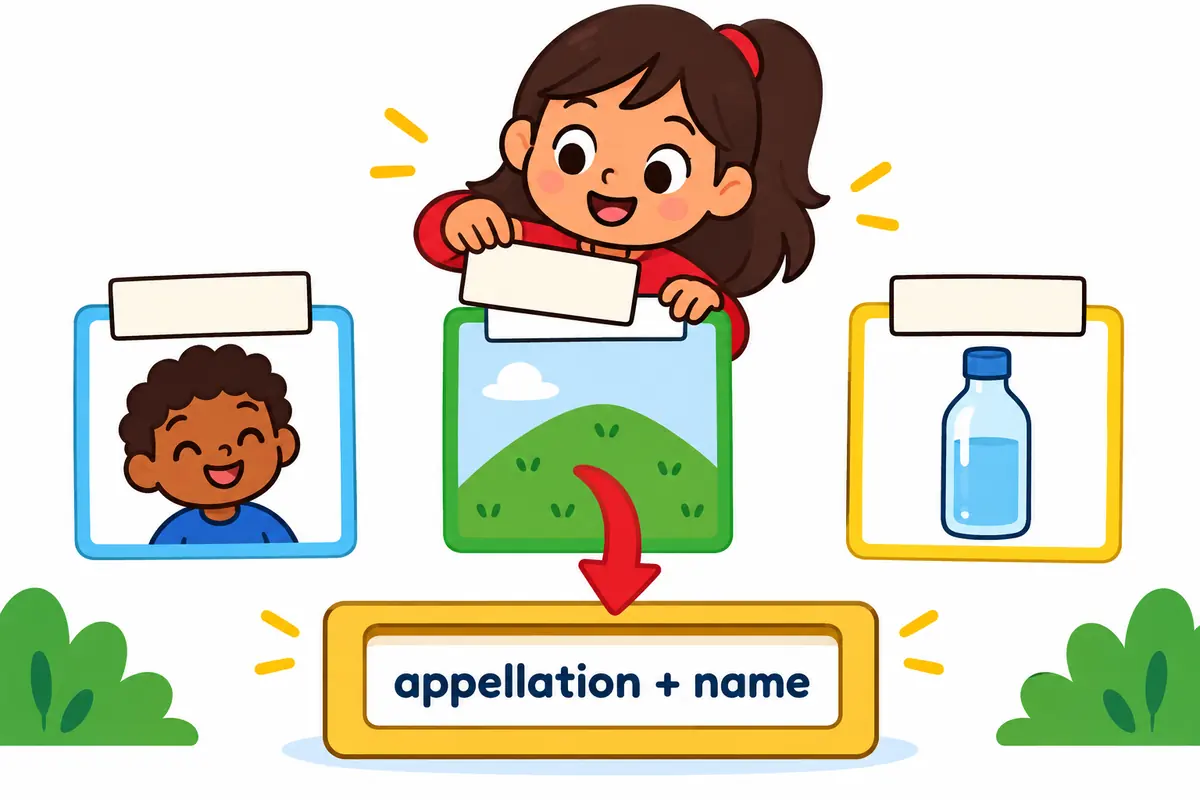
Appellation in a sentence: examples across contexts
Appellation changes register more than meaning. The nine sentences below keep the same noun while moving from a classroom to a wine list, and each one attaches the name to something specific.
| Context | Example sentence | Why this works |
|---|---|---|
| Classroom | The class gave the new hamster the appellation Sir Nibbles. | A playful title shows the word is not only formal. |
| School report | Her classmates settled on the appellation the Spelling Bee. | A descriptive label built from a talent reads naturally. |
| Travel writing | The valley carries the appellation Land of a Thousand Springs. | A place name in the descriptive sense. |
| News report | The district earned the appellation the Silicon Prairie. | A nickname adopted by the press, used with quotation marks. |
| Wine list | This white comes from a single appellation in Alsace. | The technical origin sense, standard on labels. |
| Literary prose | The poet disliked the appellation the Great, which critics had invented. | Shows the name was imposed rather than chosen. |
| Botany note | The species is known by the common appellation cuckoo pint. | An established folk name recorded in a field guide. |
| History essay | Later historians dropped the appellation the Cruel. | A name can be revoked as reputations change. |
| Conversation | His friends use the appellation Doc because he fixes everything. | The playful everyday register of the noun. |
Only the wine sentence uses the noun as a technical term. Everywhere else it is a name someone chose, which is why the surrounding verb is usually earn, give or use.
Appellation vs nickname
Appellation and nickname both name a person, and they differ in register and origin. Appellation is formal or literary and can be official; a friendly nickname is informal and usually affectionate. Using appellation for a pet name sounds deliberately grand.
| Attribute | appellation | nickname |
|---|---|---|
| Register | Formal, literary, sometimes official | Informal and conversational |
| Who assigns it | An authority, a region or a tradition | Friends, family or fans |
| Typical subject | A place, a wine, a historical figure | A person one knows |
| Feeling | Neutral to respectful, occasionally ironic | Affectionate or teasing |
| Example | The appellation El Libertador | Charlie, short for Charlotte |
Verdict: choose appellation when the name is formal, recorded or descriptive, and nickname when it is personal and informal. A witty sobriquet sits between them, at home in wit and journalism.
Word forms and grammar of appellation
Appellation is a regular noun, and its rarity is part of its effect: the singular is used far more often than the plural. The table also lists a related adjective and an unrelated word that learners mistake for it.
| Form | Part of speech | Example |
|---|---|---|
| appellation | noun, singular | The appellation pleased nobody who used it. |
| appellations | noun, plural | French appellations are strictly regulated. |
| appellative | adjective or noun, rare | The essay uses the appellative habit of renaming. |
| appeal | noun or verb, different meaning | The ruling is open to appeal. |
| appellation contrôlée | fixed French phrase | The label reads appellation contrôlée. |
Common mistakes with appellation
- Incorrect:
The wine has a protected appeal.Correct: The wine has a protected appellation. Rule: Appeal means an attraction or a legal request; appellation means a name or origin. - Incorrect:
She is a famous appellation in physics.Correct: She is a famous figure in physics. Rule: Appellation is the name, not the person who carries it. - Incorrect:
The appellation of the street is named after a poet.Correct: The street takes its appellation from a poet. Rule: A name is not itself named; choose takes or receives. - Incorrect:
We visited several appellation’s last week.Correct: We visited several appellations last week. Rule: The plural is appellations, never a possessive. - Incorrect:
Every table is an appellation.Correct: Every named table carries its own appellation. Rule: The noun labels a specific named thing, not a whole category.
Practice using appellation
Work through the six items, then check the reasoning rather than only the answer.
- Fill the gap: The ridge earned the ______ the Sleeping Giant long before maps existed.
- Choose the better word: At a formal dinner, refer to the wine region as its (appellation / nickname).
- Correct the error: The town has a protected appeal for its cider.
- Build a sentence: use be known by the appellation about a wild flower with a folk name.
- Spot the register: which belongs in a wine guide – the appellation is strictly defined, or we gave it that name, no idea why?
- Rewrite in the plural: The label lists one appellation. Make it more than one.
Answers
- appellation – the name given to the ridge is exactly what the noun means.
- appellation – a formal dinner calls for the official name, not a pet one.
- The town has a protected appellation for its cider – appeal means attraction, not a registered name.
- Model answer: The bluebell is known by the appellation fairy thimble in the old county.
- The appellation is strictly defined – a wine guide is technical and impersonal.
- The label lists several appellations – the plural simply adds s.
The bottom line
Use appellation in a sentence when something carries a name or title, and keep the noun close to a determiner and a verb such as earn or give. The two nuances that decide most sentences are these: the word is formal, so a casual context prefers nickname, and the wine sense is a fixed technical technical term rather than a general one. A name assigned by an authority is the closest ordinary meaning.
Frequently asked questions about appellation
Is appellation a common word?
Appellation is uncommon in everyday speech and belongs to formal, literary and technical writing. It survives strongly in wine labels, where it names a regulated place of origin. In ordinary conversation most people say name, title or nickname, and appellation would sound deliberately grand.
What is the difference between appellation and nickname?
An appellation is a formal or descriptive name, sometimes official, such as a wine region or a historical title. A nickname is informal and usually affectionate, given by friends or family. Both name something, but only the appellation can appear on a certificate or a label without irony.
Does appellation always mean a place name?
No. The general sense is any name or title, as in the appellation the Quiet Captain. The place-name sense is a narrower use tied to wine regions and origin labels. Only context tells you which one is meant, so check whether the sentence is about wine or about a person.
Can appellation be plural?
Yes, the plural is appellations, as in French appellations are strictly regulated. It is used mostly in technical and official writing about several regions at once. The singular is far more common because the noun usually names one specific thing at a time.
Have you ever come across a word that seemed unfamiliar or unique in its usage? This type of word is commonly known as an “appellation,” and it refers to a name or title that is used to identify someone or something in a distinctive way.
An appellation can be a formal designation, a nickname, or an alternate term used to label a person, place, or thing. It serves as a way to distinguish and categorize, providing clarity and understanding in communication.
7 Examples Of Appellation Used In a Sentence For Kids
- Appellation means a special name or title for something.
- I have an appellation for my pet dog, it is Sparky.
- Tell me your appellation, that is your nickname.
- The appellation for a baby cat is a kitten.
- What is the appellation for a baby sheep? It is a lamb.
- My appellation is Buddy because I am everyone’s friend.
- Do you have a special appellation for your favorite toy?
14 Sentences with Appellation Examples
- Appellation is another term for a descriptive name or title given to a person.
- It is important to address your professors with the proper appellation, such as Dr. or Professor.
- In India, it is common to use specific appellations to show respect to elders or authority figures.
- When writing academic papers, it is crucial to include the correct appellation for any references cited.
- The Indian education system places a strong emphasis on using the appropriate appellation for individuals based on their status.
- In formal settings, students are expected to use the appropriate appellation to address dignitaries and officials.
- Understanding cultural norms around appellation usage is essential for effective communication in academic and social settings.
- The use of appellations plays a significant role in maintaining decorum and respect in Indian colleges and universities.
- Students should be aware of the hierarchical structure within academic institutions to know when to use specific appellations.
- Misusing an appellation can be seen as disrespectful and may lead to misunderstandings or strained relationships.
- Professors may have specific preferences for their appellations, so it’s essential to inquire about the preferred form of address.
- The student body president’s appellation can vary across different colleges and universities in India.
- Graduating students may be awarded honorary appellations based on their academic achievements during college.
- Collaborating with classmates to address group projects using the appropriate appellation can foster a sense of professionalism and mutual respect.
How To Use Appellation in Sentences?
Appellation refers to a name or title used to identify someone or something, especially in regard to geographical locations or products such as wines. When using the word Appellation in a sentence, it is important to ensure that it is used in the correct context.
Here’s a simple guide on how to use Appellation in a sentence:
-
Appellation is usually placed at the beginning or middle of a sentence. For example, “The wine’s Appellation was printed on the label.”
-
Appellation can also be used in a sentence to describe a specific place or region. For instance, “The cheese’s Appellation indicated that it was produced in France.”
-
Remember to capitalize Appellation when it is used as part of a proper noun, such as “Napa Valley Appellation.”
-
Always make sure that the sentence makes sense and provides clarity when using the word Appellation. Avoid using it in a way that may confuse the reader.
By following these simple guidelines, beginners can easily incorporate Appellation into their sentences accurately and effectively. Remember to practice using Appellation in different contexts to become more familiar with its usage.
Conclusion
In conclusion, sentences with the appellation “Dr.” before a name typically indicate that the individual holds a doctorate degree in a specific field, such as medicine, psychology, or education. This honorific title is used to address and recognize the expertise and qualifications of the person being referred to. For instance, “Dr. Smith will be leading the research team” signifies that an individual named Smith, who has earned a doctorate, will be in charge of the research efforts.
Furthermore, the use of the appellation “Mrs.” or “Mr.” before a name usually denotes that the person is married or is perceived as an adult. These titles are commonly used in formal and respectful contexts to address individuals with a certain level of dignity and respect. For example, “Mrs. Johnson will be the keynote speaker at the event” conveys that a married woman named Johnson has been selected to deliver the main address.


