Arbitrary means based on personal choice or chance rather than reason, rule or system. To use arbitrary in a sentence, name the decision and the authority behind it: “The deadline felt arbitrary.” The adjective often describes rules, decisions, numbers and selections that seem random because no principle explains them.
Arbitrary at a glance
- Arbitrary is an adjective; its forms are arbitrarily (adverb) and arbitrariness (noun).
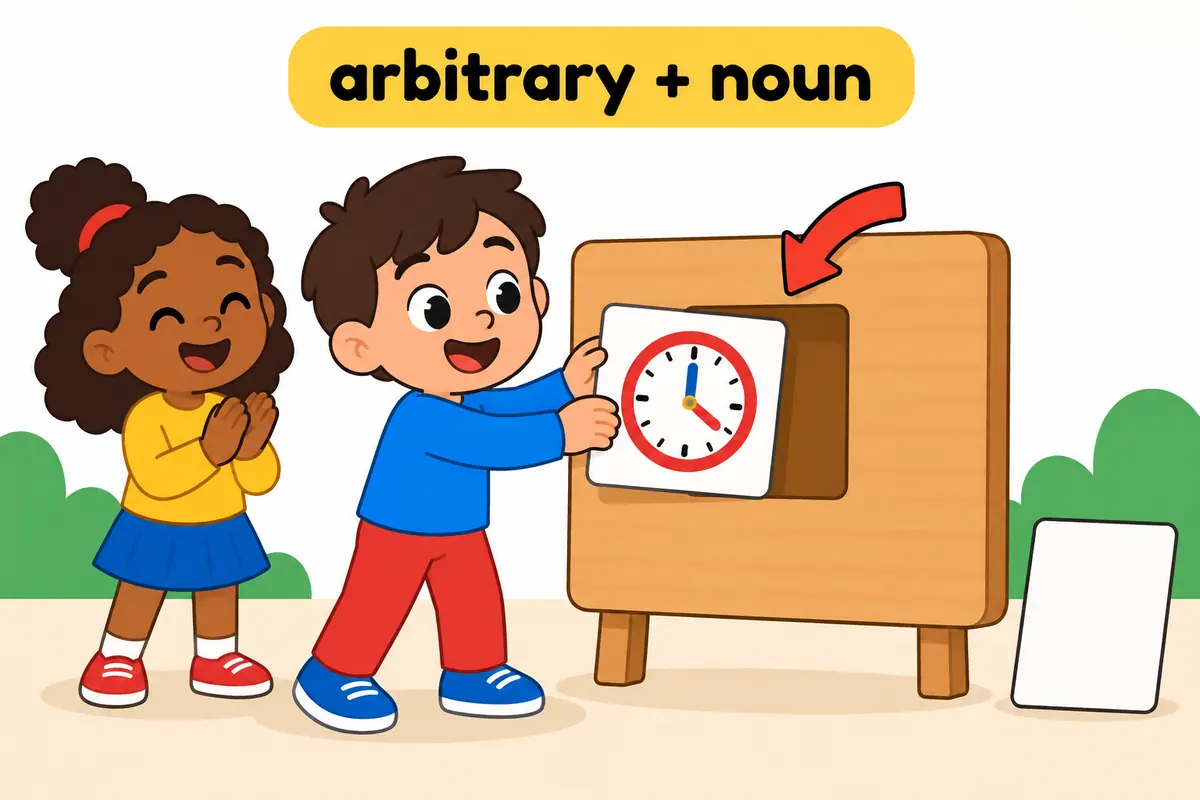
- The dominant pattern is arbitrary + noun, as in an arbitrary decision or an arbitrary rule.
- Arbitrary applies to decisions, rules, numbers, selections and choices, not to whole people.
- Common collocations include arbitrary decision, arbitrary power and seemingly arbitrary.
- The commonest error is using arbitrary when random is intended; arbitrary implies a chooser.
What does arbitrary mean?
Arbitrary is an adjective meaning decided by personal whim or chance instead of a rule or reason. The Cambridge entry for arbitrary records the neutral sense of a choice made at random as well as the critical sense of power used without principle. The three senses below differ by whether a person chose and whether anyone was harmed.
| Sense | Plain meaning | Example sentence |
|---|---|---|
| Based on whim | Decided by personal choice, not by rule | The team changed the rules on an arbitrary basis. |
| Unreasoned and unfair | Applied without a fair or stated principle | The fines were criticised as arbitrary. |
| Chosen at random (mathematics) | Any one of a set, fixed for convenience | Choose an arbitrary point on the line. |
Arbitrary is not a synonym for optional. A compulsory rule can be arbitrary if nothing justifies it, so the criticism is about missing reasons rather than about force. It also shades into irrational only loosely, because an irrational decision contradicts logic, while an arbitrary decision simply has no rule behind it and may even be harmless.
How do you use arbitrary in a sentence?
Arbitrary almost always sits before the noun it judges, or after a linking verb such as be, seem or feel. The adverb arbitrarily is used when the choosing itself is the point.
| Pattern | Example | What it signals |
|---|---|---|
| arbitrary + noun | an arbitrary deadline | The noun names the decision being judged |
| be / seem / feel + arbitrary | The rule seems arbitrary. | A judgement about fairness |
| be arbitrary about + noun | The editor was arbitrary about deadlines. | Names what the person treats without a rule |
| arbitrarily (adverb) | The winner was chosen arbitrarily. | Describes how an act was carried out |
| It is arbitrary to + verb | It is arbitrary to cap the number at ten. | Criticises a rule in the abstract |
Arbitrary in a sentence: examples across contexts
| Context | Example sentence | Why this works |
|---|---|---|
| Classroom | The teacher admitted the seating plan was arbitrary. | A linking verb plus adjective states a judgement. |
| Workplace email | Staff questioned the arbitrary deadline for the report. | Attributive use names the exact target. |
| News report | Residents called the new parking zones arbitrary. | A short quote verb frames public criticism. |
| Legal writing | The court found the penalty arbitrary and unfair. | Pairs the word with a legal standard. |
| Academic writing | Take an arbitrary sample of one hundred cases. | The neutral technical sense means any sample. |
| Conversation | The cut-off date feels arbitrary to everyone. | feels softens the criticism in speech. |
| Government | Critics said the minister used arbitrary power. | Forms the fixed phrase arbitrary power. |
| Sports | The referee made an arbitrary call on the final play. | Names a single decision as unreasoned. |
| Personal writing | I chose the password arbitrarily and forgot it. | The adverb marks a deliberate, casual choice. |
Arbitrary vs random
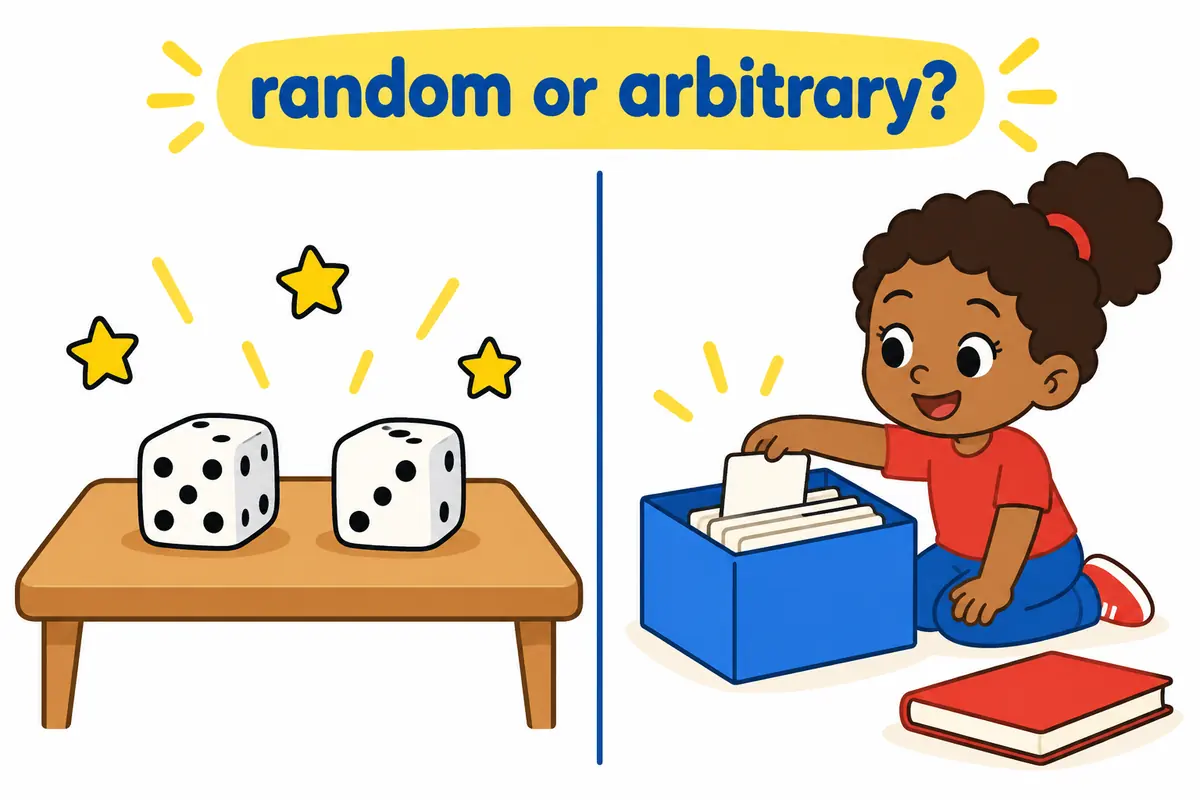
Random and arbitrary both describe a lack of pattern, and that overlap causes most of the confusion. Random means no rule and no chooser governs the outcome; arbitrary means a chooser exists but followed no rule.
| Attribute | Arbitrary | Random |
|---|---|---|
| Core meaning | Chosen without a guiding rule | Following no pattern at all |
| Is there a chooser | Yes, a person or body decides | No, the result simply occurs |
| Typical target | Rules, deadlines, selections and power | Outcomes, samples and events |
| Register | Legal, political and everyday criticism | Science, statistics and everyday speech |
| What it implies | Someone could still give a reason | No reason exists to give |
A random result has no chooser behind it, while an arbitrary one always does, so a lottery is random and a referee’s call is arbitrary. A capricious person changes mood without warning, whereas an arbitrary rule is fixed but unreasoned. A subjective judgement reflects one person’s taste, while an arbitrary one ignores the criteria that were supposed to apply.
Word forms and grammar of arbitrary
| Form | Part of speech | Example |
|---|---|---|
| arbitrary | adjective | an arbitrary rule |
| arbitrarily | adverb | They chose the date arbitrarily. |
| arbitrariness | noun (quality) | Critics attacked the arbitrariness of the fines. |
| arbitraryness | non-standard noun | Write arbitrariness instead. |
| arbitrate | verb (different root sense) | A neutral judge will arbitrate the dispute. |
The adverb arbitrarily modifies a verb, so it never sits directly before a noun, and the abstract noun arbitrariness names the quality an arbitrary decision shows. The words arbitrate, arbitration and arbitrator share the same root but mean settling a dispute, not acting without a rule, so they belong to a separate family of meaning.
Common mistakes with arbitrary
Incorrect: The lottery result was arbitrary. Correct: The lottery result was random. Rule: random has no chooser; arbitrary needs one.
Incorrect: She arbitrary chose a seat. Correct: She arbitrarily chose a seat. Rule: the adverb, not the adjective, modifies the verb.
Incorrect: He is an arbitrary person who changes his mind daily. Correct: He is a capricious person who changes his mind daily. Rule: arbitrary judges decisions; capricious judges shifting moods.
Incorrect: The arbitrary of the ruling upset residents. Correct: The arbitrariness of the ruling upset residents. Rule: the noun is arbitrariness, never arbitrary.
Incorrect: The manager gave a willful fine with no reason. Correct: The manager gave an arbitrary fine with no reason. Rule: willful describes a deliberate act, not one lacking a rule.
Practice using arbitrary
- Fill in the blank: The judge described the penalty as ______ and unfair.
- Choose the better word: The dice roll was ______ (random / arbitrary), with nobody deciding the outcome.
- Correct the error: The teacher arbitrary set the exam date.
- Build a sentence: Use arbitrary decision about a committee choosing a budget figure.
- Spot the register: Which sentence belongs in a formal report? (a) The selection process was arbitrary. (b) They just picked people out of thin air.
- Fill in the blank: The rule was criticised for its ______, since no principle justified it.
Answers
- arbitrary — the adjective follows the linking verb described and judges the penalty.
- random — nobody chose the outcome, so random is the precise word.
- The teacher arbitrarily set the exam date — the adverb modifies the verb set.
- The committee made an arbitrary decision on the budget figure — the frame is arbitrary plus noun.
- (a) — it keeps the formal register, while (b) uses an informal idiom.
- arbitrariness — the abstract noun names the quality being criticised.
The bottom line
Arbitrary judges a decision that rests on whim or chance rather than a rule, and it usually sits before the noun it describes. Keep it apart from random, which has no chooser at all, and from subjective, which reflects personal taste but may still be consistent. When the choosing itself is at issue, switch to the adverb arbitrarily. The phrase arbitrary in a sentence works best when the sentence names who decided and what principle was missing.
Frequently asked questions about arbitrary
Is arbitrary always a criticism?
Arbitrary usually criticises a decision because it suggests the choice followed no rule or reason. In a complaint about fines or deadlines, the word accuses someone of acting on whim. In mathematics, however, arbitrary is neutral: an arbitrary point simply means any point chosen for convenience, with no judgement attached.
Can arbitrary be used in mathematics?
Mathematics uses arbitrary in a technical, neutral way. An arbitrary number or point is one chosen without conditions, and a proof that works for an arbitrary case works for every case. This sense is close to any, so it carries none of the unfairness that arbitrary suggests in a sentence about rules or punishments.
What is the adverb of arbitrary?
The adverb is arbitrarily, and it describes how an action was carried out rather than what something is. A committee that picks a winner arbitrarily has acted without a principle. Because arbitrarily modifies a verb, it never sits before a noun: write arbitrarily chosen, not arbitrary chosen, when the choosing is the point.
How is arbitrary different from subjective?
Subjective means shaped by personal feelings or taste, which may still be consistent and defensible. Arbitrary means chosen without any guiding rule at all, which implies carelessness or an abuse of power. A subjective review reflects one person’s judgement; an arbitrary review ignores the criteria entirely. The first can be fair, while the second cannot.
Use arbitrary in a sentence when a choice seems to lack a clear reason, plan, or consistent rule. For example, “The committee’s arbitrary deadline changed from week to week” suggests the deadline was not guided by a stated criterion. In mathematics, however, “an arbitrary number” usually means any eligible number, not a number chosen at random.


What does arbitrary mean in a sentence?
Arbitrary is an adjective for a choice, rule, or action made without a clear reason or consistent principle; it can also describe a selection based on chance. Cambridge Dictionary includes both chance-based and reason-based usage. The surrounding words show which sense the writer intends and whether the sentence criticizes the choice.
| Context | Example sentence | What arbitrary means |
|---|---|---|
| Unexplained rule | “The arbitrary cutoff excluded late applications without explaining why that date was chosen.” | No clear criterion is given. |
| Personal preference | “The director made an arbitrary change to the seating plan based on a whim.” | The choice reflects personal will rather than a stated plan. |
| Chance selection | “For the warm-up, the teacher chose an arbitrary color from the jar.” | Any color could be selected; the exact one does not matter. |
| Mathematical proof | “Let n be an arbitrary positive integer, and prove the claim for n.” | The proof must work for every eligible positive integer. |

Is arbitrary the same as random?
No. Random specifically points to chance or an unpredictable selection, while arbitrary can mean chance-based or chosen without a consistent reason or standard. A random draw can be fair when everyone has the same chance; an arbitrary rule may feel unfair when similar cases receive different treatment and no rationale is provided.
Compare the sentences “A random number generator selected the winner” and “The manager applied an arbitrary rule.” The first names a chance process; the second criticizes a decision for lacking a clear basis. Capricious emphasizes changeability or unpredictability, while haphazard often describes a disorganized process. These words overlap, but they are not interchangeable in every sentence.
What does arbitrary mean in mathematics?
In a proof, an arbitrary object is any object that meets the stated conditions. Stanford’s CS103 handout explains that if a proof begins “consider an arbitrary natural number n,” the reasoning must work for any natural number n; it does not mean to pick a random value or one specific number.

How can you make an arbitrary example sentence precise?
State the missing reason or rule rather than guessing someone’s motive. “The reviewer’s decision seemed arbitrary because the published criteria were not applied consistently” gives readers an observable basis for the judgment. If a decision only appears arbitrary, use seemed or explain what information is missing instead of presenting an inference as a proven fact.

In legal writing, the phrase arbitrary and capricious has a context-specific role in judicial review. Cornell Law School’s Legal Information Institute describes how the standard considers whether a decision had a reasonable basis and accounted for relevant facts. In ordinary writing, avoid using the legal phrase as if it automatically proves that a decision is unlawful.
Sources: Cambridge Dictionary, “arbitrary”; Stanford CS103, “Mathematical Vocabulary”; Cornell Law School Legal Information Institute, “capricious.”
Note on the original examples: The source below is preserved unchanged. Some examples use arbitrary as if it always meant random or assert that a decision lacked a rationale without showing one. Randomness is one possible sense, but the word can also criticize a choice as lacking a clear reason or consistent standard; in proof writing, it means any eligible object. Check the context before inferring someone’s motive or a decision’s fairness.
Have you ever heard of the term “arbitrary” and wondered what it means? In simple terms, something is considered arbitrary when it is based on personal choice or whim rather than any solid reason or system.
In everyday language, we often come across arbitrary decisions, rules, or actions that seem random or without a clear rationale. Understanding the concept of arbitrariness can help us navigate situations where choices may seem inconsistent or illogical.
7 Examples Of Arbitrary Used In a Sentence For Kids
- Arbitrary means something that is chosen or done without any specific reason.
- We can play any game we want – it’s arbitrary!
- Today, let’s pick an arbitrary color to paint with.
- Let’s take turns choosing arbitrary activities to do together.
- You can wear any arbitrary costume for the dress-up day at school.
- Let’s use arbitrary materials to build our own creative project.
- The order of the story characters is arbitrary.
14 Sentences with Arbitrary Examples
- Arbitrary rules about attendance are causing unnecessary stress among college students.
- I don’t understand why the professor gave us such arbitrary deadlines for submitting our assignments.
- The selection process for the college committee seems a bit arbitrary to me.
- It’s frustrating when college authorities make arbitrary decisions without consulting the students.
- The college administration’s decision to increase the fees seems completely arbitrary.
- The college’s dress code policy feels arbitrary and outdated.
- I wish the exam schedule was more organized and less arbitrary.
- The college’s decision to ban certain activities on campus seems quite arbitrary.
- The grading system for this course feels too arbitrary and subjective.
- The college’s decision to cancel classes without prior notice seems arbitrary and unfair.
- The allocation of hostel rooms seems arbitrary and biased towards certain students.
- The college’s policy on late submissions is quite arbitrary and inflexible.
- I find the distribution of funds for extracurricular activities to be quite arbitrary.
- The college’s rules regarding student conduct appear arbitrary and inconsistent.
How To Use Arbitrary in Sentences?
Arbitrary is an adjective that means based on random choice or personal whim, rather than any reason or system. When using Arbitrary in a sentence, it is important to consider the context in which the word is being used.
Here are a few examples to help you understand how to use Arbitrary properly in a sentence:
-
The teacher’s decision to assign grades seemed Arbitrary as there was no clear criteria for evaluation.
-
The committee members made an Arbitrary selection based on their personal preferences rather than objective qualifications.
-
The store’s policy on returns appeared to be Arbitrary, as it varied depending on which employee you talked to.
-
The dictator ruled the country with an Arbitrary iron fist, making decisions without considering the needs of the people.
-
The judge’s Arbitrary sentencing left many questioning the fairness of the legal system.
To use Arbitrary effectively in a sentence, make sure it accurately reflects a decision or action that is random, unjust, or based on personal choice rather than logic or principle. By understanding the meaning of Arbitrary and practicing with different sentence structures, you will become more confident in using this word correctly in your writing.
Conclusion
In conclusion, the examples of sentences with arbitrary show how this term is used to describe decisions or actions made without a clear reason or basis. These sentences illustrate instances where choices are made at random, without following a set rule or pattern, leading to outcomes that may seem random or capricious.
Understanding the concept of arbitrary is important in recognizing when decisions are made without a solid rationale, which can be crucial in various contexts such as law, mathematics, or everyday decision-making. By being aware of the potential consequences of arbitrary decisions, individuals and organizations can strive for more consistency and fairness in their actions, ultimately leading to better outcomes and more transparent processes.


