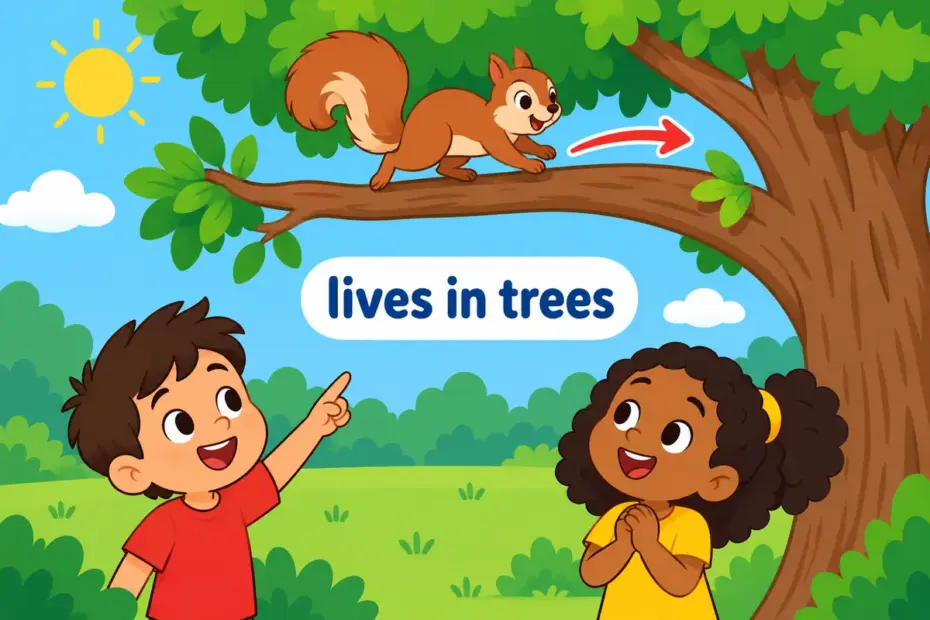
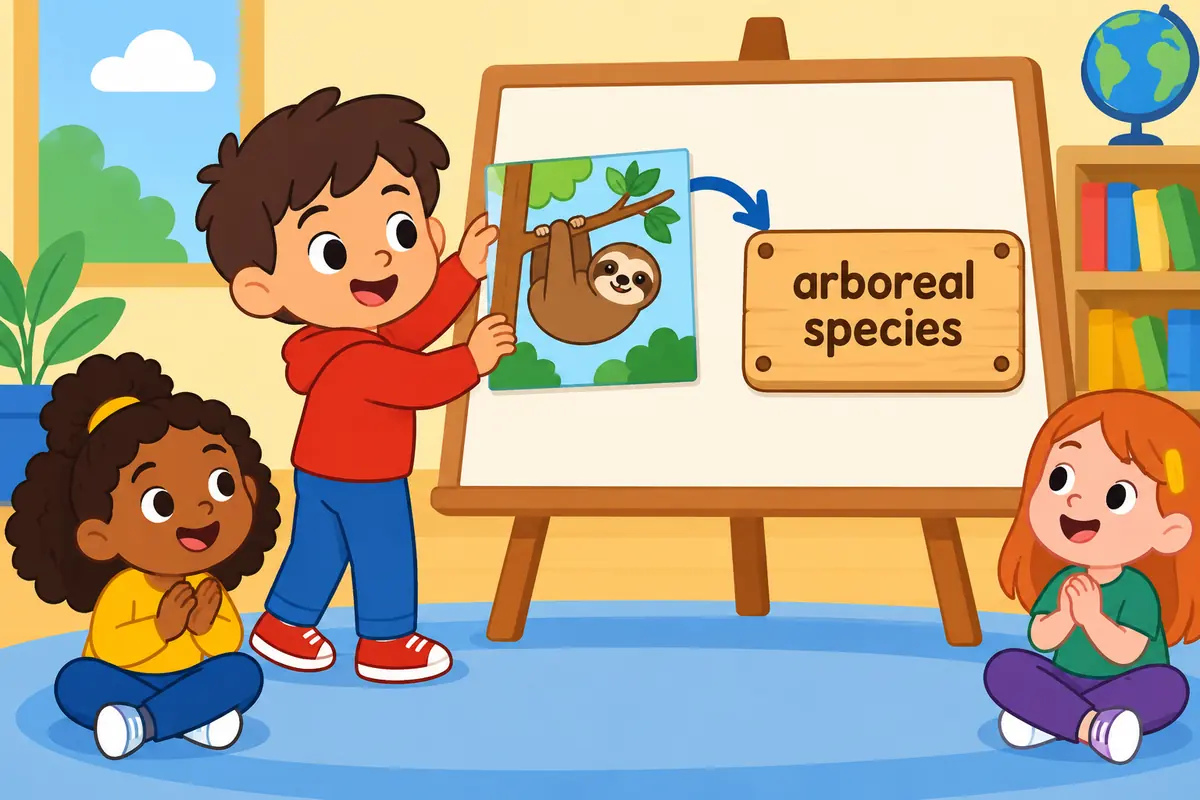
Arboreal describes an animal or plant that lives in, grows on or is suited to trees. To use arboreal in a sentence, attach it to the creature or feature: “The arboreal frog never touches the forest floor.” The adjective pairs naturally with species, habitat and lifestyle, and it contrasts with terrestrial for ground-dwelling life.
Arboreal at a glance
- Arboreal is an adjective, and its rare adverb is arboreally; it has no common verb or noun form of its own.
- The dominant pattern is be arboreal or arboreal + noun, as in an arboreal species.
- Its usual partners are species, mammal, habitat, lifestyle and canopy.
- The word belongs to science, nature writing and conservation rather than casual speech.
- The commonest error is adding a place phrase such as in the trees, which simply repeats what the adjective already means.
What does arboreal mean?
Arboreal is an adjective meaning living in or adapted to trees, or relating to trees as a subject or habitat. The Cambridge entry for arboreal records the tree-dwelling sense, and the distinction from nearby labels matters: arboreal life takes place in the canopy, terrestrial life on the ground, and aquatic life in water. Where the point is simply that an area is covered with trees, wooded describes the place rather than the creature.
| Sense | Plain meaning | Example sentence |
|---|---|---|
| Living in trees | An animal that spends its life in the canopy | Squirrels are arboreal and rarely descend. |
| Relating to trees | Connected with trees as a habitat or subject | Arboreal cover keeps the nest cool at midday. |
| Growing on trees | A plant attached to or climbing a trunk | An arboreal fern clings to the bark. |
| Suited to trees | A body built for climbing and gripping | Gripping toes are an arboreal adaptation. |
The word carries a quiet trap. Arboreal already contains the idea of trees, so a sentence such as the monkey was arboreal in the branches says the same thing twice. State the animal and its label, then let a separate clause explain what it does among the leaves. Arboreal is not a synonym for wild or for green, and it never describes a person who simply likes forests. The root also gives English arboriculture, the cultivation of trees, and arborist, a tree specialist, which keeps the word anchored to trees rather than to woods in general.
Behaviour is where the label earns its place. A gibbon swings through the canopy, a tree frog lays its eggs on a leaf above water, and a marsupial grips branches with a prehensile tail. Each detail belongs to an arboreal way of life, and each one would fail for a ground-dwelling animal. That is why the adjective rewards precise use: it names a whole suite of habits at once, from climbing and gripping to nesting and feeding high above the ground.
How do you use arboreal in a sentence?
Arboreal works after a linking verb or directly before a noun. The attributive position is the more common in science writing, because a label such as arboreal species compresses a whole habitat fact into two words. The linking position suits a general statement about one animal, and a rare adverb, arboreally, appears mostly in formal descriptions of behaviour.
| Pattern | Example | What it signals |
|---|---|---|
| be + arboreal | The species is arboreal. | Classifies a whole animal group. |
| arboreal + noun | An arboreal lifestyle suits the canopy. | Attributive use before the noun described. |
| become + arboreal | Some ground lizards became arboreal over time. | Describes gradual evolutionary change. |
| arboreal + in + habitat | The frogs are arboreal in the wet season. | Names when the behaviour holds. |
| not arboreal but terrestrial | The adults are not arboreal but terrestrial. | Contrasts one habitat label with another. |
Two habits mark a careful writer. The first is to pair arboreal with a creature that genuinely uses trees, not with a fish or a mole. The second is to let the contrast do the work: writing that a snake is arboreal for part of the year and terrestrial for the rest is more precise than calling it simply arboreal, because it names the condition under which the label applies.
Arboreal in a sentence: examples across contexts
Arboreal keeps a single meaning while its subject moves from a squirrel to a survey to a whole forest. These ten sentences show the adjective doing different work, and each one names the tree relationship rather than merely asserting it.
| Context | Example sentence | Why this works |
|---|---|---|
| Science writing | Many arboreal mammals never descend to the forest floor. | A general class shows the technical label. |
| Zoo label | This arboreal gecko grips smooth bark with ease. | A named animal makes the sense concrete. |
| Nature documentary | Above the mist, an arboreal world wakes with the light. | A whole habitat becomes the subject. |
| Academic paper | Arboreal cover reduced the nest temperature by three degrees. | A measured effect suits a formal register. |
| Conservation report | Logging removes the arboreal corridors that connect the reserves. | A management term keeps the register technical. |
| Children’s book | The arboreal frog hopped from leaf to leaf. | A simple action image suits young readers. |
| News feature | Rangers found the arboreal python coiled in a high branch. | A specific species shows the everyday use. |
| Travel writing | A wooden walkway carries visitors through the arboreal canopy. | A setting makes the adjective vivid. |
| Field notes | Adults are arboreal; juveniles stay on the ground. | A compact contrast records a real pattern. |
| Conversation | Squirrels are the most arboreal animals in our garden. | Everyday speech keeps the plain label. |
A general word for the place is forest, and a general word for tree cover is woodland. Arboreal adds the extra idea of a creature or feature using that cover, which is why a naturalist reaches for it when the exact habitat matters. Where the emphasis falls on the trees as a resource, timber shifts the sentence toward forestry rather than ecology.
Arboreal vs terrestrial, aquatic and fossorial
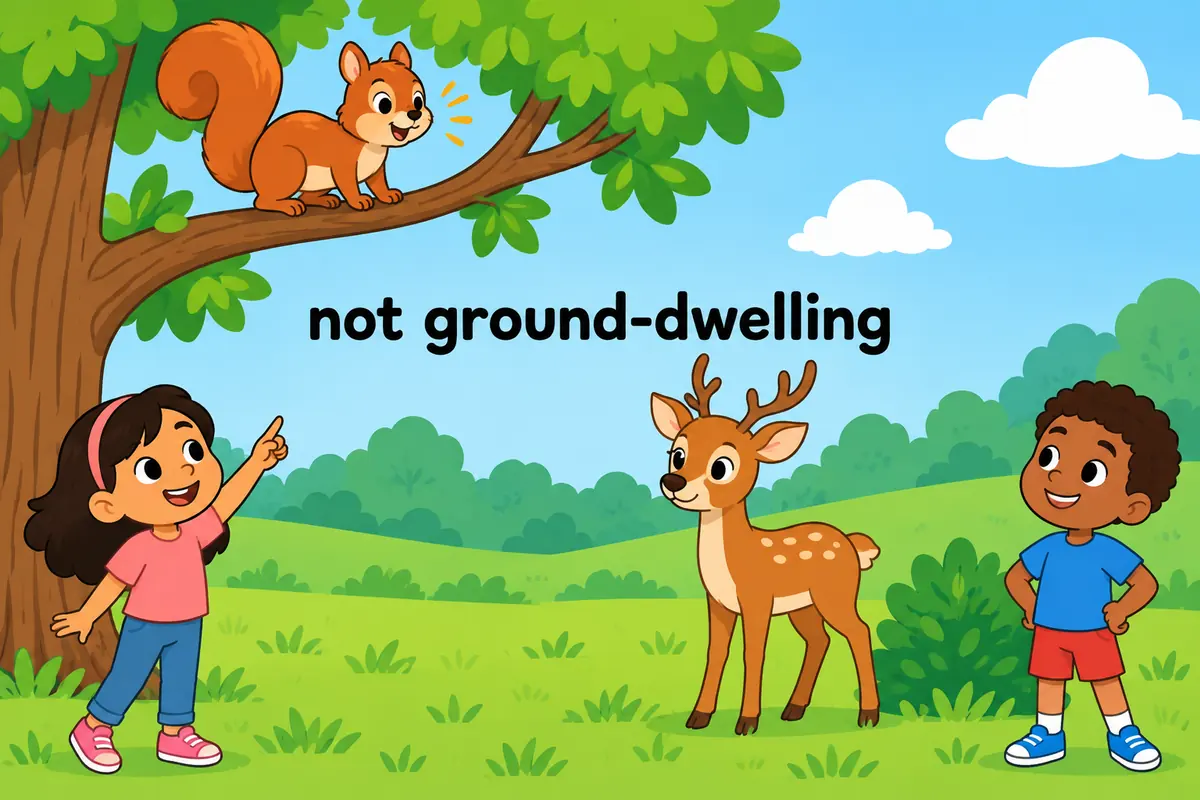
Arboreal is one of four habitat adjectives that biologists use as a set. Arboreal means living in trees, terrestrial means living on the ground, aquatic means living in water, and fossorial means living underground. A single species can carry more than one label across its life, so the words describe a habit or a life stage rather than a fixed identity.
| Attribute | arboreal | terrestrial | aquatic | fossorial |
|---|---|---|---|---|
| Habitat | Trees and canopy | Ground surface | Water | Soil and burrows |
| Typical animal | Squirrel, tree frog | Deer, wolf | Fish, newt | Mole, earthworm |
| Key adaptation | Gripping feet, long limbs | Strong running legs | Fins or webbed feet | Broad digging claws |
| Opposite label | Terrestrial | Arboreal | Terrestrial | Arboreal |
| Register | Scientific | Scientific | Scientific | Scientific |
Verdict: choose arboreal only when the tree is the creature’s home or route, choose terrestrial for ground life, and use both labels together when a species changes habitat with the season, as many tree-dwelling frogs do between the wet and dry months.
Word forms and grammar of arboreal
Arboreal is an adjective with almost no derived forms in everyday English, so the table is short and honest about what does not exist. The look-alike words below share the root but not the meaning, which is where learners slip.
| Form | Part of speech | Example |
|---|---|---|
| arboreal | adjective | The young are fully arboreal from birth. |
| arboreally | adverb, rare | The species feeds arboreally at dusk. |
| arboriculture | noun | Arboriculture concerns the care of trees. |
| arborist | noun | An arborist inspected the damaged oak. |
| arbor | noun — different meaning | They rested under a shady garden arbor. |
Common mistakes with arboreal
- Incorrect:
The monkey was arboreal in the trees.Correct: The monkey was arboreal. Rule: Arboreal already means living in trees, so the place phrase repeats the adjective. - Incorrect:
An arboreal fish swam between the branches.Correct: An arboreal lizard climbed between the branches. Rule: Match the adjective to a creature that actually uses trees. - Incorrect:
The forest held many arboreal.Correct: The forest held many arboreal species. Rule: Arboreal is an adjective and cannot stand alone as a noun. - Incorrect:
The bird is arboreal to tall trees.Correct: The bird is arboreal. Rule: The adjective needs no prepositional phrase to complete its meaning.
Practice using arboreal
Work through the seven items, then check the reasoning rather than only the key.
- Fill the gap: The tree frog is almost entirely ______, spending its life above the ground.
- Choose the better word: A mole digs tunnels, so it is (fossorial / arboreal).
- Correct the error: Squirrels are arboreal animals that live in trees.
- Build a sentence: use arboreal + noun about a lizard in a rainforest.
- Spot the register: which fits a field guide — adults are arboreal, or the adults hang out in trees a lot?
- Contrast two labels: write one sentence using both arboreal and terrestrial.
- Rewrite without a place phrase: The possum is arboreal and lives in the canopy. Remove the repetition.
Answers
- arboreal — the frog uses trees for its whole life, which is the core sense.
- fossorial — a mole lives underground, and arboreal would mean in trees.
- Squirrels are arboreal — living in trees is already contained in the adjective.
- Model answer: The arboreal lizard clings to the trunk with gripping toes.
- Adults are arboreal — a field guide prefers the precise label.
- Model answer: The young are arboreal, but the adults become terrestrial after a year.
- Model answer: The possum is arboreal — the canopy is understood.
The bottom line
Use arboreal in a sentence when an animal or plant uses trees as its home or route, and attach the adjective to the creature rather than to the tree itself. Two details decide most sentences: arboreal already contains the idea of trees, so no place phrase is needed, and it contrasts with terrestrial for ground-dwelling life.
Frequently asked questions about arboreal
What does arboreal mean for an animal?
For an animal, arboreal means it lives and moves mainly in trees rather than on the ground. Squirrels, tree frogs and many monkeys are arboreal, with gripping feet and long limbs suited to branches. The word is a habitat label and sits opposite terrestrial.
Is arboreal the same as a tree?
No. A tree is the plant, while arboreal is the adjective describing something that lives in, grows on or relates to trees. You can describe an arboreal animal in a forest full of trees, but the noun and the adjective do different jobs and are never swapped.
What is the opposite of arboreal?
The direct opposite is terrestrial, which means living on the ground. Water-dwelling life is aquatic and underground life is fossorial, so a species can be described by more than one label. A frog may be arboreal in the wet season and terrestrial in the dry months.
Can arboreal describe a plant?
Yes. A plant that grows on or climbs trees, such as an arboreal fern clinging to bark, can be called arboreal. The sense is less common than the animal sense, but it follows the same idea of living on a tree rather than on the ground.