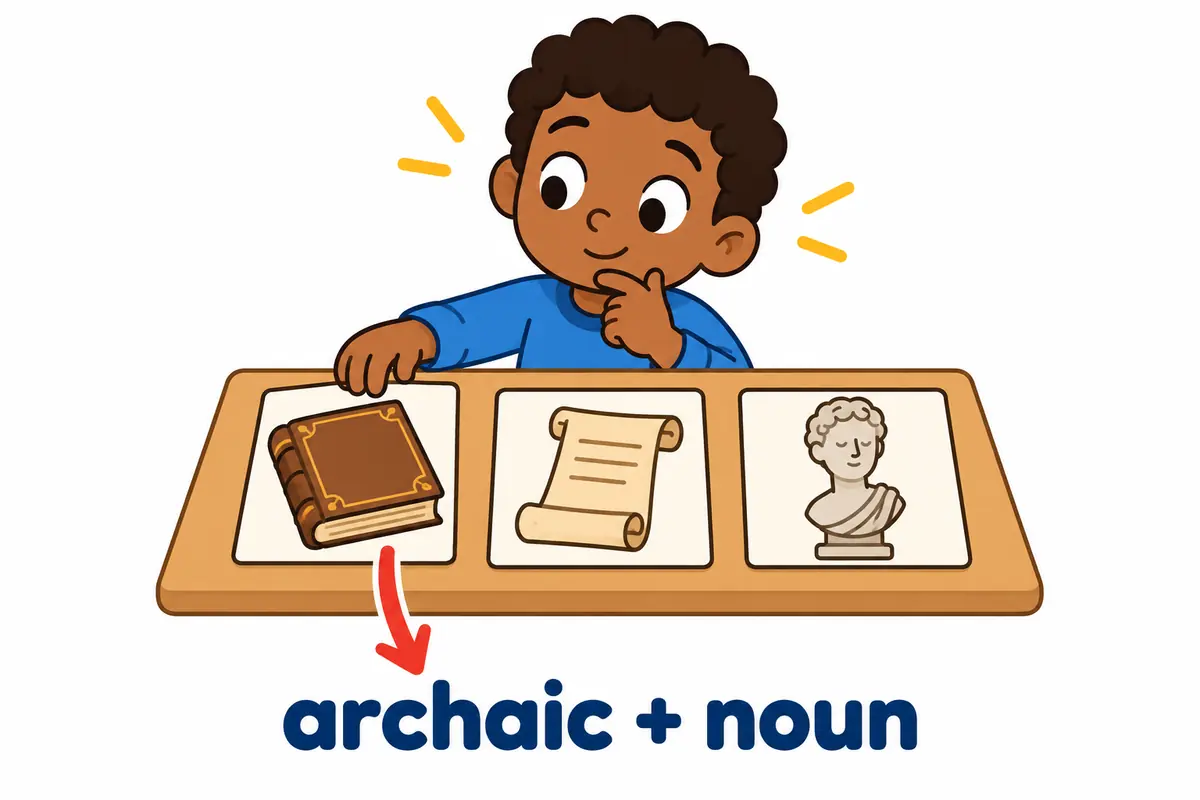
Archaic means belonging to an earlier period and no longer in ordinary use, and it most often describes old words, laws or styles. To use archaic in a sentence, place it before the noun: an archaic spelling, an archaic law. The adjective judges age and disuse, not quality, so it can sound neutral or gently critical.
Archaic at a glance
- Archaic is an adjective; its adverb is archaically and its noun is archaism.
- The dominant pattern is archaic + noun, as in archaic language.
- It also follows linking verbs: the law is archaic.
- Common collocations are archaic word, archaic law and archaic style.
- The commonest error is using archaic for anything merely old, where ancient fits.
What does archaic mean?
Archaic is an adjective meaning belonging to an earlier time and no longer current in everyday use. The Cambridge entry for archaic applies it to language that has fallen out of general circulation, a sense it shares with old objects and practices. Where a thing is old but still perfectly usable, antiquated often fits better, because it stresses being out of date rather than ancient.
| Sense | Plain meaning | Example sentence |
|---|---|---|
| Linguistic | A word or form no longer used in ordinary speech | Thou is an archaic pronoun. |
| Cultural | A custom, law or style from a much earlier period | The village kept an archaic rule about the common land. |
| Artistic | Deliberately imitating an older manner | The statue has an archaic smile. |
One limitation matters here. Archaic does not mean useless or wrong. Archaic words survive in law, religion and poetry, and an archaic spelling can still be correct in a quotation. The adjective also cannot be used for things that are simply old, so ancient is the word for something from long ago that still has its place, and defunct is the word for an organisation or custom that has ended altogether.
How do you use archaic in a sentence?
Archaic works as a normal adjective: it sits before a noun or follows a linking verb. The noun it modifies is usually a word, a law, a custom or a style, and the sentence often names the period or the modern replacement.
| Pattern | Example | What it signals |
|---|---|---|
| archaic + word noun | Whither is now an archaic word. | Labels a form no longer in use. |
| archaic + legal noun | The archaic statute still binds the council. | An old rule that remains in force. |
| noun + be + archaic | That spelling is archaic. | A predicate judgement of age and disuse. |
| archaic + style noun | She favoured an archaic style of carving. | An artistic manner from an early period. |
| archaic + to + reader | The phrasing feels archaic to modern readers. | Names who finds it outdated. |
For a mild complaint about something simply out of date, outdated is the plainer adjective, and it carries less weight than archaic.
Archaic in a sentence: examples across contexts
Archaic keeps its meaning across subjects, but the noun it modifies decides the tone. The eight sentences below move from a classroom to a museum label, and each one names what has fallen out of ordinary use.
| Context | Example sentence | Why this works |
|---|---|---|
| Classroom | The poem uses archaic words such as betwixt. | A concrete linguistic example. |
| Workplace email | We replaced the archaic sign-in process. | Signals an out-of-date procedure. |
| News report | Campaigners called the rule archaic. | A public judgement of disuse. |
| Legal writing | The archaic clause was finally repealed. | A technical sense tied to statute. |
| Museum label | The figure wears an archaic smile. | A precise art-historical term. |
| Travel writing | The town preserves its archaic street plan. | Old form still visible today. |
| Academic prose | The scribe copied an archaic letter form. | A specialist observation about writing. |
| Conversation | That phrase sounds archaic now. | The predicate pattern in speech. |
Archaic vs obsolete
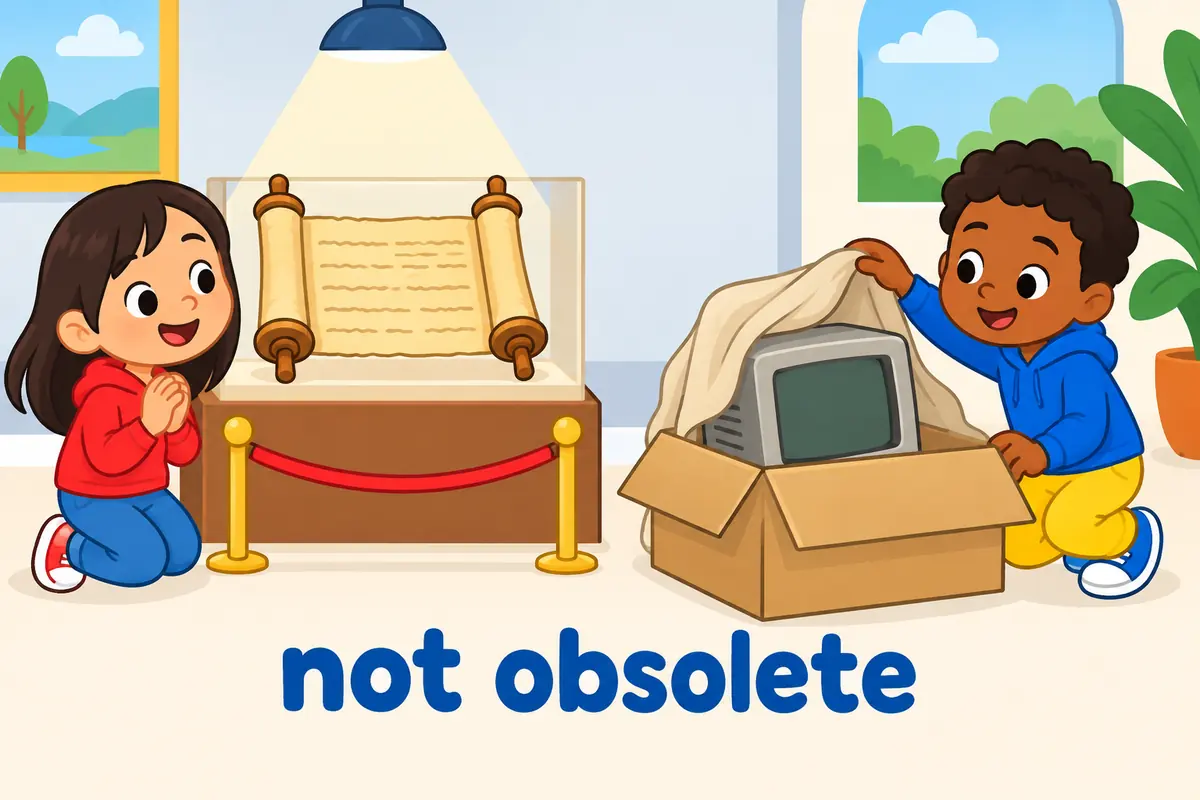
Archaic and obsolete both describe things from the past that have fallen out of use, and they differ in what remains. Archaic things often survive in special settings such as law, religion or poetry; obsolete things have gone completely. The pair is close, so the choice depends on whether anything still lives on.
| Attribute | archaic | obsolete |
|---|---|---|
| Core meaning | From an earlier period, no longer ordinary | No longer used at all |
| Survival | Often survives in religion, law or poetry | Gone from current use |
| Typical noun | A word, a law, a style | A technology, a machine, a method |
| Period implied | Very distant past | Often recent past |
| What it implies | Old but sometimes still meaningful | Replaced and no longer needed |
Verdict: choose archaic for old forms that still carry meaning somewhere, and obsolete only for things that have been completely replaced.
Word forms and grammar of archaic
Archaic has a small regular family, and its noun is the form that appears most in scholarly writing. The table lists each form with a typical example.
| Form | Part of speech | Example |
|---|---|---|
| archaic | adjective | The text uses archaic spelling. |
| archaically | adverb | The sign was archaically worded. |
| archaism | noun | The poet borrows one archaism per line. |
| archaize | verb | The translator chose to archaize the dialogue. |
| archaic-looking | compound adjective | The modern font is archaic-looking. |
The noun archaism names the old word or feature itself, which is useful when the object rather than the quality is the subject.
Common mistakes with archaic
- Incorrect:
The temple is archaic and thousands of years old.Correct: The temple is ancient and thousands of years old. Rule: Ancient describes great age; archaic describes things from an earlier period that are no longer current. - Incorrect:
The fax machine in the office is archaic.Correct: The fax machine in the office is obsolete. Rule: The machine has been completely replaced, so obsolete is exact; archaic suits words, laws and styles. - Incorrect:
The archaic language in the letter was a mistake.Correct: The archaic language in the letter was intentional. Rule: Archaic does not mean erroneous; the form is old, not wrong. - Incorrect:
He spoke archaic.Correct: He spoke in an archaic way. Rule: Archaic is an adjective, so it cannot modify a verb directly; use the adverb archaically or a phrase. - Incorrect:
The archaic car would not start.Correct: The battered old car would not start. Rule: An everyday object is old, not archaic; reserve archaic for language, custom and style.
Practice using archaic
Work through the six items, then read the reasons rather than only the answers.
- Fill the gap: Whither is an ______ word in modern English.
- Choose the better word: The windmill is (archaic / obsolete) machinery.
- Correct the error: The archaic statue is three thousand years old.
- Build a sentence: use archaic + noun about a legal rule.
- Spot the register: which belongs in a museum label, an archaic smile, or the smile looks old?
- Rewrite with the noun: The poem contains one old word. Use archaism instead.
Answers
- archaic — the word is old and out of ordinary use, which is exactly archaic.
- obsolete — the machinery has been replaced, so obsolete is more precise.
- The ancient statue is three thousand years old — great age calls for ancient, not archaic.
- Model answer: The council finally removed an archaic rule about parking.
- an archaic smile — the technical art term belongs on a museum label.
- The poem contains one archaism — the noun names the old feature itself.
The bottom line
Use archaic in a sentence for words, laws or styles that belong to an earlier age and have fallen out of ordinary use, placing the adjective before its noun. Two nuances decide most uses. Archaic things often survive in law, religion or poetry, so obsolete is reserved for what has gone completely, and ancient is the word for great age. The adjective judges currency, not quality.
Frequently asked questions about archaic
What is the difference between archaic and ancient?
Ancient describes something of great age, such as an ancient temple or an ancient civilisation, without saying whether it is still current. Archaic describes something from an earlier period that is no longer in ordinary use, especially a word or a custom. A temple is ancient; an old pronoun that nobody now speaks is archaic.
Is archaic a negative word?
Archaic is mildly critical in most modern contexts, since it points to something out of date. It is neutral in linguistics and art history, where it simply labels an early form, as in an archaic smile or an archaic spelling. The tone depends on whether the writer is describing or judging.
What is the difference between archaic and obsolete?
Archaic things come from an earlier period and have left ordinary use, but often survive in law, religion or poetry, so they can still carry meaning. Obsolete things have been completely replaced and are no longer needed at all. A videotape player is obsolete; the pronoun thou is archaic.
Can archaic describe technology?
Archaic can describe old technology, but it usually sounds literary or exaggerated, as if the machine belongs to a distant age. For equipment that has simply been replaced, obsolete or outdated is more accurate. Reserve archaic for language, custom, style and law, where the sense of an earlier period is exact.
Have you ever come across a word that sounds strangely old-fashioned or out of place in modern language? These words may be considered archaic, meaning they are no longer in common use.
Archaic words are remnants of vocabulary from earlier times that have faded from current everyday speech. Despite their disuse, they can still be found in literature, historical documents, or used deliberately to create a specific tone or atmosphere in writing.
7 Examples Of Archaic Used In a Sentence For Kids
- Archaic means very old or ancient.
- My grandmother has an archaic photo album from when she was young.
- The dinosaur is an archaic creature that lived millions of years ago.
- The knight’s armor looked archaic compared to modern military gear.
- The cave paintings are considered archaic forms of art.
- People used to communicate through archaic methods like smoke signals.
- The ancient temple has archaic carvings and sculptures.
14 Sentences with Archaic Examples
- Archaic language can sometimes be difficult to understand in older scientific texts.
- It’s essential for students to familiarize themselves with archaic terminology to improve their comprehension of historical documents.
- The professor recommended that we consult a dictionary to decipher the meaning of archaic words in our literature assignments.
- Some of the laws discussed in our constitutional law class are considered archaic by today’s standards.
- The students were intrigued by the use of archaic symbolism in the ancient religious texts they were studying.
- It’s important for history students to recognize and interpret archaic symbols in archaeological artifacts.
- The language used in the medieval literature course had many examples of archaic expressions.
- As we delved deeper into ancient poetry, we encountered more instances of archaic vocabulary that required explanation.
- The students struggled to translate the archaic text into modern language for their class presentation.
- Understanding the context in which archaic laws were written is crucial for their interpretation in our legal studies.
- The archaic practices outlined in the anthropology textbook provided insight into cultural norms of the past.
- The ancient texts we are studying in our philosophy class are filled with archaic references that require interpretation.
- The professor encouraged us to explore the significance of archaic rituals in the religious practices of ancient civilizations.
- Studying archaic languages can be challenging, but it provides a valuable glimpse into the past for linguistics students.
How To Use Archaic in Sentences?
To use the word Archaic in a sentence, start by identifying a term, phrase, or word that is considered outdated, old-fashioned, or belongs to an ancient era. For example, “The use of parchment scrolls is considered archaic in today’s digital age.”
When constructing a sentence with the word Archaic, remember to place it appropriately within the sentence structure. “Her insistence on using a typewriter seemed archaic to her younger colleagues.”
Furthermore, consider the context in which archaic is being used to ensure that the sentence conveys the intended meaning. “The tribal language was deemed archaic and was rarely spoken in modern times.”
It’s important to note that using archaic in a sentence adds a touch of sophistication or historical reference. For instance, “The knight’s armor appeared archaic compared to the sleek, modern tanks on display.”
In summary, when incorporating the word archaic into a sentence, make sure to select a suitable context that highlights its meaning of being outdated or belonging to an earlier time period. By considering these tips, you can effectively incorporate archaic into your writing to convey a sense of antiquity or historical significance.
Conclusion
In conclusion, sentences with archaic language can be challenging to understand for modern readers due to the outdated vocabulary and syntax used. These sentences often require additional context or interpretation to grasp the intended meaning. While encountering archaic sentences can provide insights into historical texts and cultural contexts, they may obscure communication and hinder comprehension in contemporary settings.
To enhance understanding of sentences with archaic language, readers can utilize resources such as dictionaries, translations, or annotations that offer explanations of unfamiliar terms or structures. By actively seeking to decipher archaic sentences, individuals can bridge the linguistic gap between past and present, enabling a deeper appreciation of literature and historical documents.