Argot in a Sentence: Meaning, Examples & Practice
Argot means the special vocabulary of a particular group, especially a closed or marginal one. To use argot in a sentence, name the group with an of-phrase: “The argot of the trading floor was full of numbers and nicknames.” The noun is often singular with a definite article, and it usually sounds formal or literary.
Argot at a glance
- Argot is a countable noun; its plural is argots, and the adjective argotic is rare.
- It normally appears in the phrase the argot of a group.
- The word often suggests a closed or marginal group, not just a profession.
- It is formal and slightly literary, at home in essays and journalism.
- The commonest error is confusing argot with the unrelated sound-alikes bigot and target.
What does argot mean?
Argot is a noun meaning the specialised language of a group, particularly one that keeps outsiders at a distance. The Cambridge entry for argot records this sense of a group vocabulary, and the tone it carries is social rather than neutral. The word can describe the private words of a trade, a subculture or, in older writing, a criminal circle. Workplace jargon is understood by a trade; argot usually marks a tighter, sometimes closed group. Cant names the secret or insincere language of a group, often with a disapproving tone.
Argot differs from a national language because it is not taught or standardised; it is picked up by joining the group. That is why glossaries and footnotes are often needed when an argot appears in print. A word can leave an argot and enter general use, and that is the moment it stops marking membership.
| Sense | Plain meaning | Example sentence |
|---|---|---|
| Group vocabulary | The private words of a trade or clique | The argot of the kitchen filled the back room. |
| Closed or secret code | Language meant to exclude outsiders | Prison argot changed with each new intake. |
| Literary usage | A writer’s borrowed group language | The novel captures the argot of the docks. |
Argot is not a single rude word. It is a whole vocabulary, so a sentence that calls one expression an argot stretches the sense. For one expression, use slang term or jargon.
How do you use argot in a sentence?
Argot attaches to the people who use it through an of-phrase, and it works as the subject of a sentence about language. The patterns below show the shapes it takes and what each one signals.
| Pattern | Example | What it signals |
|---|---|---|
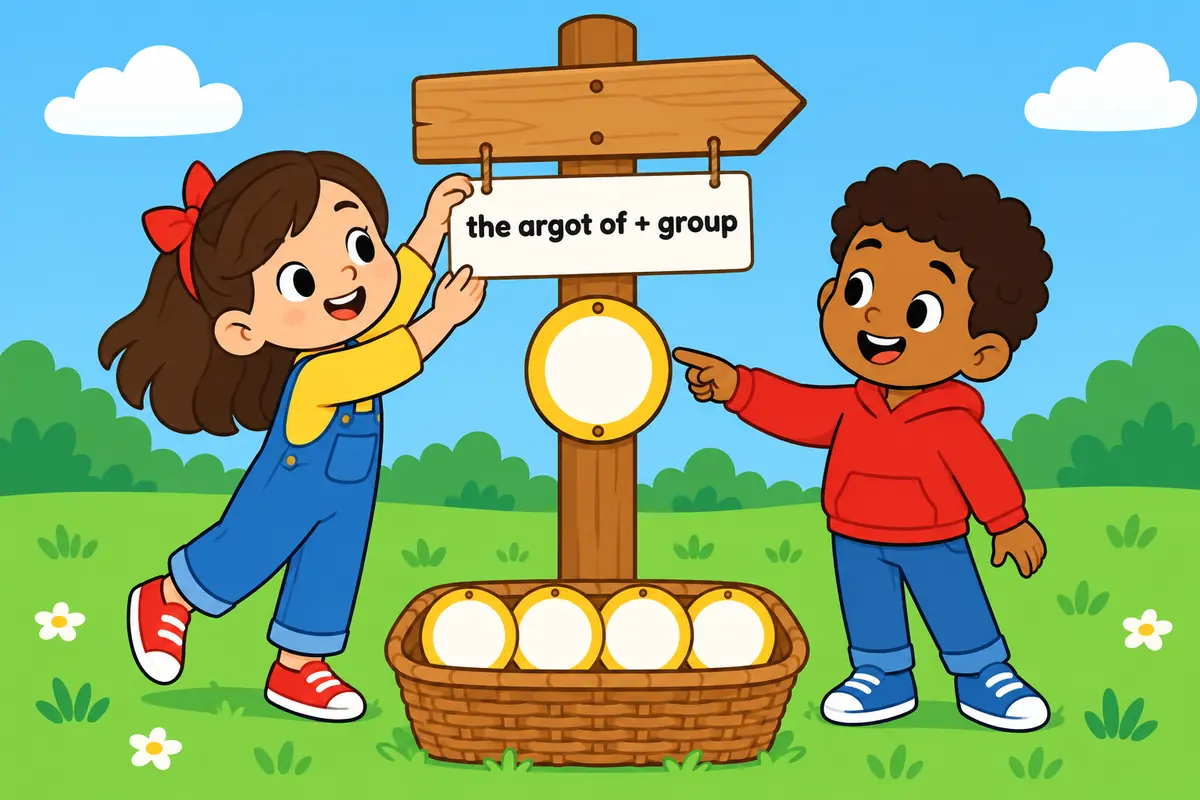
| the argot of + group | the argot of jazz musicians | the default and clearest use |
| in the argot of + group | in the argot of the trade | cites a term inside a group language |
| argot + verb | The argot shifted every year. | treats the vocabulary as a living thing |
| a word from the argot of + group | a word from the argot of sailors | picks out one borrowed expression |
| speak in + argot | They spoke in a private argot. | emphasises exclusion of listeners |
The of-phrase is doing real work here, because an argot without a named group is hard to place. Compare the argot of waiters with the argot of surgeons: the first leans on shared shift humour, the second on precise technical shorthand. Naming who uses the language tells the reader how public it is.
A single argot can also age quickly, because the words that mark a group today can be adopted by outsiders tomorrow. When the boundary fades, the vocabulary either disappears or joins the general slang of the language.
Argot in a sentence: examples across contexts
| Context | Example sentence | Why this works |
|---|---|---|
| Classroom | The teacher explained the argot of online gamers. | Names a group code students already meet. |
| Journalism | Reporters had to learn the argot of the police unit. | Shows insiders using a closed vocabulary. |
| Literary essay | The author borrows the argot of the boxing ring. | Points to deliberate borrowing in style. |
| Sociology | Each shift developed its own factory argot. | Describes language marking a subgroup. |
| Music writing | The argot of the scene kept newcomers guessing. | Signals exclusion through shared words. |
| Prison writing | Cellmates shared an argot that guards rarely followed. | Uses the older, closed sense of the word. |
| Sports report | The cycling team argot filled the radio feed. | Shows a dense in-group shorthand. |
| Detective fiction | He recognised the argot of the smuggling trade. | Uses the older association with crime. |
| Conversation | Family dinner had its own gentle argot. | Applies the word warmly to a small group. |
| Business writing | Consultants dress advice in the argot of finance. | Notes the social power of a trade language. |
Notice that the plural argots suits a comparison across trades, while the singular suits one group on its own. Reporters and sociologists tend to keep the singular with of, which keeps ownership clear. The word rarely needs an adjective, because the of-phrase has already named the owners.
Argot vs slang
Argot and slang both name informal language, but slang belongs to no single group, while an argot belongs to one and can be used to mark who is inside.
| Feature | Argot | Slang |
|---|---|---|
| Core sense | The private vocabulary of one group | Informal language across a whole speech community |
| Who uses it | Insiders in a trade, clique or subculture | Anyone, often the young |
| Register | Formal and literary as a label | Casual and neutral as a label |
| Social effect | Can exclude listeners | Signals ease, not membership |
| Typical phrase | the argot of the pit crew | teen slang, internet slang |
Choose argot when membership matters and slang when the point is simply informality.
Both words can describe language that outsiders find odd, but only argot carries the social boundary. If a term circulates widely through television and music, slang is the honest label; if it stays inside a workplace or a tight circle, argot is the more accurate one.
Word forms and grammar of argot
Argot has a small family, and its closest look-alikes are unrelated. The table lists the forms and the sound-alike traps.
| Form | Part of speech | Example |
|---|---|---|
| argot | noun | the argot of the stage crew |
| argots | plural noun | Trades develop rival argots. |
| argotic | adjective, rare | an argotic phrase |
| argent | noun, unrelated | a shield of bright argent |
| ergot | noun, unrelated | ergot is a fungus of rye |
| bigot | noun, unrelated | a bigot holds narrow views |
Informal writers often reach for lingo, which is the relaxed word for any special vocabulary, while a regional form of a language is a dialect and the everyday speech of a whole community is its vernacular. Ergot, argent and bigot sit close to argot in spelling or sound but carry no related meaning. The adjective argotic is real but so rare that most writers avoid it and say of the argot instead.
A useful test is the group: if you can name the people who use the words in an of-phrase, argot fits. If the words belong to no particular group, slang is safer, and if they belong to a profession, jargon is the sharper tool.
Common mistakes with argot
- Incorrect: The waiter used an argot to mean one rare word.Correct: The waiter used a slang term for one rare word.Rule: argot is a whole group vocabulary, not a single word.
- Incorrect: The argot was spoke by the crew.Correct: The argot was spoken by the crew.Rule: the passive needs the past participle spoken.
- Incorrect: He is an argot person.Correct: He uses the argot of his trade.Rule: argot is a noun and does not describe a person directly.
- Incorrect: The bigot of the group was hard to follow.Correct: The argot of the group was hard to follow.Rule: bigot means a narrow-minded person, not a vocabulary.
- Incorrect: an argotsCorrect: an argotRule: a singular count noun takes a, not an, before the consonant sound.
A final check is the tone: argot often carries a faint hint of secrecy, so using it for a neutral professional vocabulary can sound as if something is being hidden. When no boundary is implied, jargon or vocabulary is the plainer and safer noun.
Practice using argot
- Fill in the blank: The ______ of the harbour pilots puzzled the tourists.
- Choose the better word: The private code of the gang was its (argot / bigot).
- Correct the error: She learned the argots of two different trades.
- Build a sentence: use argot with an of-phrase naming a profession.
- Spot the register: which sentence suits an essay? (a) They used weird words. (b) The crew spoke a dense occupational argot.
- Fill in the blank: A word from the ______ of computer programmers spread to the office.
Answers
- argot — the group vocabulary of the pilots is the subject.
- argot — bigot means a person, not a language.
- the argots of two different trades — the plural argots is correct for two separate codes.
- The argot of surgeons is rich in abbreviations. — the of-phrase names the group.
- (b) — occupational argot is the precise, formal choice.
- argot — a single borrowed term comes from a group vocabulary.
The bottom line
Argot in a sentence names the shared, often closed vocabulary of a particular group, and it usually appears in the phrase the argot of a group. Use it for a whole group code rather than a single expression, and keep its formal, slightly literary tone in view. For broad informal language use slang, and for a profession’s technical terms jargon is often the plainer choice.
Frequently asked questions about argot
Is argot a countable noun?
Yes, argot is a countable noun, so it takes the plural argots when you mean the separate vocabularies of two groups. It most often appears in the singular with the definite article, as in the argot of the pit crew. The counted plural is useful when two trades are being compared side by side.
What is the difference between argot and jargon?
Jargon is the technical vocabulary of a profession, and it is not usually meant to exclude anyone. An argot is the wider, often private code of a group, and it can mark membership or secrecy. A hospital shares jargon; a closed circle of dockworkers may share an argot that outsiders cannot follow.
Can argot refer to criminal language?
It can, and that association is older than the neutral modern use. Dictionaries and older fiction often tie argot to the language of thieves, beggars or prisoners. Today the word extends to jazz musicians, gamers or any tight group, but the hint of a closed and slightly shady circle survives.
How is argot pronounced?
Argot is borrowed from French, so the final t is silent. It is said with two beats and the stress on the first, roughly AR-go, rhyming with cargo. Saying AR-got with a sounded t is the usual mistake. The silent t also separates it in speech from the unrelated word ergot.