
Assert means to state something firmly as true, or to defend a right or quality so that others accept it. To use assert in a sentence, put the speaker first and the confident claim second, as in she asserted that the figures were correct. The verb takes either a that-clause or a noun phrase.
Assert at a glance
- Assert is a transitive verb; its forms are asserts, asserted and asserting.
- It takes a that-clause, a noun phrase such as authority, or a reflexive pronoun as in assert yourself.
- The two senses are stating something firmly and defending a right or position.
- Common partners are authority, independence, control, rights, innocence and superiority.
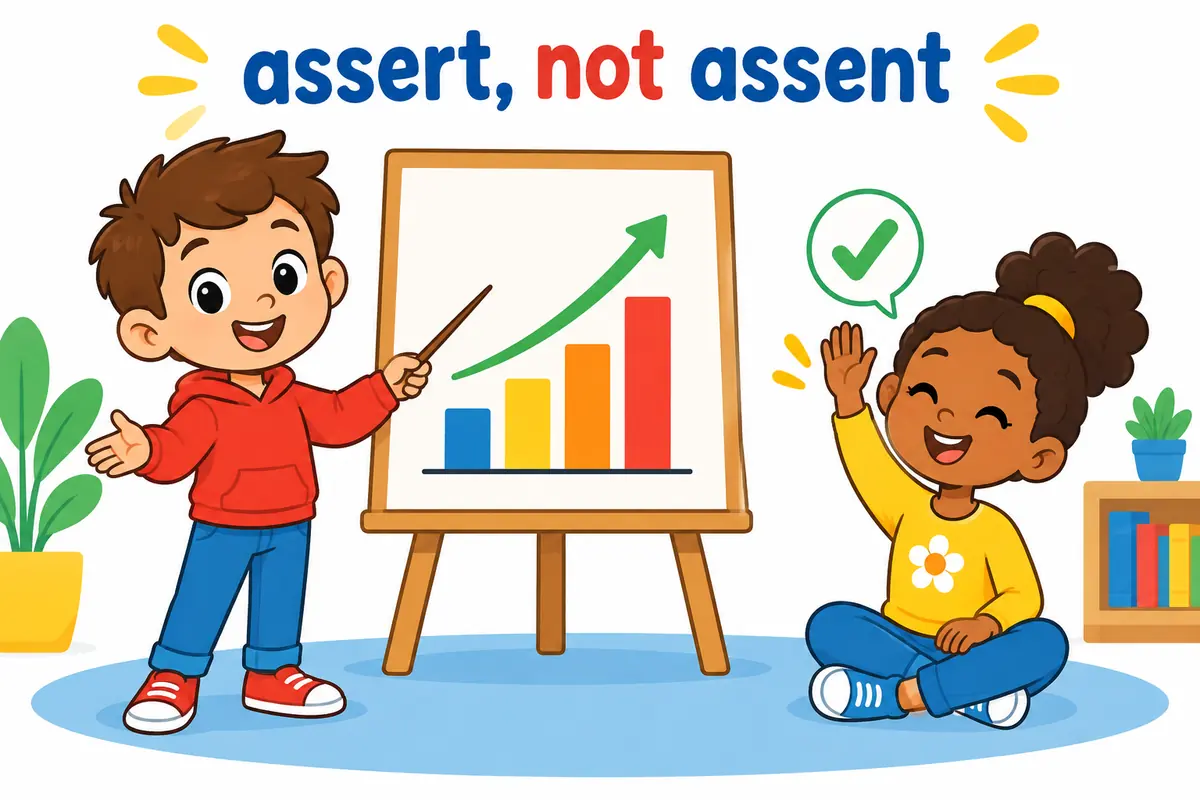
- The commonest error is confusing assert with assent, which means to agree.
What does assert mean?
Assert is a verb meaning to state something confidently and forcefully, or to defend a right or position against challenge. The Cambridge entry for assert separates the two, and the division is useful: the first sense is about the manner of speaking, while the second is about holding ground. A manager who asserts authority is not merely talking; she is making the authority felt.
| Sense | Plain meaning | Example sentence |
|---|---|---|
| State firmly | Say that something is true, with confidence | She asserted that the audit was complete. |
| Defend a right | Make a claim or entitlement felt | The tenants asserted their right to repairs. |
| Assert yourself | Speak and act with confidence among others | He learned to assert himself in meetings. |
One honest limit belongs here: assert claims strength of delivery, not truth. A speaker can assert something false, so an argument that needs support should use demonstrate or establish. Where an affirmation is offered to a doubter rather than a claim pressed on listeners, affirm is the closer verb.
How do you use assert in a sentence?
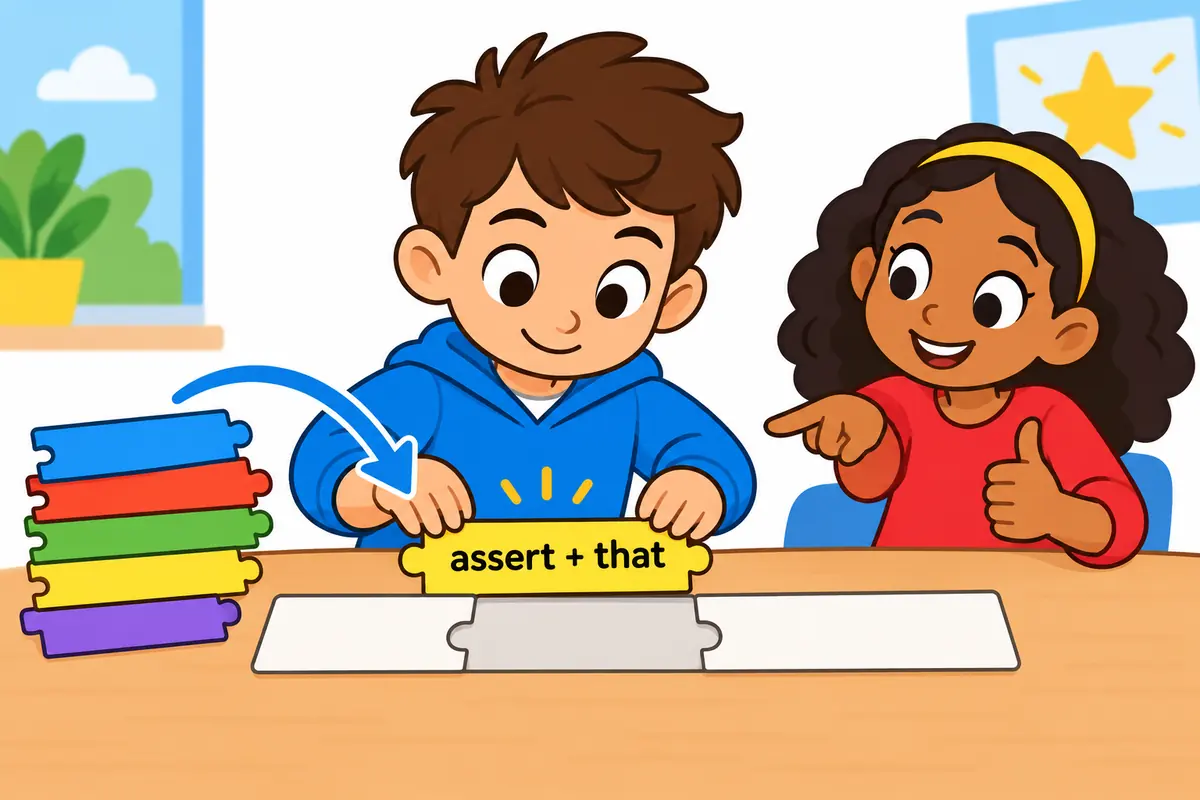
Five patterns cover almost every real sentence, and the object you choose decides which sense the reader hears.
| Pattern | Example | What it signals |
|---|---|---|
| assert + that-clause | The report asserts that costs have fallen. | A confident claim about a fact. |
| assert + noun | The new coach asserted her authority early. | A right or quality is made felt. |
| assert oneself | He finally asserted himself at the meeting. | The subject becomes the focus, not the claim. |
| assert + a right or claim | Villagers asserted their claim to the water. | A formal entitlement is pressed. |
| be asserted | It is often asserted that the law is outdated. | Passive, used to attribute an unnamed claim. |
The passive is a writer’s shield: it repeats a claim while keeping the source vague, which is why it appears so often in editorials.
Assert in a sentence: examples across contexts
Assert changes force rather than meaning as it moves between registers. The eight sentences below place the same verb in a classroom, an office, a courtroom and a news report.
| Context | Example sentence | Why this works |
|---|---|---|
| Classroom | Maya asserted that the answer was on the last page. | A that-clause suits a confident factual claim. |
| Workplace email | We must assert our position before the deal closes. | The noun object makes it about standing ground. |
| News report | The minister asserted that no rules had been broken. | Reporting a claim without endorsing it. |
| Legal writing | The claimant asserts a right of way over the field. | The present tense states a formal position. |
| Sports report | The visitors asserted control after the break. | Abstract object shows dominance being imposed. |
| Academic prose | It is often asserted that the two dialects merged. | Passive attributes a claim to unnamed scholars. |
| Management advice | New team leaders should assert themselves politely. | Reflexive use targets confidence, not a fact. |
| Everyday conversation | He kept asserting his innocence to anyone listening. | The repeated aspect hints at protest. |
Only the last sentence carries a note of desperation; in the others the verb stays neutral, which is why reporters rely on it.
Assert vs affirm and contend
Assert overlaps with two verbs and is interchangeable with neither. Contend adds the idea of arguing against opposition, and affirm offers something positive to a doubter rather than pressing a claim.
| Attribute | assert | affirm | contend |
|---|---|---|---|
| Core job | State firmly, or defend a right | Declare positively, often to reassure | Argue a position against rivals |
| Needs opposition | No | No | Yes, always |
| Typical object | A fact, right or oneself | A value, belief or commitment | A thesis or interpretation |
| Register | Formal to neutral, common in news | Formal, often solemn | Formal and argumentative |
Verdict: choose assert to press a claim or a right, affirm to endorse a value, and contend only when somebody is arguing back. The one-letter word assent means to agree, so it points the opposite way.
Word forms and grammar of assert
Assert inflects regularly, and its family supplies the noun and adjective that learners need most. The table also lists a form that is not standard English.
| Form | Part of speech | Example |
|---|---|---|
| assert | verb, base form | They will assert their independence soon. |
| asserted | verb, past and past participle | She asserted that the total was right. |
| asserting | verb, present participle | He is asserting a claim the court will test. |
| assertion | noun | That assertion needs evidence. |
| assertive | adjective | An assertive question got a straight answer. |
| assertation | non-standard | Use assertion instead; assertation is not accepted English. |
The noun assertion names the statement itself, while the adjective assertive describes a manner, so the two are not interchangeable.
Common mistakes with assert
- Incorrect:
Her assertation surprised the panel.Correct: Her assertion surprised the panel. Rule: The noun is assertion; assertation is a non-standard blend. - Incorrect:
He asserted on his innocence.Correct: He asserted his innocence. Rule: Assert is transitive, so it needs no preposition before its object. - Incorrect:
She asserted to be the best candidate.Correct: She asserted that she was the best candidate. Rule: Use a that-clause, not an infinitive, after assert. - Incorrect:
They assented their authority over the site.Correct: They asserted their authority over the site. Rule: Assent means agree and never takes an object this way.
Practice using assert
Six items follow; read the reason with each answer, because the pattern is the point.
- Fill the gap: The union ______ that the figures had been misread.
- Choose the better word: The witness could only (assert / assent) what she had seen, not prove it.
- Correct the error: The chair asserted on her right to speak.
- Build a sentence: use assert yourself about a shy pupil in a class debate.
- Spot the register: which belongs in a formal report, it is asserted that costs rose or people say costs went up?
- Rewrite with the noun: The lawyer asserted that the contract was void. Use assertion instead.
Answers
- asserted — a confident claim about a fact takes a that-clause.
- assert — she states what she saw; assent would mean she agreed with someone.
- The chair asserted her right to speak — assert takes a direct object, with no on.
- Model answer: Sam asserted himself in the debate and made his first clear point.
- It is asserted that costs rose — the passive keeps a formal, impersonal tone.
- The lawyer’s assertion was that the contract was void — the noun carries the claim.
The bottom line
Use assert in a sentence to state something firmly or to press a right, and let the object tell the reader which sense you mean. The two nuances that decide most sentences are that assert signals confidence rather than proof, and that the reflexive form assert yourself shifts the focus from a claim to a person. Where evidence must carry the point, demonstrate is the stronger choice.
Frequently asked questions about assert
Is assert a formal word?
Assert sits in formal and journalistic writing, where claims are reported without being endorsed. In relaxed speech most people say say or claim instead. A news report may write the minister asserted that no rules were broken, while a friend would simply say she said nothing was wrong.
What is the difference between assert and assent?
Assert means to state something firmly or defend a right. Assent is a verb or noun meaning to agree, and it moves in the opposite direction. The two differ by one letter, so a sentence such as the board assented its authority is wrong; the board asserted it.
Can assert take an infinitive?
No. Standard English allows a that-clause or a noun phrase after assert, never an infinitive. Write she asserted that she was ready, not she asserted to be ready. The infinitive pattern is the single commonest grammatical error with this verb, and it marks a learner immediately.
What is the noun of assert?
The noun is assertion, which names a confident statement or a defended claim. The adjective is assertive, describing a manner, and the adverb is assertively. A non-standard form, assertation, sometimes appears in speech but is not accepted in careful writing, so use assertion instead.
Do you want to express your thoughts confidently and clearly in writing or speech? Using the word “assert” in your sentences can help you convey your ideas with authority and conviction. When you assert something, you declare it strongly and firmly, making your viewpoint or opinion known.
Being able to assert yourself effectively can enhance your communication skills, whether in your academic, professional, or personal life. By using assertive language, you can make a strong and persuasive argument, ensuring that your message is heard and understood by others. So, let’s explore how to incorporate “assert” into your sentences to make a bold and impactful statement.
7 Examples Of Assert Used In a Sentence For Kids
- Assert that you are good at drawing.
- Assert that you can count to ten.
- Assert that you like to play with your friends.
- Assert that you know the colors of the rainbow.
- Assert that you enjoy listening to stories.
- Assert that you can say please and thank you.
- Assert that you are a kind and helpful person.
14 Sentences with Assert Examples
- Assert your opinions and ideas confidently during classroom discussions.
- It is important to assert yourself when facing academic challenges and seek help when needed.
- Remember to assert your boundaries with classmates and roommates to maintain a healthy living environment.
- When presenting a project, make sure to assert your key points clearly and effectively.
- It is crucial to assert your independence and decision-making abilities while navigating college life.
- Don’t be afraid to assert your right to a fair and unbiased evaluation of your academic work.
- Assert your needs when it comes to managing your time and balancing academics with other responsibilities.
- Practice asserting yourself in group projects to ensure your voice is heard and your contributions are valued.
- Assert your goals and aspirations by actively working towards them with determination.
- When facing discrimination or unfair treatment, it is important to assert your rights and seek support.
- In job interviews or internship applications, confidently assert your skills and qualifications.
- Assert your academic integrity by always citing sources properly in your assignments.
- If you disagree with a professor’s evaluation, you have the right to assert your perspective and request a review.
- It’s essential to assert your need for self-care and prioritize your mental health during stressful academic periods.
How To Use Assert in Sentences?
Assert is a crucial concept in programming that allows developers to validate if a given condition is true before proceeding with the code execution. It helps in catching errors and bugs early on in the development process.
To effectively use Assert in a sentence, you first need to construct a statement that you want to test. For example, suppose you have a function that calculates the square of a number. Using Assert, you can validate if the function is working correctly by checking if the output is as expected.
To use Assert in a sentence, you can write something like:
python

assert square(3) == 9, "The square function is not working correctly"
In this example, the Assert statement checks if the result of calling the square function with the input of 3 is equal to 9. If the condition is true, the program continues to run without any issues. However, if the condition is false, an AssertionError is raised, indicating that there is an issue with the square function.
When using Assert, it is essential to provide a meaningful error message that helps in identifying the cause of the failure. This message will be displayed when the condition in the Assert statement is not met, aiding in debugging and resolving the issue efficiently.
Conclusion
In conclusion, assertive sentences play a crucial role in communication by expressing thoughts, opinions, or beliefs confidently and clearly. By using assertive language, individuals can effectively convey their ideas with conviction, leading to better understanding and engagement. For instance, a sentence like “I believe we should pursue this strategy” clearly asserts a stance on a matter, promoting decisiveness and direction in communication.
Furthermore, assertive sentences can help establish boundaries, set expectations, and assert one’s rights in various situations. Statements such as “I need some time alone to recharge” demonstrate self-awareness and self-assurance, enabling individuals to communicate their needs assertively. Employing assertive sentences can ultimately enhance communication effectiveness and facilitate healthy interactions in both personal and professional settings.


