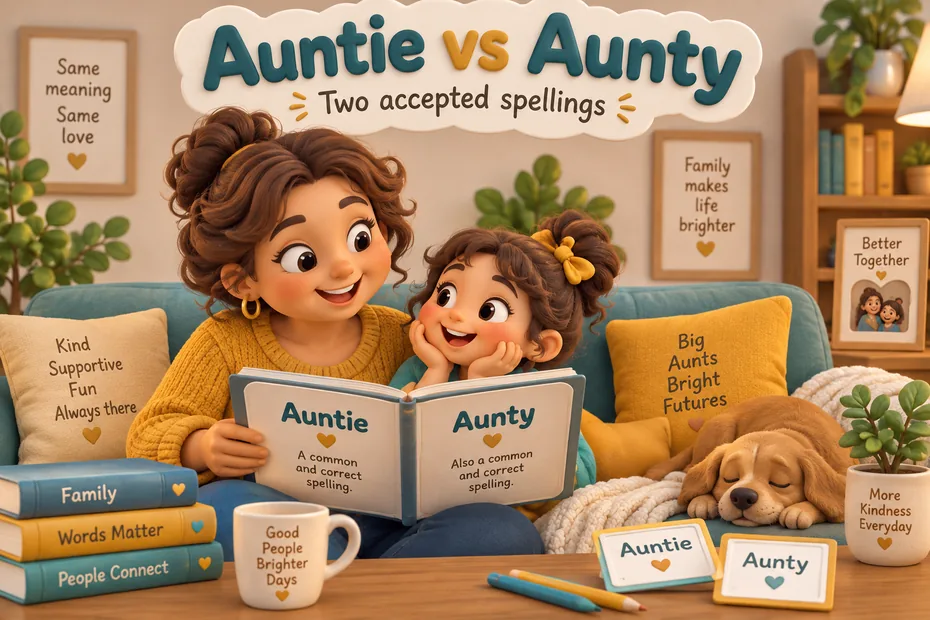
Auntie and aunty are accepted spelling variants of the same familiar word for aunt. Neither spelling creates a separate family relationship or automatically makes the address more formal. Choose the spelling your family or the person prefers, keep it consistent, and use aunt or the person’s name when a more neutral expression fits.
Auntie vs aunty: key facts
- Merriam-Webster records aunty as a variant of auntie.
- Both spellings can express familiar or affectionate address.
- There is no dictionary rule making one spelling a different relationship.
- A family member’s preference is a useful guide for cards and messages.
- Addressing an unrelated person this way requires attention to context and preference.
What is the actual spelling difference?
| Form | Relationship meaning | Original example | Practical choice |
|---|---|---|---|
| Auntie | Familiar word for aunt | Auntie Maya sent a postcard. | Use if this is the family’s spelling |
| Aunty | The same familiar word | Aunty Maya sent a postcard. | Use if this is the preferred variant |
| Aunt | Neutral family term | My aunt sent a postcard. | Useful in neutral explanatory prose |
| A person’s name | Individual address | Maya sent a postcard. | Follow the person’s preference |
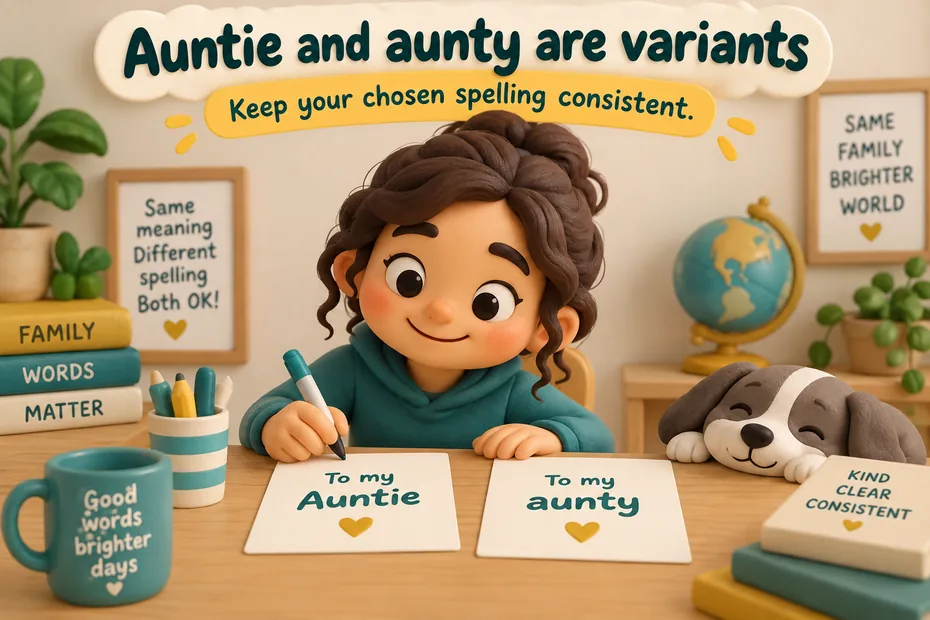
Merriam-Webster’s auntie entry explicitly lists aunty as a spelling variant. Collins’s auntie entry also records the alternative. This supports treating the forms as variants, rather than teaching them as two terms with a mandatory meaning distinction.
The original explanation below assigns auntie to American English, aunty to British English, and a more formal tone to aunty. Those claims should not be used as rigid rules. The spelling alone does not establish a speaker’s country, the exact tone of a message, or the nature of a relationship.
Which spelling should you use in a family message?
Use the form already used by your family or the recipient. If a relative signs a note “Aunty Maya,” matching that spelling is a straightforward choice for a reply. If your family has always written “Auntie Maya,” there is no reason to change solely because another spelling appears in a dictionary.
Consistency helps a reader recognize the intended address. In one invitation or card, choose a single spelling unless you are quoting someone who uses the other. A quotation should preserve the original wording. Your surrounding text can still follow your chosen form without treating the quoted variant as a mistake.
For a neutral description in a formal document, aunt is often the clearest family term: “My aunt will attend.” Auntie or aunty can still fit a personal quotation or a familiar address. The decision concerns the document’s voice and the person’s preference, not a rule that one of the two spellings is inherently formal.
How do capitalization and plurals work?
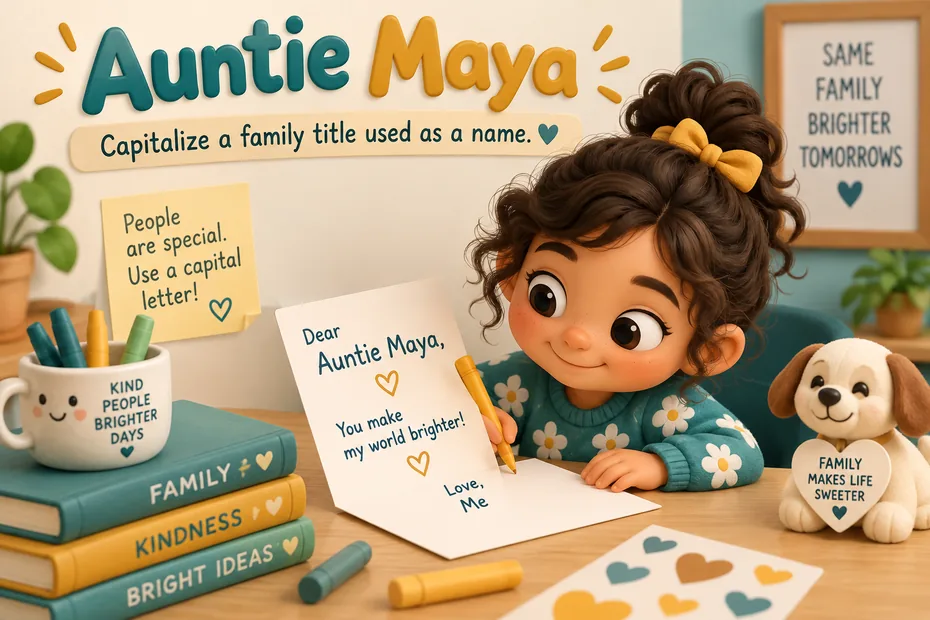
Capitalize a family title when it forms part of the name you use: “Auntie Maya” or “Aunty Maya.” In a general description after my, use lowercase: “my auntie” or “my aunty.” Direct address often treats the title as the name: “Thank you, Auntie.” Keep the distinction between naming someone and describing a relationship.
For the plural, auntie becomes aunties. Aunty also becomes aunties: the final y changes to ies. An apostrophe indicates possession rather than a simple plural: “my auntie’s card” describes one auntie’s card, while “my aunties” names more than one. Write “my aunties’ cards” when the cards belong to several aunties.
These spelling mechanics do not change the family meaning. Choose a variant first, then apply ordinary capitalization and possession conventions to the sentence. A card heading can use a title-like capital, but an ordinary prose sentence should not capitalize every relationship word automatically.
Can auntie refer to someone who is not a relative?
Auntie or aunty can be used as a familiar or respectful address beyond literal family relationships in some communities. That does not make the address appropriate for every older woman. Merriam-Webster labels this broader use informal and sometimes offensive, so consider the actual person’s preference rather than assuming warmth is guaranteed.
When you do not know the preferred address, use the person’s name or an established title. If someone has invited you to call her Auntie, that gives useful context. The spelling question is secondary to the relationship: choosing aunty instead of auntie does not resolve an address that the recipient dislikes.
Frequently asked questions
Is aunty a misspelling?
No. Aunty is recorded as a spelling variant of auntie. It can be used for the same familiar family address. Keep the spelling consistent within your own message and respect a recipient’s preference, rather than correcting the variant simply because you learned the other form first.
Does aunty sound more formal than auntie?
The spelling alone does not create a dependable formality distinction. Both forms are familiar ways to refer to an aunt. Tone comes from the relationship, the surrounding wording, and local custom. For neutral prose, aunt is a useful choice; for a family message, the established preferred form usually fits better.
Should I capitalize my auntie?
In ordinary prose, write my auntie with a lowercase letter because the phrase describes the relationship. Use a capital when the title is functioning as part of a name, such as Auntie Maya. Direct address can likewise use the title as a name: “Please call me tomorrow, Auntie.”
Can I call every older woman Auntie?
No. Some people welcome the familiar address, while others find it inappropriate or unwelcome. Follow the person’s preference and the community’s actual convention. If you are unsure, use a name or established title. Selecting a different spelling does not change whether the form of address suits that person.
Growing up, I always wondered about the proper usage of the terms “auntie” and “aunty.” Are they interchangeable? Does it depend on where you’re from? As I delved deeper into the topic, I realized that there is indeed a distinction between these two seemingly similar words. In this text, I’ll unravel the mystery and provide you with a clear understanding of when to use “auntie” and when to use “aunty.” So, whether you’re writing a heartfelt birthday card or addressing a family member, stick around as I guide you through the nuances of these terms and help you navigate the auntie vs aunty conundrum.
Key Takeaways
- “Auntie” and “aunty” are two distinct terms used to address an aunt or older female relative.
- “Auntie” is more commonly used in American English, while “aunty” is primarily used in British English.
- “Auntie” has a friendly and affectionate connotation, while “aunty” is slightly more formal.
- Regional variations and personal preferences can influence the choice between “auntie” and “aunty.”
- Usage can vary within regions, dialects, and cultural backgrounds.
- Respect personal preferences and adapt language to accommodate others.
The Difference Between “Auntie” and “Aunty”
As a language enthusiast, I’ve always been curious about the subtle differences between words that appear to be similar. One such pair of words that have often puzzled me is “auntie” and “aunty.” You may have come across both of these terms and wondered if they are interchangeable or if there are specific contexts where one should be used over the other. Let’s jump into the distinction between “auntie” and “aunty” to gain a better understanding.
When it comes to the definition of these two words, both “auntie” and “aunty” are informal terms used to address an aunt or an older female relative. The main difference lies in their usage and regional preferences.
The term “auntie” is more commonly used in American English and reflects the American spelling of the word “aunt.” It has a friendly and affectionate connotation, often used by younger individuals or in informal settings. On the other hand, “aunty” is primarily used in British English and follows the British spelling of the word “aunt.” It is less commonly used in American English but is widely understood due to its usage in literature and media.
It’s important to note that the choice between “auntie” and “aunty” is often influenced by personal preference and cultural background. Some individuals may have grown up using one term over the other, while others may interchange them depending on the situation or the person they are addressing.
To summarize the differences between the two terms:
- “Auntie” is more commonly used in American English, while “aunty” is more prevalent in British English.
- “Auntie” has a friendly and affectionate tone, while “aunty” is slightly more formal.
- The choice between the two is often based on personal preference and cultural background.
To better understand the usage of these terms, let’s consider a few examples:
- “Hey auntie, can you help me with my assignments?”
- “I’ll be visiting my aunty in London next week.”
Regional Variations in Usage
In exploring the distinction between “auntie” and “aunty,” it’s important to note that usage can vary regionally. While both terms are used to refer to a person’s aunt, the choice between “auntie” and “aunty” can depend on cultural and geographical factors. Let’s take a closer look at how these variations in usage occur:
- American English: In American English, “auntie” is the more commonly used variant. It carries a friendly and affectionate connotation. You’ll often hear children using the term when referring to their aunts. For example, “I love spending time with my Auntie Lisa.” This usage reinforces the idea of a warm and nurturing relationship between the aunt and the child.
- British English: On the other hand, British English primarily uses the term “aunty.” It is slightly more formal in nature and is commonly used by both children and adults. For instance, “I’m going to visit my Aunty Mary this weekend.” The usage of “aunty” in British English reflects a respect and formality in addressing one’s aunt.
- Other Variations: It’s worth noting that regional variations can also occur within English-speaking countries. Different dialects, accents, and cultural backgrounds can influence the preferred term. For example, in some parts of England, “auntie” or “auntie” may be used interchangeably, reflecting the melting pot of language within a specific region.
The choice between “auntie” and “aunty” largely comes down to personal preference and cultural background. While the general guidelines discussed above can help you understand the variations in usage, it’s important to be respectful of individuals’ preferences and adapt accordingly.
By acknowledging the regional variations in usage, we can better appreciate the nuances of language and how it reflects cultural diversity. Understanding these differences can lead to more effective communication and strengthen our connections with those around us. So, whether you say “auntie” or “aunty,” the affection and love for your aunt remain the same.
The Evolution of the Terms
When it comes to the terms “auntie” and “aunty,” it’s fascinating to explore their evolution and how they have become part of our everyday language. Understanding the historical context behind these terms can shed light on their usage and the subtle differences between them.
Definition of “auntie” and “aunty”
Both “auntie” and “aunty” refer to a female sibling of a parent or a female relative who is older than oneself. The terms are used as affectionate ways to address or refer to these relatives. While the meaning remains the same, the choice between “auntie” and “aunty” can vary based on cultural and regional influences.
The British Influence
The term “aunty” predominantly emerged from British English and is still widely used in the United Kingdom and other Commonwealth countries. The British accent and cultural preference for formality contribute to the prevalent use of “aunty” in these regions.
The American Influence
On the other hand, “auntie” is more commonly used in American English and has a friendlier connotation. It is often seen as a term of endearment, symbolizing a close and affectionate relationship with one’s aunt. The usage of “auntie” in American English reflects a more casual and informal approach.
Cultural and Personal Preferences
While these distinctions exist, it’s important to note that personal preference and cultural background play a significant role in the choice between “auntie” and “aunty.” Some individuals may simply prefer one term over the other, based on their upbringing or individual taste. It’s crucial to respect and adapt to the preferences of the person being addressed.
Regional Variations in Usage
Beyond the British and American influences, there are regional variations within these countries as well. Different dialects, accents, and cultural backgrounds can shape the preferred term for addressing or referring to one’s aunt. These regional variations add diversity to our language and enrich our understanding of the nuances in communication.
By exploring the evolution of these terms and the cultural factors that shape their usage, we can gain a deeper appreciation for the rich linguistic world that exists within the English language. It’s important to embrace these variations and adapt our language to respect the preferences of others.
When to Use “Auntie”
As I dive deeper into the nuanced world of “auntie” and “aunty,” it’s important to understand when to use “auntie” specifically.
Definition of “Auntie”: “Auntie” is a term affectionately used to address or refer to a female relative who is older than oneself. It’s a term that conveys a close and affectionate relationship with one’s aunt.
So, when is it appropriate to use “auntie” in your everyday language? Let’s explore some scenarios:
- Informal Conversations: In casual conversations with your aunt, friends, or family members, you can freely use “auntie.” It’s a term that reflects intimacy and closeness.
- Familiar Settings: “Auntie” is commonly used within familiar settings among family members or close friends. For instance, during family gatherings, you can address your aunt as “auntie” to demonstrate affection and familiarity.
- Showing Respect: Using “auntie” can also be a respectful way to address someone’s aunt, especially when you are meeting them for the first time or want to show honor and deference.
- Cultural Influence: Depending on your cultural background, using “auntie” might be the norm in your community. It is widely used by communities and individuals influenced by American English.
Remember, personal preference and cultural background also come into play when deciding between “auntie” and “aunty.” While “auntie” tends to be more common in American English, there are regional variations and dialect influences within both British and American English. Adapt your language to respect the preferences of others while embracing the beautiful linguistic variations within the English language.
When to Use “Aunty”
As we discussed earlier, the terms “auntie” and “aunty” both refer to a female relative who is older than oneself. But, there are certain situations where using “aunty” specifically is more appropriate. Let’s explore when it is fitting to use this term:
- Formal occasions with unfamiliar individuals: In formal settings, especially when you are meeting someone for the first time, it’s advisable to use “aunty” as a sign of respect. This demonstrates politeness and acknowledges the age and seniority of the person you are addressing.
- Cultural traditions and customs: Many cultures have specific terms of endearment or respect for older female relatives, such as “aunty” in Indian, Pakistani, or Sri Lankan cultures. If you come from such a background or are interacting with individuals from these cultures, using “aunty” can help create a sense of familiarity and warmth.
- Familiar settings and informal conversations: When you are in a casual or familiar setting, such as among family or close friends, using “aunty” can convey a sense of comfort and intimacy. It reinforces the close bond you have with the person you are addressing.
- Personal preference: It’s crucial to respect individual preferences when it comes to addressing someone as “aunty” or “auntie.” Some people may have a strong preference for one term over the other based on their personal upbringing or cultural background. By using the term they prefer, you show sensitivity and respect for their linguistic choices.
To summarize, “aunty” is a term that is often used in formal settings, cultural contexts, familiar settings, and when respecting personal preferences. By understanding these nuances, you can confidently navigate various social situations and effectively communicate with your older female relatives.
Conclusion
Understanding the appropriate usage of “auntie” and “aunty” is crucial when addressing or referring to older female relatives. Throughout this article, we have explored the evolution of these terms and when to use “auntie” specifically.
In informal conversations and familiar settings, “auntie” conveys a close and affectionate relationship. It is a term that shows respect and is commonly used among family members. But, cultural influence and personal preference also play a role in the choice between “auntie” and “aunty.”
On the other hand, “aunty” is more suitable for formal occasions with unfamiliar individuals and situations where cultural traditions and customs are involved. It can also be used in familiar settings and informal conversations, depending on personal preferences.
By understanding these nuances, we can confidently navigate various social situations and effectively communicate with our older female relatives. Whether it’s “auntie” or “aunty,” the key is to use the term that best fits the context and relationship, ensuring that we show the appropriate level of respect and affection.
Frequently Asked Questions
Q: When should I use the term “auntie”?
A: The term “auntie” should be used when addressing or referring to a female relative who is older than oneself. It conveys a close and affectionate relationship and is appropriate in informal conversations, familiar settings, and to show respect.
Q: What factors influence the choice between “auntie” and “aunty”?
A: Cultural influence and personal preference play a role in choosing between “auntie” and “aunty.” Consider the context and the relationship with the female relative.
Q: When is it more appropriate to use “aunty” specifically?
A: It is more appropriate to use “aunty” in formal occasions with unfamiliar individuals, cultural traditions and customs, familiar settings and informal conversations, and when respecting personal preferences.
Q: How can I navigate social situations with older female relatives?
A: By understanding the nuances between “auntie” and “aunty,” one can confidently communicate with older female relatives. Consider the context, relationship, cultural factors, and personal preferences when choosing which term to use.


