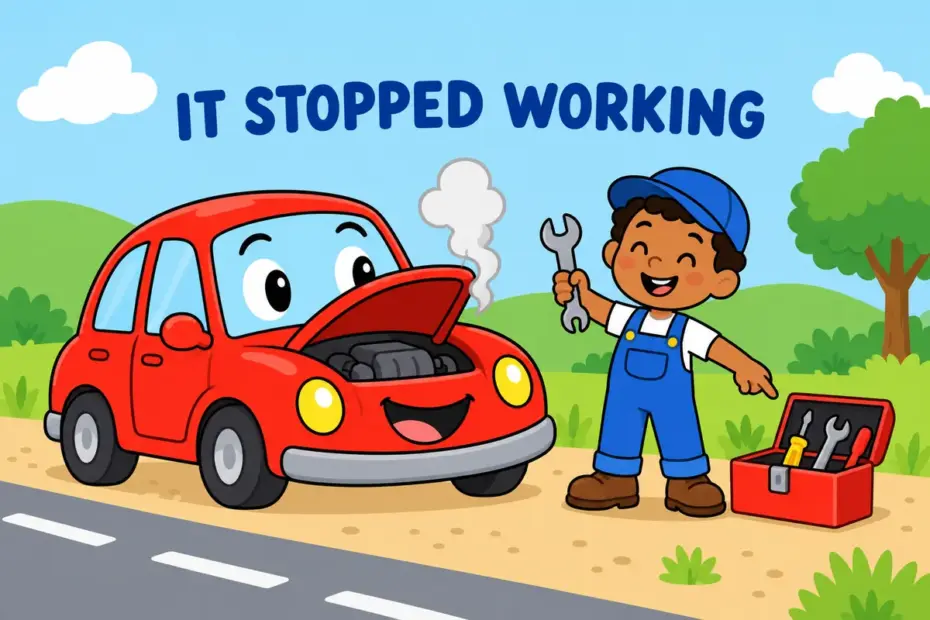
Break down means to stop working, to lose emotional control, or to divide something into smaller parts. To use break down in a sentence, first pick the sense, because the grammar changes: “The van broke down on the ring road.” The verb separates in the dividing sense but stays whole in the mechanical one.
Break down at a glance
- Break down is a phrasal verb with several senses: stop working, collapse, and divide into parts.
- It is intransitive when a machine, a person or a talk fails, and transitive when you divide something.
- It is separable only in the dividing sense: break the figures down by region.
- The commonest patterns are break down into, break down in or over, and break plus object plus down.
- The usual errors are splitting the verb in the wrong sense and writing the noun as two words.
What does break down mean?
Break down is a phrasal verb whose meaning shifts with its sense and its preposition. Broadly it means to stop working normally or to come apart into pieces. The Cambridge entry for break down lists both the malfunction sense and the divide sense, and the table keeps them apart because they behave differently in a sentence.
| Sense | Plain meaning | Example sentence |
|---|---|---|
| Stop working | A machine or system ceases to function | The lift broke down again. |
| Lose control | A person collapses emotionally | She broke down during the interview. |
| Divide into parts | Separate something for analysis | Break the budget down by month. |
| Decompose | Rot or separate into simpler parts | Leaves break down in the soil. |
| Fail | Talks or a process end unsuccessfully | The talks broke down over pay. |
Break down is not the same as destroy: a thing that breaks down has stopped working and may be repaired, while a thing that is destroyed is gone. The contrary of the dividing sense is assemble or build, which put the parts back together.
How do you use break down in a sentence?
Separability is the trap, and it depends on the sense: only the dividing sense lets the object move between the verb and the particle. In the machine, emotional and collapse senses the verb is intransitive and must stay whole.
| Pattern | Example | What it signals |
|---|---|---|
| break down (no object) | The lift broke down again. | A machine or system stops working. |
| break + object + down | Break the problem down into steps. | The dividing sense; separable. |
| break down into + noun | The task breaks down into five stages. | Dividing with no object. |
| break down in / over + noun | Talks broke down over money. | Negotiations fail. |
| be broken down | The data was broken down by age. | Divisions presented systematically. |
| break down (no object) | He broke down at the news. | Emotional collapse, intransitive. |
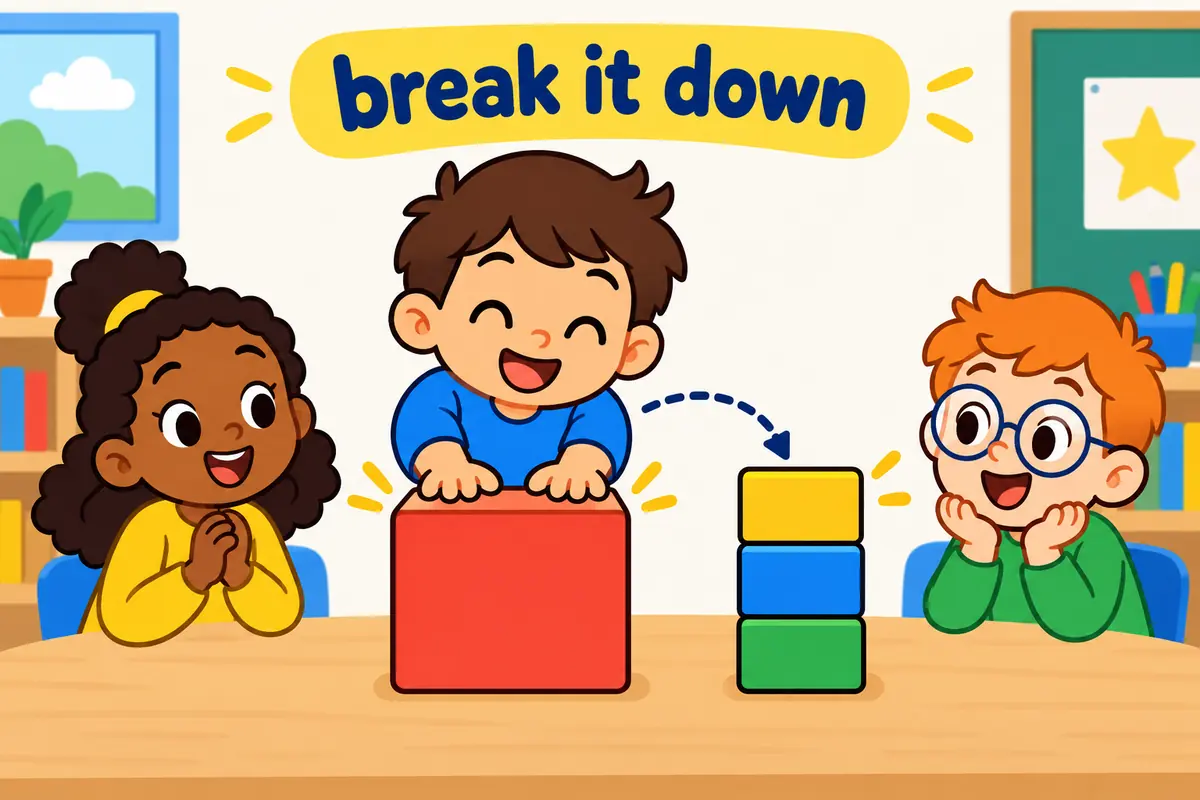
Break down in a sentence: examples across contexts
| Context | Example sentence | Why this works |
|---|---|---|
| Motoring | The van broke down on the ring road. | The machine is the subject and no object follows. |
| Classroom | Break the poem down line by line. | The dividing sense, with the object moved forward. |
| Workplace email | The figures break down into three cost centres. | Intransitive dividing with into. |
| News report | Talks between the two sides broke down overnight. | The failure sense for negotiations. |
| Conversation | She broke down when she heard the result. | The emotional sense, intransitive. |
| Academic writing | The sample was broken down by age and region. | A passive dividing in a methods line. |
| Technical writing | The pump breaks down if the filter clogs. | A conditional cause for a malfunction. |
| Gardening | The compost breaks down over the winter. | The decompose sense, slow and natural. |
| Sports commentary | The champion broke down in the final set. | The emotional collapse in a match context. |
Break down vs break up
Break up means to come apart into separate pieces or to end a relationship, while break down means to stop functioning or to divide for analysis.
| Attribute | break down | break up |
|---|---|---|
| Core meaning | Stop working or divide into parts | Come apart into pieces or end |
| Typical subject | Machines, talks, people, data | Couples, crowds, ice, meetings |
| Separability | Only in the dividing sense | Separable in most senses |
| What it implies | A slow failure or analysis | A split into parts, or an ending |
| Register | Neutral, common everywhere | Neutral, common in speech |
| Example | The engine broke down. | The band broke up. |
One further trap: make the verb two words and the noun one. Break down is what a machine does; a breakdown is the noun for the failure itself.
Related verbs fill in the details. A machine that stops has a malfunction; organic matter that rots will decompose; to analyze a figure is to break it into parts; talks that fail may collapse; to dismantle is to take something apart on purpose; and break up or back down reuse the same family words with different meanings.
Word forms and grammar of break down
| Form | Part of speech | Example |
|---|---|---|
| break down | base phrasal verb | Break down the total by department. |
| breaks down | third person singular | The photocopier breaks down weekly. |
| broke down | past tense | The car broke down outside town. |
| broken down | past participle | The data was broken down by region. |
| breaking down | present participle | The engine is breaking down. |
| breakdown | one-word noun | There was a breakdown in talks. |
Common mistakes with break down
- Incorrect:
The machine broke itself down.Correct: The machine broke down. Rule: the malfunction sense is intransitive, so no reflexive or object follows. - Incorrect:
They broke down the negotiations.Correct: The negotiations broke down. Rule: talks are the subject of the failing sense. - Incorrect:
She broke down the news and cried.Correct: She broke down at the news and cried. Rule: emotional collapse takes a phrase with at, not a direct object. - Incorrect:
Break down the report into points for me.Correct: Break the report down into points. Rule: when the object is a full noun, it may sit between verb and particle. - Incorrect:
He had a break down after the exam.Correct: He had a breakdown after the exam. Rule: the noun is written as one word.
Practice using break down
Each item tests a different sense or the separable rule.
- Fill the gap: The washing machine ______ halfway through the cycle.
- Choose the better word: The committee (broke down / broke up) when two members resigned.
- Correct the error: Please break down the schedule for me into weeks.
- Build a sentence: use break down into about a large budget.
- Spot the register: which suits a report, The sample was broken down by region. or We broke it all down.
- Rewrite with the noun: Talks stopped working yesterday. Use breakdown.
Answers
- The washing machine broke down halfway through the cycle. A machine stops working, so the verb is intransitive.
- broke up fits because the committee came apart and ended; broke down would suggest it stopped working like a machine.
- Please break the schedule down into weeks. The separate form is preferred when the object is a full noun.
- The grant breaks down into three separate funds. The pattern break down into divides one whole into parts.
- The sample was broken down by region. The passive dividing form is precise and impersonal, which suits a report.
- There was a breakdown in the talks yesterday. The one-word noun names the failure itself.
The bottom line
Break down in a sentence is easy once the sense is fixed: machines and people break down with no object, while data and problems are broken down into parts. Keep the particle joined except in the dividing sense, and write the noun as the single word breakdown.
Frequently asked questions about break down
Is break down always separable?
No. Break down is separable only in the dividing sense, where you can break the figures down by region. In the senses of a machine stopping, a person losing control, or talks failing, the verb is intransitive and stays whole, so you cannot move anything between break and down.
What is the difference between break down and breakdown?
Break down is the two-word verb and breakdown is the one-word noun. You write the car broke down, but you write the breakdown of the car. The same contrast holds for the other meanings, so the data breaks down by age and the breakdown of the data is useful.
Does break down mean the same as destroy?
No. Something that breaks down has stopped working and can often be repaired, while something that is destroyed is gone for good. A car breaks down, but a building is destroyed. Choosing break down keeps the possibility of repair or recovery in view.
Can break down describe a person?
Yes. In the emotional sense, break down means to lose control of your feelings, as in she broke down at the news. This sense is intransitive, it is not a criticism, and it takes a phrase with at, under or with rather than a direct object.
Have you ever struggled to understand a complex concept or piece of information? This is where the process of breaking down comes into play. Breaking down involves dissecting something intricate into simpler, more manageable components for better comprehension.
When you break down a concept, topic, or task, you essentially analyze its different parts, helping you grasp the overall idea more effectively. This technique is often used to simplify challenging subjects, making them easier to understand and work through.
7 Examples Of Break Down Used In a Sentence For Kids
- Break down can mean something stops working.
- We use tools to help us break down big tasks into small ones.
- When we eat food, our bodies break down the food to get energy.
- Sometimes our emotions can make us feel like we want to break down and cry.
- Let’s work together to break down the difficult problem into easy steps.
- It’s okay to ask for help when you feel like you need to break down.
- Can you help me break down the toys after we finish playing?

14 Sentences with Break Down Examples
- Break down the complex math problem into simpler steps.
- It’s important to break down the Indian history chapter for better understanding.
- Can you help me break down the steps to prepare for the upcoming exam?
- Let’s break down the project into smaller tasks to manage our time effectively.
- I need to break down the syllabus to make a study plan for the semester.
- The professor will break down the assignment requirements in the next class.
- Don’t wait until the last minute to break down the research paper topic.
- Group study sessions can help you break down difficult concepts with your peers.
- Use mind mapping to break down and visualize your ideas before writing the essay.
- Break down the chemistry experiment to understand the reactions involved.
- The tutorial video will break down the software installation process step by step.
- You can break down the economics concept with real-life examples for better grasp.
- It’s essential to break down the programming problem to identify the errors in the code.
- Use flashcards to break down and memorize key terms for the exam.

How To Use Break Down in Sentences?
To Break Down something means to analyze or separate it into smaller parts. Here’s a simple guide on how to use Break Down in a sentence:
- Identify the concept or object you want to break down. For example, “I want to break down the steps to completing a puzzle.”
- Use the phrase “to break down” followed by the specific item or idea. For instance, “Let’s break down the components of the project.”
- Consider using Break Down when explaining a process in simple steps. For example, “Can you break down how the machine functions?”
- Remember that Break Down can also refer to analyzing information or understanding complex topics. For instance, “She was able to break down the scientific jargon so everyone could understand.”
- It’s also common to use Break Down when talking about emotional reactions or situations becoming more manageable. For instance, “He started to break down the problem and find a solution.”
By following these steps and examples, you can effectively incorporate Break Down into your sentences. Keep practicing to become more comfortable using this phrase in your everyday conversations.

Conclusion
In summary, understanding how to break down sentences can greatly improve one’s writing and communication skills. By analyzing the structure of a sentence, individuals can grasp its components, such as subject, verb, and object, leading to clearer and more effective communication. Recognizing grammatical elements in a sentence helps in forming coherent thoughts and conveying ideas more succinctly.
Moreover, breaking down sentences aids in identifying errors and improving overall grammar proficiency. By deconstructing sentences, individuals can pinpoint and rectify mistakes, thus enhancing the quality of their writing. Embracing the skill of breaking down sentences can elevate writing proficiency and foster better communication in various environments.


