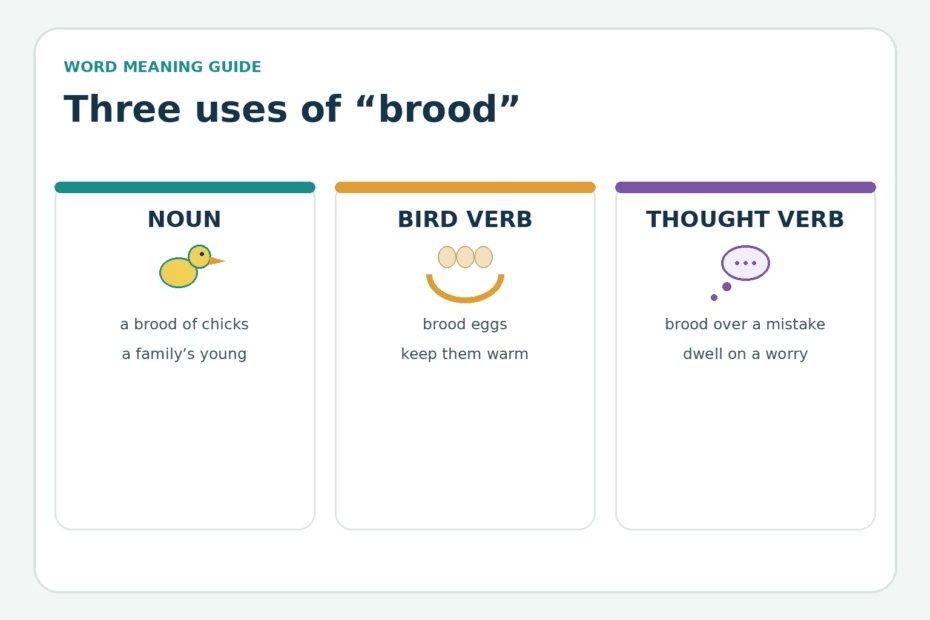
Brood has more than one meaning: as a noun, it can mean a group of young animals (especially birds) or, informally, a family’s children; as a verb, it can mean to sit on eggs to keep them warm, or to dwell anxiously on a thought. The surrounding words tell you which meaning is intended: “a brood of chicks,” “the hen broods her eggs,” and “he broods over the delay.”
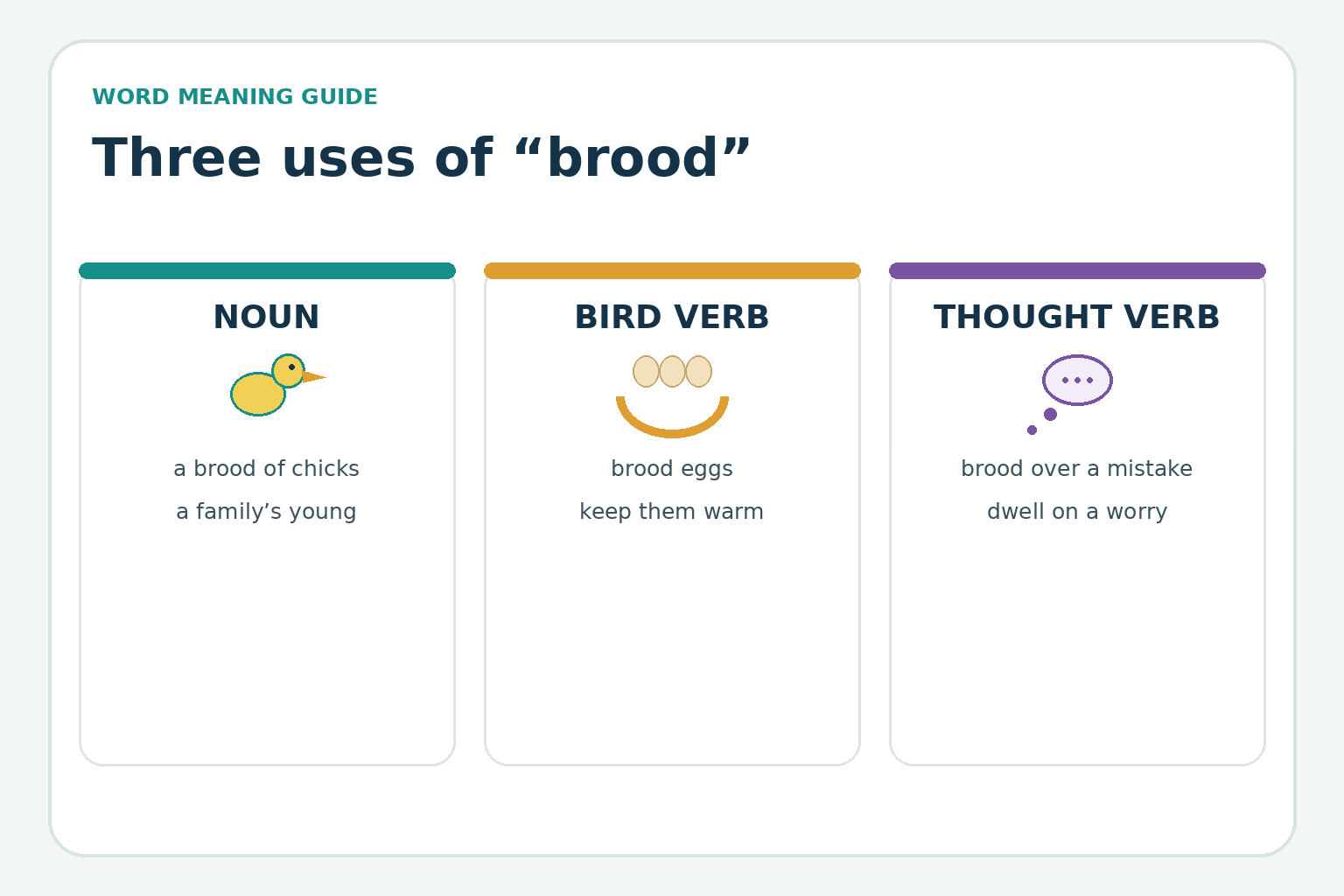

Brood meaning and grammar at a glance
| Form | Meaning | Common pattern | Example |
|---|---|---|---|
| Noun | A group of young, especially birds hatched or cared for at one time; informally, a family’s children | a brood of + plural noun | “A brood of ducklings followed the parent bird.” |
| Verb: bird care | To sit on or cover eggs or young, keeping them warm | brood eggs / brood over young | “The hen brooded her eggs in the nest.” |
| Verb: thought | To dwell on something in an anxious, gloomy, or resentful way | brood over/about + subject | “He brooded over the remark all afternoon.” |
Pronounce brood as one syllable, /bruːd/ (“brood,” rhyming with food). The noun’s plural is broods; the verb forms are broods, brooded, and brooding. Merriam-Webster and Cambridge both give the group-of-young and troubled-thinking senses; Merriam-Webster also lists the bird-care verb sense.
How to use brood as a noun
As a countable noun, brood usually refers to young produced or cared for together. It most often describes birds, but the broader animal sense can include other offspring. Use a phrase such as a brood of chicks when you want to make the group clear. For a person’s children, brood can sound humorous, affectionate, or slightly dismissive depending on context, so use the neutral word children when tone matters.
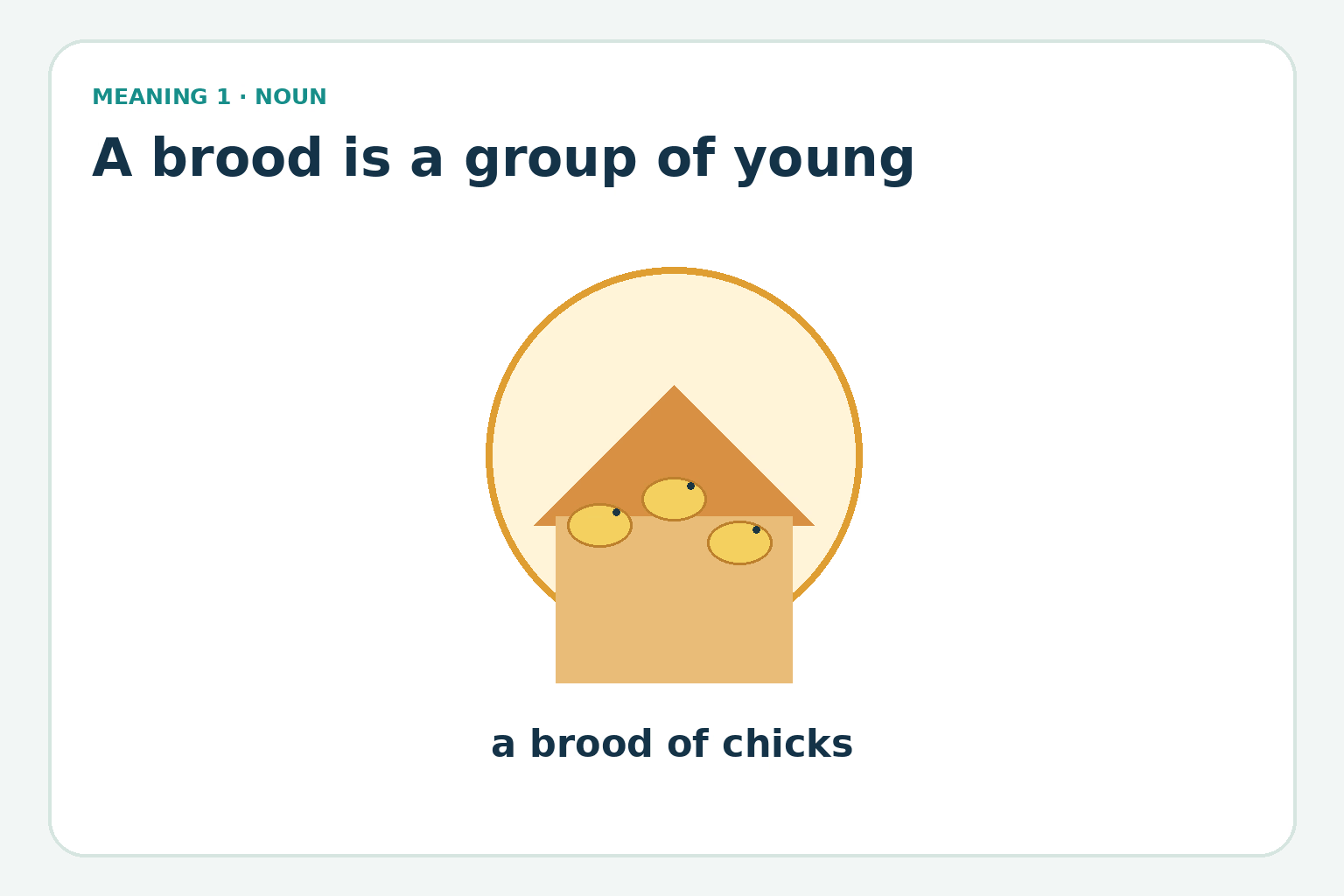
Examples: “The robin carried food to its brood”; “A brood of ducklings crossed the path”; “She arrived with her whole brood.” In the last example, brood means her children, not a group of birds. When the intended group is not obvious, naming it prevents confusion.
How to use brood as a verb
For bird care, brood describes sitting on eggs or covering young. This is a literal animal-behavior use: “The hen brooded the eggs until they hatched.” The verb can take a direct object (brood the eggs), and birds may also be described as brooding over their young. Keep this meaning distinct from the emotional one: in a sentence about a nest, eggs, or chicks, brood refers to care or incubation.
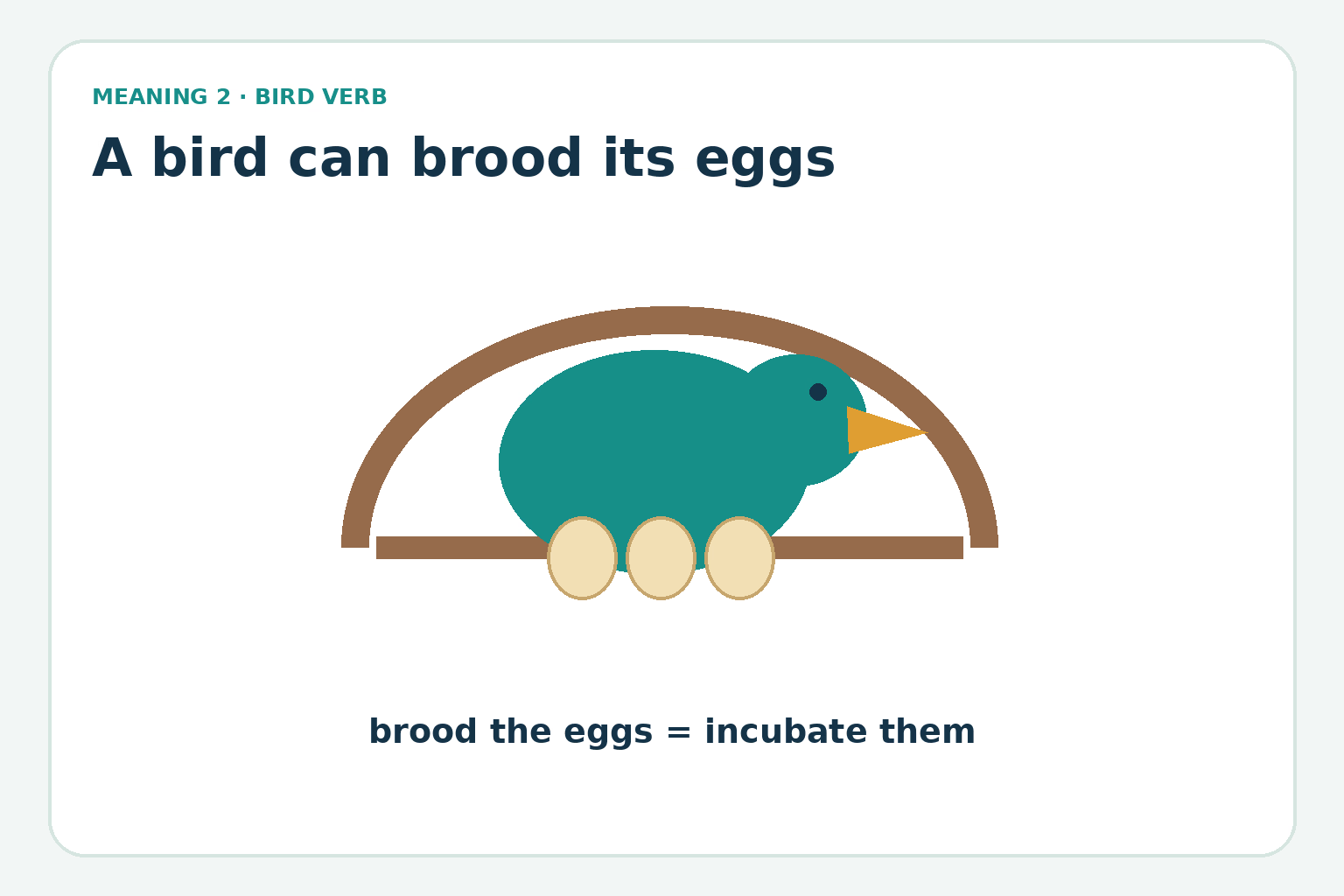
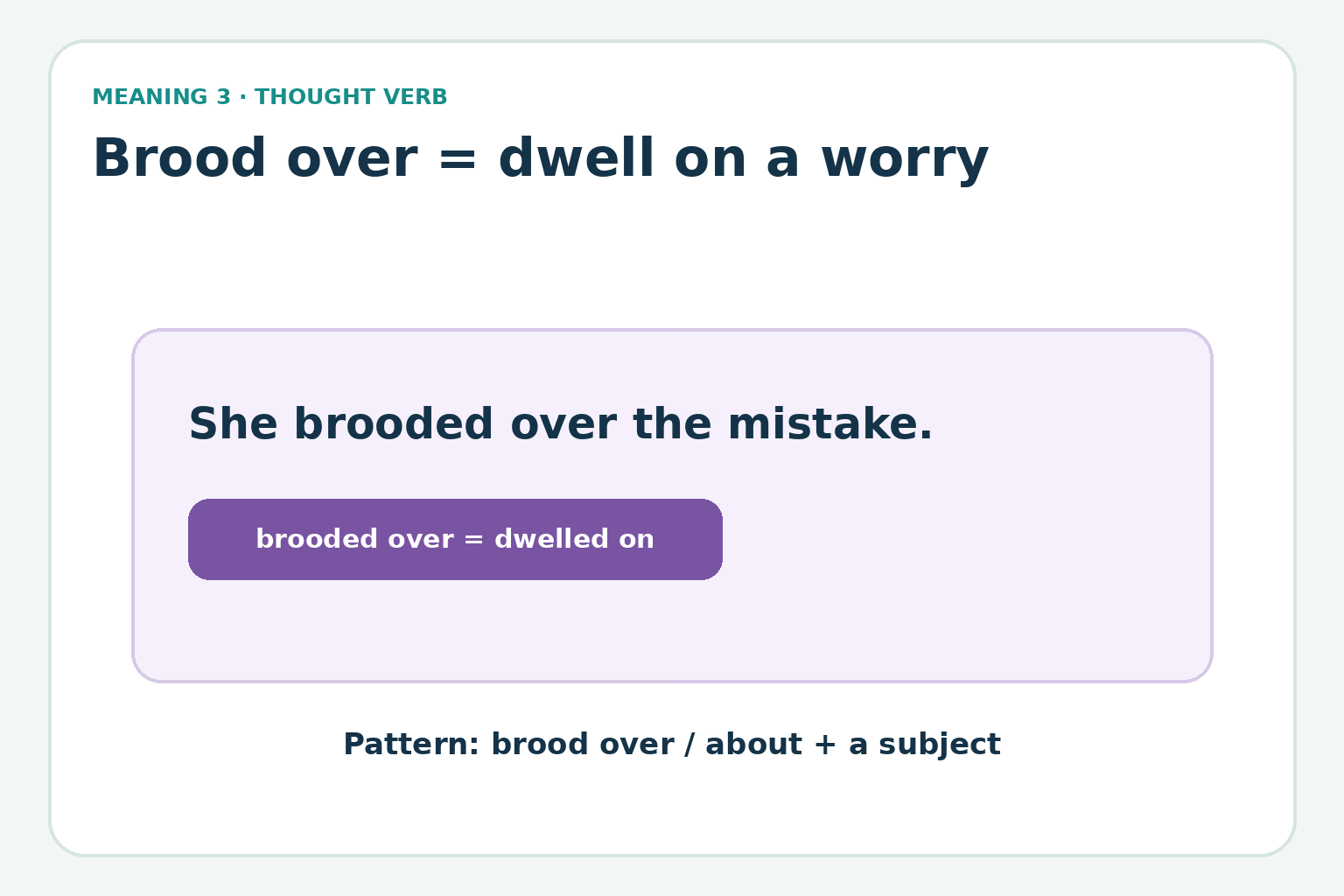
In the thought-related sense, brood usually describes prolonged, unhappy thinking. It is often followed by over or about: “They brooded over the lost opportunity.” A person can also brood without naming the topic: “After the argument, he sat alone and brooded.” The word suggests that the thought lingers; it does not simply mean calmly considering a choice.
Examples of brood in a sentence
These original examples show the noun, bird-care verb, and troubled-thinking verb. The words around brood make each sense visible.
- “A brood of chicks followed the mother hen around the farm.” (noun: a group of young birds)
- “The blackbird returned to feed its brood.” (noun: its young)
- “Our neighbor arrived with her lively brood of children.” (noun: informal reference to children)
- “The hen brooded her eggs in the quiet nesting box.” (verb: kept eggs warm)
- “The parent bird brooded over its chicks during the cold rain.” (verb: covered and cared for young)
- “Maya brooded over the critical comment instead of asking what it meant.” (verb: dwelled anxiously on a thought)
- “He brooded about the interview for days after it ended.” (verb: remained troubled by it)
- “Rather than brood over one mistake, the team reviewed what it could improve.” (verb: dwell gloomily on something)
- “A second brood hatched later in the season.” (noun: another group of young)
- “The old castle brooded above the valley.” (verb: loomed darkly; a less common literary use)
The final example is a separate, figurative verb use: something can brood above or brood over a place when it seems to loom over it. In ordinary conversation and writing, the two central verb patterns are usually bird-care language and brood over/about a troubling subject.
Brood, brood over, and brood on: choosing the right pattern
When brood means “think gloomily or anxiously,” English commonly uses brood over or brood about: “She brooded over the decision” and “He brooded about what might happen.” Brood on also occurs, but over and about are especially clear choices for learners. Use an object after the preposition: a mistake, a setback, the past, or what someone said.
Do not use the noun brood as if it meant a state of contemplation. “She sat in deep brood” is not the usual construction. Write “She sat brooding” or “She brooded over the news.” Likewise, brooding is the -ing form of the verb and can also work as an adjective, as in “a brooding mood.”
Common mistakes to avoid
- Do not confuse the parts of speech: a brood is a group; to brood is an action. Say “a brood of chicks,” but “the hen broods over the eggs.”
- Use a natural thought pattern: say “brood over the result,” not “deep in brood.”
- Do not treat all thinking as brooding: the verb usually carries an unhappy, anxious, or gloomy tone. For neutral thought, choose consider, think about, or reflect on.
- Choose a neutral noun when needed: calling someone’s children a “brood” can be playful but may sound dismissive in formal writing.
Quick answer
In a sentence, brood can name a group of young or describe lingering over a worry. For example: “A brood of chicks gathered under the hen” uses the noun, while “She brooded over the mistake” uses the verb. In bird-care contexts, it can also mean to sit on eggs or cover young.
Sources
Definitions and usage distinctions are checked against Merriam-Webster’s entry for brood and the Cambridge Dictionary entry for brood. Cambridge gives /bruːd/ for pronunciation and illustrates the noun and troubled-thinking verb senses; Merriam-Webster lists the bird-care verb, plural and verb forms, and the “loom” sense.
Editorial note on the original examples
The original article below is preserved in full after this updated guide. Some legacy examples need a usage distinction: a few describe hens brooding eggs or young (the bird-care verb), while many student examples use the “dwell anxiously on” meaning. The original wording “deep in brood” is not the standard construction; use “deep in thought,” “brooding,” or “brooding over a concern.”
Have you ever heard of the term “brood”? In the context of language and writing, a brood is a group of young animals that are born or hatched at the same time, often referring to a group of offspring from the same parents.
When it comes to constructing sentences to illustrate the concept of a brood, it can be as simple as mentioning a set of siblings, a litter of puppies, or a clutch of chicks. By using this term in your writing, you can vividly paint a picture of a family or group of young ones gathered together, showcasing unity and kinship.
7 Examples Of Brood Used In a Sentence For Kids
- Brood of chicks followed the mother hen around the farm.
- The hen likes to brood over her eggs to keep them warm.
- The little girl found a brood of baby rabbits in the garden.
- The brood of ducklings waddled after their mother to the pond.
- The cat would brood over her kittens to keep them safe.
- The brood of puppies played happily in the yard.
- The farmer had a large brood of chickens running around.
14 Sentences with Brood Examples
- Brood over which elective courses to take next semester.
- Some students brood over their performance in the recent exams.
- It’s common for students to brood about their future careers.
- Brood on whether to join a club or society on campus.
- Many students brood about their projects and assignments deadlines.
- Don’t brood about the past, focus on your present studies.
- Students often brood over their relationships and friendships in college.
- It’s not healthy to constantly brood over your mistakes.
- Some students tend to brood over their financial situation during college.
- It’s okay to brood for a while, but make sure to seek help if it becomes overwhelming.
- Try not to brood about your grades, focus on improving them instead.
- Brood over whether to take a gap year or jump straight into post-graduate studies.
- College can be a time to brood over your identity and beliefs.
- Remember not to brood over things that are beyond your control.
How To Use Brood in Sentences?
To use the word “Brood” effectively in a sentence, you should become familiar with its meaning and usage. Brood typically refers to the act of thinking deeply or worrying about something in a troubled or unhappy way. Here’s a simple guide on how to incorporate “brood” into a sentence:
-
Understand the Meaning: Before using “brood” in a sentence, make sure you understand its definition. This will help you convey your message accurately.
-
Choose Appropriate Context: “Brood” is often used to describe someone who is deep in thought or contemplation. You can use it in situations where someone is pondering over a problem or feeling uneasy about something.
-
Construct a Sentence: When constructing a sentence, think about a scenario where someone is seen to be brooding. For example, “After receiving bad news, she sat alone in her room, deep in brood.”
-
Use the Word Naturally: Incorporate “brood” into your sentence in a natural way that flows with the rest of your writing. Avoid forcing the word in and ensure it fits the context appropriately.
By following these steps, you can effectively include the word “brood” in a sentence. Remember to practice using the word in different contexts to become more comfortable with its usage.
Conclusion
In conclusion, brood refers to a set of young birds produced at a single hatching or a group of young children or offspring. It can also describe deep in thought, contemplative, or worried. Brood can be used in a literal sense, such as “The hen sat on her brood of eggs,” or in a figurative manner as in “He brooded over his mistakes.”
Understanding the various ways in which brood can be employed in different contexts is essential for grasping its full meaning and applying it accurately in verbal and written communication. Whether referring to a group of offspring, a state of deep contemplation, or a worried mindset, brood can convey diverse shades of meaning depending on its usage.


