
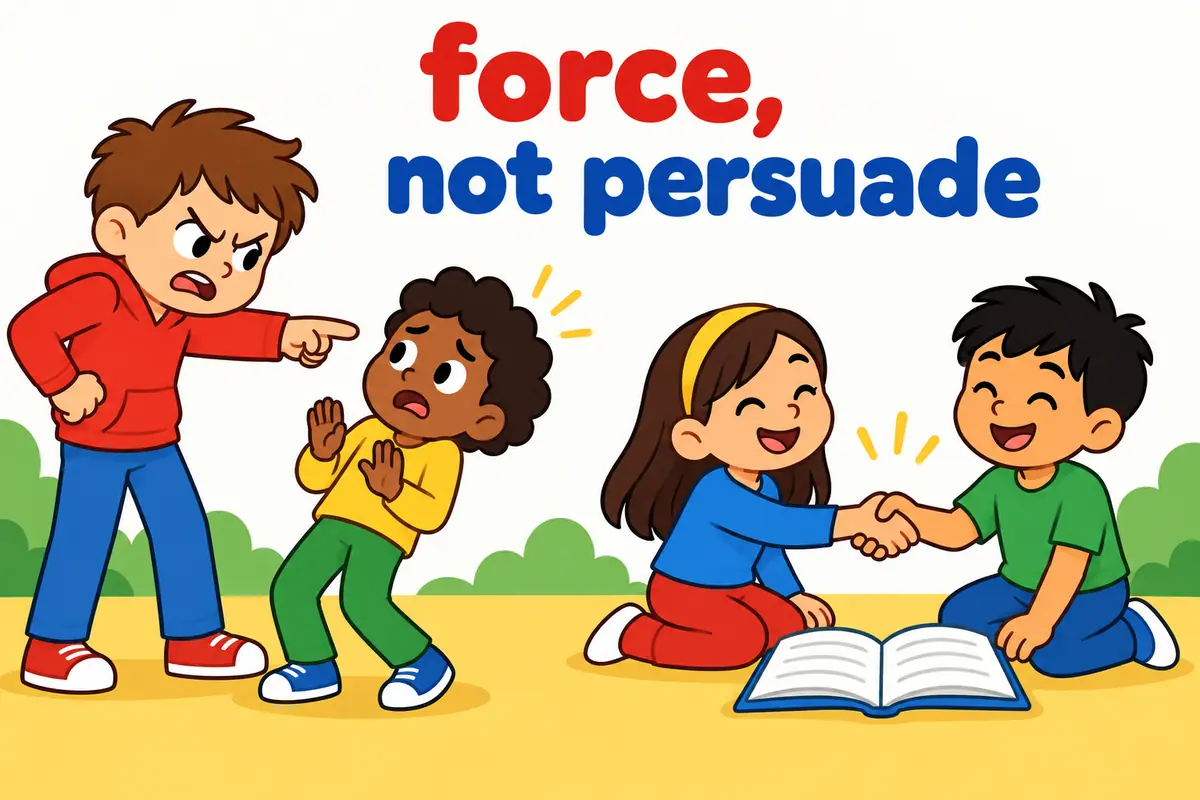
Browbeat means to force someone to do something by intimidating them with stern looks or threatening words. To use browbeat in a sentence, name both the person pressured and the result: “The manager browbeat the interns into working late.” The verb is transitive and usually takes into before a gerund or a state.
Browbeat at a glance
- Browbeat is a transitive verb meaning to pressure someone into compliance by intimidation.
- Its forms are browbeats and browbeating; the past tense is browbeat and the participle is browbeaten.
- The dominant pattern is browbeat + person + into + action or state.
- The usual subjects are a manager, a bully, a loud voice or, collectively, a group.
- The commonest error is writing browbeated, which is not standard English.
What does browbeat mean?
Browbeat is a transitive verb meaning to force a person into agreement or action through fear, noise or an overbearing manner. The Cambridge entry for browbeat records the same core idea: winning by pressure rather than by reason. The older sense of intimidating with a stern frown survives in the word, which is why a browbeat is always something one person does to another. Where the pressure takes the form of a clear warning, coerce is the more exact verb.
| Sense | Plain meaning | Example sentence |
|---|---|---|
| Pressure into action | Force someone by fear rather than reason | The coach browbeat the team into extra practice. |
| Wear down verbally | Bully someone with loud, repeated demands | He browbeat the witness until she changed her story. |
| Domineer a group | Overawe people by sheer presence | One loud voice browbeat the whole meeting. |
One limitation is worth stating plainly. Browbeat is not a synonym for persuade or argue down, because it always carries fear. Where the pressure becomes a specific warning of harm, threaten is the plainer and more honest word, and where the pressure is lawful argument, browbeat simply does not apply.
How do you use browbeat in a sentence?
Browbeat is transitive, so it always needs a person as its object, and into usually names what the pressure produced. Five patterns cover almost every real use, and the passive is the one journalism chooses when the victim matters more than the bully.
| Pattern | Example | What it signals |
|---|---|---|
| browbeat + person + into + gerund | The agent browbeat the seller into lowering the price. | Names the action the pressure forced. |
| browbeat + person + into + noun | The captain browbeat the squad into silence. | Names the state the pressure produced. |
| be + browbeaten + into + gerund | New staff are often browbeaten into staying quiet. | Passive voice focused on the victim. |
| browbeat + person + for + time | He browbeat the witness for an hour. | Shows sustained pressure with no single outcome. |
| browbeat + person + out of + noun | They browbeat him out of his objection. | Pressure that removes something rather than adds it. |

Browbeat in a sentence: examples across contexts
Browbeat changes tone more than meaning. The nine sentences below keep the same verb while moving from a playground to a tribunal, and each names the person being pressured and the result of that pressure.
| Context | Example sentence | Why this works |
|---|---|---|
| Classroom | Two older pupils browbeat a new boy into giving up his seat. | A familiar school scene makes the pressure concrete. |
| Workplace email | The director browbeat the team into accepting the weekend rota. | Names the authority figure and the forced decision. |
| News report | Investigators said the manager had browbeaten staff into signing the forms. | Reporting uses the past perfect of a completed campaign. |
| Legal writing | The claimant was browbeaten into withdrawing the complaint. | The passive keeps attention on the person harmed. |
| Academic prose | Reviewers should not browbeat authors into citing their own work. | States an ethical norm in impersonal language. |
| Sports commentary | The veteran defender browbeat the younger players into silence. | Shows status turning into pressure without violence. |
| Conversation | He tried to browbeat me into lending him the car. | The first person reports a real social moment. |
| Historical writing | Party officials browbeat delegates into an early vote. | Frames pressure as a political tactic. |
| Family life | Nobody should browbeat a child into an apology. | States a principle with a moral weight. |
The verb carries disapproval in every row, which is why it rarely appears in a neutral description of a decision. A colleague who is merely forceful harass is too strong; browbeat names pressure that crosses into intimidation.
Browbeat vs intimidate
Browbeat and intimidate overlap because both describe pressure, yet they end differently. Intimidate describes the fear itself and needs no outcome, while browbeat almost always pushes a person toward a specific act or state. A silent, frightened colleague has been intimidated; one who signs the form has been browbeaten.
| Attribute | browbeat | intimidate |
|---|---|---|
| Core meaning | Pressure by words into an action | Fill someone with fear |
| Usual means | Loud, persistent, overbearing talk | Threats, size, authority or reputation |
| Typical object | A person who must comply | A person who may simply freeze |
| Usual result | Compliance or a changed decision | Fear, hesitation or silence |
| Register | Critical, used of bullies | Neutral to formal, common in law |
Verdict: use intimidate when the point is the fear itself, and browbeat when the pressure wins a particular outcome.
Word forms and grammar of browbeat
Browbeat is irregular in a way that trips learners: the past tense does not change, so she browbeat him yesterday is correct, and the participle adds -en. The table also lists the worn-out form many writers reach for by mistake. A related verb, cow, catches the same idea of being overawed.
| Form | Part of speech | Example |
|---|---|---|
| browbeat | verb, base form | Bullies browbeat quieter classmates. |
| browbeats | third person singular | He browbeats every new colleague. |
| browbeating | present participle | The browbeating tone silenced the room. |
| browbeat | past tense | She browbeat the committee into a vote. |
| browbeaten | past participle | The staff felt browbeaten into agreement. |
| browbeated | non-standard | There is no form browbeated; the past tense is browbeat. |
Common mistakes with browbeat
- Incorrect:
She browbeated the seller into a lower price.Correct: She browbeat the seller into a lower price. Rule: The past tense is browbeat, unchanged; browbeaten is the participle. - Incorrect:
He browbeat the client for a discount.Correct: He browbeat the client into giving a discount. Rule: The verb takes into before the action it forces. - Incorrect:
They browbeat about the proposal.Correct: They pressured him about the proposal. Rule: Browbeat is transitive and always needs a person as its object. - Incorrect:
The chair was browbeaten by the argument.Correct: The chair was browbeaten into silence by the argument. Rule: The passive still needs into to name what the pressure produced.
Practice using browbeat
Work through the six items, then check the reasoning rather than only the answer.
- Fill the gap: The older boys tried to ______ the newcomer into handing over his money.
- Choose the better word: The silent, frightened intern had been (browbeaten / intimidated) but had signed nothing.
- Correct the error: The manager browbeated the team into working through the holiday.
- Build a sentence: use browbeaten into about a pupil pressured to join a club.
- Spot the register: which belongs in a news report — staff were browbeaten into signing, or the boss was really mean about it?
- Change the voice: The captain browbeat the squad into silence. Make it passive.
Answers
- browbeat — the base form follows the infinitive to after tried.
- intimidated — the intern felt fear but was pushed toward no action, which is intimidation only.
- The manager browbeat the team into working through the holiday — there is no form browbeated.
- Model answer: The pupil was browbeaten into joining the club by two classmates who would not take no for an answer.
- Staff were browbeaten into signing — a report favours the passive and drops the colloquial mean.
- The squad was browbeaten into silence by the captain — the passive promotes the squad and keeps into.
The bottom line
Use browbeat in a sentence when one person forces another into an action or a state through fear and noise, and remember to put a person after the verb. The two nuances that decide most uses are these: browbeat always implies a result, so it is stronger than intimidate, and its past tense is browbeat, not browbeated. Where the pressure is merely a loud bully at work, choose the plainer verb.
Frequently asked questions about browbeat
Is browbeat one word or two?
It is one word, written closed and never hyphenated. The compound joins brow and beat and keeps the single past tense browbeat. A reader will treat brow-beat with a hyphen as a misspelling, and most spell-checkers flag the hyphenated form even though the meaning is obvious.
What is the past tense of browbeat?
The past tense is browbeat, exactly like the base form, and the past participle is browbeaten. A sentence reads she browbeat the committee yesterday, and the staff had been browbeaten for months. The form browbeated is not standard English and marks a learner at once.
Is browbeat a synonym for persuade?
No. Persuade suggests winning someone over with reasons, while browbeat means forcing compliance through fear and pressure. If a person changes their mind freely, they were persuaded; if they give in only to stop the pressure, they were browbeaten. The two verbs differ in consent.
Can a group of people browbeat someone?
Yes. A single person or a group can do the browbeating, and the object is usually one person who must comply. A crowd can browbeat a speaker into silence, and a committee can browbeat a witness. The pressure is social rather than physical, which keeps the verb distinct from threaten.
Have you ever encountered someone who uses intimidation or harsh words to pressure others into doing what they want? This type of behavior is commonly known as “browbeating.” Essentially, it involves trying to force or persuade someone to comply through fear or aggression.
Browbeating can manifest in various forms, such as bullying, threats, or verbal abuse. It often leaves the recipient feeling powerless and belittled. Understanding how to identify and address browbeating behavior is crucial for maintaining healthy relationships and asserting personal boundaries.
7 Examples Of Browbeat Used In a Sentence For Kids
- Browbeat means to make someone feel scared or intimidated.
- It is not nice to browbeat your friends into doing something they don’t want to do.
- We should always be kind and not browbeat others.
- If someone tries to browbeat you, you should tell a grown-up.
- It is important to stand up to anyone who tries to browbeat you.
- Let’s always treat each other with kindness and not browbeat anyone.
- Remember, it is never okay to browbeat someone into doing something they don’t want to do.
14 Sentences with Browbeat Examples
- Browbeating your classmates into sharing their notes is not the most effective way to study for exams.
- Your friends should not browbeat you into going out when you need to focus on your assignments.
- Group projects should be collaborative, not a platform for one person to browbeat the others into doing all the work.
- It’s important to stand up to professors who try to browbeat students into accepting unfair grades.
- Senior students should mentor juniors, not browbeat them for not knowing things they haven’t been taught yet.
- Browbeating your roommates about cleaning up shared spaces won’t create a harmonious living environment.
- It’s better to politely decline a friend’s invitation than to browbeat them into letting you skip an important lecture.
- Don’t let your parents browbeat you into changing your major if it’s something you’re truly passionate about.
- It’s not okay for classmates to browbeat others for asking questions in class – learning is a shared experience.
- Always speak up if you see someone browbeating a fellow student for not conforming to societal norms.
- Professors should inspire and guide their students, not browbeat them into pursuing a specific career path.
- Students should support each other, not browbeat someone for struggling with a particular subject.
- Don’t let peer pressure browbeat you into participating in activities that you’re not comfortable with.
- Remember to maintain a healthy work-life balance and not let anyone browbeat you into neglecting your mental health.
How To Use Browbeat in Sentences?
Browbeat is a powerful tool that can help you analyze and improve your writing by providing feedback on your tone and emotion used in your sentences. To use Browbeat effectively, simply copy and paste your text into the tool’s interface. Browbeat will then examine your writing and highlight areas where you could potentially enhance your communication.
For beginners, it is essential to carefully review the feedback provided by Browbeat and consider making adjustments to your writing based on the suggestions given. Remember to pay attention to the emotional and tonal cues in your writing and make changes accordingly to ensure your message is clear and effective.
Additionally, Browbeat offers a variety of useful features such as word suggestions, sentence rephrasing, and grammar corrections. These tools can be utilized to further refine your writing and polish your communication skills.
By using Browbeat regularly, you can improve your writing skills and become a more confident communicator. Don’t hesitate to reach out to the Browbeat support team if you have any questions or encounter any issues while using the tool. Happy writing!
Conclusion
In conclusion, the use of browbeat in sentences often portrays a sense of intimidation or coercion. It typically implies the act of pressuring someone through harsh or relentless words or actions to make them comply with a particular demand or viewpoint. The connotation of browbeat is associated with bullying or strong-arming tactics to overpower or control others.
When encountering sentences containing browbeat, it is important to recognize the power dynamics at play and to consider whether the behavior depicted aligns with ethical and respectful communication. Understanding the implications of browbeating in language can help individuals navigate conversations effectively and advocate for healthy, assertive communication practices in various interpersonal interactions.


