Brush up means to improve or refresh a skill you already have, usually before you need it again. To use brush up in a sentence, add on before the skill: “She brushed up on her French before the trip,” and the verb takes that skill as its object. Brush up is transitive and separable.
Brush up at a glance
- Brush up is a transitive phrasal verb; it often appears as brush up on something.
- The main senses are refreshing a skill and tidying or cleaning something.
- The particle up can separate from the verb when the object is a pronoun.
- Common objects are a language, maths, a skill, a room and a jacket.
- The commonest learner error is writing brush up to something instead of brush up on it.
What does brush up mean?
Brush up is a phrasal verb meaning to refresh knowledge you once had, or to make something neat by cleaning it. The Cambridge entry for brush up records both, and the sense depends on the object: skills and subjects point to revision, while rooms and clothes point to tidying.
| Sense | Plain meaning | Example sentence |
|---|---|---|
| Refresh a skill | To improve knowledge you already have | He brushed up his Spanish before the interview. |
| Tidy or clean | To make something neat by brushing | She brushed up the coat and hung it away. |
One honest limitation: brush up is informal. In a formal report you would revive, refresh or update a skill rather than brush it up, and the tidy sense belongs in the home rather than in a technical document. The phrasal verb is natural in speech and friendly writing, not in a legal brief.
How do you use brush up in a sentence?
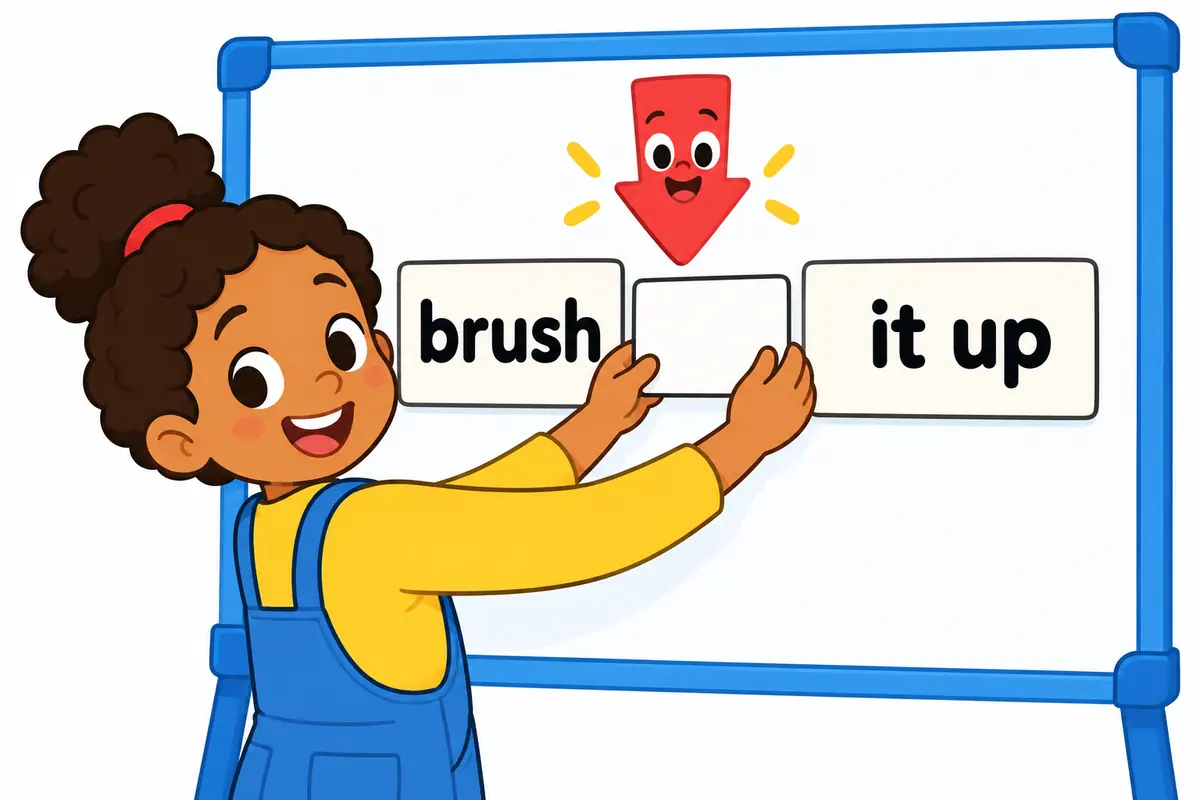
Brush up is transitive, so it always needs an object, and it is separable: the object can sit between brush and up. When the object is a pronoun, it must go in the middle.
| Pattern | Example | What it signals |
|---|---|---|
| brush up + object | I should brush up my French. | The object follows the whole verb. |
| brush up on + subject | She brushed up on algebra for the test. | on introduces the skill being revised. |
| brush + object + up | Brush your notes up before Friday. | Separable, with the object in the middle. |
| brush it up | Your Italian is good, but brush it up. | A pronoun object must sit between the parts. |
| a brush-up | Her talk was a quick brush-up on safety. | The hyphenated noun names the revision itself. |
That last row is the trap: brush-up as a noun takes a hyphen, while the verb stays as two words. Writers who skip the hyphen produce a brush up that looks unfinished.
Brush up in a sentence: examples across contexts
Brush up stays informal wherever it goes, and its object is what tells a reader whether knowledge or tidiness is meant. The ten sentences below cover both, from revising a language to tidying a spare room.
| Context | Example sentence | Why this works |
|---|---|---|
| Conversation | I ought to brush up on my driving before the test. | The on pattern names a skill being refreshed. |
| Workplace email | Could you brush up the slides before the meeting? | Separable verb with a concrete object. |
| Language learning | She brushed up her German on the train. | Transitive use with the language as object. |
| Job interview | He brushed up on the company history. | The on pattern frames preparation. |
| Home | We brushed up the spare room for guests. | The tidy sense with a place as object. |
| Tailoring | The tailor brushed up the jacket and pressed it. | Literal cleaning of a garment. |
| Coaching | Brush your technique up before the season starts. | Object in the middle of a separable verb. |
| Refresher course | The seminar was a brush-up on the new rules. | Hyphenated noun for the revision itself. |
| Volunteering | They brushed up their first aid for the fete. | Transitive use with a practical skill. |
| Exams | Brush it up and you will pass easily. | Pronoun object correctly in the middle. |
Brush up vs brush off
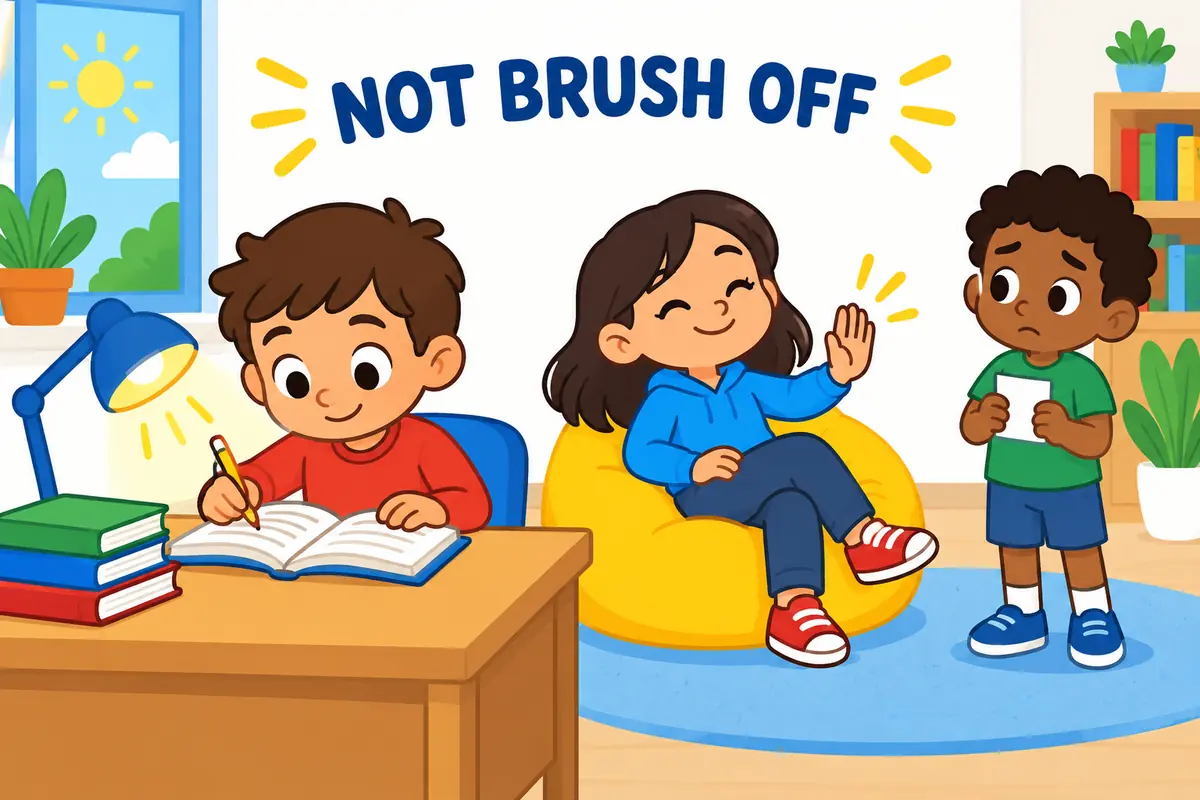
Brush up and brush off share the base verb brush and mean almost opposite things. One improves something; the other dismisses it.
| Attribute | brush up | brush off |
|---|---|---|
| Core meaning | Refresh or tidy something | Dismiss or ignore something |
| Typical object | A skill, a language, a room | A comment, a worry, a person |
| Effect on the object | Improves it | Waves it away |
| Register | Informal, encouraging | Informal, often dismissive |
| Example | Brush up your spelling. | He brushed off the criticism. |
Verdict: use brush up when something gets better and brush off when something gets ignored; the particle, not the base verb, carries the meaning.
A third relative is brush aside, which is nearer to brush off but more physical, as when a hand sweeps an objection away. Keeping the three apart stops a serious sentence from sounding flippant.
Word forms and grammar of brush up
Brush up inflects on the verb, not on the particle, and one spelling change matters for the noun.
| Form | Part of speech | Example |
|---|---|---|
| brush up | phrasal verb, base form | I brush up my maths each summer. |
| brushes up | verb, third person singular | She brushes up her notes before class. |
| brushed up | verb, past and past participle | We brushed up our French in Lyon. |
| brushing up | verb, present participle | He is brushing up on his coding. |
| brush-up | noun, hyphenated | A quick brush-up will do. |
Watch the difference between the verb and the noun. In the sentence a brush up sounds wrong, the phrase needs the hyphen of a compound noun.
Common mistakes with brush up
- Incorrect:
I need to brush up to my English.Correct: I need to brush up on my English. Rule: the particle up pairs with on, not to. - Incorrect:
She brushed up on.Correct: She brushed up on her spelling. Rule: on is a preposition and needs an object. - Incorrect:
I brushed up for my French exam.Correct: I brushed up on my French before the exam. Rule: use on for the skill, not for. - Incorrect:
We will brush up ourselves.Correct: We will brush up on our maths. Rule: brush up is not reflexive; name the skill. - Incorrect:
He gave the room a brush up.Correct: He gave the room a brush-up. Rule: the noun form takes a hyphen.
Practice using brush up
Work through the six items, then read the reason beside each answer.
- Fill the gap: Before the exam, I will ______ on my chemistry.
- Choose the better word: He (brushed up / brushed off) the warning and carried on.
- Correct the error: She wants to brush up to her keyboard skills.
- Build a sentence: use brush it up about a half-forgotten language.
- Spot the register: which belongs in a friendly email, brush up your slides, or refresh the foregoing figures?
- Rewrite as a noun: They spent an hour revising. Use a brush-up.
Answers
- brush: the skill follows in the brush up on pattern.
- brushed off: the warning was ignored, so the dismissive particle is right.
- She wants to brush up on her keyboard skills: on introduces the skill.
- Model answer: Your Spanish is solid, but brush it up before the trip.
- Brush up your slides: the phrasal verb suits a friendly, informal email.
- They did a quick brush-up: the hyphenated noun names the revision session.
The bottom line
Use brush up in a sentence when you improve something you already have, and add on before the skill in the pattern brush up on. The verb is transitive and separable, so a pronoun object goes in the middle, as in brush it up, while the noun takes a hyphen. Keep it for informal speech and friendly writing.
Frequently asked questions about brush up
Is it brush up or brush up on?
Both forms exist, but they attach to different things. Brush up a skill is transitive, as in brush up your French, while brush up on introduces the subject being revised, as in brush up on algebra. Choose on when you want to name the field and the plain form when the object is a concrete thing.
Can you separate brush up?
Yes, brush up is separable, so the object may sit between the two parts. Brush your notes up and brush up your notes are both acceptable, but a pronoun must go in the middle, giving brush it up. A native speaker would not say brush up it.
Does brush up mean clean or improve?
It can mean either, depending on the object. With a language, a skill or a subject, brush up means refresh knowledge you already have. With a room, a coat or a table, it means tidy or clean by brushing. The object always decides which sense is active.
Is brush up formal or informal?
Brush up is informal and fits conversation, friendly emails and study talk. A formal report would use refresh, revive or update a skill instead. The tidy sense is likewise domestic, so a technical document would say clean or renovate rather than brush up.
Looking to brush up on your skills? When we talk about “brushing up,” we’re referring to the act of refreshing or improving a particular skill or knowledge that may have become rusty or outdated. It’s like giving yourself a quick touch-up to ensure you’re up to speed and competent in a specific area.
Whether it’s a language, a hobby, or professional expertise, taking the time to brush up on your abilities can boost your confidence and enhance your performance. With a little effort and commitment, you can easily sharpen your skills and stay current in today’s fast-paced world.
7 Examples Of Brush Up Used In a Sentence For Kids
- Brush up your English skills with fun games and activities.
- Let’s brush up on our counting by practicing with colorful blocks.
- It’s time to brush up on our drawing by using different colors and shapes.
- Join us as we brush up on our alphabet by singing the ABC song together.
- Brush up your hand-eye coordination by playing catch with a friend.
- Let’s brush up on our manners by saying “please” and “thank you” to each other.
- Practice your colors and shapes as we brush up on our knowledge of them.
14 Sentences with Brush Up Examples
- Have you brushed up on your math skills before the upcoming exam?
- It’s important to brush up on your coding knowledge for the hackathon next week.
- I need to brush up on my presentation skills for the seminar tomorrow.
- Let’s brush up on our grammar before submitting our essays.
- It’s a good idea to brush up on your history facts before the quiz.
- Before the interview, make sure to brush up on your industry knowledge.
- I’m planning to brush up on my French before the language proficiency test.
- We should brush up on our marketing strategies for the group project.
- Don’t forget to brush up on your networking skills for the career fair.
- Let’s brush up on our research methodology before starting our thesis.
- It’s time to brush up on our coding languages for the upcoming software development workshop.
- We need to brush up on our time management skills to stay on top of our assignments.
- Before the debate competition, we should brush up on our argumentation techniques.
- I should brush up on my statistics knowledge for the upcoming data analysis assignment.
How To Use Brush Up in Sentences?
Brush Up is a phrasal verb that means to improve or refresh a skill or knowledge. It is often used in informal settings to describe someone’s efforts to sharpen their abilities in a certain area.
When using Brush Up in a sentence, it is important to follow a few simple guidelines. First, identify the specific skill or knowledge that you want to improve. For example, “I need to brush up on my Spanish before my trip to Spain.”
Next, insert Brush Up into your sentence in the appropriate context. For instance, “I plan to brush up on my coding skills over the weekend.”
To make your sentence more detailed, you can include the reason why you want to Brush Up on a particular skill. For example, “I am brushing up on my piano skills for an upcoming recital.”
Remember to place Brush Up after the subject of the sentence and before the skill or knowledge you wish to improve. Avoid using Brush Up in a negative connotation, as it is typically viewed as a positive action towards self-improvement.
By following these simple guidelines, you can effectively use Brush Up in a sentence and convey your intentions of enhancing your abilities in a certain area.
Conclusion
In conclusion, “brush up” refers to the action of reviewing, improving or refreshing one’s knowledge or skills in a particular area. By brushing up on a subject, individuals can become more proficient and confident in their abilities. Through practice, study, or training, one can effectively brush up on a wide range of skills, from language learning to computer programming.
Whether it’s revisiting a hobby or preparing for a job interview, taking the time to brush up on relevant skills can lead to greater success and personal growth. Overall, incorporating regular brush-up sessions into one’s routine can help maintain and enhance their capabilities in various facets of life.


