Can vs may both sit before a plain verb, but can covers ability and informal permission while may carries formal permission and possibility. “She can swim” reports a skill; “she may leave” grants permission. “May I come in?” sounds more polite than “Can I come in?”
Can vs May at a glance
- Both can and may are modal verbs, so neither takes -s in the third person.
- Can expresses ability, general possibility, and informal permission.
- May expresses formal permission, specific possibility, and polite requests.
- May I is the safe polite form; Can I is common but less formal in writing.
- The commonest error is using may for a physical ability, as in may swim.
What do can and may mean?
Can is a modal verb meaning to be able to, to be allowed to, or to be possible. May is a modal verb meaning to be permitted, to be possible, or, in a wish, to be wished. The Cambridge entry for can and the Cambridge entry for may show the overlap: both can grant permission, but only can names a skill, as in “she can run five kilometres”.
| Sense | Word | Plain meaning | Example |
|---|---|---|---|
| Ability | can | Have the skill to do something | He can drive a tractor. |
| Informal permission | can | Be allowed to in everyday speech | You can stay up late on Friday. |
| General possibility | can | Be possible in general | Temperatures can drop fast here. |
| Formal permission | may | Be permitted by a rule or person | Candidates may bring one calculator. |
| Specific possibility | may | Be likely in this case | It may rain before evening. |
| Wish or blessing | may | Express a hope for someone | May you travel safely. |
What is the difference between can and may?
The difference is ability against permission and formality. Can names what someone or something is able to do, while may grants permission or states a specific likelihood, so a pair such as ad vs add works the same way: the two forms sit close together but do different jobs.
| Test | Can | May |
|---|---|---|
| Core use | ability and possibility | permission and likelihood |
| Permission tone | informal | formal and polite |
| Possibility type | general | specific to this case |
| Negation | cannot | may not |
| Request form | Can I | May I |
| Used for ability | yes | no |
Choose can for what someone is able to do and for everyday permission, and choose may for formal permission or a specific possibility.
How do you use can and may in a sentence?
Both modals take a bare verb with no to, and their patterns are fixed; to watch the verb behave, read may in a sentence.
| Pattern | Example | What it signals |
|---|---|---|
| can + base verb | She can lift the box. | ability |
| can + for permission | Can we leave early? | everyday permission |
| can + for general truth | Oil can float on water. | general possibility |
| may + base verb | You may borrow the book. | formal permission |
| may + for likelihood | The train may be late. | specific possibility |
| may + subject + verb (wish) | May your team win. | a hope or blessing |

Can and may in a sentence: examples across contexts
Reading both modals in different registers makes the choice automatic, and a further simple contrast sits in abel vs able, which hinges on a single letter.
| Context | Example sentence | Why this works |
|---|---|---|
| Classroom | You can use a pencil for this test. | everyday permission between teacher and class |
| Workplace email | May I book the meeting room for Friday? | may opens a polite formal request |
| News report | The storm may reach the coast by midnight. | may states a specific likelihood |
| Legal writing | Applicants may submit one reference letter. | may grants formal permission |
| Everyday speech | Can you pass the salt? | can suits a casual request |
| Academic writing | Results can vary across regions. | can states a general possibility |
| Customer service | You may cancel within fourteen days. | may states a policy right |
| Narration | He could swim before he could walk. | could is the past of can for ability |
| Travel writing | Passengers may use the lounge while they wait. | may names an allowed action |
| Formal letter | May I take this opportunity to thank you. | may marks a courteous fixed phrase |
Which should you use?
Match the modal to the job: ability and casual permission take can, while formal permission and specific possibility take may.
| Situation | Use | Example |
|---|---|---|
| Naming a skill | can | She can speak three languages. |
| Asking a teacher politely | may | May I leave the room? |
| Stating a general truth | can | Glass can break easily. |
| Stating a specific chance | may | The parcel may arrive today. |
Register is the second test. Can fits texts, emails, and conversation, while may suits rules, notices, and formal letters. That split explains why the polite May I sounds old-fashioned to some ears yet still appears in every formal register.
Word forms and grammar of can and may
| Form | Part of speech | Example |
|---|---|---|
| can | modal verb | I can help you. |
| cannot / can’t | modal verb, negative | He cannot attend. |
| could | modal verb, past or polite | Could you repeat that? |
| may | modal verb | You may sit down. |
| may not | modal verb, negative | Visitors may not smoke. |
| might | modal verb, tentative | It might snow tonight. |
| may have | modal, past possibility | She may have missed the bus. |
| could have | modal, past ability or chance | We could have won. |
Common mistakes with can and may
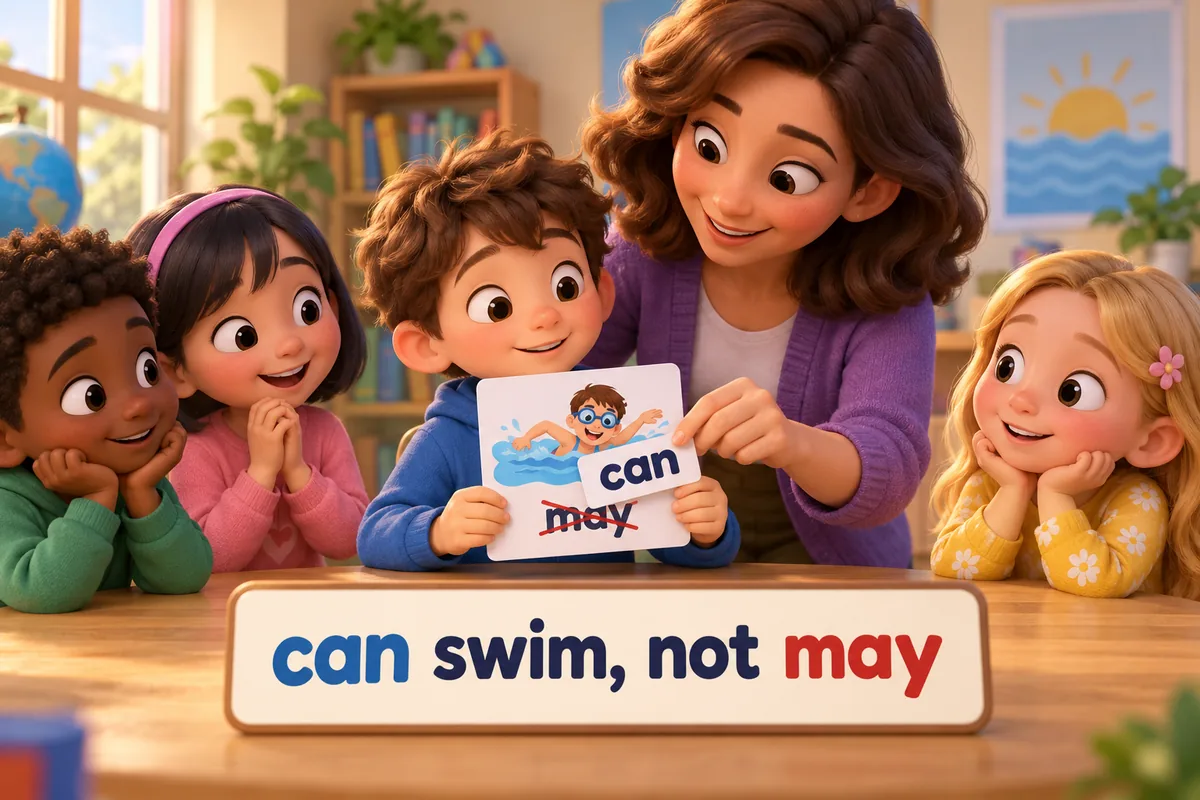
Mistake 1: may for ability. Incorrect: He may swim across the pool. Correct: He can swim across the pool. Rule: physical ability always takes can.
Mistake 2: can in a formal rule. Incorrect: Visitors can not enter after six. Correct: Visitors may not enter after six. Rule: formal rules take may, not can.
Mistake 3: to after a modal. Incorrect: She can to drive. Correct: She can drive. Rule: modals take a bare verb with no to.
Mistake 4: -s on a modal. Incorrect: He cans juggle. Correct: He can juggle. Rule: modal verbs never take -s in the third person.
Mistake 5: two modals in a row. Incorrect: We might can finish early. Correct: We might finish early. Rule: English allows only one modal before a verb.
Practice using can and may
- Fill in the blank: She ___ play the violin very well.
- Choose the better word in a formal notice: Visitors (can / may) take photographs.
- Correct the error: He may lift a hundred kilos.
- Build a sentence: ask a librarian politely to borrow a book.
- Spot the register: which line suits a formal letter, (a) Can I borrow your pen, or (b) May I borrow your pen?
- Fill in the blank: The roads ___ be icy tonight, so drive carefully.
Answers
- can, because playing well is an ability.
- may, because a notice uses formal permission.
- He can lift a hundred kilos; ability takes can.
- May I borrow this book?
- (b), because may is the polite formal request.
- may, because ice is a specific possibility tonight.
The bottom line
The can vs may choice turns on one distinction: can names ability and everyday permission, while may grants formal permission and states a specific possibility. Use Can I in conversation and May I in writing that needs polish. Remember that only can can describe a skill, and the pair stops causing trouble.
Frequently asked questions about can and may
Is may more polite than can?
May is the more formal of the two, so it usually sounds more polite in a request, as in May I sit here. Can is standard in conversation and is rarely rude, but in formal writing May I reads as more careful. Choose may when you want distance and respect.
Can and may be used for permission interchangeably?
They overlap for permission but differ in tone. Can gives everyday permission, as in You can go now, while may gives formal permission, as in You may go now. Both are grammatical, so the choice is about register rather than a rule, though rules and notices favour may.
What does may mean in you may go?
In you may go, may means are permitted to go. It is a grant of permission from someone with the authority to give it, such as a teacher or a manager. That is the core difference from can, which would describe ability rather than permission in the same sentence.
Can may express possibility in the present?
Yes. May states a specific present or future possibility, as in It may rain this afternoon, which means rain is possible today. Can states a general possibility, as in It can rain here in spring. Use may for the particular case and can for the general pattern.