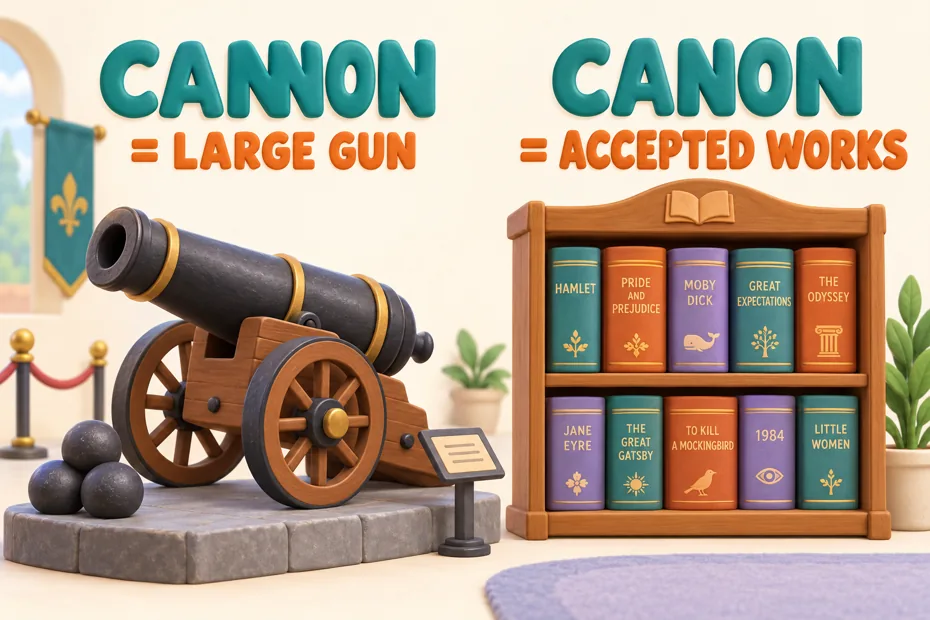
Cannon usually means a large gun or a device that propels something; canon means an accepted rule or body of works, among other senses. Write “a museum cannon,” “the literary canon,” and “a loose cannon” for an unpredictable person. Canon uses one n in the middle; cannon uses two.
Cannon vs. canon: key facts
- Cannon commonly names a large gun.
- Canon commonly names an accepted rule or collection of works.
- The standard idiom is loose cannon.
- Canon also has musical and religious meanings.
- Common modern meanings decide this comparison; specialized historical senses need context.
Which meaning fits your sentence?
Choose cannon for the weapon or a propelling device, and canon for accepted works or rules. Merriam-Webster’s entries for cannon and canon identify these common distinctions. They sound alike, so meaning is the useful spelling test.
| Context | Word | Original example | Meaning clue |
|---|---|---|---|
| Museum weapon | Cannon | The display includes an old cannon. | Large gun |
| Propelling device | Cannon | The stadium uses a T-shirt cannon. | Launches an object |
| Literature | Canon | The seminar discusses the literary canon. | Accepted works |
| Principles | Canon | The essay examines a canon of criticism. | Accepted rule or standard |
A story can contain a cannon without making the weapon canon. “The novel describes a cannon” identifies an object within the story; “the novel belongs to the canon” identifies the work’s accepted place in a body of literature. Ask whether the sentence names the weapon or describes a work’s status.

Why is it loose cannon?
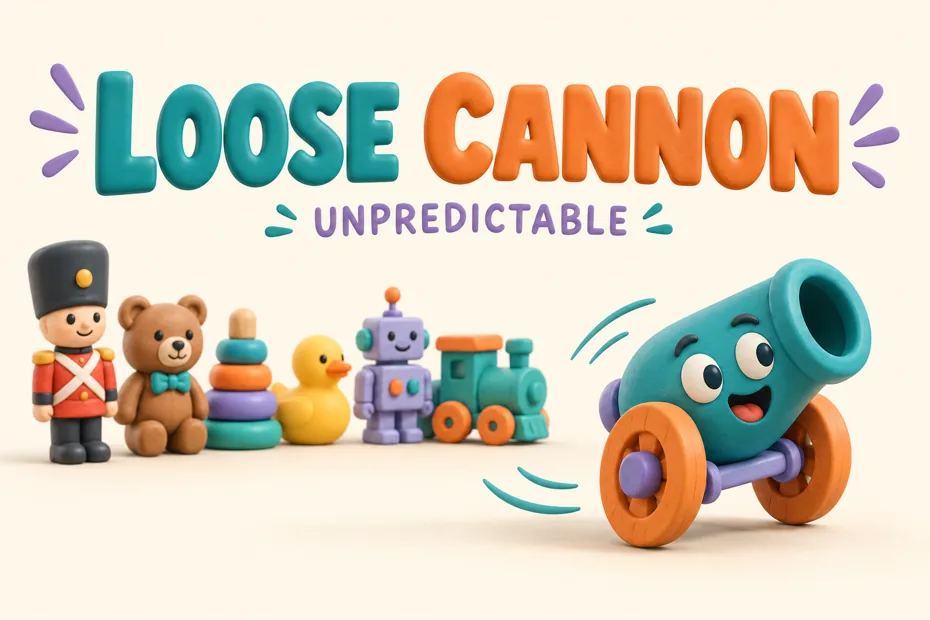
Loose cannon describes someone or something dangerously unpredictable or difficult to control. The spelling is cannon, recalling the weapon rather than an accepted principle. Use the phrase carefully when describing a person: it can imply a serious lack of reliability, not merely an unconventional style.
Compare “The character is a loose cannon” with “The character appears in the canon.” The first describes behavior; the second concerns inclusion in accepted works or an established fictional account. “Loose canon” is not the ordinary idiom for unpredictability, although a writer might deliberately create a pun. A pun requires an audience that understands the standard spelling first.
Does canon always mean great literature?
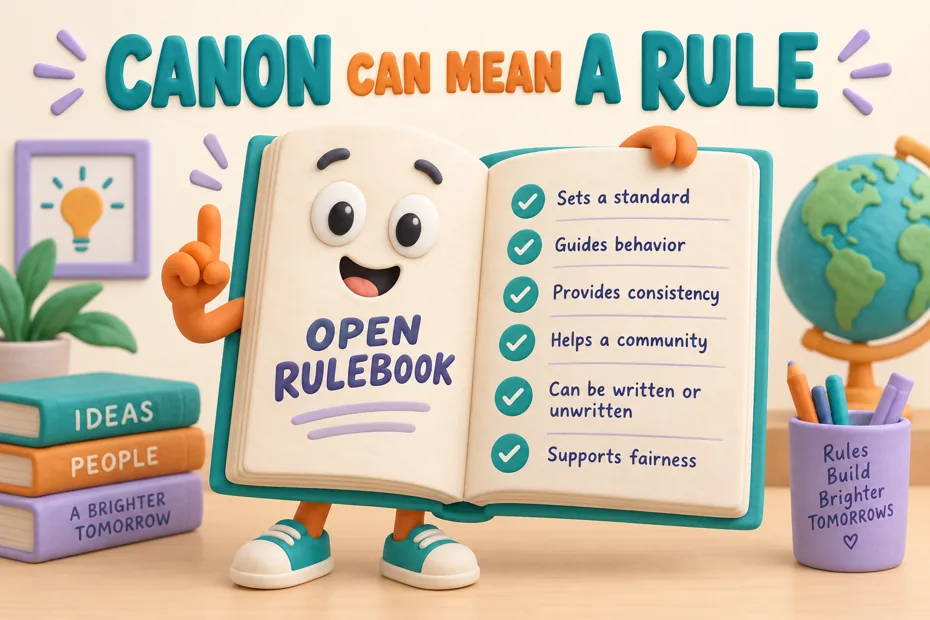
No. Canon can refer to accepted rules, authentic works of an author, an accepted body of related works, religious texts, or a musical form. Collins Dictionary’s canon entry covers this wider range. A sentence must establish which kind of acceptance or rule is relevant.
A literary canon is a selected or accepted body of works in a particular context, not simply every book that has sold well. An author’s canon concerns works accepted as belonging to that author. In discussions of a fictional series, canon concerns material treated as part of the established story. Specify the series, institution, or scope when the reader might otherwise be unsure.
The older guide’s emphasis on works surviving the test of time is useful as a description of some literary discussions, but it is not a condition attached to every sense of canon. An accepted rule or newly established fictional account does not need to be centuries old before the word can be used.
Can cannon mean something other than artillery?
Yes. Cannon can name other propelling devices and has figurative and verb uses. Collins Dictionary’s cannon entry records broader meanings. A water cannon or T-shirt cannon shows why the older statement limiting the word to military weapons is too narrow.
For an everyday spelling decision, ask whether the phrase concerns propulsion or force rather than rules or accepted works. Do not extend that shortcut into a claim that dictionaries have no specialized or historical senses. Unusual contexts require checking the relevant entry and the author’s intended meaning.
A quick editing exercise
- Try large gun or propelling device for cannon.
- Try accepted works, rule, or established account for canon.
- Check the complete idiom loose cannon.
- Preserve names and quotations after verifying their exact spelling.
Complete “The museum restored a ___,” “The novel entered the literary ___,” and “The manager called him a loose ___.” The answers are cannon, canon, and cannon. For cannon vs. canon, meaning determines whether the middle of the word needs one n or two.
Frequently asked questions
Is loose canon the usual idiom?
No. The usual expression for an unpredictable person is loose cannon. Canon concerns accepted works or rules and does not supply the weapon image behind the idiom. A deliberate literary joke might use loose canon, but standard explanatory writing should use cannon when describing unpredictable behavior.
Does canon only concern religion?
No. Canon also occurs in literature, art, criticism, music, and discussions of fictional works. The common connection is an accepted body of works or a rule, though the exact dictionary sense varies. Specify the relevant field so a reader knows what kind of canon the sentence describes.
Can cannon and canon appear together?
Yes. “The cannon appears in the series’ canon” uses cannon for the weapon and canon for the established fictional account. The words identify different things within one sentence. This example illustrates why nearby subject matter alone does not settle the spelling; determine each word’s role and meaning separately.
Should I capitalize canon?
Ordinary canon is usually lowercase unless it begins a sentence or belongs to a proper name or title. Check the specific name rather than capitalizing every reference to accepted works. The same principle applies to cannon. Capitalization and the choice between one n and two are separate editing decisions.
Key Takeaways
- Cannon refers to a large artillery weapon used in warfare, while canon has different meanings in literature, art, and law.
- In literature and art, canon refers to a collection of influential works that have withstood the test of time and have had a significant impact.
- In a legal or religious context, canon refers to a collection of rules, principles, or laws that guide behavior or belief within a specific institution or community.
- It is important to use cannon and canon appropriately in writing and conversations to avoid confusion.
- Cannon should be used to describe large artillery weapons used in military contexts.
- Canon should be used to refer to influential works in literature or art, or rules or laws in a legal or religious context.
Understanding the Difference between Cannon and Canon
When it comes to the English language, there are many words that can easily be confused and misused. Two such words that often get mixed up are “cannon” and “canon.” While they may sound similar, they have completely different meanings. Let’s explore the definitions and differences between these two words.
Cannon refers to a large, heavy artillery weapon used in warfare. It typically consists of a metal tube mounted on a carriage, which is used to fire projectiles at high speeds. Cannons have been used throughout history in battles and wars, serving as powerful weapons of destruction. For example, during the American Civil War, cannons were used extensively by both Union and Confederate forces.
On the other hand, canon has a different meaning altogether. It is typically used in the context of literature, art, and law. In literature and art, “canon” refers to a collection of works that are considered to be highly influential or important within a particular field. These works have withstood the test of time and have had a significant impact on the development and understanding of the subject. For instance, Shakespeare’s plays are considered part of the literary canon due to their enduring popularity and profound impact on the English language.
In a legal or religious sense, “canon” refers to a collection of rules, principles, or laws that serve as a guide for behavior or belief within a specific institution or community. For example, the Bible is considered the canonical text in Christianity, providing believers with a set of guidelines for living a moral and righteous life.
To summarize the key differences:
- Cannon refers to a large artillery weapon used in warfare.
- Canon refers to a collection of influential works in literature or art, or a set of rules or laws in a legal or religious context.
Understanding the distinction between these words is crucial to use them correctly in your writing and conversations. So, the next time you come across the words “cannon” and “canon,” you’ll know exactly what they mean and how to use them appropriately.
The Usage of “Cannon” in Context
When it comes to the words “cannon” and “canon,” understanding their correct usage is important. In this section, I’ll focus specifically on the usage of “cannon” and provide you with a clear understanding of its various contexts.
Definition of “Cannon”
The word “cannon” refers to a large artillery weapon used in warfare. It typically indicates a type of gun with a long barrel, designed to shoot projectiles at high speeds. Cannons have been used throughout history in battles and wars, and they are often associated with military power.
Difference between “Cannon” and “Canon”
It’s important to note the difference between “cannon” and “canon.” While “cannon” refers to a weapon, “canon” has various meanings depending on the context. In literature and art, “canon” refers to a collection of influential works that are considered to be of high quality and important for study and reference. On the other hand, in a legal or religious sense, “canon” refers to a set of rules or laws that govern a particular domain.
Usage of “Cannon”
Let’s jump into the different contexts in which the word “cannon” is commonly used:
- Military: In military contexts, “cannon” is used to describe the large artillery weapons used in warfare. For example, “The soldiers fired the cannons to defend their position.”
- Historical: When discussing historical events or periods, “cannon” can be used to refer to the weapons used during that time. For instance, “During the Civil War, cannons played a significant role in battles.”
- Metaphorical: In a metaphorical sense, “cannon” can be used to describe something that is forceful or powerful. For example, “Her voice was like a cannon, commanding attention and respect.”
Remember, “cannon” specifically refers to the artillery weapon used in warfare. It’s crucial to use this word appropriately in the right context to ensure clear and accurate communication.
So, now that we have covered the usage of “cannon,” let’s move on to exploring the various meanings and contexts of the word “canon” in the next section. Stay tuned!
The Usage of “Canon” in Context
In this section, I’ll investigate into the various meanings and contexts of the word “canon.” It’s important to understand how to use it properly to avoid confusion and miscommunication. Let’s explore its different definitions and usage scenarios.
Definition of “Canon”
When we talk about “canon,” it can refer to different things depending on the context. Here are a few common meanings:
- Literary and Artistic Canon: In literature and art, “canon” refers to a collection of influential works that are considered to be of high artistic or literary merit. These works have stood the test of time and have had a profound impact on their respective fields.
- Legal and Religious Canon: On the other hand, in a legal or religious sense, “canon” refers to a set of rules, laws, or religious texts that have been established as authoritative or normative. These canons serve as a guide for behavior and provide a framework for decision-making.
Understanding the Context
To use “canon” appropriately, it’s crucial to consider the specific context in which the word is being used. Here are a few examples:
- Literature: When writing about literature, you might refer to a novel as a “classic of the literary canon” or discuss how a particular poem has influenced the poetic canon.
- Art: In the art world, you could talk about an artist who has made a significant contribution to the art canon or analyze how a specific painting challenges the conventions of the artistic canon.
- Religion: Within a religious context, you might reference a particular text as a sacred canon or discuss how an interpretation aligns with the religious canon.
- Law: In a legal context, “canon law” refers to the body of laws or regulations that governs the internal affairs of a religious organization.
The Importance of Contextual Accuracy
Using “canon” correctly in the appropriate context is essential for effective communication. It ensures that your message is clear and properly conveys your intended meaning. Confusing the different meanings of “canon” can lead to misunderstandings or misinterpretations.
By understanding the various contexts in which “canon” is used, you’ll be able to use the word accurately and confidently in your writing or conversations.
Common Mistakes to Avoid
One of the most common mistakes when using the words “cannon” and “canon” is confusing their meanings and contexts. Let’s take a closer look at some of the common misconceptions and errors to avoid:
- Confusing “cannon” with “canon”: The first mistake to avoid is using the word “cannon” when you actually mean “canon.” These two words have different meanings and using them interchangeably can lead to confusion. Remember, “cannon” refers to a large artillery gun, while “canon” can mean a set of principles, a collection of works, or a religious law.
- Misusing “cannon” in religious contexts: Another common mistake is using the word “cannon” instead of “canon” when referring to religious texts or laws. The word “canon” is used to describe authoritative or accepted religious writings, such as the Bible or the Quran. On the other hand, “cannon” refers to a military weapon, not a religious book or law.
- Using “canon” instead of “cannon” in military contexts: Conversely, using “canon” instead of “cannon” in military contexts is also a mistake. Remember, “cannon” is the correct term to describe a large gun used in warfare. Using “canon” in this context would be incorrect and may lead to confusion.
- Not understanding the difference between “canon” and “cannon” in literature and art: It’s important to understand the specific meanings of “canon” and “cannon” within the context of literature and art. “Canon” refers to a collection of works that are considered to be of great importance or influence in a particular field. On the other hand, “cannon” has no relevant meaning in this context.
By avoiding these common mistakes, you’ll be able to use “cannon” and “canon” appropriately and effectively in your communication.
Remember, understanding the difference between these two words and using them accurately in the appropriate context is crucial for effective communication.
When to Use “Cannon” and When to Use “Canon”
As a language enthusiast, I understand how confusing and frustrating it can be to differentiate between similar-sounding words with distinct meanings. In this section, I’ll guide you through the appropriate usage of “cannon” and “canon,” helping you avoid common mistakes and write with precision.
Definition of “Cannon”
Let’s start by clarifying the meaning of “cannon.” A cannon refers to a large, heavy artillery used in warfare. It’s a powerful weapon that launches projectiles, such as cannonballs, with force and precision. When writing about military history, battles, or weaponry, remember to use “cannon” to describe these fascinating pieces of machinery.
Definition of “Canon”
On the other hand, “canon” has a different definition and usage. In the context of literature, art, and religion, canon refers to authoritative, accepted works. It represents a collection of sacred texts, recognized literary works, or the body of artistic material produced by a particular author or movement.
The Difference Between “Cannon” and “Canon”
To avoid any confusion, let me summarize the key differences between “cannon” and “canon” for you:
- “Cannon” refers to a type of heavy artillery used in warfare.
- “Canon” refers to authoritative writings or recognized artistic works.
Remember, the usage of each word depends on the context in which you’re writing. It’s essential to use the correct term to ensure accurate and effective communication.
Examples of “Cannon” and “Canon” in Context
To illustrate the proper usage of “cannon” and “canon,” let’s look at some examples:
- “The historical novel described the thunderous roar of cannons during the battle.” (Military context – “cannon”)
- “The literary canon includes Shakespeare’s plays and other classic works of literature.” (Literature context – “canon”)
- “The church abides by the religious canon, which includes sacred scriptures and teachings.” (Religious context – “canon”)
By understanding when to use “cannon” and when to use “canon,” you’ll be able to express yourself accurately and effectively, whether you’re discussing military history, literature, or religious topics.
Conclusion
Understanding the appropriate usage of “cannon” and “canon” is essential for effective communication. By using the correct term in the right context, you can avoid confusion and convey your message accurately.
Throughout this article, we have explored the definitions of “cannon” and “canon” and provided examples of their usage in various contexts, such as military, literature, and religion. This knowledge allows us to appreciate the nuances of these words and choose the appropriate one based on the subject matter.
Remember, “cannon” refers to a large gun or artillery, while “canon” pertains to a set of accepted principles, rules, or standards. By adhering to these distinctions, we can enhance our writing and convey our ideas more effectively.
So, whether you are discussing historical battles, analyzing literary works, or exploring religious doctrines, remember to use “cannon” when referring to weaponry and “canon” when discussing accepted principles or standards.
By mastering the appropriate usage of “cannon” and “canon,” you can ensure that your writing is clear, concise, and accurate, eventually enhancing your communication skills.
Frequently Asked Questions
Q: What is the difference between “cannon” and “canon”?
A: “Cannon” refers to a large gun used in warfare or a musical instrument, while “canon” refers to a collection of rules or principles, or a body of work considered to be authentic or authoritative.
Q: When should I use “cannon” in my writing?
A: Use “cannon” when referring to a weapon or a musical instrument, such as a cannonball or a cannon blast, or a brass cannon.
Q: When should I use “canon” in my writing?
A: Use “canon” when referring to a body of work considered to be authentic or authoritative, such as literary canon, biblical canon, or artistic canon.
Q: Why is it important to use the correct term?
A: Using the correct term ensures clarity and accuracy in your writing. Misusing “cannon” or “canon” can lead to confusion or misunderstandings about your intended meaning.
Q: Can you provide examples of how to use “cannon” and “canon” in different contexts?
A: Certainly! For example, “The soldiers fired the cannon during the battle” (cannon) or “Shakespeare’s plays are part of the literary canon” (canon). Understanding the correct usage in various contexts allows for effective communication.


