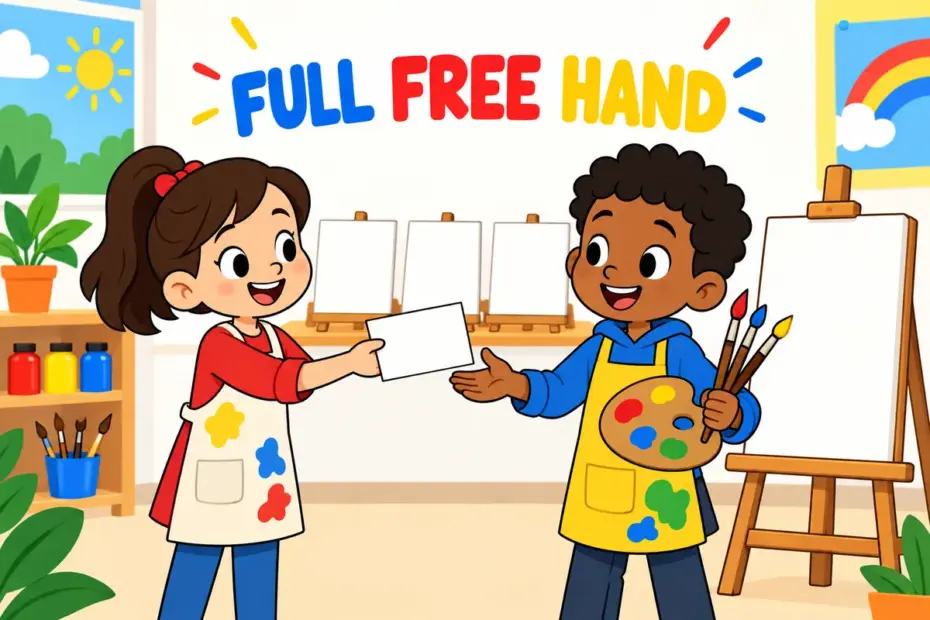
Carte blanche means the freedom to act as you choose, with no conditions attached, and in a sentence it usually follows give, have or get before naming who receives it. “The board gave the new director carte blanche.” The phrase names authority granted by one person to another rather than a simple absence of rules.
Carte blanche at a glance
- Carte blanche is a noun phrase borrowed from French, where it means a blank card or sheet of paper.
- It means unlimited authority or freedom to act exactly as one sees fit.
- The usual patterns are give someone carte blanche, have carte blanche and carte blanche to do something.
- It appears in business, workplace and news writing far more than in casual speech.
- The commonest error is treating it as a verb or confusing it with a blank cheque, which is about money.
What does carte blanche mean?
Carte blanche is a noun phrase meaning complete freedom or authority to act as one wishes. The Cambridge entry for carte blanche gives the sense of permission to do whatever you want, and that unrestricted quality is what separates it from ordinary consent. A manager who grants this grant permission without setting a budget, a deadline or a method, and a committee that delegate authority in the same way, have handed over the decision itself rather than a task.
| Shade of meaning | Plain meaning | Example sentence |
|---|---|---|
| Unlimited authority | Someone may decide anything within the brief | The editor gave her carte blanche over the magazine. |
| Freedom without conditions | No limits, rules or approvals are set | The committee had carte blanche to redesign the course. |
| Trust in judgement | The grantor relies on the holder entirely | The trust gave its solicitor carte blanche to settle. |
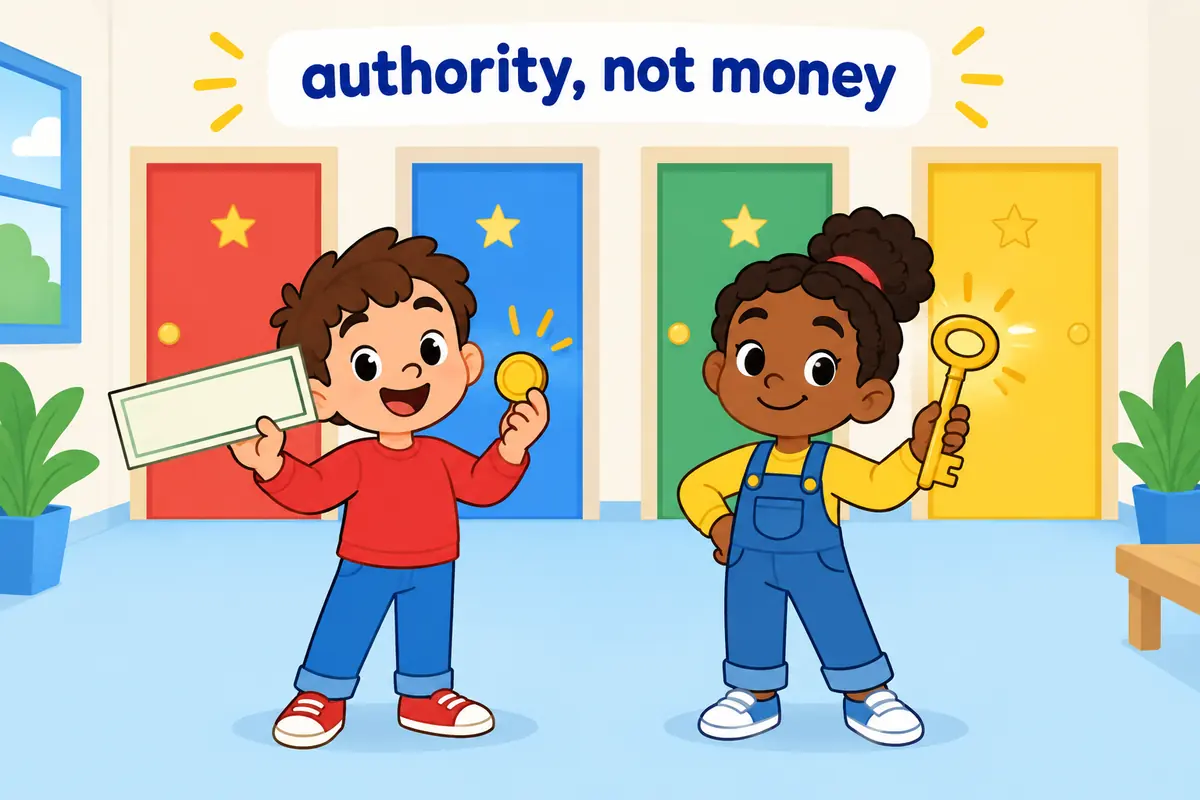
One limitation is worth stating plainly. Carte blanche describes authority, not money and not a legal immunity. It also implies that somebody with power handed the freedom over, so it does not fit a situation where no one was ever in charge. For a small, bounded favour, an ordinary phrase such as permission works better.
How do you use carte blanche in a sentence?
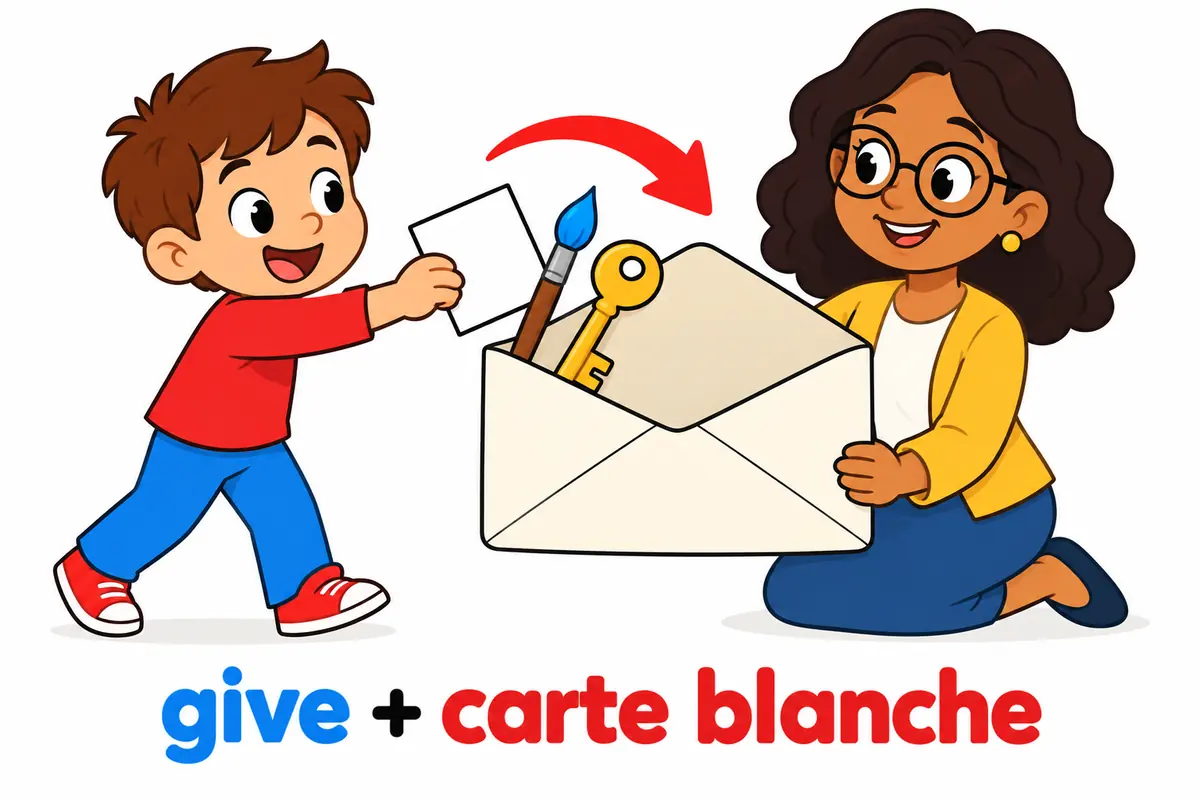
Put the grantor first, the person receiving the freedom second, and the phrase itself last: give someone carte blanche. Five patterns cover almost every real sentence, and the infinitive pattern is the one that makes the purpose of the freedom explicit.
| Pattern | Example | What it signals |
|---|---|---|
| give + someone + carte blanche | The principal gave the science club carte blanche. | A named person or body hands over the freedom. |
| have + carte blanche | The new chef has carte blanche in the kitchen. | Someone holds an ongoing free hand. |
| carte blanche + to + verb | They were given carte blanche to spend the budget. | States what the freedom is actually for. |
| get / receive + carte blanche | The team received carte blanche to rebuild the site. | Marks the moment the permission arrives. |
| with carte blanche | He acted with carte blanche throughout the negotiation. | Places the freedom alongside the action it enables. |
Carte blanche in a sentence: examples across contexts
Carte blanche keeps its meaning while its register shifts from a staffroom to a news desk. The nine sentences below each name the grantor and the freedom, which is what keeps the phrase from sounding vague.
| Context | Example sentence | Why this works |
|---|---|---|
| Classroom | The teacher gave the class carte blanche to paint the corridor mural. | Names who granted the freedom and the project it serves. |
| Workplace email | Our manager has carte blanche to approve any repair under two thousand pounds. | Pairs the free hand with a concrete limit, which reads as realistic. |
| News report | The minister was given carte blanche to reshape the rail network. | Uses the passive so the grantor stays generic, as reporting prefers. |
| Business writing | The agency worked with carte blanche on the rebrand. | Shows the phrase inside a normal professional idiom. |
| Conversation | My brother had carte blanche in the kitchen on Sunday. | Everyday subject and setting prove the phrase is not only formal. |
| Academic writing | The research team was granted carte blanche to choose its methods. | The formal passive suits a report and keeps the focus on the freedom. |
| Legal or technical | The contract gives the contractor carte blanche to vary the schedule. | Precise about who may change what and under which document. |
| Historical narrative | The envoy received carte blanche to sign the treaty. | Signals wide discretion under a formal commission. |
| Family life | The grandparents had carte blanche to spoil the children for a week. | A light, familiar use shows the freedom can be trivial as well as grand. |
Notice how each sentence names the person or body that handed the freedom over, even when the sentence uses the passive. Carte blanche without a grantor reads as an incomplete thought.
Carte blanche vs free rein
Carte blanche overlaps with free rein and with the money phrase blank cheque, and it is interchangeable with neither. To give free rein is to stop controlling how a task is done; to use your discretion is to choose within a brief that still exists.
| Attribute | carte blanche | free rein |
|---|---|---|
| Core meaning | Blanket authority over a task or decision | Freedom to decide how to carry something out |
| What is granted | Authority and permission | Relief from restraint |
| Who acts first | Someone with power hands it over | Someone stops interfering |
| Typical verb | give, have, get carte blanche | give free rein, allow free rein |
| Connotation | Formal, almost contractual | Relaxed trust in good judgement |
Verdict: choose carte blanche when the authority itself is unlimited and was formally handed over, and free rein when the job is fixed but the method is left open.
Word forms and grammar of carte blanche
Carte blanche is a fixed phrase, so what changes is the verb in front of it and the infinitive after it, not the phrase itself. Managers who allow latitude keep a boundary in place, and that is exactly what this phrase removes.
| Form | Part of speech | Example |
|---|---|---|
| carte blanche | noun phrase, normally no article | They were given carte blanche to redesign the syllabus. |
| cartes blanches | plural, rare | The two agencies received separate cartes blanches. |
| give + carte blanche | verb phrase | The director gave the team carte blanche. |
| have + carte blanche | verb phrase | She has carte blanche on the budget. |
| carte blanche to + verb | phrase plus infinitive | The panel had carte blanche to set its own rules. |
| a blank cheque | related phrase, different meaning | A blank cheque limits only money, never choice. |
Common mistakes with carte blanche
- Incorrect:
The manager carte-blanched the whole project.Correct: The manager gave the project carte blanche. Rule: carte blanche is a noun phrase and never a verb. - Incorrect:
She had a carte blanche.Correct: She had carte blanche. Rule: the phrase normally takes no article. - Incorrect:
He had carte blanche to doing whatever he liked.Correct: He had carte blanche to do whatever he liked. Rule: to is followed by the base verb. - Incorrect:
The blank cheque let her choose the design.Correct: Carte blanche let her choose the design. Rule: a blank cheque concerns money; carte blanche concerns authority. - Incorrect:
They gave carte blanche the new teacher.Correct: They gave the new teacher carte blanche. Rule: the person comes before the phrase, not after it.
Practice using carte blanche
Work through the six items, then read the reasoning rather than only the answer.
- Fill the gap: The head chef gave the apprentice ______ to redesign the dessert menu.
- Choose the better word: After the takeover, the new chief executive was given (carte blanche / a blank cheque) over staffing.
- Correct the error: The board carte-blanched the finance team last month.
- Build a sentence: use give … carte blanche about a school play.
- Spot the register: which belongs in a formal proposal — The committee was granted carte blanche to revise the policy, or We basically got total freedom to do whatever?
- Rewrite with have: The council gave the planners carte blanche. Use have instead.
Answers
- carte blanche — the apprentice receives the freedom and the menu is its purpose.
- carte blanche — the gift is authority over staffing, not a sum of money.
- The board gave the finance team carte blanche — the phrase is a noun and takes a verb.
- Model answer: The drama teacher gave the cast carte blanche to choose the closing song.
- The committee was granted carte blanche to revise the policy — a proposal avoids total and the first person.
- The planners have carte blanche — have shows an ongoing free hand.
The bottom line
Use carte blanche in a sentence when one party hands another complete authority to decide, and name both parties so the freedom has a source. The two details that decide most sentences are the article, which is normally absent, and the infinitive pattern, which states what the freedom is for. Where the arrangement is looser and the method alone is open, give leeway or free rein is the more accurate choice.
Frequently asked questions about carte blanche
Is carte blanche a formal phrase?
Carte blanche belongs to business, workplace and news writing, where authority is handed over in writing or in a meeting. In relaxed conversation people reach for freedom or free rein instead. Saying you were given carte blanche to pick the restaurant would sound oddly grand, while a committee report would use it naturally.
Can carte blanche be used as a verb?
No. Carte blanche is a noun phrase, so it needs a verb such as give, have, get or receive in front of it. Sentences like the manager carte-blanched the project are not English. The correct form is the manager gave the project carte blanche, or the project was given carte blanche.
Does carte blanche take an article?
In standard use it takes no article: you have carte blanche, not a carte blanche. Adding a reads like a mistake to most editors, because the phrase behaves like an uncountable quality rather than a countable object. The rare plural cartes blanches appears only when several separate grants are being compared.
Does carte blanche mean unlimited money?
No. Carte blanche means unlimited authority to decide, while a blank cheque means no spending limit is set. A person can hold carte blanche on a fixed budget and still be restricted by the sum itself. When money is the point, write blank cheque; when discretion is the point, write carte blanche.
Have you ever heard of the term “carte blanche”? In French, this expression translates to “blank card,” but its meaning goes beyond its literal translation. Carte blanche refers to the unrestricted freedom or authority to act as one wishes.
This phrase is commonly used to give someone full control or permission to make decisions without any limitations or restrictions. Whether in the creative arts, business dealings, or personal matters, having carte blanche can provide individuals with complete autonomy to execute tasks or express themselves as they see fit.
7 Examples Of Carte Blanche Used In a Sentence For Kids
- You have carte blanche to draw whatever you like.
- The teacher gave us carte blanche to choose our own project topics.
- Use your carte blanche to color the picture in any way you want.
- I love having carte blanche to play with my favorite toys.
- You can use carte blanche to create a beautiful craft.
- Let’s use our carte blanche to make a fun story together.
- Remember, you have carte blanche to be creative in everything you do.
14 Sentences with Carte Blanche Examples
- Carte blanche was given to the event organizers to plan the college cultural fest.
- Students were granted carte blanche to decorate the common room for the upcoming festival.
- As part of their project, the group was given carte blanche to choose any topic they were passionate about.
- The college administration provided the student council with carte blanche to organize a fundraising event.
- The professors gave the students carte blanche to choose their own research topics for the academic year.
- The editorial team had carte blanche to design the layout of the college magazine.
- The college library offers students carte blanche to suggest new book additions to the collection.
- The college canteen chef was given carte blanche to experiment with new recipes for the menu.
- Student clubs have carte blanche to organize events and activities for their members.
- The college authorities provided the sports committee with carte blanche to schedule intercollegiate tournaments.
- Students were offered carte blanche to choose elective courses based on their interests.
- The career guidance cell provides students with carte blanche to explore various job opportunities.
- The college administration gave the student body carte blanche to propose changes to campus facilities.
- The college counselling center offers students carte blanche to schedule appointments with the mental health professionals.
How To Use Carte Blanche in Sentences?
To use Carte Blanche in a sentence for beginners, follow these steps:
-
Understand the meaning: Carte Blanche is a French term that means “full discretionary power” or “complete freedom to act as one wishes.” It implies unrestricted authority or autonomy.
-
Identify the context: Determine the appropriate situation where you want to convey the idea of unlimited freedom or authority.
-
Construct a sentence: Start your sentence with an appropriate subject, followed by a verb and then incorporate Carte Blanche. For example, “The manager gave her team Carte Blanche to design the new project however they saw fit.”
-
Check for clarity: Make sure the sentence clearly communicates the concept of complete freedom or unrestrained power.
-
Practice using it: Try incorporating Carte Blanche in different sentences to become more comfortable with its use. For instance, “As the lead singer, she had Carte Blanche to choose the setlist for the concert.”
-
Seek feedback: Ask for feedback from others on how you have used Carte Blanche in a sentence to ensure you are conveying the intended meaning accurately.
Remember, using Carte Blanche in a sentence adds sophistication and clarity to your communication, indicating absolute freedom or authority in a given situation. Happy communicating!
Conclusion
In conclusion, providing someone with carte blanche means giving them complete freedom or authority to act as they see fit in a particular situation, without any limits or restrictions. This can be seen in examples such as “She was given carte blanche to decorate the office however she pleased” or “The committee has carte blanche to make decisions regarding the project budget.”
Granting carte blanche can be empowering, but it also comes with the need for trust and responsibility. It implies a high level of confidence in someone’s judgment and abilities. Whether in a professional setting or personal relationships, offering carte blanche can lead to innovation and creative solutions, but it also necessitates clear communication and mutual understanding of expectations to ensure that the freedom given is used wisely.


