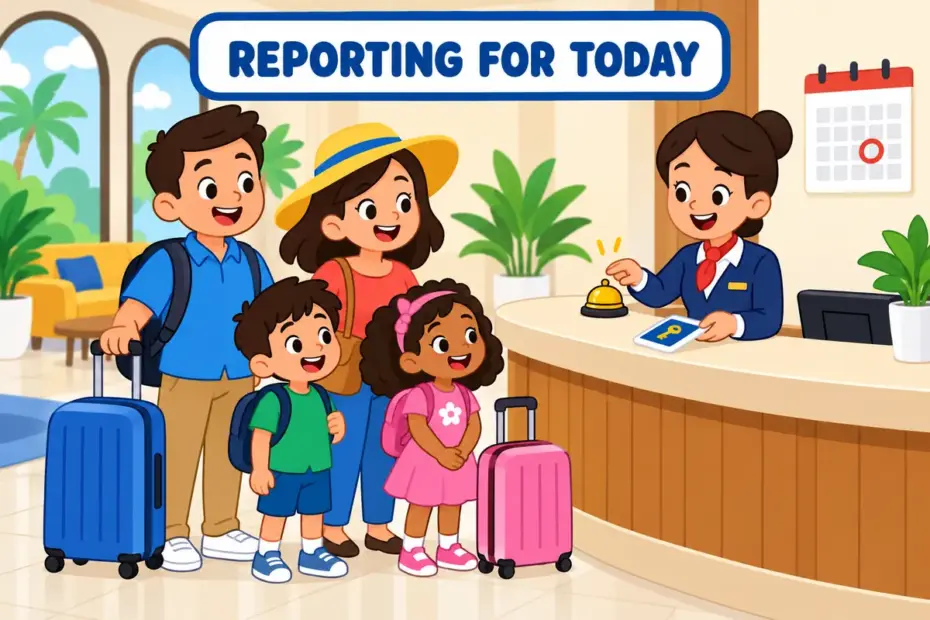
Check in is a phrasal verb that means to register your arrival at a hotel, airport, clinic or online service. To use check in in a sentence, keep the two words together: We checked in at the front desk. The verb is usually intransitive, so no object sits between check and in.
Check in at a glance
- Check in is a phrasal verb; the base is check, and the particle is in.
- The common sense is intransitive: you check in, with no object.
- A second sense, check in with someone, means to report briefly.
- Typical settings are hotels, airports, clinics, offices and apps.
- The commonest error is writing check-in as one word when it is a verb.
What does check in mean?
Check in is a phrasal verb meaning to register your arrival or confirm that you are present. The Cambridge entry for check in records the arrival sense, and the surrounding words divide the labour: the formal verb is to register, which check in replaces in everyday speech. Three senses cover almost every sentence you will meet.
| Sense | Plain meaning | Example sentence |
|---|---|---|
| Register on arrival | Officially record that you have arrived | We checked in at the airport two hours early. |
| Report to someone | Tell a person you are present or available | She checks in with her manager each morning. |
| Register online | Mark your presence on an app or site | He checked in at the gym on the app. |
Check in is the wrong choice when you mean to settle into a place or to investigate something; those need check into. For a lasting welcome, greet or welcome reads more naturally than a repeated check in.
How do you use check in in a sentence?
As a phrasal verb, check in has firm grammar rules. The two words stay together in the common sense, and the object appears only with the transitive senses.
| Pattern | Example | What it signals |
|---|---|---|
| check in (no object) | We checked in at noon. | The core intransitive arrival sense. |
| check in with + person | I check in with my tutor weekly. | A brief report, not a full meeting. |
| check + object + in | The clerk checked the guests in. | The separable transitive sense. |
| check in at + place | They checked in at the clinic. | Where the arrival is recorded. |
| check in on + person | He checked in on his neighbour. | A quick visit to see that all is well. |
Two points separate native use from learner error. First, the pronoun must sit inside when the verb is separable: check them in, never check in them. Second, the particle cannot move to the front, so in the guests checked is impossible.
Check in in a sentence: examples across contexts
Check in moves easily between travel, work and technology. Each setting brings a slightly different sense of reporting in.
| Context | Example sentence | Why this works |
|---|---|---|
| Conversation | Text me when you check in at the hostel. | Everyday travel instruction. |
| Workplace email | Please check in with the duty editor before you leave. | A brief report to a colleague. |
| News report | Delegates checked in at the venue before the vote. | Neutral record of arrivals. |
| Travel writing | We checked in as the sun set over the airstrip. | Sets a scene while recording the act. |
| Medical setting | Patients check in at the reception window first. | A clear routine instruction. |
| Technology | Players check in daily to keep their streak alive. | The app sense of marking presence. |
| Customer service | Guests may check in from three in the afternoon. | States a policy plainly. |
| School | New pupils check in at the office on their first day. | Describes an arrival routine. |
| Sports | The team checked in at the hotel before the final. | Reports a squad arriving. |
Check in vs check into
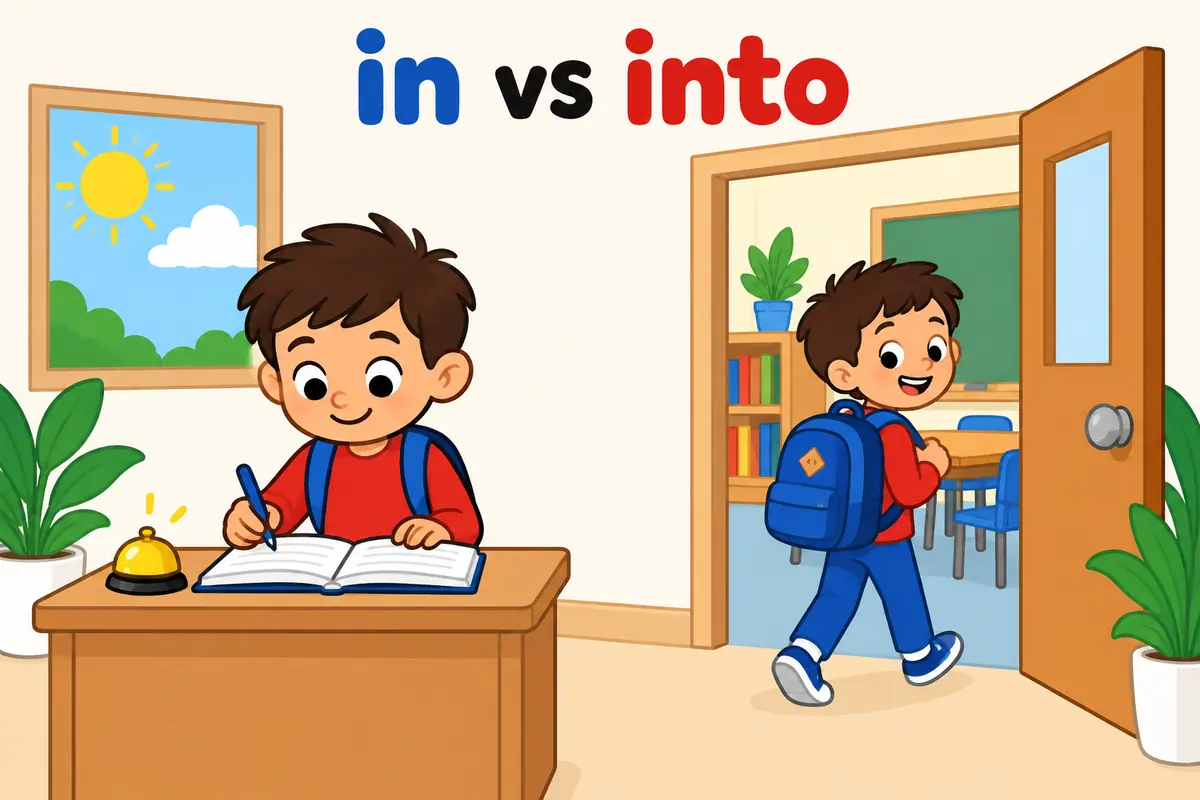
Check in and check into share the verb check but not their grammar. One records an arrival; the other means to settle into a place or to investigate.
| Attribute | Check in | Check into |
|---|---|---|
| Core meaning | Register your arrival | Settle into a place or look into a matter |
| Object | Usually none | Needs a place or a question |
| Typical place | A desk, counter or app | A hotel room or a case file |
| Separability | Keeps the two words together | Particle stays with into |
| Register | Everyday and neutral | Neutral, slightly more formal |
The verdict: choose check in when you register your arrival, and check into when you enter a room to stay or begin investigating a problem. Guests check into a hotel, while crews check in at the desk. The opposite action, to settle the bill and leave, is to check out.
Word forms and grammar of check in
| Form | Part of speech | Example |
|---|---|---|
| check in | Phrasal verb (base) | We check in before every flight. |
| checked in | Past tense and participle | They checked in at dusk. |
| checking in | Present participle | She is checking in as we speak. |
| check-in | Hyphenated noun | The check-in took twenty minutes. |
| check in on | Phrasal verb with particle on | He checked in on his aunt. |
| check in them | Non-standard | Write check them in; the pronoun goes inside. |
Common mistakes with check in
- Incorrect:
We check-in at noon.Correct: We check in at noon. Rule: the verb is two words; the hyphen belongs only to the noun, as in the check-in desk. - Incorrect:
Please check in it.Correct: Please check it in. Rule: with a pronoun object the particle moves after it. - Incorrect:
She checked in to the hotel.Correct: She checked into the hotel. Rule: use into, one word, when a place follows. - Incorrect:
He checked in the case.Correct: He checked into the case. Rule: investigating a matter takes check into, not check in.
Practice using check in
- Fill in the blank: Guests should ___ at the desk before collecting their keys.
- Choose the better word: The officer decided to (check in / check into) the missing file.
- Correct the error: The nurse will check in them at the desk.
- Build a sentence about arriving at a hostel using check in plus a time.
- Spot the register: which belongs on a hotel sign, Check in from 3pm or We checked in yesterday?
- Fill in the blank: She likes to ___ with her sister every Sunday.
Answers
- check in; the arrival sense takes no object.
- check into; investigating a matter needs the particle into.
- The nurse will check them in; the pronoun sits inside the phrasal verb.
- We checked in at the hostel just after dark; check in plus a time phrase.
- Check in from 3pm suits a sign; the past-tense sentence is narrative prose.
- check in; check in with a person means to report briefly.
The bottom line
Check in means to register your arrival or confirm that you are present, and the core sense takes no object. Online, you log in with a password but check in on a map, and in an office, to report briefly to a colleague is to touch base. Keep the two words of the verb apart from the hyphenated noun, and the phrase will never look wrong.
Frequently asked questions about check in
Is check-in written with a hyphen?
The verb is two words and takes no hyphen, as in we check in at noon. The hyphen belongs to the noun or adjective formed from it, as in the check-in desk or a quick check-in. Both forms are correct in their own place; mixing them is the error.
Can check in take a direct object?
Yes, in the transitive sense of registering someone, and then it is separable: the clerk checked the guests in, or the clerk checked in the guests. With a pronoun the object must sit between the two parts, so check them in is correct and check in them is wrong.
What is the difference between check in and log in?
Check in records that you have arrived somewhere or are present, whether at a desk or on an app. Log in proves your identity with a password to open an account. You log in once and then check in when you reach the place or mark your presence.
Does check in mean the same as check into?
No. Check in records an arrival and needs no object, as in we checked in at the desk. Check into means to settle into a place, as in they checked into the hotel, or to investigate a matter, as in police checked into the theft. The particle changes the meaning.
Are you familiar with the concept of “check in” but unsure of how to use it correctly in a sentence? In English, “check in” is a phrasal verb often used to describe the act of registering upon arrival at a hotel, airport, or event.
Additionally, “check in” can also be used figuratively to signify a quick update or review of a situation or one’s well-being. This versatile expression is commonly used in both casual conversation and formal settings to ensure clarity and communication.
7 Examples Of Check In Used In a Sentence For Kids
- Check in with your teacher when you arrive at school.
- Remember to check in with your friends before starting to play.
- Check in with your family members when you reach home.
- Let’s all check in with each other to make sure everyone is safe.
- Always check in with an adult before going somewhere new.
- We should check in with our feelings to understand how we are doing.
- Don’t forget to check in with the rules before starting a game.
14 Sentences with Check In Examples
- Check in at the college hostel before 6 pm to avoid any inconvenience.
- Remember to check in at the library before borrowing any books.
- Don’t forget to check in at the gym to make the most of your membership.
- It is important to check in with your professors during their office hours for extra help.
- Make sure to check in at the student council office to get updates on upcoming events.
- Check in at the college clinic if you’re feeling unwell or need medical assistance.
- Check in at the career counseling center to explore different job opportunities.
- Before attending any college event, always check in with the event coordinator for any last-minute changes.
- For group projects, it’s essential to check in with your team regularly to stay on track.
- Check in at the cafeteria for today’s menu and meal options.
- Before leaving the campus for the holidays, remember to check in with the security office.
- As part of your attendance requirement, make sure to check in at every lecture.
- Don’t forget to check in at the computer lab to access the necessary software for your assignments.
- For any study abroad programs, students must check in with the international office for guidance on visas and paperwork.
How To Use Check In in Sentences?
Check In is a useful tool to track your attendance or whereabouts. To use Check In correctly, you can start by opening the app or website where the Check In feature is available. Locate the Check In button or section in the app.
Once you find the Check In feature, click on it to let others know that you have arrived at your designated location. Make sure to follow any instructions provided, such as adding a comment or confirming your location.
After you have successfully checked in, you may receive a confirmation message or notification. This confirms that your check-in has been registered. If there are any issues with your check-in, reach out to the appropriate person or support team for assistance.
Remember to check in whenever you are required to do so, whether it’s for work, events, or other purposes. By checking in, you help others keep track of your presence and ensure efficient communication and coordination.
In summary, to use Check In effectively, locate the feature, check in at the right time and place, and follow any provided instructions. Checking in is a simple and important task that can benefit you and those around you.
Conclusion
In summary, the examples of sentences with “check in” demonstrate different ways this phrase can be used in everyday language. Whether it’s referring to a physical location where someone reports their presence, or a figurative reference to monitoring or acknowledging something, “check in” is a versatile term. From “Don’t forget to check in at the front desk” to “I’ll check in with you later,” these sentences showcase the various contexts in which this term can be employed.
Overall, incorporating “check in” into sentences adds clarity and direction to communication. It signals the need for verifying presence, status, or well-being, making it a useful and common phrase in interpersonal interactions. Understanding the nuances of how to use “check in” in sentences can help facilitate smoother and more effective communication in a wide range of situations.


