Check off is a separable phrasal verb meaning to mark a list item as done. To use check off in a sentence, name the list and then the item: “She checked off each task as she finished it.” The particle can follow the object, so check it off and check off the form are both correct.
Check off at a glance
- Check off is a transitive phrasal verb; its forms are checks off, checked off and checking off.
- It is separable, so both check off the item and check the item off are standard.
- The particle may strand at the end, as in the entries I already checked off.
- The usual objects are tasks, names, boxes, entries and items on a list.
- The commonest error is confusing check off with check out, which means leave or examine.
What does check off mean?
Check off is a phrasal verb meaning to mark an item on a list as done, chosen or verified. The Cambridge entry for check off gives the sense of ticking a name on a list, and the verb is always transitive: something must be checked off. Two shades are common, finishing a task and confirming that an entry belongs to a set, and a third records that a step has been dealt with. Where a record is being confirmed rather than a task finished, verify is the closer verb.
| Sense | Plain meaning | Example sentence |
|---|---|---|
| Mark as done | Tick an item once it is finished | He checked off the last chore on the board. |
| Confirm a selection | Mark an entry as included or correct | The clerk checked off each guest on the register. |
| Register as handled | Note that a step has been dealt with | Please check off the safety points before take-off. |
One limitation matters. Check off records a decision about a list, not the quality of the work. Ticking the box means the item was dealt with, not that it was done well. Where you mean to examine something closely, check over or inspect is the better verb.
How do you use check off in a sentence?
Check off is transitive and separable, which gives three positions for the same meaning. Name the list item as the object, and keep the particle either before or after it. When the object is a pronoun, the particle must follow it. Once the item is handled, many teams mark it complete.
| Pattern | Example | What it signals |
|---|---|---|
| check off + object | She checked off the invoice. | The default order, used when the object is a long phrase. |
| check + object + off | She checked the invoice off. | Common when the object is short. |
| check + pronoun + off | She checked it off. | A pronoun object forces the particle to follow. |
| be checked off | The form was checked off by the tutor. | Passive voice; the list item becomes the focus. |
| check off + each + noun | Check off each box as you go. | Signals one-by-one handling of a list. |
Particle stranding is the test of a phrasal verb here: the entries I still have to check off is idiomatic, because off can stay at the end of the clause. A learner who writes check off on the box has added a preposition the verb never takes.
Check off in a sentence: examples across contexts
Check off changes its setting more than its meaning. The nine sentences below keep the same phrasal verb while moving from a classroom to an audit, and each one gives the list something specific to record. Writers often mark a box in the same position.
| Context | Example sentence | Why this works |
|---|---|---|
| Classroom | Each pupil checked off their name after handing in the form. | Ties the verb to a visible class register. |
| Workplace email | Please check off the actions you have completed this week. | Makes the request and the list explicit. |
| Project planning | The team checked off three milestones before Friday. | Counts finished items, which reads as progress. |
| Audit and finance | The auditor checked off every receipt against the ledger. | Uses the confirm-a-selection sense. |
| Travel | We checked off the safety card before the plane left the gate. | Applies the register-as-handled sense. |
| Packing | She checked off each item on her packing list. | Pairs the verb with a list a reader can picture. |
| Recruitment | The panel checked off the names of candidates who had replied. | Shows the confirm-a-selection sense at scale. |
| Conversation | I checked it off as soon as the plumber rang. | Demonstrates the pronoun object order. |
| Academic prose | Supervisors checked off the required modules as they were passed. | Keeps the passive sense of formal records. |
Check off vs check out
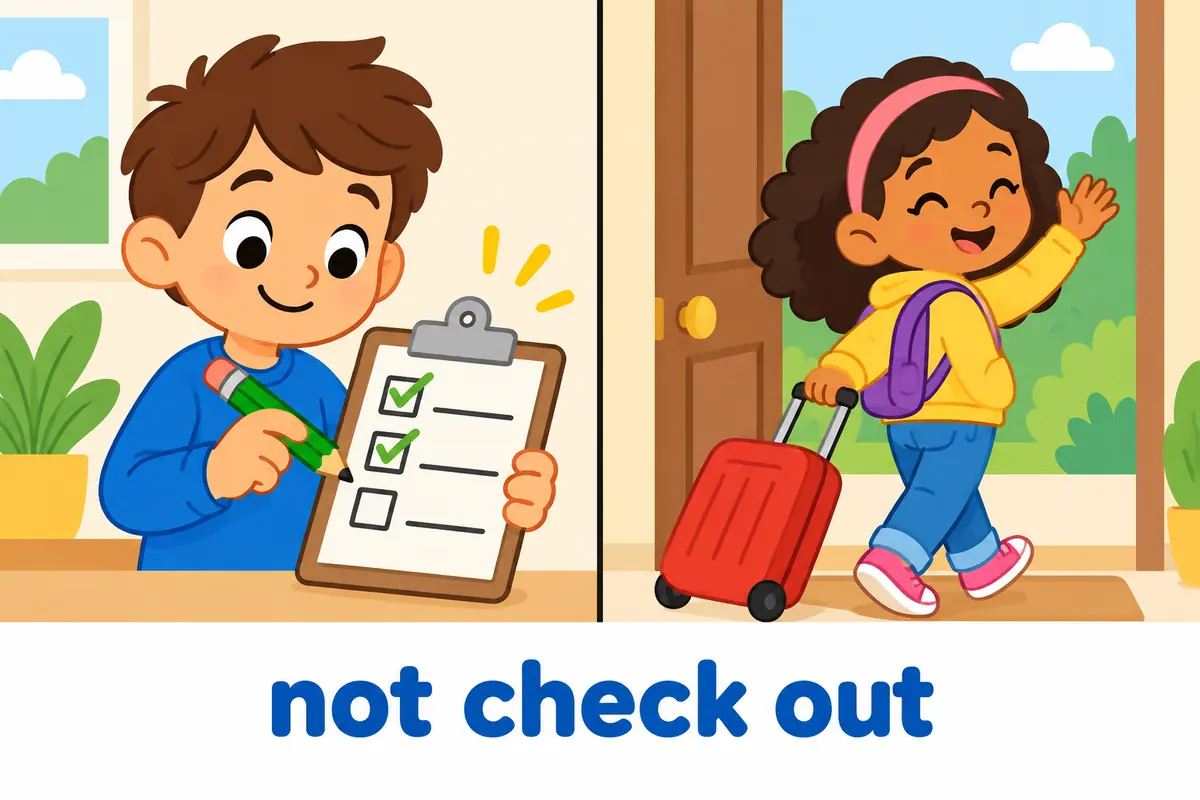
Check off and check out share a base verb but almost nothing else. Check out means to leave a place or to examine something, while check off means to tick an item on a list. Learners who shorten the particle often say check out a box when they mean mark it off.
| Attribute | check off | check out |
|---|---|---|
| Core meaning | Mark an item as done or verified | Leave, or examine something closely |
| Typical object | A task, name, box or entry | A room, hotel or suspect |
| Needs a list | Almost always | Never |
| Register | Neutral and administrative | Informal or investigative |
| Separable | Yes: check it off | Yes: check it out |
Verdict: use check off when a list is being cleared, and check out when a place is being left or a thing examined. For a quick, informal tick, tick often replaces check off in British writing.
Word forms and grammar of check off
Check off inflects on the verb, not the particle, and the related noun checkoff is written as one word. The table also lists the forms learners build by mistake.
| Form | Part of speech | Example |
|---|---|---|
| check off | phrasal verb, base form | I will check off the boxes tonight. |
| checks off | phrasal verb, third person singular | She checks off every invoice. |
| checked off | phrasal verb, past and past participle | They checked off the list at noon. |
| checking off | phrasal verb, present participle | He is checking off the names now. |
| checkoff | noun, one word | The checkoff list hangs by the door. |
| check off on | non-standard | Drop on: check off the box, never check off on it. |
Common mistakes with check off
- Incorrect:
Please check off on the box when you are done.Correct: Please check off the box when you are done. Rule: Check off takes a direct object and no on. - Incorrect:
She checked off.Correct: She checked off the form. Rule: The verb is transitive, so the item must be named or replaced by a pronoun. - Incorrect:
He checked off it quickly.Correct: He checked it off quickly. Rule: A pronoun object sits between the verb and the particle. - Incorrect:
I checked off that the report was sent.Correct: I checked off the report. Rule: Check off takes a noun, never a that-clause. - Incorrect:
We checked out the last item on the list.Correct: We checked off the last item on the list. Rule: Check out means leave or examine, not tick. Do not omit an entry you still need to record.
Practice using check off
Work through the six items, then read the reasoning rather than only the answer.
- Fill the gap: The teacher asked us to ______ our names before we left.
- Choose the better order: Sam (checked off the task / checked the task off) and smiled.
- Correct the error: I checked off it after lunch.
- Build a sentence: use check off in the passive about a health form signed by a nurse.
- Spot the register: which belongs in a project email – please check off the finished tasks, or you guys totally checked out the tasks?
- Rewrite with a pronoun: Maria checked off the invoices. Replace the invoices with it.
Answers
- check off – the names are the direct object of the phrasal verb.
- Both are correct – the verb is separable, so either order works.
- I checked it off after lunch – a pronoun must sit between the verb and the particle.
- Model answer: The health form was checked off by the nurse.
- Please check off the finished tasks – the email keeps the neutral administrative verb.
- Maria checked them off – the plural pronoun keeps the particle at the end.
The bottom line
Use check off in a sentence when an item on a list is being marked as done or verified, and name that item as the object. The two details that decide most sentences are that the verb is transitive, so something must always be checked off, and that it is separable, so the particle may follow a pronoun or strand at the end of the clause. Keep it clear of check out, which means to leave or examine, and the sentence will read correctly.
Frequently asked questions about check off
Is check off one word or two?
As a verb it is always two words, as in check off the tasks. The related noun is written as one word, checkoff, and it usually names a levy or a list, as in a checkoff form. Keep the verb open and the noun closed, and you will match standard usage every time.
Is check off separable?
Yes, check off is separable, so the particle can come before or after the object: check off the item or check the item off. When the object is a pronoun such as it or them, the particle must follow it, so check it off is correct and check off it is not.
Can the particle come at the end?
It can. Because check off behaves as a genuine phrasal verb, off may strand at the end of a clause, as in the tasks I still have to check off. This stranding is normal in both speech and writing, and it never changes the meaning of the verb.
Is check off the same as check out?
No. Check off means to mark an item on a list as done or verified, and it almost always implies a list. Check out means to leave a place or to examine something, so you check off a box but you check out of a hotel or check out a strange noise.
Have you ever come across the term “check off” and wondered what it means? In simple terms, using “check off” in a sentence typically indicates completing or marking an item as done on a list or a task.
When someone mentions “checking off” something, they are referring to the action of indicating completion or verification of a specific task, responsibility, or item on a checklist. This commonly used phrase embodies the idea of progress, organization, and accountability in various aspects of work and everyday life.
7 Examples Of Check Off Used In a Sentence For Kids
- Check off the number of fruits in the picture.
- Check off the colors that make a rainbow.
- Check off the animals that live in the jungle.
- Check off the shapes you can see around you.
- Check off the objects you use in the kitchen.
- Check off the clothes you wear in winter.
- Check off the things you need for a picnic.
14 Sentences with Check Off Examples
- Before starting your assignment, make sure to check off all the necessary reading materials.
- After attending a lecture, don’t forget to check off the topic from your to-do list.
- It’s essential to check off all the deadlines for your projects in your planner.
- Make sure to check off your name on the attendance sheet during examinations.
- You can check off the subjects you have completed studying in your study planner.
- Don’t forget to check off the items you need to buy from the grocery list.
- As you complete each task, check off the items on your daily to-do list.
- Check off all the important dates for exams in your calendar.
- Make sure to check off the books you have returned to the library.
- Before submitting your homework, always remember to check off the guidelines provided by your professor.
- Use a highlighter to check off the key points in your textbook.
- Check off all the assignments you have submitted on the online portal.
- Create a checklist and check off the steps as you complete your project report.
- Check off the subjects you have registered for next semester in your student portal.
How To Use Check Off in Sentences?
Check off is a versatile phrasal verb that is commonly used in daily conversations. When you check off something, it means that you mark or indicate that a task, item, or action has been completed or verified.
To use check off in a sentence, simply place it after the task or item that has been completed, followed by the word “off.” For example, “I need to check off the items on my grocery list before going to the store.”
Another way to use check off is in the past tense. For instance, “She checked off all the names on the attendance list.” In this case, “checked” is the past tense of “check,” and “off” is still used to indicate completion.
You can also use check off in a negative context by adding the word “not” before it. For example, “Do not forget to check off your tasks before leaving work.”
Remember, check off is a convenient way to keep track of tasks or items that have been completed, so feel free to incorporate it into your daily conversations and written communication. Be sure to place the task or item before check off and the word “off” after to effectively convey that something has been successfully marked or completed.
Conclusion
In conclusion, using sentences with “check off” can help you keep track of tasks, items, or goals that need to be completed or achieved. These sentences serve as a reminder and can provide a sense of accomplishment when items are checked off the list. Whether it’s a simple to-do list or a complex project plan, incorporating “check off” sentences can improve organization and productivity.
By breaking down larger tasks into smaller, manageable steps that can be checked off one by one, you can stay focused and motivated to complete the overall goal. This method also helps prevent tasks from slipping through the cracks and ensures a clear understanding of progress. So, next time you have a list of tasks to complete, consider using “check off” sentences to streamline your workflow and achieve success.


