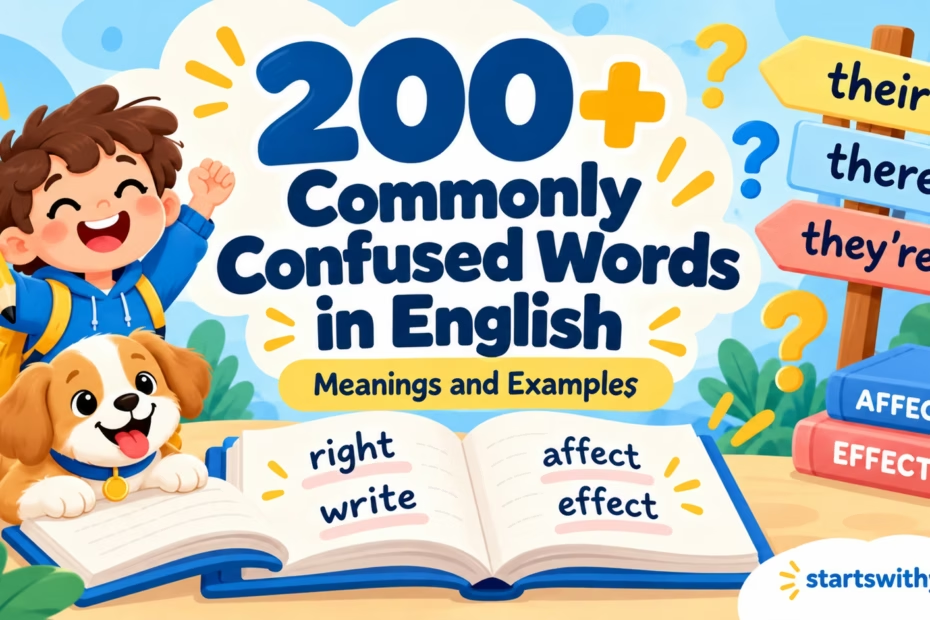
Commonly confused words are words that people mix up because of similar sounds, spellings, meanings, or grammatical functions. Affect/effect, accept/except, and their/there/they’re are familiar examples. Understanding each word’s meaning and role in a sentence helps writers choose accurately.
Key facts
- Some confused words are homophones; others only resemble one another.
- Grammar can identify the correct choice even when pronunciation cannot.
- Spellcheck may miss an incorrect but correctly spelled word.
- Contextual sentence practice helps prevent repeated mistakes.
Common homophones and their meanings
Accept—receive or agree; except—excluding. Aisle—passageway; isle—island. Allowed—permitted; aloud—audibly. Altar—religious structure; alter—change. Ate—past tense of eat; eight—number 8. Bare—uncovered; bear—animal or carry. Be—verb; bee—insect. Blue—color; blew—past of blow. Board—flat material; bored—uninterested. Brake—slowing device; break—damage or interrupt. Buy—purchase; by—near or through an agent; bye—farewell. Cell—small unit; sell—exchange for money. Cent—money unit; scent—smell; sent—past of send. Cereal—grain-based food; serial—in a sequence. Coarse—rough; course—route or class. Dear—beloved; deer—animal. Die—cease living; dye—change color. Fair—just; fare—travel charge. Flour—powdered ingredient; flower—plant structure. For—preposition; four—number 4. Grate—shred; great—excellent. Hear—perceive sound; here—in this place. Hole—opening; whole—complete. Hour—60 minutes; our—belonging to us. I—pronoun; eye—organ of sight. Knew—past of know; new—recent. Knight—historic title; night—dark period. Know—understand; no—negative. Mail—letters; male—sex category. Main—principal; mane—animal hair. Meat—animal flesh as food; meet—come together. One—number 1; won—past of win. Pair—two associated things; pear—fruit. Peace—absence of conflict; piece—portion. Plain—simple or flat region; plane—aircraft. Rain—precipitation; reign—period of rule; rein—strap for controlling an animal. Right—correct or direction; write—form written words. Sea—body of salt water; see—perceive visually. Son—male child; sun—our star. Tail—animal appendage; tale—story. To—preposition; too—also or excessively; two—number 2. Wait—remain until an event; weight—heaviness. Weak—lacking strength; week—seven days. Weather—atmospheric conditions; whether—introduces alternatives. Which—asks about choice; witch—associated with magic. Wood—tree material; would—modal verb.
Similar-looking words
Affect—usually a verb meaning influence; effect—usually a noun meaning result. Advice—noun; advise—verb. Allusion—indirect reference; illusion—misleading perception. Appraise—assess value; apprise—inform. Assure—reassure someone; ensure—make certain. Breath—noun; breathe—verb. Canvas—fabric; canvass—seek opinions or support. Climactic—related to a climax; climatic—related to climate. Complement—complete or enhance; compliment—praise. Continual—recurring; continuous—without interruption. Defuse—make safer; diffuse—spread out. Desert—arid region; dessert—sweet course. Discreet—tactful; discrete—separate. Elicit—draw out; illicit—prohibited. Eminent—distinguished; imminent—about to happen. Imply—suggest indirectly; infer—conclude from evidence. Ingenious—inventive; ingenuous—candid. Lose—misplace; loose—not tight. Moral—related to right and wrong; morale—confidence. Personal—individual; personnel—staff. Precede—come before; proceed—continue. Prescribe—recommend; proscribe—forbid. Respectfully—with respect; respectively—in corresponding order. Than—comparison; then—time or sequence.
Confusing grammar groups
Their is possessive, there indicates a place or introduces a clause, and they’re means they are. Your is possessive and you’re means you are. Its is possessive; it’s means it is or it has. To indicates direction or the infinitive, too means also or excessively, and two is the number. Check contractions by expanding them: if “you are” does not fit, do not use you’re.
Related-meaning pairs
Fewer generally applies to countable items and less to amounts. Historic means notable in history; historical means related to the past. Economic concerns the economy; economical means avoiding unnecessary expense. Uninterested means lacking interest; disinterested traditionally means impartial. Learn means acquire knowledge; teach means help someone acquire knowledge. Lend means give temporarily; borrow means receive temporarily.
How can you avoid these mistakes?
Identify whether the sentence needs a noun, verb, adjective, or determiner. Check the intended meaning, then read the entire sentence. Write your troublesome pairs in a notebook with one original example apiece; do not rely exclusively on spellcheck.
Frequently asked questions
Is affect always a verb?
No. Affect is usually a verb and effect usually a noun, but both have less common alternative grammatical uses.
Why does spellcheck miss homophone errors?
Each option can be a correctly spelled word; choosing the wrong one is a contextual error.
What is an easy way to remember you’re?
Replace it with “you are.” If the full phrase fits naturally, the contraction is appropriate.
Conclusion
Commonly confused words are best learned through their meanings, grammatical roles, and use in complete sentences rather than sound alone.