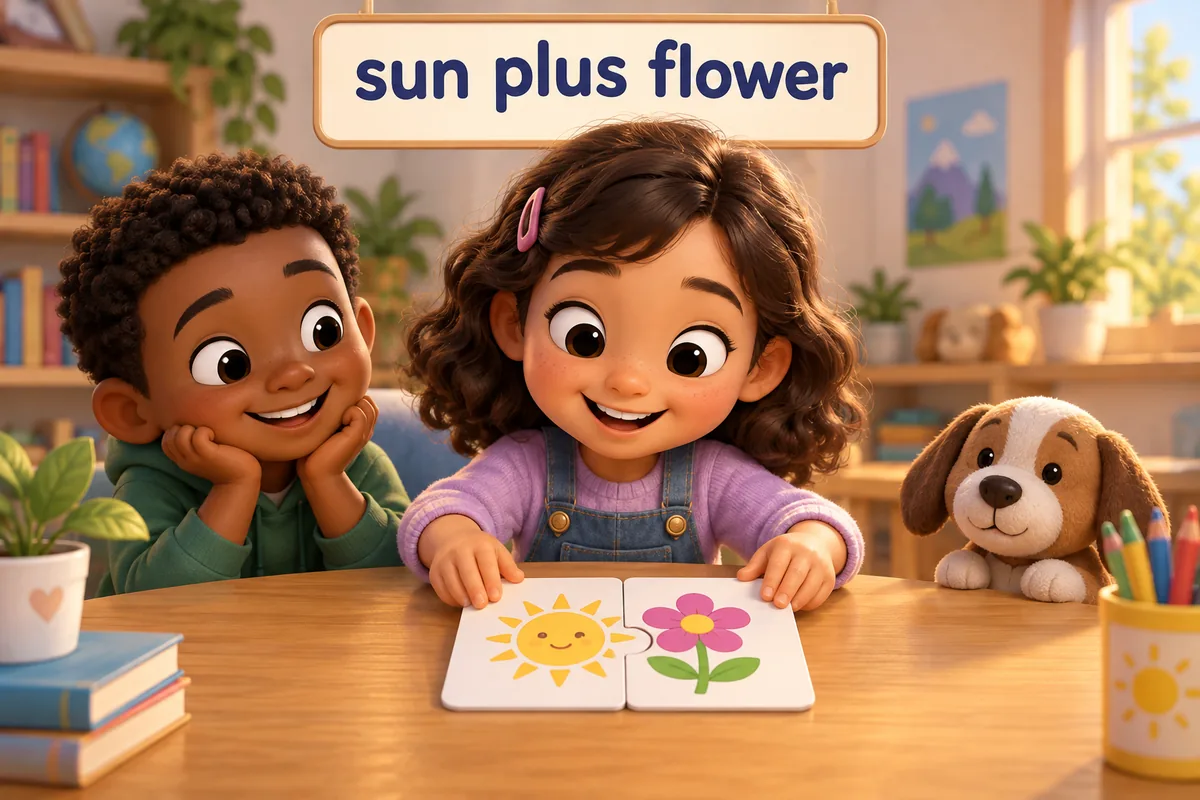
Compound words in English with 1000 examples begin with a simple idea: two words join to make one new meaning, as when sun and flower become sunflower. The joining takes three shapes, closed, hyphenated and open, and the meaning is often more than the sum of its parts. One example is “I put sunflower seeds on the bread.”
Compound words in English with 1000 examples at a glance
- A compound word joins two or more base words into one unit.
- Closed compounds have no space, as in sunflower.
- Hyphenated compounds join with dashes, as in well-known.
- Open compounds keep a space, as in ice cream.
- The commonest error is splitting a closed compound into two words.
What are the three types of compound words?
The type depends on how the two words are printed, not on the meaning. The same pair of ideas can be written as one word, joined by hyphens, or left apart, and a learner who knows the three shapes can spell any compound correctly. A related page for young readers is compound words for kids.
| Type | How it looks | Examples |
|---|---|---|
| closed | written as one word | sunflower, notebook, bedroom |
| hyphenated | joined with hyphens | well-known, mother-in-law, passer-by |
| open | written as two words | ice cream, living room, school bus |
What are examples of compound words?
The list below gives the compound, the words it joins, a plain meaning and one example, so each entry can be read aloud. Longer practice sets fill the compound sentence page, and a fuller collection of joining patterns sits at the compound adjectives page.
| Compound | Parts | Meaning | Example |
|---|---|---|---|
| sunflower | sun + flower | a tall yellow flower | The sunflower turned to the sun. |
| rainbow | rain + bow | an arc of colours | A rainbow crossed the sky. |
| basketball | basket + ball | a court game | We played basketball after school. |
| notebook | note + book | a book for notes | Open your notebook at page one. |
| toothbrush | tooth + brush | a brush for teeth | Pack your toothbrush. |
| playground | play + ground | a place to play | The playground was full. |
| birthday | birth + day | the day you were born | Happy birthday to you. |
| watermelon | water + melon | a large green fruit | Slice the watermelon. |
| butterfly | butter + fly | a colourful insect | A butterfly landed on the leaf. |
| football | foot + ball | a ball game | He kicked the football hard. |
| mailbox | mail + box | a box for letters | Check the mailbox daily. |
| bedroom | bed + room | a room with a bed | My bedroom is small and warm. |
| grandmother | grand + mother | your parent’s mother | My grandmother bakes bread. |
| handbag | hand + bag | a small bag | She lost her handbag. |
| well-known | well + known | known by many people | A well-known singer came. |
| ice cream | ice + cream | a frozen dessert | We ate ice cream. |
| living room | living + room | a room for sitting | The living room is bright. |
| mother-in-law | mother + in + law | your spouse’s mother | My mother-in-law visits. |
| passer-by | passer + by | someone walking past | A passer-by helped us. |
| school bus | school + bus | a bus for pupils | The school bus is late. |
| high school | high + school | a secondary school | She starts high school soon. |
| typewriter | type + writer | a machine for typing | The typewriter is very old. |
How do you use a compound word in a sentence?
A compound word behaves like the single word it replaces, so it sits where a noun or an adjective would. The pattern table shows the commonest positions and the punctuation each needs.
| Pattern | Example | What it signals |
|---|---|---|
| compound as a noun | The sunflower is tall. | The whole unit acts as the subject. |
| compound as an object | She packed a toothbrush. | The unit receives the action. |
| hyphenated adjective before a noun | A well-known author spoke. | The hyphens hold the pair before the noun. |
| open compound as a noun | We ate ice cream. | The two words stay apart. |
| compound in a place phrase | The school bus is here. | The unit names a thing and takes the verb. |
A compound usually takes the word class of its last element, so a compound ending in room acts as a noun and one ending in known acts as an adjective. That test helps a learner place an unfamiliar compound in a sentence without looking it up.
Compound words across contexts
Compounds fill everyday speech, and each setting leans on a different set. The table shows nine of them.
| Context | Example sentence | Why this works |
|---|---|---|
| Garden | The sunflower is taller than the fence. | A closed compound names the plant. |
| Home | Your toothbrush is by the sink. | A closed compound names a daily object. |
| School | Bring your notebook to class. | A closed compound names a tool. |
| Play | The children ran to the playground. | A closed compound names a place. |
| Weather | A rainbow appeared after the rain. | A closed compound names a sight. |
| Kitchen | Serve the ice cream in a bowl. | An open compound keeps its space. |
| News | A well-known chef opened a cafe. | A hyphenated adjective precedes a noun. |
| Family | My mother-in-law arrives on Sunday. | A hyphenated compound names a relative. |
| Travel | The school bus stops at the corner. | An open compound names a vehicle. |
| Art class | A rainbow of paint filled the tray. | A closed compound works as a metaphor. |
| Sports desk | The basketball team won again. | A closed compound names the sport. |
Closed, hyphenated and open compared
The three shapes differ in spacing, in plurals and in where the emphasis falls in writing. The table sets the same test beside each form so the choice is clear.
| Point | closed | hyphenated | open |
|---|---|---|---|
| Spacing | one word | joined by hyphens | two separate words |
| Plural rule | add -s at the end | put -s on the main noun | add -s to the last word |
| Plural example | notebooks | mothers-in-law | school buses |
| Before a noun | a bedroom window | a well-known face | an ice cream van |
| Risk | splitting it in two | dropping the hyphens | joining it by mistake |
Word forms and plural rules of compounds
The plural goes on the main word rather than on the compound as a whole, and a hyphenated adjective loses its hyphens after a linking verb. Learning the two habits prevents most errors.
| Form | Rule | Example |
|---|---|---|
| notebooks | regular plural at the end | Two notebooks are on the desk. |
| mothers-in-law | plural on the main noun | Both mothers-in-law arrived. |
| passers-by | plural in the middle | Many passers-by stopped to watch. |
| school buses | plural on the second word | Three school buses waited. |
| well-known | hyphen before a noun | A well-known author spoke. |
| well known | no hyphen after a linking verb | The author is well known. |
Common mistakes with compound words
Most errors come from splitting a closed compound, dropping the hyphens in a compound adjective, and putting the plural in the wrong place.
- Incorrect:
I bought a sun flower.Correct: I bought a sunflower. Rule: a closed compound is written as one word. - Incorrect:
She is well known writer.Correct: She is a well-known writer. Rule: a compound adjective before a noun takes hyphens and an article. - Incorrect:
Two mothers-in-laws arrived.Correct: Two mothers-in-law arrived. Rule: the plural goes on the main noun, not the whole compound. - Incorrect:
We saw three passersby.Correct: We saw three passers-by. Rule: the hyphens stay inside the plural form. - Incorrect:
It is a ice cream.Correct: It is an ice cream. Rule: ice begins with a vowel sound, so it takes an. - Incorrect:
She wore a well known coat.Correct: She wore a well-known coat. Rule: a compound adjective before a noun keeps its hyphens.
Practice using compound words
Try each item, then read the reason beside the answer.
- Fill in the blank: The ________ turned its face to the sun. (sunflower / sun flower)
- Fill in the blank: Pack your ________ before the trip. (toothbrush / tooth brush)
- Choose the better word: She is a (well-known / well known) author.
- Correct the error: Two mothers-in-laws arrived.
- Build a sentence: use an open compound about a room in a home.
- Spot the register: which fits a school note, “Bring your notebook” or “Bring a note book”?
- Fill in the blank: The ________ stops at the corner. (school bus / schoolbus)
Answers
- sunflower: the closed compound is written as one word.
- toothbrush: the closed compound is written as one word.
- well-known: a compound adjective before a noun takes hyphens.
- Two mothers-in-law arrived: the plural goes on the main noun.
- Sample: The living room is bright. The open compound keeps its space.
- The first: the closed compound is the standard spelling.
- school bus: the open compound keeps its space.

The bottom line
Compound words in English with 1000 examples all follow three shapes, and knowing which shape a word takes settles the spelling. Write closed compounds as one word, hyphenate a compound adjective before a noun, and keep open compounds apart. Put the plural on the main noun, as in mothers-in-law, and the hundreds of examples fall into place.
Frequently asked questions about compound words
What are compound words?
A compound word joins two or more base words into one unit with a single meaning, as sun and flower make sunflower. The result behaves like one word in a sentence. English forms compounds freely, which is why the total runs into many thousands.
What are the three types of compound words?
The three types are closed, hyphenated and open. Closed compounds such as notebook have no space, hyphenated compounds such as well-known use a dash, and open compounds such as ice cream keep a space. The type is a spelling choice, not a difference in meaning.
Is ice cream one word or two?
Ice cream is an open compound, so it stays as two words with a space. Some related forms close up over time, but the standard spelling of this dessert keeps the space. Dictionaries list it as the two-word form rather than as icecream.
How do you make a compound word plural?
Put the plural ending on the main noun rather than the whole compound. A closed compound simply adds -s at the end, as in notebooks, while a hyphenated compound keeps the ending inside, as in mothers-in-law. Open compounds add -s to the last word, as in school buses.