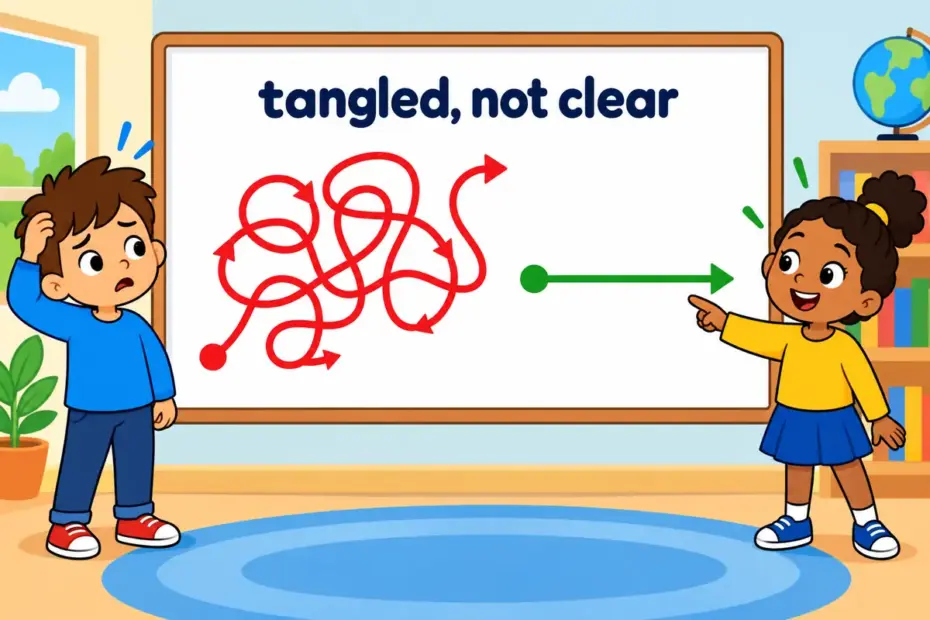
Convoluted describes something so tangled in its parts that following it takes real effort. To use convoluted in a sentence, point the adjective at whatever twists: a convoluted plot, a convoluted tax rule or a convoluted explanation. The word criticises the shape of an idea, not difficulty on its own.
Convoluted at a glance
- Convoluted is an adjective; its verb is convolute and its noun is convolution.
- It modifies plots, arguments, rules, processes and explanations.
- The literal sense, coiled or twisted, survives in anatomy and mathematics.
- The commonest error is using convoluted where the neutral complicated would be fairer.
- A convoluted sentence is hard to follow because of its structure, not its vocabulary.
What does convoluted mean?
Convoluted is an adjective meaning twisted into so many parts that the result is hard to follow. The Cambridge entry for convoluted holds the literal and figurative senses together, and the difference matters: a coiled shape is convoluted without fault, while an argument is convoluted because the twisting was needless. For a thing with many hard parts but no wasted ones, complex is the fairer adjective.
| Sense | Plain meaning | Example sentence |
|---|---|---|
| Tangle of parts | Hard to follow because too many pieces twist together | The film’s convoluted plot lost half the audience. |
| Coiled shape | Literally wound or folded in curves | The shell has a convoluted inner chamber. |
| Overcomplicated | Needlessly complex where a simple form existed | A convoluted approval chain delayed every request. |
One limitation is worth stating plainly. Convoluted carries a complaint, so it is the wrong word for detail that earns its complexity. Where the detail is fine and necessary, intricate praises what convoluted condemns. The word never means difficult to pronounce, and it never means long.
How do you use convoluted in a sentence?
Place convoluted before the noun it criticises, or after the verb be as a predicate adjective. The five patterns below cover the sentences writers actually build, from a single noun phrase to a degree-and-result construction.
| Pattern | Example | What it signals |
|---|---|---|
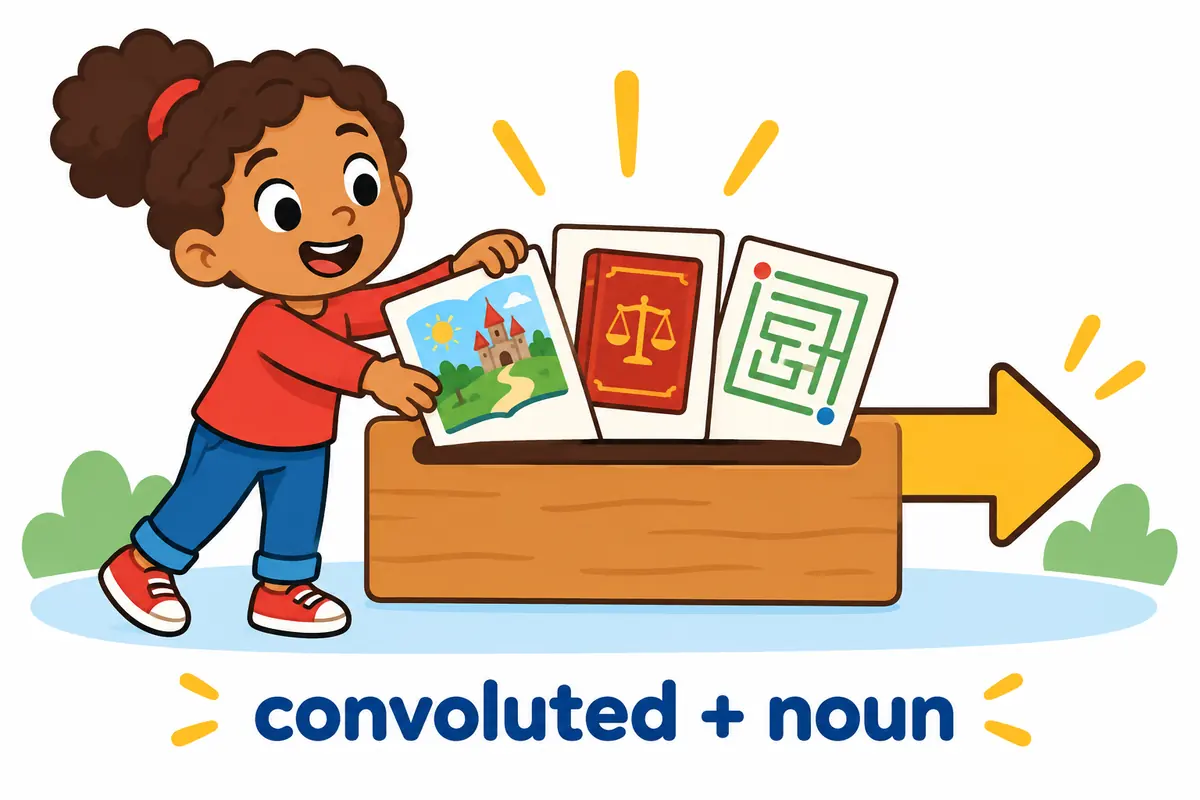
| convoluted + noun | The novel’s convoluted timeline jumps between four narrators. | Criticises the structure rather than the subject. |
| it is convoluted | The booking process is so convoluted that staff keep a cheat sheet. | Uses the adjective predicatively after be. |
| grow + convoluted | The rules grew convoluted after each amendment. | Tracks a drift toward over-complication. |
| too convoluted to + verb | The instructions were too convoluted to follow. | Pairs naturally with degree and result. |
| sound + convoluted | The answer sounded convoluted, so nobody trusted it. | Judges how an explanation lands on a listener. |
Convoluted in a sentence: examples across contexts
Convoluted moves easily between subjects, and the nine sentences below show it criticising a plot, a process and a literal shape in turn. A path can be convoluted in the coiled sense; a tortuous route twists to mislead, and a tangled cord is knotted without being complex at all.
| Context | Example sentence | Why this works |
|---|---|---|
| Classroom | The substitute left instructions too convoluted for one lesson. | Shows the too…to pattern in a school setting. |
| Workplace email | The new expense form is convoluted, so requests sit unapproved. | Links the adjective to a concrete consequence. |
| News report | Investigators called the payments a convoluted web of shell companies. | Ties the word to a metaphor of tangling. |
| Legal writing | The convoluted clause had three exceptions nested inside it. | Names the exact structural fault. |
| Science writing | The protein folds into a convoluted shape that traps the ion. | Uses the literal coiled sense precisely. |
| Conversation | His story was so convoluted that I lost the thread. | Daily speech still keeps the adjective. |
| Sports report | A convoluted trade sent four players between three clubs. | Describes a deal with too many moving parts. |
| Academic prose | The theory rests on a convoluted chain of assumptions. | Criticises unearned complexity politely. |
| Travel writing | The old town hides a convoluted network of lanes. | Applies the word to physical winding. |
Convoluted vs complicated
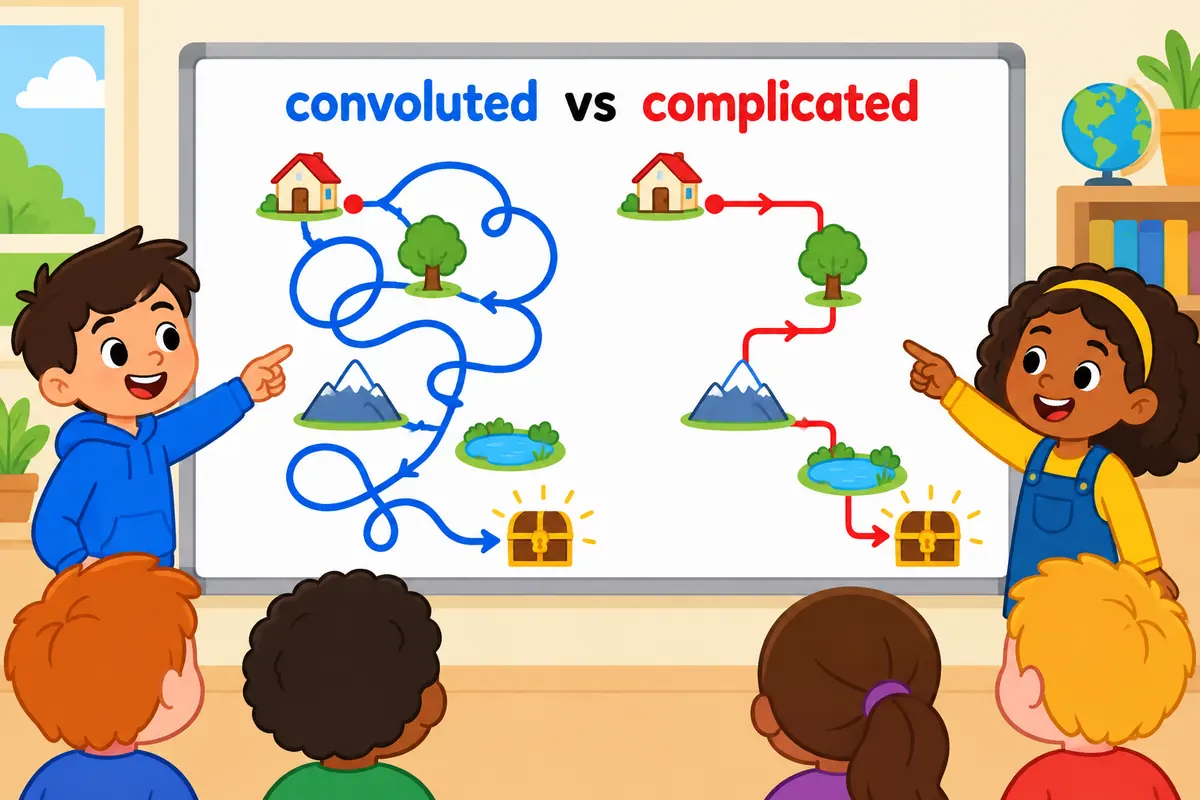
Convoluted and complicated both describe difficulty, and they are not interchangeable. Complicated describes difficulty that can be learned, while convoluted adds the charge that the difficulty is needless.
| Attribute | convoluted | complicated |
|---|---|---|
| Core meaning | Twisted beyond what the task needs | Made of many parts that must be learned |
| Tone | Critical, often a fault | Neutral, simply descriptive |
| Typical noun | plot, argument, rule, process | system, relationship, surgery |
| Implies blame | Usually yes | Not necessarily |
| Opposite | clear, straightforward | simple |
Verdict: choose complicated when the parts are necessary and convoluted when the tangling could have been avoided, because the second word is an accusation and the first is not.
Word forms and grammar of convoluted
Convoluted is the past participle of a technical verb that has largely become an adjective, and its noun convolution is common in science and in criticism of prose. The table also lists the form learners reach for by mistake.
| Form | Part of speech | Example |
|---|---|---|
| convoluted | adjective | a convoluted contract |
| convolute | verb, technical | The petals convolute as the bud opens. |
| convolution | noun | The convolution of the plot defeated me. |
| convolutedly | adverb, rare | He explained it convolutedly, which few writers do. |
| convolutedness | noun, very rare | The convolutedness of the form drew complaints. |
Common mistakes with convoluted
- Incorrect:
The directions were very convolutedly written.Correct: The directions were very convoluted. Rule: The natural predicate is the adjective, not the rare adverb. - Incorrect:
The convoluted was hard to follow.Correct: The convoluted argument was hard to follow. Rule: An adjective needs the noun it describes. - Incorrect:
The surgery was convoluted.Correct: The surgery was complicated. Rule: Convoluted means needlessly twisted, while complicated means hard. - Incorrect:
The roots convoluted through the soil.Correct: The roots twisted through the soil. Rule: Convoluted describes the result, so use a verb for movement. - Incorrect:
He convoluted the meeting with questions.Correct: He complicated the meeting with questions. Rule: Convolute is a technical verb, not a general one.
Practice using convoluted
Work through the six items, then check the reasoning rather than only the answer.
- Fill the gap: The new form is so ______ that staff keep a one-page cheat sheet.
- Choose the better word: The instructions were (convoluted / complicated), but every step was necessary and clear.
- Correct the error: The plot was very convolutedly written.
- Build a sentence: use convoluted process about a permit that passes through six desks.
- Spot the register: which fits a science paper — the folding pathway is convoluted, or the folding thing is a total mess?
- Rewrite with the noun: The rules became twisted and hard to follow. Use convolution instead.
Answers
- convoluted — needless tangling is what forces staff onto a shortcut.
- complicated — every step is necessary, so the neutral word is the fair choice.
- The plot was convoluted, or written in a convoluted way — the adverb convolutedly is rare and awkward.
- Model answer: The permit followed a convoluted process through six desks before anyone signed it.
- The folding pathway is convoluted — a paper keeps the measured adjective, not the loose phrase total mess.
- The rules turned into a convolution that nobody could follow — the noun names the tangle itself.
The bottom line
Use convoluted in a sentence when something is twisted into more parts than the task requires, and place the adjective before its noun or after be. Two nuances decide most sentences: the word blames the needless tangling rather than the difficulty, and its opposite is clear rather than merely easy. Where the detail is fine and worth having, intricate is the more generous word.
Frequently asked questions about convoluted
Is convoluted always an insult?
Convoluted is almost always critical, because it says the twisting was unnecessary. A plot, rule or process earns the label when simpler parts would have worked. In neutral description, complicated is the safer word. The rare literal use, about a coiled shape, carries no judgement at all.
What makes a sentence convoluted?
A convoluted sentence buries its main clause under too many nested points. Clues include three or more subordinate clauses, long parenthetical asides and pronouns whose referents sit far away. The fix is to split the sentence and put the main subject and verb early, where a reader can find them quickly.
Does convoluted mean the same as complicated?
No. Complicated means made of many parts that take time to learn, with no blame attached. Convoluted adds a complaint: the parts are tangled beyond what the task needs. A complicated watch is a marvel; a convoluted approval form is a nuisance. Choose the word that matches whether the difficulty is earned.
Can places and routes be convoluted?
Yes, in the literal sense of tightly coiled or winding. A convoluted staircase curls back on itself, and old towns often hide convoluted lanes. For a route that twists in order to mislead, tortuous is more precise. For a general maze of streets, labyrinthine is stronger still.
Have you ever struggled with understanding complex and intricately twisted sentences that seem to go on forever? Those are what we refer to as convoluted sentences. A convoluted sentence is one that is overly complicated, twisted, and difficult to follow due to its intricate structure and excessive use of clauses and phrases.
These sentences often lead to confusion and frustration for readers, as the intended meaning can get lost in the convoluted structure. Learning to identify and simplify convoluted sentences can greatly improve communication and clarity in writing.
7 Examples Of Convoluted Used In a Sentence For Kids
- The path to the treasure was very convoluted.
- The maze had a convoluted route to the exit.
- The tangled string was convoluted and hard to unravel.
- The complicated puzzle had a convoluted solution.
- The river took a convoluted path through the forest.
- The confusing map had convoluted roads.
- The knotted shoelaces were convoluted and tricky to tie.
14 Sentences with Convoluted Examples
- Convoluted academic regulations often confuse college students when planning their course schedules.
- Students often struggle to understand the convoluted topic of quantum physics in their advanced level courses.
- The professor’s convoluted explanation of the theorem left many students scratching their heads.
- The convoluted process of applying for scholarships can be overwhelming for college students.
- Writing a convoluted thesis statement can make it difficult for readers to understand the main point of the essay.
- Some students find it challenging to navigate the convoluted library catalog to find the resources they need.
- The convoluted networking system on campus can make it hard for students to connect with their peers.
- Understanding the convoluted instructions for the chemistry experiment proved to be a daunting task for many students.
- The professor’s convoluted grading criteria made it difficult for students to know how they were being evaluated.
- The convoluted financial aid application process can deter some students from seeking assistance.
- Deciphering the convoluted assignment guidelines can be a time-consuming task for college students.
- Some students resort to online forums to seek clarification on convoluted concepts they encounter in their coursework.
- The convoluted campus map can lead to students getting lost on their way to classes or events.
- Group projects can become convoluted when members have different ideas on how to approach the assignment.
How To Use Convoluted in Sentences?
To use the word Convoluted in a sentence, consider the following example:
The instructions for assembling the furniture were so convoluted that I had to ask for help.
In this sentence, the word convoluted is used to describe the complexity or intricacy of the assembly instructions. It implies that the instructions were confusing and difficult to follow.
When incorporating convoluted into your writing, it is important to provide context so that the reader can understand the meaning of the word. Try to use it in a sentence where it makes sense to describe something complicated, tangled, or twisted.
Here are a few more examples of how you can use convoluted in a sentence:
- The plot of the movie was so convoluted that many viewers found it hard to follow.
- The company’s organizational structure was so convoluted that employees often got confused about their roles.
- The legal language in the contract was so convoluted that it took hours to decipher its meaning.
By using convoluted in your sentences, you can effectively convey the idea of something complex, intricate, or twisted. Experiment with incorporating this word into your writing to improve your vocabulary and communicate more precisely.
Conclusion
In conclusion, sentences with convoluted structures can be confusing and difficult for readers to follow. By simplifying and clarifying our sentence constructions, we can enhance communication and make our writing more accessible to a wider audience. It is important to strive for clear and concise sentences to ensure our message is effectively conveyed and understood.
Avoiding convoluted sentences can improve the readability of our writing, making it easier for readers to grasp our intended meaning. By using straightforward language and organizing our ideas logically, we can create a more engaging and effective piece of writing that resonates with its audience. Remember, simplicity is key when it comes to effective communication.


