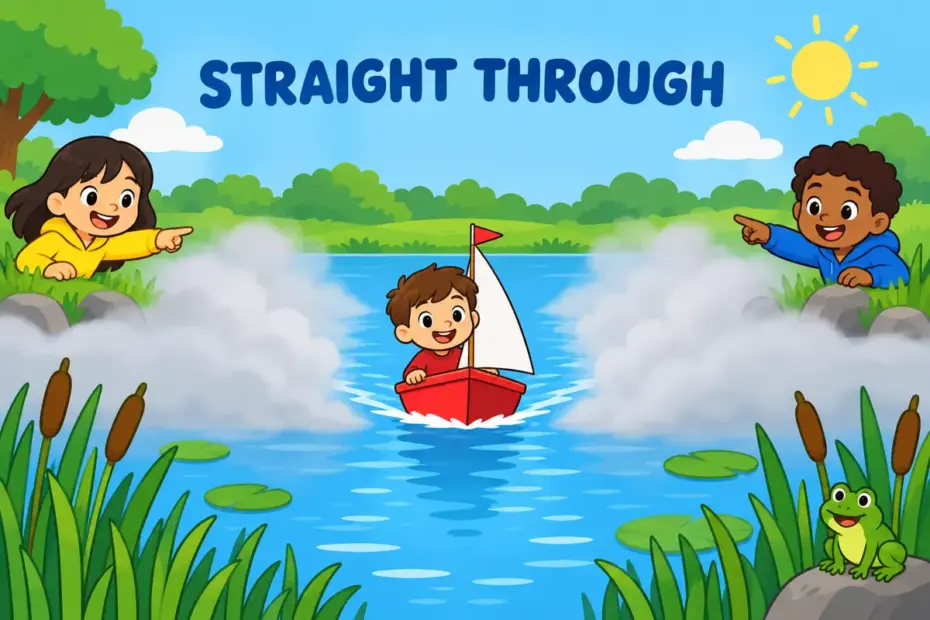
Cut through means to pass straight through something, to move directly across a crowded space, or to get past an obstacle such as noise or jargon. To use cut through in a sentence, name what is being crossed: “The ferry cut through the morning mist.” The word through is fixed, so the object always follows it.
Cut through at a glance
- Cut through is a transitive phrasal verb meaning to pass through, cross directly or overcome an obstruction.
- Its forms are cut through, cuts through and cutting through; the past tense stays cut.
- Through cannot be separated from cut, so the object always follows the particle.
- The physical sense takes water, fog, rope or a crowd as the object; the figurative sense takes noise, jargon or red tape.
- The commonest error is splitting the pair and writing cut the rope through.
What does cut through mean?
Cut through is a transitive phrasal verb meaning to make a way through something, to cross a space by the shortest route, or to get past a barrier that is blocking attention. The Cambridge entry for cut through separates the physical act from the figurative one, and the object tells you which is meant. A knife, a boat or a road signals the first; noise, confusion or bureaucracy signals the second, and the shift is one of the most useful patterns in the word.
| Sense | Plain meaning | Example sentence |
|---|---|---|
| Penetrate physically | Pass through a solid or liquid object | The blade cut through the thick rope. |
| Move directly across | Take the shortest route through a space | We cut through the park to reach the station. |
| Overcome an obstruction | Get past noise, confusion or delay | Her calm voice cut through the panic. |
A related noun, a cut-through, names a shortcut route, as in the alley is a handy cut-through. One limitation is worth stating plainly. The figurative sense is powerful but easy to overuse: if a sentence simply means to make something clear, clarify is often the plainer and better verb, and cut through the noise has become a stock phrase in business writing. A reader who meets the figurative sense may also notice the nearby go through, which shares the same particle but means to examine something from start to finish.
How do you use cut through in a sentence?
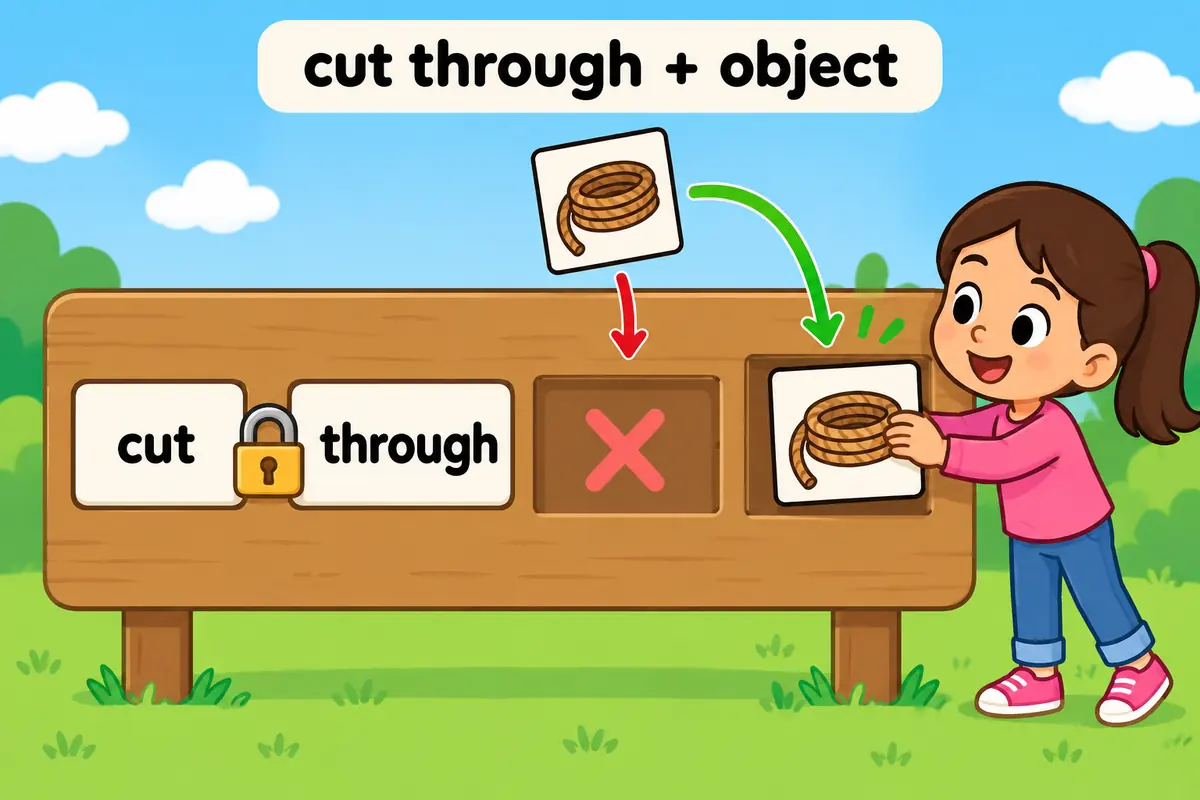
Put the thing being crossed straight after the particle: cut through + object. Unlike rope off or lay out, this verb cannot be split, because through works as a preposition rather than a movable particle. Five patterns cover the physical and figurative uses.
| Pattern | Example | What it signals |
|---|---|---|
| cut through + object | The knife cut through the plastic strap. | The physical sense, with a solid or liquid object. |
| cut through + place | We cut through the market to save time. | A route taken directly across a space. |
| cut through + noise or jargon | The summary cuts through the jargon. | Figurative sense: removing what blocks understanding. |
| be cut through by + object | The valley is cut through by a narrow river. | Passive, describing a feature of the landscape. |
| cut through + to + person or truth | The apology cut through to the heart of the matter. | Reaches something essential behind surface detail. |
Cut through in a sentence: examples across contexts
Cut through keeps one shape while its object changes the sense. The eleven sentences below move from a kitchen to a news bulletin, and each keeps through firmly attached to cut. Where cut through removes what blocks understanding, skim through describes reading quickly past it instead.
| Context | Example sentence | Why this works |
|---|---|---|
| Classroom | The scissors cut through the card easily. | A concrete tool and material make the physical sense clear. |
| Home | We cut through the side streets to beat the traffic. | A route sense with a clear purpose. |
| Workplace email | This one-page brief cuts through the detail. | The figurative sense suits a summary that saves time. |
| News report | The rescue boat cut through the swell before dawn. | Vivid physical action in a reporting register. |
| Sports | The winger cut through the defence and scored. | Movement through opposition, a common sporting use. |
| Science writing | The beam cut through the sample in under a second. | Precise, measurable physical penetration. |
| Public speaking | Her clear voice cut through the noise of the hall. | The figurative sense, with sound as the obstruction. |
| Business | The new rules cut through the paperwork at last. | Removing bureaucratic delay, a frequent formal use. |
| Nature writing | A stream cuts through the meadow on its way downhill. | A landscape feature described with the passive-friendly verb. |
| Conversation | Let us cut through all this and decide. | Figurative sense in relaxed speech, still fully standard. |
| Music review | Her voice cut through the strings without effort. | Being heard above a texture, an idiomatic critical use. |
Only the landscape sentence invites the passive, which is the clearest clue that cut through prefers an active subject doing the cutting.
Cut through vs cut across
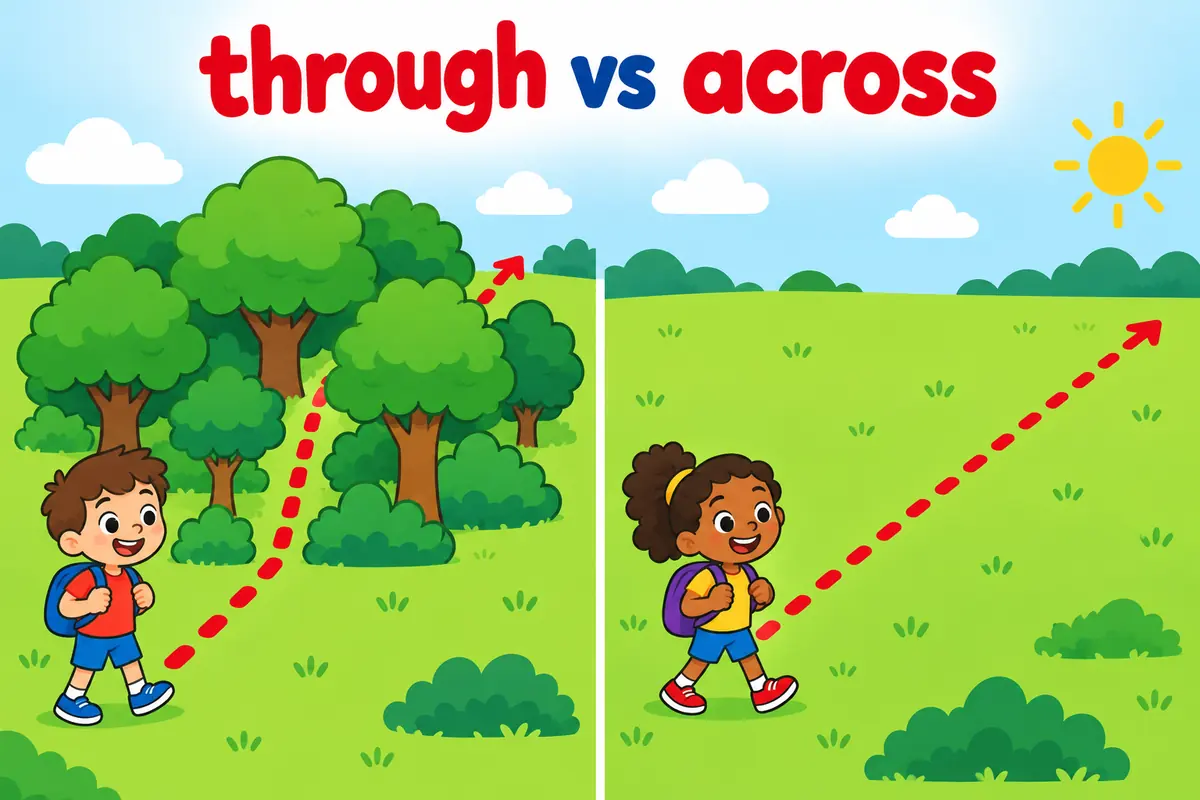
cut across and cut through both describe a route, but they draw different paths. Cut through goes into the middle of something and out the other side; cut across goes diagonally over the top of a larger area. Two other members of the family, cut off and cut down, are more distant still.
| Attribute | cut through | cut across |
|---|---|---|
| Path taken | Straight through the middle and out the far side | Diagonally over or across a larger area |
| Typical object | A rope, mist, crowd, park, jargon | A field, car park, trend, group |
| Senses | Penetrate, cross, overcome | Cross diagonally, affect widely |
| Figurative use | Removing what blocks attention | Cutting across boundaries or groups |
| Register | Neutral to vivid; common in business | Neutral; common in analysis and geography |
| What it implies | An obstruction was overcome | A line or effect crossed a boundary |
Verdict: cut through a crowd but cut across a field. Choose cut through when something is in the way, and cut across when the point is the angle or the spread.
Word forms and grammar of cut through
Cut is a rare verb whose base, past and past participle are all cut, so the phrasal verb never changes its core. The family includes several other run through-style combinations, and the noun cut-through is written with a hyphen. The particle family also includes follow through, which is about finishing a movement rather than crossing an obstacle.
| Form | Part of speech | Example |
|---|---|---|
| cut through | base phrasal verb | Let the saw cut through the branch. |
| cuts through | third person singular | His argument cuts through the confusion. |
| cutting through | present participle | She is cutting through the red tape. |
| cut through | past and past participle | They cut through the fence to get in. |
| cut-through | noun, hyphenated | The lane is a useful cut-through at rush hour. |
| cut across | related phrasal verb | The path cuts across the field. |
Common mistakes with cut through
- Incorrect:
He cut the rope through.Correct: He cut through the rope. Rule: Through is a preposition here and cannot be separated from cut. - Incorrect:
The brief cuts through.Correct: The brief cuts through the detail. Rule: Cut through is transitive, so it needs an object. - Incorrect:
He cutted through the wrapping.Correct: He cut through the wrapping. Rule: The past tense of cut is cut, never cutted. - Incorrect:
The road cut through the valley.Correct: The road runs through the valley. Rule: Use cut through when something is overcome; a road simply passing through takes run or pass. - Incorrect:
We cut through the field diagonally.Correct: We cut across the field diagonally. Rule: A diagonal crossing over an open area is cut across, not cut through.
Practice using cut through
Work through the seven items, then check the reasoning as well as the answer.
- Fill the gap: The torch beam ______ the darkness.
- Choose the better word: To reach the pool we (cut through / cut across) the car park at an angle.
- Correct the error: The team cut the defence through and scored.
- Build a sentence: use cut through about a clear summary that removes jargon.
- Spot the register: which belongs in a news report — rescuers cut through the wreckage, or rescuers got through the mess?
- Fill the gap: A narrow stream ______ the meadow behind the farm.
- Rewrite in the passive: A new tunnel cuts through the hill. Use be cut through instead.
Answers
- cut through — the beam penetrates the darkness, and through stays attached.
- cut across — a diagonal route over an open area takes cut across.
- The team cut through the defence and scored — the object follows through.
- Model answer: The summary cuts through the jargon and states the facts.
- Rescuers cut through the wreckage — the vivid phrasal verb suits the reporting register.
- cuts through — a third person singular subject takes cuts through.
- The hill is cut through by a new tunnel — the passive keeps through next to cut.
The bottom line
Use cut through in a sentence when something passes into an obstacle and out the other side, whether that obstacle is rope, mist, a crowd or a wall of jargon. The two points that decide most sentences are grammar, since through is fixed and never splits from cut, and sense, since the object tells a reader whether something is physically crossed or simply clarified. When the meaning is only to make things clear, clarify is often the better choice.
Frequently asked questions about cut through
Is cut through a separable phrasal verb?
No, cut through is not separable. Through works as a preposition, so it stays attached to cut and the object always follows it. He cut through the rope is correct, while he cut the rope through is not. Learners who know rope off and lay out often assume the same freedom applies here, and it does not.
What does cut through the noise mean?
Cut through the noise means to be noticed or understood when many other messages are competing. A clear headline that cuts through the noise reaches people that a wordy one would miss. The phrase is figurative, and it has become common enough in business writing that plainer words sometimes serve better.
What is the difference between cut through and cut across?
Cut through goes into the middle of something and out the far side, as when a path cuts through a wood. Cut across goes diagonally over a larger area, as when a path cuts across a field. The first implies an obstruction overcome, while the second is about the angle of the route.
Can cut through be used in the passive?
Yes, though less often than the active. The passive suits landscape descriptions, as in the valley is cut through by a river. In everyday and business writing the active is stronger, because it names the thing doing the cutting and keeps the sentence moving.