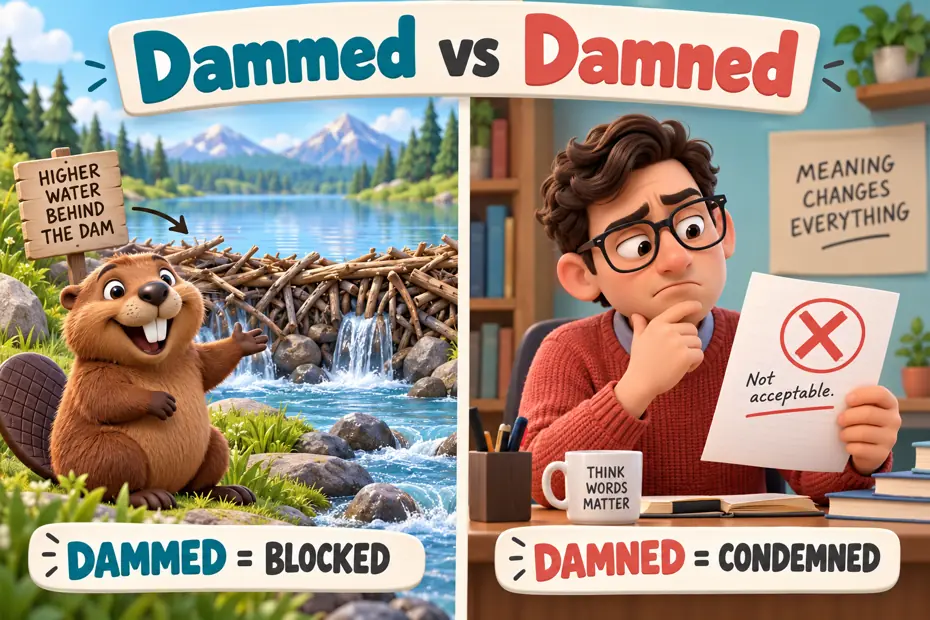
Dammed vs damned: dammed means blocked or restrained with a dam, while damned can mean condemned, cursed or used for strong emphasis. Dammed is the past form of dam; damned is the past form of damn and also has adjective and adverb uses. Choose by meaning, not sound alone.
- Dammed normally describes a barrier or blocked flow.
- Damned can be a verb form, adjective or intensifying adverb.
- Dam becomes dammed and damming, with doubled m.
- Damn becomes damned and damning, keeping the written n.
- Some uses of damned are profanity; formal writing often benefits from a precise alternative.

Dammed vs damned: a comparison with examples
Use dammed for a blocked stream or figuratively restrained flow. Use damned for condemnation or emphatic language. “They dammed the river” describes a barrier; “The critics damned the plan” describes severe criticism. Neither spelling can replace the other without changing the intended action.
| Meaning | Correct form | Example |
|---|---|---|
| Blocked a watercourse | Dammed | Beavers dammed the stream. |
| Restrained a figurative flow | Dammed up | She dammed up her feelings. |
| Condemned or criticized | Damned | The reviewer damned the argument. |
| Annoying or objectionable, emphatic | Damned | The damned lock would not open. |
| Very, informal emphasis | Damned | The solution was damned clever. |
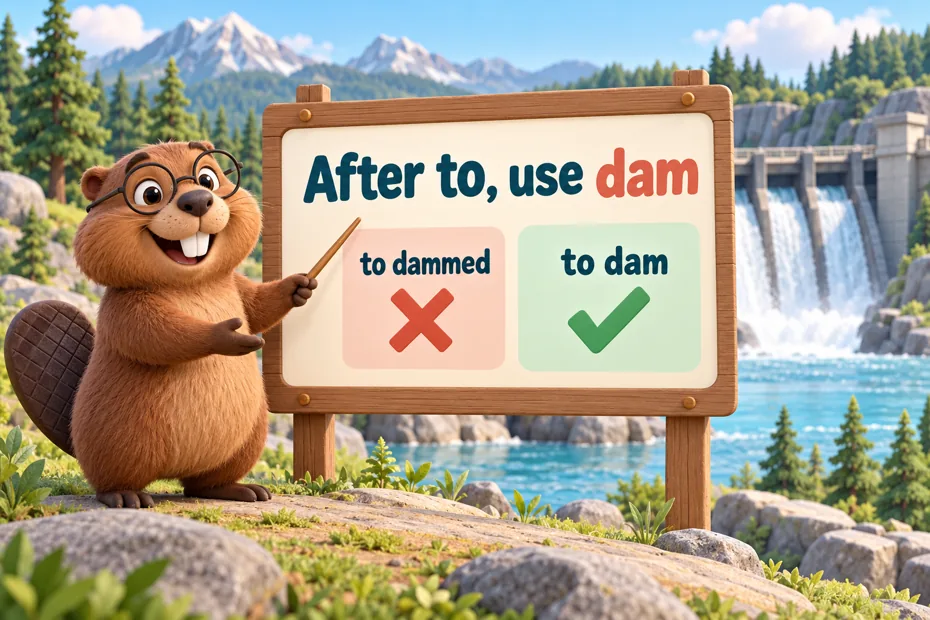
| Base form after to | Dam or damn | They planned to dam the creek. |
A replacement test can resolve the spelling: try blocked and condemned. “Blocked the river” points to dammed; “condemned the decision” points to damned. Where damned simply adds emphasis, consider whether removing it preserves the factual content and better matches the audience.
Why does dammed have two m letters?
Dammed doubles the final m when the one-syllable verb dam takes the suffix -ed. The same spelling pattern produces damming with -ing. The verb damn already ends in the written sequence mn, so its forms retain that sequence: damned and damning.
Merriam-Webster’s dam entry lists dammed and damming and includes both water restraint and figurative blocking. Its damn entry lists condemnation and the forms damned and damning. Read the spelling as a word-family clue rather than add letters according to how strongly someone speaks.
Can damned be a verb as well as an adjective?
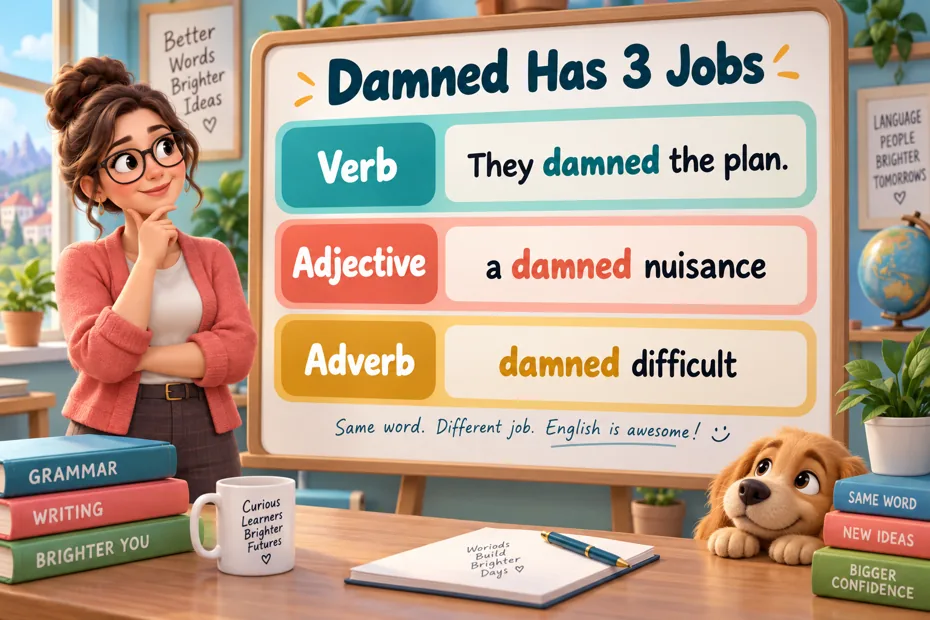
Yes: damned is the past tense and past participle of damn. “The committee damned the proposal” uses an active past-tense verb. “The proposal was damned by the committee” uses a passive verb construction. Neither sentence is grammatically wrong merely because damned names an action rather than describes a noun.
Damned also works adjectivally in “that damned noise,” and as an intensifying adverb in “damned difficult.” The Merriam-Webster damned entry records these categories separately. A word can have several grammatical jobs; its ending alone does not identify the job it performs in a particular sentence.
Dammed likewise appears before a noun in “a dammed stream,” describing a stream that has been blocked. This participial use does not change the underlying meaning to condemnation. Compare “the dammed stream” with “the damned proposal”: the first describes restraint, while the second can express a speaker’s objection.
Pronunciation and tone
In common speech, dammed and many uses of damned sound alike. The written n in the ordinary verb damn is silent. Collins also records a two-syllable pronunciation in oratory; a blanket claim that every use must sound identical is too strong.
For an engineering description, dammed is neutral. For criticism, damned can sound forceful or profane depending on context. Replace it with condemned, criticized, objectionable or very when those words express the intended meaning more clearly. The right replacement depends on whether the word describes an action, an attitude or degree.
Corrections and a short practice exercise
The retained older discussion says using damned as a verb is a mistake. That advice is incorrect: damned is a standard verb form. It also includes “planned to dammed the creek,” which needs the base form after infinitival to: planned to dam the creek. Compare “They dammed the creek yesterday,” where a past-tense verb fits.
- “The debris ___ the channel.” Choose dammed if debris blocked the flow.
- “The audience ___ the performance.” Choose damned if the audience condemned it.
- “They want to ___ the stream.” Choose dam, the base form.
- “The job was ___ hard.” Choose damned for informal emphasis, or very for a neutral tone.
These are language examples, not claims that constructing a dam automatically improves an ecosystem or prevents flooding. Such outcomes require site-specific evidence. For dammed vs damned, a precise sentence states what was blocked or condemned without attaching an unsupported benefit to the action.
Frequently asked questions
Is “the river was damned” correct?
It is grammatical if a person metaphorically condemned or cursed the river, but it is the wrong spelling for a barrier holding back water. For the physical meaning, write “the river was dammed.” Identify the intended event first: the same sentence structure can accommodate both words while describing very different things.
Can dammed refer to something other than water?
Yes. Dam can mean to stop up or block, including figurative uses such as “dammed-up emotions.” The central idea remains restraint or obstruction. If the intended meaning is criticism, curse or strong emphasis, choose damned instead. A figurative use of dammed does not make it a synonym of damned.
Do I write daming or damming?
Write damming for blocking or restraining with a dam. The final m doubles before -ing. Write damning for condemning, or for evidence that strongly establishes blame. The two forms preserve their separate word families, and a context check is more reliable than choosing by pronunciation alone.
Is damned always negative?
No. As an intensifier, damned can modify a positive description such as “damned impressive.” It still carries a strong informal tone, so the favorable adjective does not automatically make it appropriate for every audience. In a neutral report, “very impressive” or a specific factual description can communicate the praise more directly.
Have you ever been in a situation where you weren’t sure whether to say “dammed” or “damned”? It can be confusing, but fear not, because I’m here to shed some light on this linguistic dilemma. In this text, I’ll jump into the differences between “dammed” and “damned” and show you how to use them appropriately. Whether you’re a language enthusiast or just someone looking to improve their writing skills, this is the guide for you. So, let’s unravel the mystery behind these two words and discover the correct way to use them in everyday conversation and writing. Get ready to banish any doubts and confidently choose the right word for the right situation.
Key Takeaways
- “Dammed” is a verb that refers to the construction of a barrier to control the flow of water, while “damned” is an adjective that conveys disapproval or curse.
- Using the correct word is important for effective communication.
- Examples of using “dammed” in sentences include constructing water barriers, controlling water flow, and redirecting water.
- Examples of using “damned” in sentences include expressing disapproval, describing something as cursed or doomed, intensifying a negative situation, or expressing frustration.
- Common mistakes to avoid include mixing up the meanings of “dammed” and “damned” and using the incorrect word in a sentence.
Understanding the Difference
When it comes to the words “dammed” and “damned,” it’s easy to get confused. They may sound similar, but they have completely different meanings and uses. Let’s dive deeper into understanding the difference between the two.
Definition of “Dammed”
The word “dammed” is a verb that refers to the act of constructing a barrier, typically made of earth or concrete, to hold back or control the flow of water. Dams are used for various purposes, such as generating electricity, providing irrigation water, or preventing floods.
Definition of “Damned”
On the other hand, “damned” is an adjective derived from the verb “damn.” It is used to describe something or someone that is condemned, cursed, or held in disapproval. It can also be used as an expletive to express frustration or strong emphasis.
Difference in Meaning
The main difference between “dammed” and “damned” lies in their meanings and usage. “Dammed” is an action-oriented verb that describes the construction of a physical barrier to control water flow. On the other hand, “damned” is an adjective that conveys condemnation, disapproval, or cursing.
Usage Examples
To further clarify the difference between the two words, let’s look at some usage examples:
- Dammed: “The engineers dammed the river to create a reservoir for hydroelectric power.”
- Damned: “She was so frustrated with the constant delays that she exclaimed, ‘This damned traffic never ends!'”
As you can see, the word “dammed” is used to describe the action of building a dam, while “damned” is used to express disapproval or frustration.
Remember, understanding the proper usage of these words is crucial for effective communication. Whether you’re discussing water management or expressing frustration, using the correct word will ensure that your message is clear and precise.
So, the next time you encounter these words, consider their definitions and choose appropriately between “dammed” and “damned.”
No conclusions. Remember? ?
When to Use “Dammed”
Now that we’ve discussed the difference between “dammed” and “damned,” let’s focus on when to use “dammed” correctly.
What is the definition of “dammed”?
“Dammed” is a verb that refers to the act of constructing a barrier to control the flow of water. This barrier, commonly known as a dam, is built to impound or redirect water for various purposes such as generating hydroelectric power, creating reservoirs, or preventing flooding.
Difference between “dammed” and “damned”
Before we jump into specific examples of when to use “dammed,” let’s clarify the distinction between “dammed” and “damned” once again. While “dammed” is a verb related to water flow control, “damned” is an adjective that carries a sense of condemnation or disapproval. Understanding this difference is crucial to avoid confusion and communicate effectively.
When to use “dammed”?
Here are a few situations in which you should use “dammed” correctly:
- Construction of water barriers: When referring to the process of building a dam or constructing water barriers, use “dammed.” For example:
- The engineers dammed the river to create a reservoir.
- The government invested in projects to dam the creek and prevent flooding.
- Controlling water flow: Use “dammed” to describe situations where water flow is being regulated or controlled through a dam. For instance:
- The dammed river provides a reliable source of irrigation for the surrounding farmlands.
- The hydroelectric power plant dams the river to generate electricity.
- Redirecting water: If water is being redirected or redirected using a dam, “dammed” is the correct term to use. Consider these examples:
- The dammed reservoir diverts water to the canals for irrigation.
- They dammed the natural stream to provide drinking water to the nearby town.
Remember, using “dammed” accurately in these contexts will help ensure clear and effective communication. By avoiding confusion with “damned,” you can convey your intended meaning without any misunderstandings.
Examples of “Dammed” in Sentences
When discussing the usage of the word “dammed,” it’s important to understand its definition and how it differs from “damned.” So, let me provide you with some examples of how “dammed” is used correctly in sentences:
- The engineers dammed the river to create a reservoir for drinking water.
- Here, “dammed” is a past tense verb referring to the construction of a barrier to control the flow of water. It describes the action taken by the engineers to create a reservoir by diverting the river’s flow.
- The city built a dammed canal system to prevent flooding during heavy rains.
- In this example, “dammed” is used as an adjective to describe the canal system that has been constructed with barriers to control and regulate water flow. The purpose of creating this system is to mitigate flooding during periods of heavy rainfall.
- They strategically dammed the river to direct water towards the irrigation channels.
- Here, “dammed” is again used as a verb, indicating the intentional construction of a barrier to control the river’s flow. The purpose is to redirect the water towards specific irrigation channels, ensuring the efficient distribution of water for agricultural purposes.
- The authorities planned to dammed the creek to restore the ecosystem and protect wildlife habitats.
- This example highlights the use of “dammed” as a past tense verb. The authorities intended to construct a barrier, or a small dam, in the creek to restore the natural ecosystem and safeguard the habitats of local wildlife.
These examples illustrate the appropriate use of “dammed” in different contexts related to constructing barriers, controlling water flow, and directing water for various purposes. By using the word correctly, you can avoid confusion and communicate your ideas clearly.
Remember, understanding the difference between “dammed” and “damned” is essential for effective communication. The former refers to the action of constructing water barriers, while the latter conveys condemnation or disapproval. So, always double-check your usage to ensure accuracy and clarity in your writing.
When to Use “Damned”
As I mentioned earlier, “damned” is an adjective that conveys condemnation or disapproval. Now, let’s investigate into when it is appropriate to use this word in your writing.
First and foremost, “damned” can be used to express strong disapproval or criticism towards someone or something. For example:
- “That movie was absolutely damned awful. I can’t believe I wasted my time watching it.”
In this sentence, “damned” emphasizes a strong negative opinion about the movie.
Also, “damned” can be used to describe something or someone as being cursed or doomed. For instance:
- “They faced a series of damned unfortunate events that seemed to follow them wherever they went.”
Here, “damned” implies that the events were consistently unfortunate and out of their control.
Besides, “damned” can be used to intensify a negative or unpleasant situation. For example:
- “I found myself in a damned difficult position, having to choose between my career and my personal life.”
In this case, “damned” adds emphasis to the already difficult situation.
Finally, “damned” can be used informally to express frustration or annoyance. For instance:
- “I can’t believe I forgot my wallet again! I’m such a damned scatterbrain.”
Here, “damned” is used to convey self-frustration and maybe a touch of humor.
Remember, in each of these examples, “damned” is used as an adjective to convey disapproval, curse, intensification, or frustration. It is important to understand the context and use “damned” appropriately to ensure clear and effective communication.
Now that we’ve covered the usage of “damned,” let’s move on to exploring more about the correct usage of “dammed” in the next section.
Examples of “Damned” in Sentences
When it comes to the word “damned,” it serves as an adjective that conveys disapproval, curse, intensification, or frustration. Understanding its correct usage is crucial for effective communication. Let’s take a look at some examples of how “damned” is used in sentences:
- “I was so damned tired after working all day.”
- “She couldn’t believe she was damned to spend her entire weekend studying.”
- “His damned car broke down again, leaving him stranded on the side of the road.”
- “The party was a complete disaster, with one damned thing going wrong after another.”
- “They were damned if they stayed and damned if they left, caught in a difficult situation.”
In these sentences, “damned” is used to express frustration, intensify the meaning of tiredness, convey a sense of being cursed or unfortunate, or describe a series of unfortunate events. It adds emphasis and emotional context to the statements.
Remember, using “damned” appropriately in context is essential to avoid misunderstanding or coming across as profane. So, take the time to understand its nuances and choose your words carefully.
Common Mistakes to Avoid
One of the main challenges when using words like “damned” and “dammed” is understanding their subtle differences in meaning and usage. Misunderstanding these words can lead to confusion and miscommunication. To help you avoid common mistakes, I’ll highlight some key points to keep in mind.
Understand the Difference
The first mistake to avoid when using “damned” and “dammed” is mixing up their meanings. “Dammed” is a verb that refers to the act of constructing a barrier to control the flow of water. On the other hand, “damned” is an adjective that conveys condemnation or disapproval.
Use the Correct Word
Using the correct word is crucial for effective communication. Here are some tips to help you use these words appropriately:
- When you want to describe the construction of a barrier to control the flow of water, use “dammed.” For example, “The river was dammed to create a reservoir.”
- If you want to express disapproval or frustration, “damned” is the right choice. For instance, “I’m so damned tired of these long working hours.”
Avoid Confusion
To avoid confusion and ensure clarity in your writing, it’s important to use these words in the right context. Pay attention to the following examples:
- Incorrect: “The project was damned for its poor execution.”
- Correct: “The project was damned for its poor execution.”
- Incorrect: “The river was dammed tired after a long day at work.”
- Correct: “The river was damned tired after a long day at work.”
By being mindful of these common mistakes, you can enhance your understanding and usage of “damned” and “dammed,” enabling you to communicate more effectively.
Remember, the key is to differentiate between the verb “dammed” used to describe the construction of barriers and the adjective “damned” used to convey disapproval or frustration. By using these words correctly, you can avoid misunderstandings and ensure clear and accurate communication.
Conclusion
Understanding the difference between “dammed” and “damned” is crucial for effective communication. While “dammed” is a verb that refers to the act of constructing a barrier to control the flow of water, “damned” is an adjective that conveys condemnation or disapproval. By using these words correctly, we can avoid confusion and ensure our message is clear.
Throughout this article, we have explored various usage examples to highlight the distinction between these two words. We have seen how “dammed” is used as a past tense verb to describe the construction of barriers for different purposes, such as creating reservoirs, preventing flooding, redirecting water, and restoring ecosystems.
By avoiding common mistakes and following the tips provided, we can confidently use “dammed” and “damned” in the appropriate context. This will enhance our writing and communication skills, allowing us to convey our thoughts accurately and precisely.
Remember, choosing the right word is essential for effective communication. So, let’s continue to expand our vocabulary and refine our language skills to express ourselves with clarity and precision.
Frequently Asked Questions
Q: What is the difference between “dammed” and “damned”?
A: “Dammed” is a verb that means constructing a barrier to control water flow, while “damned” is an adjective that expresses condemnation or disapproval.
Q: Can you give usage examples of “dammed” and “damned”?
A: Sure! For “dammed,” you can say “The river was dammed to create a reservoir.” For “damned,” an example is “He was damned for his actions.”
Q: When should I use “dammed” correctly?
A: Use “dammed” as a verb when describing the construction of a barrier to control water flow, such as for creating reservoirs or preventing flooding.
Q: Can you provide more examples of how “dammed” is used correctly?
A: Certainly! “The engineers dammed the river to redirect water flow.” “The project aimed to dam a stream, restoring the local ecosystem.”
Q: What are some common mistakes to avoid when using these words?
A: One common mistake is using “damned” as a verb when it should be an adjective. Another mistake is using “dammed” to express condemnation or disapproval.
Q: Any tips for using these words correctly?
A: To use these words correctly, remember that “dammed” is about constructing barriers for water control, while “damned” is about expressing disapproval. Pay attention to their spellings and meanings.
Q: How important is it to use the correct word?
A: Using the correct word is crucial for effective communication. It ensures clarity and avoids confusion or misinterpretation.
Q: Can you provide examples of incorrect and correct usage?
A: Incorrect: “The government was dammed for its policies.” Correct: “The government was damned for its policies.” Incorrect: “The river was damned to prevent flooding.” Correct: “The river was dammed to prevent flooding.”
Q: Why is understanding the difference between “dammed” and “damned” important?
A: Understanding the difference is essential to accurately convey intended meanings. It helps avoid errors and ensures effective communication.


