Definite vs definitive is a pairing that confuses even careful writers, because both words come from the same root and both suggest certainty. Definite means clear and certain; definitive means final and authoritative. A definite answer is simply clear, while a definitive answer settles the matter for good.
Definite vs Definitive at a glance
- Definite is an adjective meaning clear, certain, or fixed in advance.
- Definitive is an adjective meaning final, decisive, or accepted as the best version.
- Both describe nouns, but definite points to certainty now and definitive to certainty that ends a debate.
- Common partners: a definite date, a definite plan; a definitive study, a definitive ruling.
- The commonest error is swapping them, especially where both seem to fit before the word answer.
What do definite and definitive mean?
Definite is an adjective meaning clear, certain, and not vague. Definitive is an adjective meaning final, decisive, and accepted as the best or most complete. The Cambridge entry for definite and the Cambridge entry for definitive keep the two apart, and one line shows the gap: a definite time is a fixed detail, while a definitive history is the version nobody argues with.
| Sense | Word | Plain meaning | Example |
|---|---|---|---|
| Certain and clear | definite | Sure, not vague | We need a definite date. |
| Fixed in advance | definite | Settled beforehand | There is a definite plan for Friday. |
| Noticeable | definite | Clear enough to name | That is a definite improvement. |
| Final and decisive | definitive | Settling the matter | The court issued a definitive ruling. |
| Most authoritative | definitive | The standard version | This is the definitive biography. |
What is the difference between definite and definitive?
The difference is what each word claims about a noun. Definite says a thing is clear and certain; definitive says a thing is final and carries authority. A merely clear fact is not definitive, and a conclusive study need not be vague, so the two words answer different questions. A familiar mix-up such as addition vs edition fails in exactly the same way, one letter hiding two different jobs.
| Criterion | Definite | Definitive |
|---|---|---|
| Core meaning | clear and certain | final and authoritative |
| What it focuses on | what something is | what ends a debate |
| Typical nouns | answer, date, plan, decision | study, ruling, version, account |
| Strength | settles one detail | settles the whole matter |
| Register | neutral and everyday | formal, academic, editorial |
| Part of speech | adjective | adjective |
| Common error | rarely misused | used for a merely clear fact |
Choose definite when a detail only needs to be clear, and definitive when the answer is meant to close the question.
How do you use definite and definitive in a sentence?
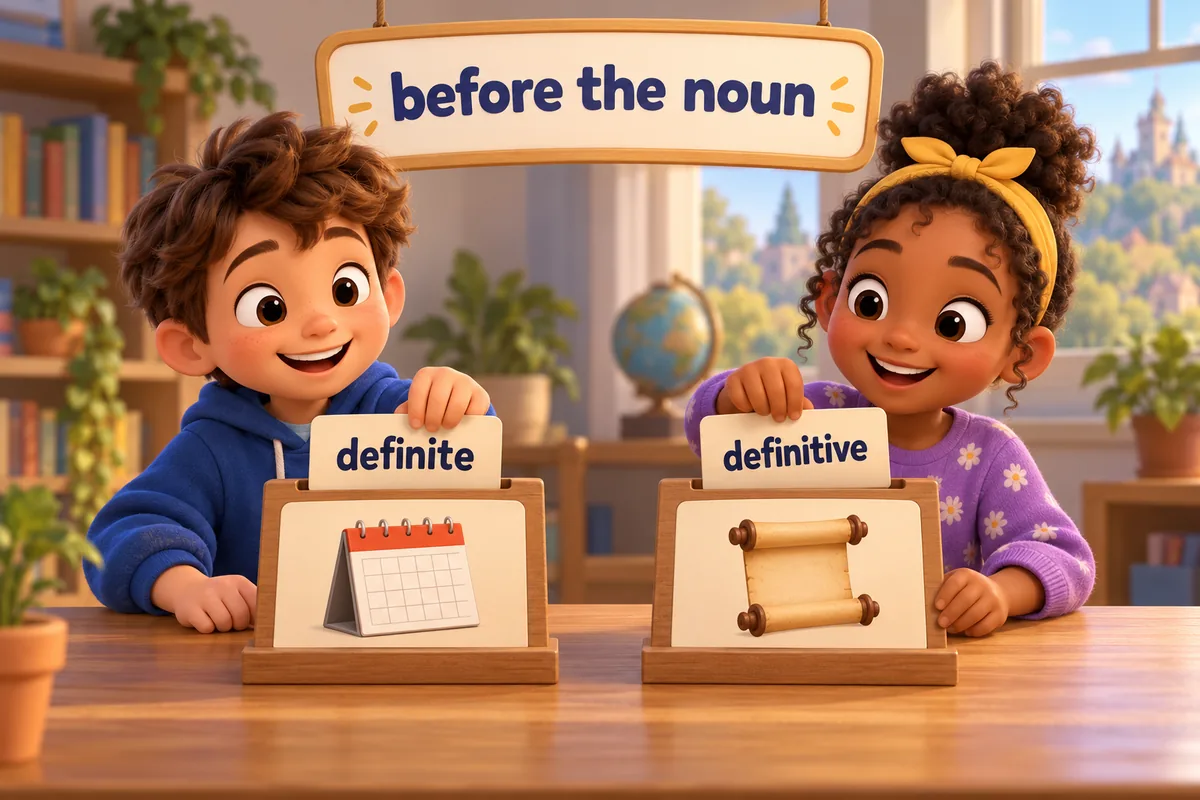
Both words are adjectives, so each stands directly before the noun it describes, and to watch that pattern in action, read definite in a sentence. The adverb forms take separate jobs as well.
| Pattern | Example | What it signals |
|---|---|---|
| definite + noun | She gave a definite date. | a detail made clear |
| be definite about + noun | He was definite about the rules. | a firm position |
| a definite + noun (informal boost) | That is a definite plus. | a clear positive point |
| definitive + noun | The study is the definitive guide. | the accepted standard |
| definitively + past participle | The issue was definitively resolved. | a matter closed for good |
Definite and definitive in a sentence: examples across contexts
Reading the pair in different registers makes the choice automatic, and more everyday frames sit in definitive in everyday sentences.
| Context | Example sentence | Why this works |
|---|---|---|
| Classroom | The teacher asked for a definite answer, not a guess. | definite marks a clear response |
| Workplace email | We would like a definite time for the handover. | definite fixes one detail |
| News report | The panel called the report the definitive account of the fire. | definitive names the accepted version |
| Academic writing | This remains the definitive survey of the topic. | definitive labels the standard work |
| Legal writing | The court gave a definitive interpretation of the clause. | definitive closes the argument |
| Everyday speech | She was definite about leaving at six. | definite about shows a firm stance |
| Customer service | Your order will arrive on a definite date, sent by email. | definite removes vagueness |
| Sport report | The late goal was a definite turning point. | definite adds emphasis to a fact |
| Science writing | The results are not yet definitive. | definitive marks a settled finding |
| Travel writing | There is no definite route through the old quarter. | definite means fixed or mapped |
Which should you use?
Match the word to the claim the sentence is making about the noun.
| Situation | Use | Example |
|---|---|---|
| Something only needs to be clear | definite | We have a definite start time. |
| Something is final and cannot be argued with | definitive | The ruling was definitive. |
| A plan or date that is fixed | definite | They set a definite deadline. |
| The best or standard version of a work | definitive | It is the definitive edition. |
| An adverb before a comparative | definitely | She is definitely faster. |
Register is the second test. Definite is at home from a text message to a schedule, while definitive belongs to reviews, rulings and editions, where a work or a decision is named as the last word. That split explains why learners meet definite far more often in speech and definitive far more often on a shelf.
Word forms and grammar of definite and definitive
| Form | Part of speech | Example |
|---|---|---|
| definite | adjective | a definite date |
| definitely | adverb | I will definitely attend. |
| definiteness | noun | The definiteness of the plan surprised us. |
| definitive | adjective | a definitive ruling |
| definitively | adverb | The question was definitively settled. |
| definition | noun | the definition of certainty |
| define | verb | Define the boundary first. |
Common mistakes with definite and definitive
Mistake 1: definitive for a plain fact. Incorrect: We need a definitive answer about the date. Correct: We need a definite answer about the date. Rule: a clear, certain answer is definite; definitive claims final authority.
Mistake 2: definite for a conclusive work. Incorrect: This is the definite history of the city. Correct: This is the definitive history of the city. Rule: the standard, best version is definitive.
Mistake 3: swapping the adverbs. Incorrect: The case was definitely closed by the ruling. Correct: The case was definitively closed by the ruling. Rule: definitively means conclusively, while definitely means certainly.
Mistake 4: definite before a comparative. Incorrect: Her results were definite better than his. Correct: Her results were definitely better than his. Rule: the adverb before a comparative is definitely.
Mistake 5: adjective after the noun. Incorrect: He gave an answer definite. Correct: He gave a definite answer. Rule: English adjectives come before the noun, so both words stand first.
Practice using definite and definitive
- Fill in the blank: The committee needs a ___ date before it can book the hall.
- Choose the better word: The judge gave a (definite / definitive) ruling that closed the case.
- Correct the error: We have a definitive plan for Friday, so the trip is on.
- Build a sentence: use definite about to describe a firm opinion on a training time.
- Spot the register: which line suits an academic review, (a) This is the definitive study of the period, or (b) This study is definitely the one?
- Fill in the blank: There is no ___ answer to that question, because experts still disagree.
Answers
- definite, because the date simply needs to be clear and fixed.
- definitive, because a ruling that closes a case is final and authoritative.
- We have a definite plan for Friday; definite means clear, while definitive would claim it is the last word.
- The coach was definite about the training time.
- (a), because definitive study is the standard phrase in academic writing.
- definitive, because the question is still open, so no final answer exists.
The bottom line
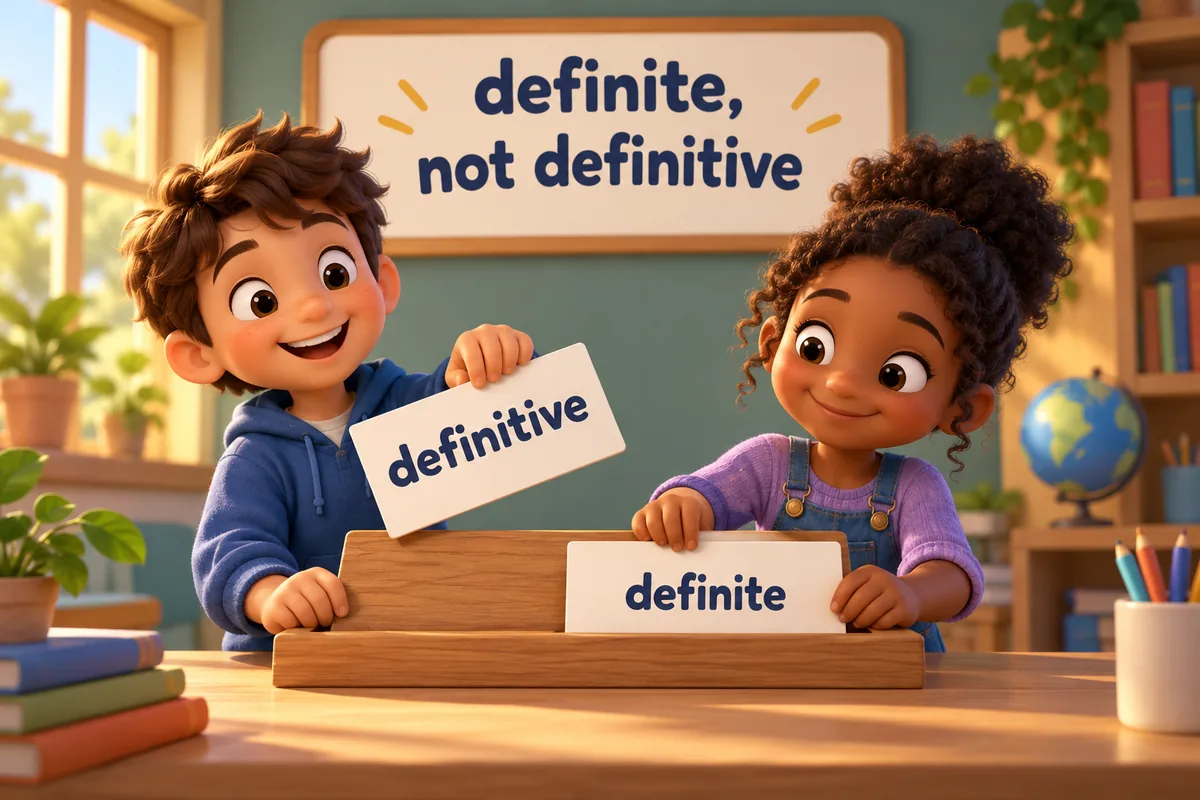
The definite vs definitive choice comes down to one question: is something simply clear, or is it final and authoritative? Definite describes a detail that is certain and fixed, while definitive describes a decision, ruling, or work that settles the matter for good. Use the noun after the adjective as your test, because a definite answer is clear and a definitive answer ends the argument. Keep definite for everyday clarity and reserve definitive for the moment something becomes the last word.
Frequently asked questions about definite and definitive
Is a definitive answer better than a definite answer?
They describe different things, so neither is better. A definite answer is clear and certain, and it removes vagueness; a definitive answer is final and accepted as authoritative, and it closes the question. Choose the word that matches what the sentence claims.
Can definite and definitive appear together in one sentence?
Yes, and the pair reads well when both meanings are needed. You might write that a study gives a definitive account after the authors reach a definite conclusion. The first word marks the standard version and the second a clear finding, so the sentence keeps the two ideas apart.
What are the adverbs of definite and definitive?
Definite forms definitely, meaning certainly, and definitive forms definitively, meaning conclusively. The two adverbs are not interchangeable: definitely comes before a comparative, as in definitely better, while definitively sits with verbs of settling, as in the issue was definitively resolved.
Does a definitive edition mean the same as a definite edition?
No. A definitive edition is the accepted, most complete version of a text, the one scholars treat as standard. A definite edition would only mean a particular, clearly identified printing, and editors do not use that phrase, so the second form sounds like an error.