
Defy means to refuse to obey someone or something, and it also means to be impossible to explain or resist. The verb is transitive, so it always needs an object such as authority, orders or belief. Here is the pattern in one line: “She defied the ruling.”
Defy at a glance
- Defy is a transitive verb; its forms are defies, defied, defying, defiance and defiant.
- The three main senses are refusing to obey, withstanding a force, and resisting explanation.
- The usual objects are a person, a rule, an order, the odds, or belief and description.
- Defy belongs to formal and journalistic writing more than to casual speech.
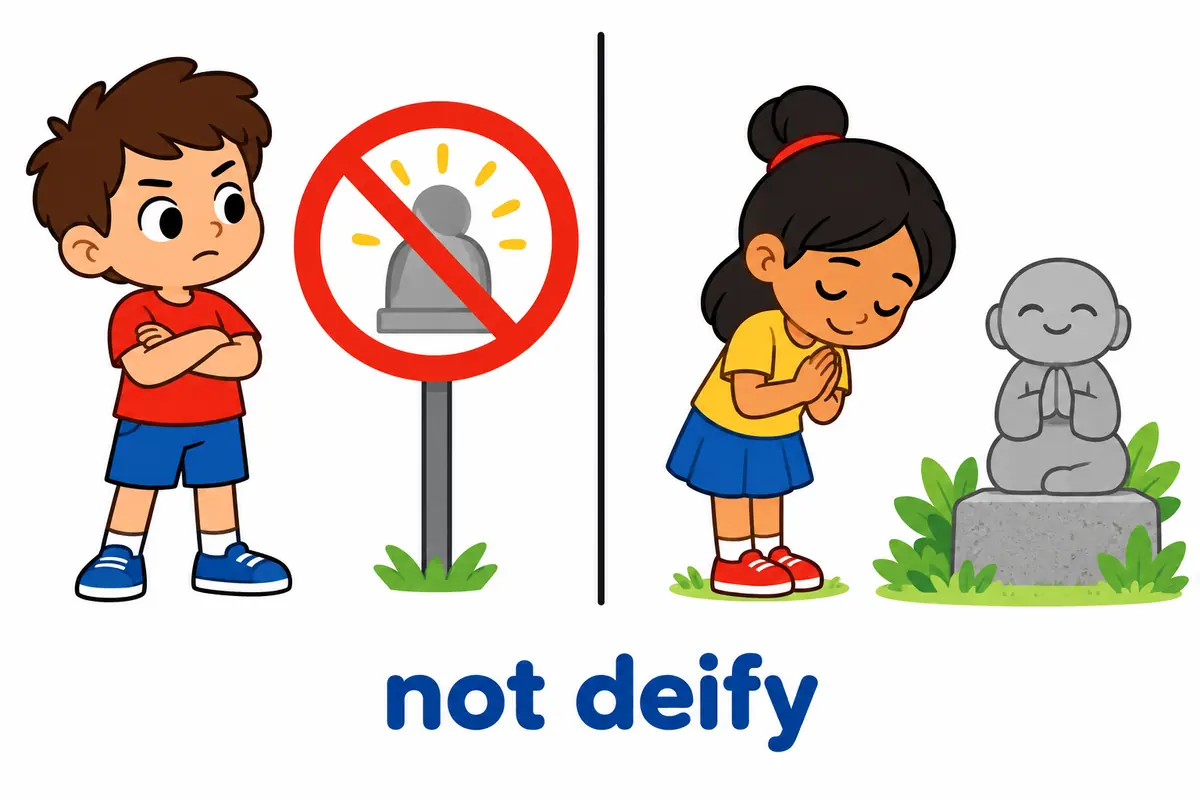
- The commonest error is confusing defy with deify, which means to make a god of.
What does defy mean?
Defy is a transitive verb meaning to openly refuse to obey a person or rule, or to be too strong to be explained or resisted. The Cambridge entry for defy records the disobedience sense and the withstand sense, and the two answer different questions: the first replies to an order, the second replies to a force or a puzzle. To flout the rules is close, but flout stresses treating a rule with contempt, while defy stresses the open challenge itself.
| Sense | Plain meaning | Example sentence |
|---|---|---|
| Refuse to obey | Openly resist a person or rule | The players defied the manager. |
| Withstand | Resist a force or hold out against something | The old bridge defied the flood. |
| Resist explanation | Be impossible to describe or account for | Her calm defies explanation. |
| Challenge someone | Dare a person to act or prove something | He defied them to repeat the claim. |
One limitation is worth stating plainly. Defy implies open, deliberate resistance, so it is the wrong verb for quiet non-compliance or an unnoticed breach. A driver who ignores a rule when nobody is watching does not defy anyone; the accurate verbs are violate the agreement or break a rule. Defy always carries the idea that the challenge is visible.
How do you use defy in a sentence?
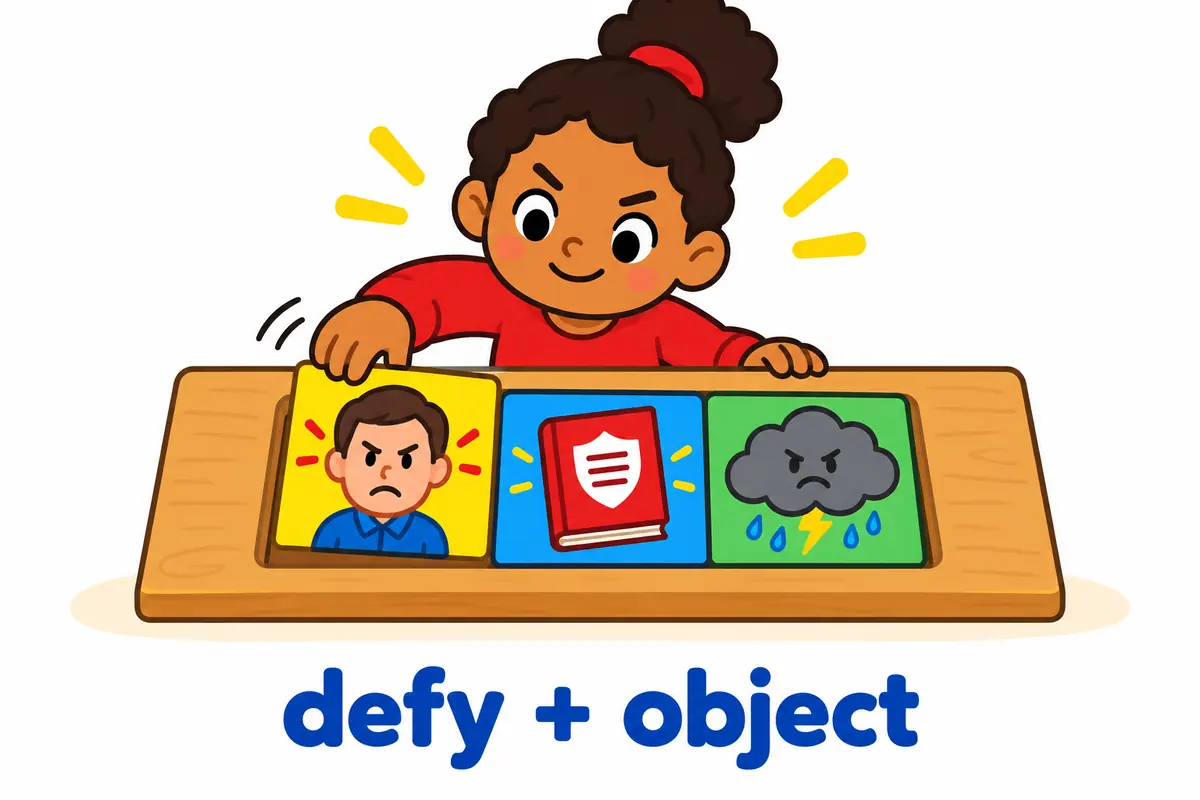
Defy takes a direct object with no preposition, and the object decides the sense. A person or rule produces the disobedience meaning, while an abstract noun such as belief, description or gravity produces the withstand or resist-explanation meaning.
| Pattern | Example | What it signals |
|---|---|---|
| defy + person or authority | The crowd defied the ban. | Direct and public disobedience. |
| defy + order or rule | He defied the court order. | A formal challenge to a legal instruction. |
| defy + belief or description | The result defies belief. | The withstand sense applied to understanding. |
| defy + someone to do | She defied him to repeat the accusation. | A dare, framed with an infinitive after to. |
| defy + the odds or gravity | They defied the odds and won. | A fixed collocation for beating expectations. |
The imperative form reverses the direction of the dare. When a teacher says defy me to find the error, the object is the challenger, not the rule, so the noun after the verb must be the person being dared. Keep that role straight and the sentence stays clear.
Defy in a sentence: examples across contexts
Defy changes subject more than it changes meaning. The nine sentences below move from a classroom to a science report, and each one names the object that the verb is challenging.
| Context | Example sentence | Why this works |
|---|---|---|
| Classroom | The pupil defied the teacher and kept talking. | A concrete person makes the disobedience visible. |
| News report | Protesters defied the curfew to hold a silent vigil. | Names the rule and the calm action that challenged it. |
| Sports writing | The underdogs defied the odds to reach the final. | Uses the fixed collocation for beating expectation. |
| Science writing | The sample defied the model that had predicted its decay. | The withstand sense applied to a scientific prediction. |
| Workplace email | One branch defied the new policy on remote work. | Frames a formal challenge to an internal rule. |
| Literature | The heroine defies her family to marry for love. | A person is the object, so the sense is disobedience. |
| Conversation | I would not defy my mother over something so small. | The conditional softens an everyday family clash. |
| Legal writing | The company defied the injunction and continued trading. | A court instruction supplies the formal object. |
| History essay | The garrison withstood the storm and defied the siege for a year. | Pairs a near synonym with the target verb. |
Only the science and history rows use the withstand sense; every other sentence points at a person or a rule. That split is the clearest guide to which meaning a reader will expect.
Defy vs disobey
Defy and disobey both describe breaking a rule, but they differ in visibility and in nerve. Disobey simply reports that an instruction was not followed, while defy insists that the refusal was open and confrontational.
| Attribute | defy | disobey |
|---|---|---|
| Core meaning | Openly resist, or withstand | Fail to follow an instruction |
| Emphasis | The public challenge | The unmet command |
| Register | Formal and journalistic | Neutral to formal |
| Typical object | A person, an authority, the odds | A parent, an order, a rule |
| What it implies | Courage or rebellion | Simple non-compliance |
Verdict: choose disobey when the fact is that a rule was broken, and defy when the point is that the person stood up to the authority behind it.
Word forms and grammar of defy
Defy inflects regularly, and its noun and adjective are far more common than the rare agent noun. Keep the verb and the adjective apart, because one takes an object and the other describes a mood.
| Form | Part of speech | Example |
|---|---|---|
| defy | verb, base form | They defy every rule on the notice. |
| defies | verb, third person singular | The result defies belief. |
| defied | verb, past and past participle | She defied the ruling last year. |
| defying | verb, present participle | Defying the weather, they marched on. |
| defiance | noun | His silence was an act of defiance. |
| defiant | adjective | The defiant pupil folded her arms. |
| deify | verb, different word | To deify is to treat someone as a god. |
Common mistakes with defy
- Incorrect:
He defied against the order.Correct: He defied the order. Rule: Defy is transitive, so no preposition stands between the verb and its object. - Incorrect:
She deified the school rules.Correct: She defied the school rules. Rule: Deify means to make a god of someone; defy means to refuse to obey. - Incorrect:
The team defied to lose.Correct: The team defied the odds. Rule: Defy takes a noun phrase, not a bare infinitive. - Incorrect:
He was defy to his parents.Correct: He was defiant towards his parents. Rule: Use the adjective defiant after a linking verb, not the verb. - Incorrect:
The castle defied from the attack.Correct: The castle defied the attack. Rule: The withstand sense still takes a direct object with no from.
Practice using defy
Work through the six items, then read the reasoning rather than only the answers.
- Fill the gap: The young trees ______ the drought and grew tall again.
- Choose the better word: The clerk quietly (defied / disobeyed) the filing rule.
- Correct the error: The athlete defied against the ban.
- Build a sentence: use defy + the odds about a small team that wins.
- Spot the register: which belongs in a news report — the council defied the minister, or the council did not do what the minister said?
- Rewrite with the noun: He defied the committee. Use defiance instead.
Answers
- defied — the trees held out against a force, which is the withstand sense.
- disobeyed — the rule was quietly unmet, with no open challenge, so disobey fits.
- The athlete defied the ban — defy is transitive, so against is wrong.
- Model answer: The village team defied the odds to win the cup.
- The council defied the minister — a report favours the formal, confrontational verb.
- Model answer: His refusal was an act of defiance against the committee.
The bottom line
Use defy in a sentence when someone openly resists an authority or when something holds out against a force it should not survive. The two nuances that decide most sentences are these: the verb is transitive and takes no preposition, and its object chooses the sense, a person or rule meaning disobedience while belief or the odds mean withstand. For quiet rule-breaking, disobey an order is the more exact verb.
Frequently asked questions about defy
What does defy mean in simple words?
In simple words, defy means to refuse to do what someone in authority tells you, or to be strong enough to survive something. The pupil who keeps talking after a warning defies the teacher, and a bridge that survives a flood defies the water. Both senses share the idea of standing against a force.
Is it defy or defies?
Use defy with I, you, we, they and plural nouns, and defies with he, she, it and singular nouns. Say the rules defy belief when the subject is plural, and the result defies belief when it is singular. The past form for every subject is defied.
What is the difference between defy and deify?
Defy means to refuse to obey or to withstand, while deify means to treat someone as a god or to worship them. The words differ by a single letter and are often mixed up, but their meanings are unrelated. Check whether the sentence is about resistance or about worship.
Can defy be used without an object?
No. Defy is transitive, so it always needs a direct object such as a person, a rule, belief or the odds. A sentence like he defied sounds unfinished. If you want to describe the attitude rather than the action, use the adjective defiant with a linking verb instead.
Have you ever encountered a situation where someone refused to follow the rules or expectations set by others? This act of going against what is customary or expected is known as defying.
To defy means to openly resist or refuse to comply with something, often challenging authority or societal norms. It can involve acts of rebellion, defiance, or nonconformity. Defying can manifest in various forms, from mild disobedience to bold and daring actions that challenge the status quo.
7 Examples Of Defy Used In a Sentence For Kids
- Defy the odds and always believe in yourself.
- Don’t be afraid to defy expectations and follow your dreams.
- Let your imagination soar and defy all limits.
- Defy gravity by reaching for the stars.
- Be brave and defy any challenges that come your way.
- Remember, you can always defy any obstacles with hard work and determination.
- Defy limitations and let your creativity shine.
14 Sentences with Defy Examples
- Defy the conventional career path and follow your passion.
- As a college student, it is important to defy procrastination and stay focused on your studies.
- You can defy expectations by achieving academic success against all odds.
- Don’t be afraid to defy stereotypes and break free from societal norms.
- It’s time to defy your fears and step out of your comfort zone.
- Defy the limitations that others try to impose on you and strive for greatness.
- College is the perfect time to defy your limitations and discover your true potential.
- Defy the pressure to conform and embrace your uniqueness.
- It’s okay to defy authority figures if it means standing up for what you believe in.
- Defy the status quo and challenge yourself to think outside the box.
- As a college student, you have the power to defy expectations and pave your own path to success.
- Don’t be afraid to defy failure and learn from your mistakes.
- Defy anyone who doubts your abilities and prove them wrong with your hard work and dedication.
- College is a time to defy limits and push yourself to new heights of achievement.
How To Use Defy in Sentences?
To use the word Defy in a sentence, start by understanding its meaning. Defy means to refuse to obey a person, decision, law, etc. It can also mean to openly resist or challenge something.
Here is an example of how to use Defy in a sentence:
- “She decided to defy her parents and pursue a career in music instead of medicine.”
In this sentence, the word “defy” is used to show that the person chose to go against her parents’ wishes and follow her own path.
When constructing a sentence with Defy, it is essential to make sure that the context makes it clear to the reader how the word is being used. This will help ensure that your sentence effectively conveys the intended meaning.
Additionally, you can enhance the impact of your sentence by providing specific details or examples that illustrate the defiance or resistance involved in defying something. This will make your sentence more engaging and vivid for the reader.
By following these guidelines and considering the context in which you are using Defy, you can effectively incorporate this word into your writing and communication.
Conclusion
In summary, the examples of sentences with the keyword “defy” illustrate instances where individuals or circumstances challenged expectations or rules. Whether it is defying gravity, defying authority, or defying odds, the word “defy” conveys a sense of resistance and determination to go against the norm. These sentences highlight how defiance can lead to unexpected outcomes or display courage in the face of obstacles.
Overall, the various sentences with “defy” showcase the power of defying limitations and pushing boundaries. They demonstrate that defying conventions can lead to innovation, growth, and overcoming adversity. In essence, these examples emphasize the importance of daring to challenge the status quo and embracing the opportunities that come from stepping outside of one’s comfort zone.


