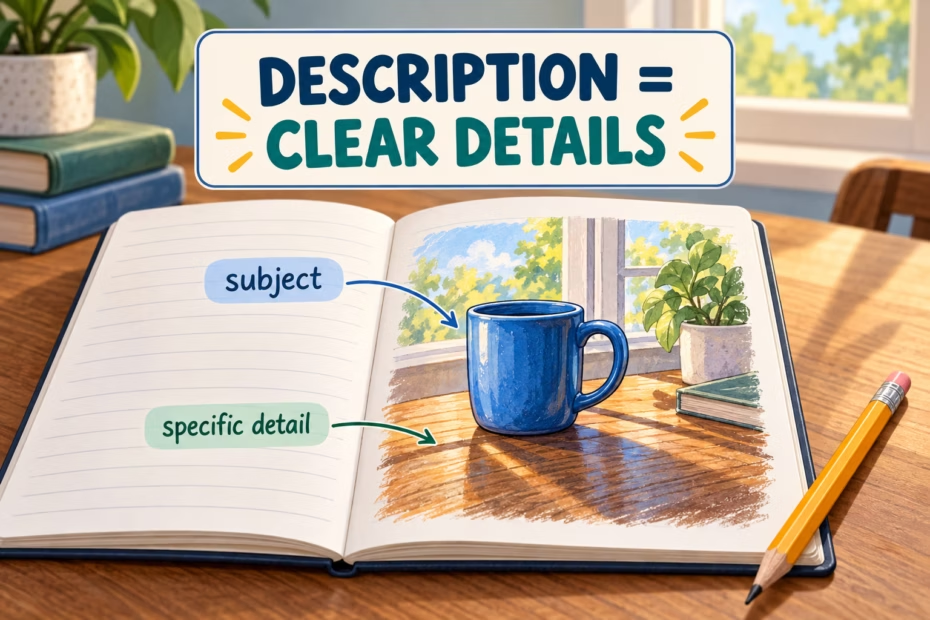
Description is a noun for words or an account that tells what someone or something is like. It may describe visible features, an event, an idea, or a process. In a sentence, the word commonly appears with of: “The guide includes a description of the trail.” The noun can also refer to describing in general: “Clear description helps readers follow the report.”


How to use description in a sentence
Use description when the sentence names an account or the act of explaining what something is like. A common pattern is a description of + a person, place, thing, event, or idea. For instance, “Mina wrote a brief description of the old lighthouse” identifies the account and its subject. You can also use the noun as the subject—“The description on the label lists the ingredients”—or as the object of a verb—“Please provide a description of the damaged package.”
Because description begins with a consonant sound, a singular countable use takes a: “a description,” not “an description.” Use descriptions for more than one account: “The catalog contains three descriptions of the painting.” In a broad statement about the practice, the noun may be uncountable: “Description is important in field notes.” Choose the form that matches the meaning.
Common sentence patterns with description
| Pattern | Example | What it does |
|---|---|---|
| a description of + noun | We read a description of the island. | Names what the account is about. |
| give / provide / write + a description | Please provide a description of the missing bag. | Requests or reports an account. |
| adjective + description | The brief description identifies the route. | Shows the account’s length, detail, or quality. |
| description + of how / why / what | The manual includes a description of how the valve works. | Introduces an explanation of a process or reason. |
Useful modifiers include brief, detailed, accurate, clear, and vivid. Pick one that adds information. “A detailed description” signals more particulars; “an accurate description” emphasizes correctness. Stacking near-synonyms such as “a detailed, thorough, comprehensive description” can make a sentence heavy when one word will do.
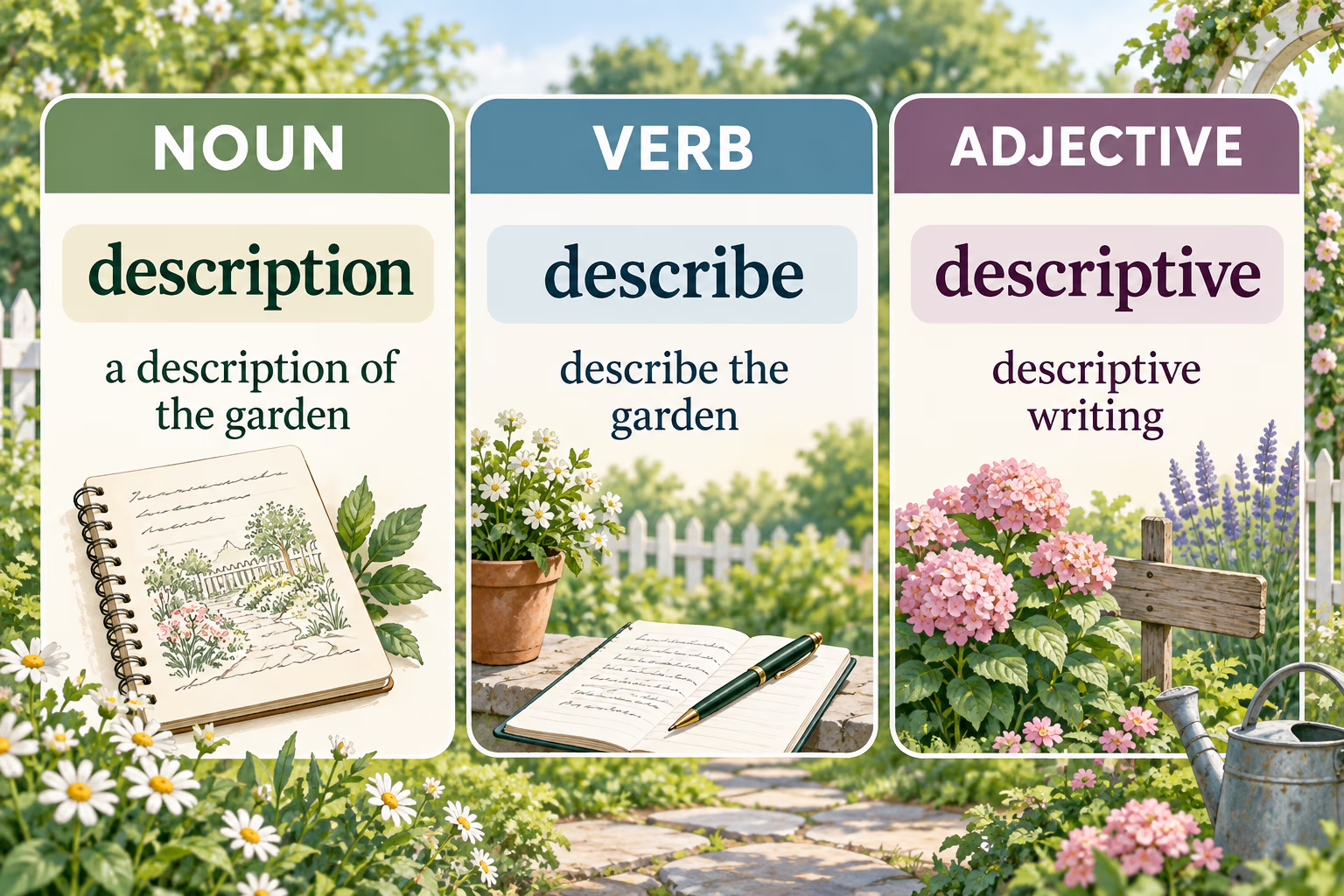
Description, describe, and descriptive
These related words have different jobs in a sentence:
- Description is a noun: “Her description of the garden mentions the stone path.”
- Describe is a verb: “She describes the garden as quiet and shaded.”
- Descriptive is an adjective: “She wrote a descriptive paragraph about the garden.”
Use descriptive to modify a noun, as in descriptive language or a descriptive report. “The description paragraph” is sometimes understood, but it can sound as if description were an adjective; “a descriptive paragraph” or “a paragraph that gives a description” is clearer. A description can be one part of descriptive writing, but the words are not interchangeable.
Make a description clear and useful
Start with the reader’s purpose. A travel note might need landmarks and distance; a product listing may need size, material, and condition; a story scene may benefit from a sound or texture that helps readers imagine the moment. Select details that answer the reader’s likely question. Purdue OWL’s guidance on descriptive essays likewise emphasizes clear, relevant language, sensory detail where it helps, and an organized impression.
Compare “The room was nice” with “The small room had pale walls, a wide south-facing window, and a desk beside the door.” The second sentence gives observable details that let a reader form a more specific picture. For a concise inventory, however, “Room: 3 m by 4 m; one south-facing window” may be more useful than a long sensory passage. Good description depends on context, not on adding the greatest number of adjectives.
Try this quick revision method:
- Name the subject. Say clearly what the description covers.
- Choose the purpose. Decide whether the reader needs identification, instructions, atmosphere, or evidence.
- Add specific details. Prefer a measurable, visible, or otherwise verifiable feature when precision matters.
- Use sensory detail selectively. Sound, smell, taste, touch, and sight can bring a scene closer when those details serve the reader.
- Organize the information. Move in a helpful order, such as outside to inside, beginning to end, or general feature to key detail.
- Trim repetition. Remove details that repeat the same point or do not help readers understand the subject.

More original examples using description
- The museum’s description of the bronze bowl notes its age and maker.
- A short description at the top of the form explains what information to enter.
- Her description of the storm focused on the rising wind and sudden loss of power.
- The witness gave a description of the bicycle, including its bright orange frame.
- In the lab report, a precise description of the method helps another team repeat the test.
- The phrase “beyond description” means so remarkable or intense that words seem inadequate: “The view from the ridge was beautiful beyond description.”
These examples show how description works as a noun in different settings. Notice the usual of phrase, the verbs that pair naturally with it, and the way a modifier can clarify the kind of account. In formal or technical writing, favor details that can be checked. In creative writing, selected details can also establish mood or invite readers to imagine a scene.
Frequently asked questions
Is description a noun or an adjective?
Description is a noun. The related adjective is descriptive, as in “a descriptive sentence.” The verb is describe.
Should I write “description of” or “description for”?
Use description of to identify the subject: “a description of the building.” Description for can identify an intended use or audience: “a description for the catalog.” The surrounding meaning determines the preposition.
What makes a good description?
A good description gives the right details for its purpose and audience. It can be brief or vivid, objective or expressive, as long as it helps the reader understand the subject without distracting repetition.
Have you ever struggled to find the right words to clearly portray something? A description is a written or spoken representation that provides details and characteristics about a person, place, object, or event. It aims to help readers visualize and understand the subject being described.
When crafting a description, it’s essential to choose descriptive words that paint a vivid picture in the reader’s mind. By incorporating sensory details, such as sight, smell, taste, touch, and sound, a description can come to life and evoke emotions. Through effective descriptions, writers can create engaging narratives, vivid imagery, and immersive storytelling experiences.
7 Examples Of Description Used In a Sentence For Kids
- Description is when we talk about how something looks or feels.
- We use description to tell others about things in detail.
- Description helps us understand and imagine different things.
- When we give a good description, it paints a picture in the mind.
- Artists use description to create beautiful paintings and drawings.
- Description can make stories more interesting and fun to read.
- Let’s practice giving description of our favorite toys and animals.
14 Sentences with Description Examples
- Description: The professor provided a detailed description of the assignment requirements.
- The students were asked to write a descriptive essay that included vivid description of the event.
- Description: The syllabus outline gave a clear description of the topics to be covered in the course.
- During the group presentation, each member gave a brief description of their research findings.
- The study guide included a detailed description of key concepts that would be covered in the exam.
- Description: The career counselor provided a thorough description of different job opportunities in the field.
- The student club’s poster had a colorful and enticing description of their upcoming event.
- Description: The library database provided a brief description of each journal article.
- The professor’s lecture included a comprehensive description of different theories in psychology.
- Description: The campus map had a detailed description of each building and its purpose.
- The internship coordinator gave a detailed description of the application process and requirements.
- Description: The online course modules included a video description of each topic to be covered.
- The study abroad program brochure had a captivating description of the cultural experiences students would have.
- Description: The academic advisor gave a thorough description of the different majors available for students to choose from.
How To Use Description in Sentences?
Description is an essential element in writing that helps to provide vivid details and create a more engaging and immersive experience for the reader. To effectively use description in a sentence, follow these simple steps:
-
Observe: Take a moment to observe the subject or scene you want to describe. Pay attention to its appearance, sounds, smells, and any other sensory details that stand out.
-
Choose adjectives: Select descriptive words that capture the essence of the subject. Use adjectives that evoke emotions or paint a picture in the reader’s mind.
-
Use sensory language: Incorporate sensory details such as sight, sound, taste, touch, and smell to make your description more vivid and realistic.
-
Show, don’t tell: Instead of simply stating facts, show the reader what you want to convey through description. Use specific examples and concrete details to create a clear image.
-
Use figurative language: Enhance your description by using similes, metaphors, and other figurative language devices to add depth and complexity to your writing.
-
Edit and revise: After writing your description, take the time to revise and refine it. Remove any unnecessary words and ensure that your description is clear and concise.
By following these steps, you can effectively use description in a sentence to engage your readers and bring your writing to life. Experiment with different techniques and practice regularly to improve your descriptive skills.
Conclusion
In conclusion, sentences with descriptions serve as detailed explanations that provide essential information about a particular subject or object. They are crucial in painting a vivid picture for the reader, helping them visualize and understand the topic being discussed. These sentences often use adjectives, adverbs, and specific details to offer clarity and depth to the writing, making it more engaging and informative.
Whether in literature, academic writing, or everyday communication, incorporating sentences with descriptions can enhance the quality of the content and effectively convey the intended message. By focusing on providing vivid and descriptive language, writers can captivate their audience, create memorable imagery, and ensure that their ideas are effectively communicated.


