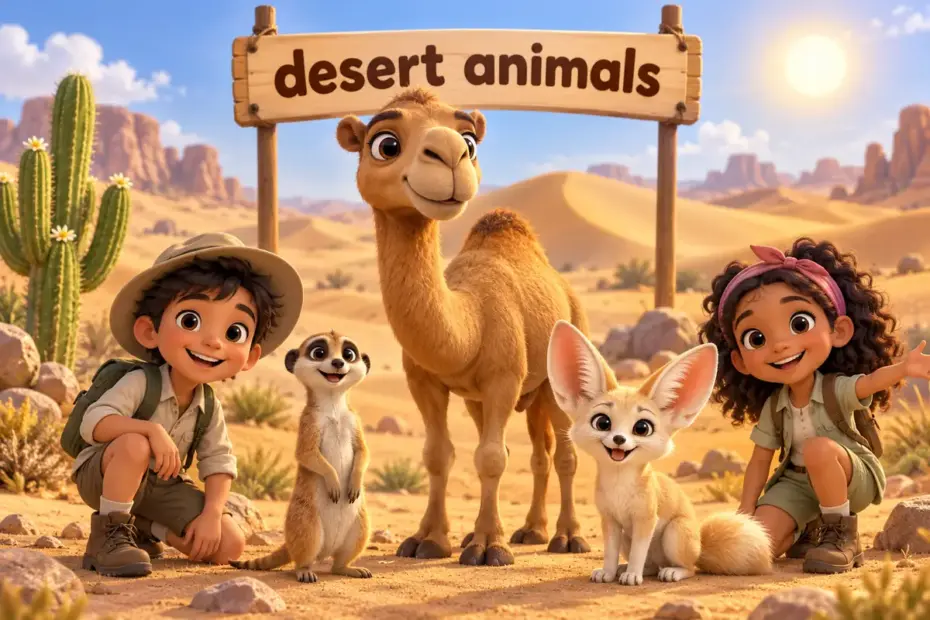
Desert animal names with pictures help learners connect each word to a creature that survives in a hot, dry place. This guide lists camels, fennec foxes, meerkats and more, explains the adaptations behind each name, and shows the words in clear sentences.
Desert Animal Names With Pictures at a glance
- A desert animal is a creature adapted to very dry, hot or cold conditions.
- Common names include camel, fennec fox, meerkat, oryx and rattlesnake.
- Many desert animals are nocturnal and rest during the hottest hours.
- Desert animals often save water and lose little through their skin.
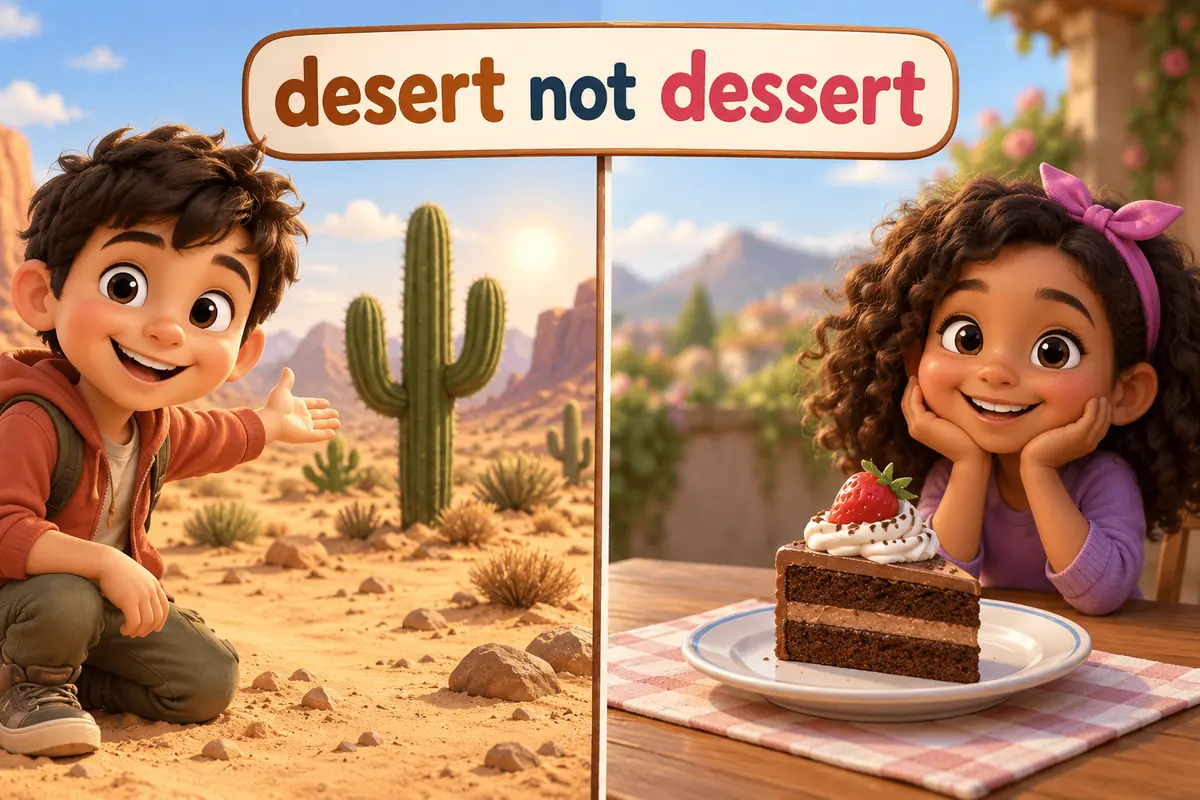
- The commonest spelling error is desert for the dry land and dessert for the sweet dish.
What are desert animals?
Desert animals are the species adapted to survive where water is scarce and temperatures swing from scorching days to cold nights. They manage this through behaviour, such as hiding by day, and through body features, such as the camel hump or the large ears of the fennec fox. A page of desert sentence examples shows the setting word in wider use.
| Type | Typical names | Main adaptation |
|---|---|---|
| Large mammals | camel, oryx, addax | Store fat, conserve water. |
| Small mammals | fennec fox, meerkat, jerboa | Burrow by day, hunt or forage at night. |
| Reptiles | rattlesnake, horned lizard, Gila monster | Tough skin and slow metabolism. |
| Birds | roadrunner, sandgrouse | Get water from food. |
| Invertebrates | scorpion, desert beetle | Hard shells that limit water loss. |
This list stays with the animals a general reader meets in books and wildlife films, so rare species are left out.
Common desert animal names in one list
The table below pairs each name with a short description and the feature that helps it survive. A wider set of animal sentence examples shows these nouns in general use.
| Name | What it looks like | Key fact |
|---|---|---|
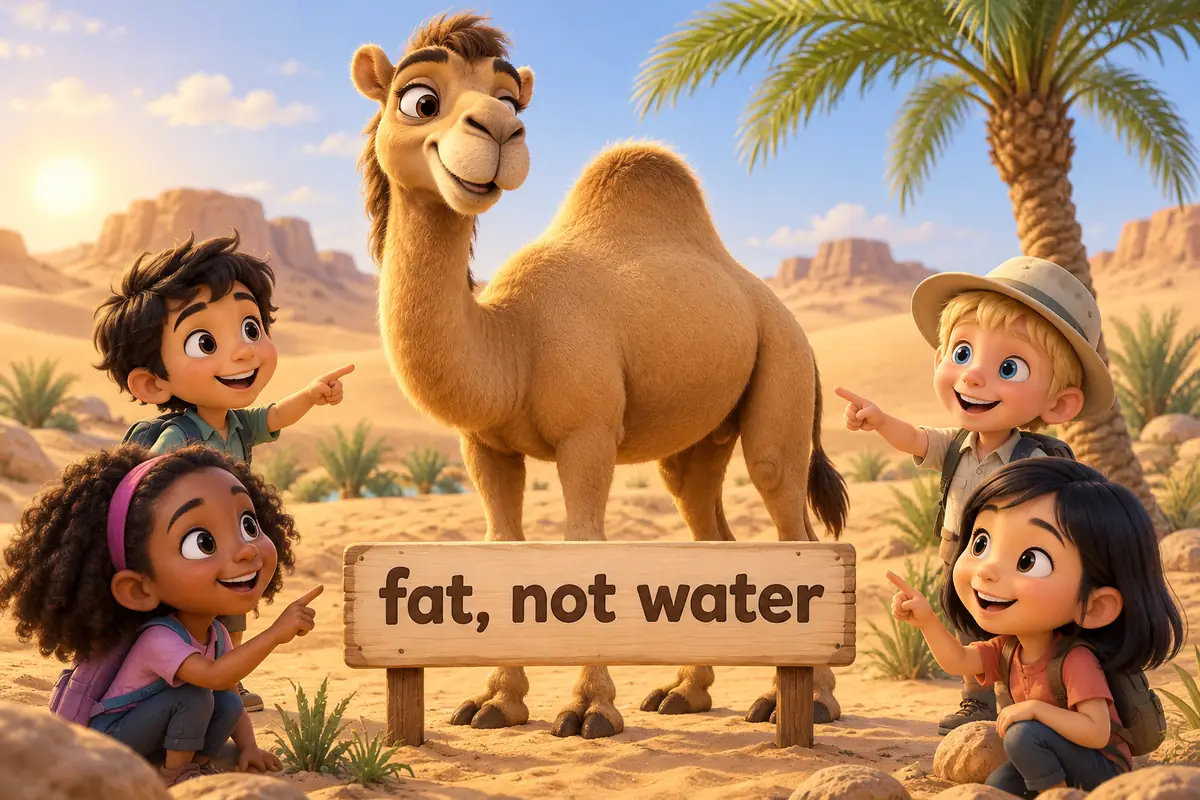
| Camel | Tall, with one or two humps | Stores fat, not water, in its hump. |
| Dromedary | A camel with one hump | Common in hot deserts. |
| Fennec fox | Small, with very large ears | Big ears release body heat. |
| Meerkat | Slender, stands upright | Sentries watch for danger. |
| Oryx | Antelope with long, straight horns | Survives with very little water. |
| Addax | Antelope with twisted horns | A pale coat reflects sunlight. |
| Jerboa | Small rodent with long hind legs | Hops and lives in burrows. |
| Kangaroo rat | Small, with a long tail | Gets water from dry seeds. |
| Rattlesnake | Coiled, with a rattling tail | Hunts warm-blooded prey. |
| Horned lizard | Flat body with horns | Buries itself to escape heat. |
| Gila monster | Heavy, patterned lizard | One of few venomous lizards. |
| Scorpion | Eight legs and a curved tail | Active mostly at night. |
| Desert tortoise | Domed shell, slow walk | Stores water in its body. |
| Sand cat | Small, pale, tufted ears | Hunts by night to stay cool. |
How do you use desert animal names in a sentence?
These names are ordinary countable nouns. The frames below cover the patterns a learner needs most often.
| Pattern | Example | What it signals |
|---|---|---|
| a + name | We saw a meerkat on the rock. | One countable animal |
| plural name | Camels cross the dunes in a line. | The whole kind |
| name + noun | fennec fox ears | A part of the animal |
| name of the group | a herd of oryx | A collective |
| there are | There are scorpions under that stone. | Stating what exists |
Desert animal names in a sentence: examples across contexts
The names work in stories, science lessons and travel writing, and a page of adjectives for desert scenes shows how to describe the setting around them.
| Context | Example sentence | Why this works |
|---|---|---|
| Classroom | Our teacher told us how a fennec fox keeps cool. | The name is the subject. |
| Science report | The kangaroo rat needs almost no drinking water. | The name takes an article. |
| Travel writing | Camel caravans moved slowly across the dunes. | The name modifies a noun. |
| Story | A scorpion slipped under the flat stone. | The name begins a scene. |
| Wildlife film | Meerkats stand guard while others forage. | The plural names the group. |
| Conversation | I have never seen a Gila monster. | The name follows a verb. |
| Zoo sign | The oryx can go for days without water. | The name is the subject. |
| Nature blog | Horned lizards bury themselves in loose sand. | The plural names the kind. |
| School poster | Desert animals save water in clever ways. | The name works as a modifier. |
| Field guide | The addax is now rare in the wild. | The name takes an article. |
Which desert animal is which?
Match the name to the feature you can see, and the choice becomes clear.
| Feature | Name | Example |
|---|---|---|
| Tall with a stored fat hump | Camel | The camel walked for days. |
| Tiny with huge ears | Fennec fox | The fennec fox listened closely. |
| Stands upright in a group | Meerkat | A meerkat scanned the sky. |
| Long straight horns | Oryx | The oryx stood on the ridge. |
| Hops on long hind legs | Jerboa | The jerboa crossed the sand fast. |
The ears, the hump and the upright stance are the three clues that separate the common names fastest in a picture.
Spelling and word forms of desert animal names
Most names add -s for the plural, and two-word names such as fennec fox pluralise the second word.
| Form | Part of speech | Example |
|---|---|---|
| camel | noun | The camel rested at noon. |
| camels | plural noun | Camels carry heavy loads. |
| fennec fox | noun | A fennec fox has large ears. |
| fennec foxes | plural noun | Fennec foxes hunt at night. |
| desert | noun or verb | The desert is dry and cold at night. |
| deserted | adjective | The road was deserted. |
Common mistakes with desert animal names
Mistake 1: desert is confused with dessert. Incorrect: The dessert is hot and dry. Correct: The desert is hot and dry. Rule: desert, the dry land, has one s; dessert, the sweet dish, has two.
Mistake 2: the camel hump is said to store water. Incorrect: A camel stores water in its hump. Correct: A camel stores fat in its hump. Rule: the hump holds fat, not water.
Mistake 3: a countable name loses its plural. Incorrect: We saw two meerkat. Correct: We saw two meerkats. Rule: these names add -s after a number.
Mistake 4: a herd takes a plural verb. Incorrect: A herd of oryx are crossing. Correct: A herd of oryx is crossing. Rule: the subject is herd, which is singular.
Mistake 5: a two-word name is pluralised wrongly. Incorrect: two fennec fox. Correct: two fennec foxes. Rule: pluralise the last word of a two-word animal name.
Practice using desert animal names
- Fill in the blank: A ___ stores fat in its hump.
- Choose the better word: The dry land is a (desert / dessert).
- Correct the error: We saw three oryxes and two meerkat.
- Build a sentence: use a herd of with a desert animal.
- Spot the register: which line suits a zoo sign, (a) Fennec foxes live here, or (b) Home: fennec fox, desert habitat?
- Fill in the blank: Tiny ___ get most of their water from seeds.
Answers
- camel, because a camel stores fat in its hump.
- desert, because the dry land takes one s.
- We saw three oryx and two meerkats; the plural of meerkat adds -s.
- A herd of camels moved along the desert track.
- (b), because a zoo sign uses short, formal labels.
- kangaroo rats, because they get water from dry seeds.
The bottom line
Desert animal names with pictures connect a word to a creature built for dry, harsh country, from the camel with its fat-storing hump to the meerkat that stands guard. Treat the names as countable nouns and pluralise the last word of a two-word name. Keep desert and dessert apart, and the spelling stays safe.
Frequently asked questions about desert animals
How do desert animals survive without much water?
Desert animals survive by saving water and avoiding the heat. Many rest in burrows during the day and come out at night, when the air is cooler. Some, such as the kangaroo rat, get most of their water from seeds, and others lose very little through toughened skin.
Does a camel really store water in its hump?
No, a camel stores fat in its hump, not water. The fat provides energy when food is scarce, and the hump helps the animal survive a long dry spell. Camels do drink large amounts quickly, but that water goes into the body, not into the hump.
Why do fennec foxes have such large ears?
The fennec fox has large ears to release body heat. More skin in the ear means more heat can escape into the cooler night air, which helps the animal stay comfortable in a hot climate. The ears also help it hear small prey moving under the sand.
Are meerkats desert animals?
Yes, meerkats live in the dry grasslands and deserts of southern Africa. They survive by digging burrows that stay cool underground, and by taking turns as sentries to watch for danger. When the group forages, one meerkat often stands upright on its hind legs to scan the sky.