A desperado is a bold, reckless outlaw who rides into a frontier town and answers to no law. To use desperado in a sentence, treat it as a countable noun and give it a Western setting: “The sheriff recognised the desperado by his silver spurs.” The word names a person, not an act.
Desperado at a glance
- Desperado is a countable noun; the plurals are desperadoes and desperados.
- The word means a bold or violent outlaw, especially in the American West.
- It usually arrives with a story setting: a sheriff, a posse or a wanted poster.
- Desperado belongs to adventure, Western and historical writing rather than everyday speech.
- The commonest error is confusing the noun desperado with the adjective desperate.
What does desperado mean?
Desperado is a noun meaning a bold or violent criminal, especially an outlaw of the American frontier. The Cambridge entry for desperado gives the outlaw sense, and the word almost always arrives with a setting attached: a dusty town, a stagecoach or a reward posted by the sheriff. It does not mean a desperate person, even though the two words grew from the same root.
| Sense | Plain meaning | Example sentence |
|---|---|---|
| Outlaw in a story | A bold, lawless bandit of the frontier | The posse tracked the desperado across the mesa. |
| Reckless criminal | A violent person who ignores the law | A gang of desperadoes held up the mail coach. |
| Romantic figure | An outlaw treated as daring rather than merely bad | The ballad turns the desperado into a folk hero. |
One limitation matters here. Desperado is a story word: it belongs to tales of the frontier, not to a police report. Modern news writing says suspect, gunman or fugitive, because desperado sounds romantic and dated. Use it when you want colour and history, and avoid it when accuracy is the only goal. The related noun a brigand covers the road robber instead.
How do you use desperado in a sentence?
The noun behaves like any countable person noun. Put an article or a plural ending on it, place it as the subject or the object, and let the surrounding words supply the Western scene. Five patterns cover almost every real sentence.
| Pattern | Example | What it signals |
|---|---|---|
| a/the + desperado + verb | The desperado spurred his horse and vanished. | Introduces one named outlaw as the subject of the sentence. |
| plural + desperadoes | Desperadoes robbed the stage at dawn. | Treats the outlaws as a group rather than an individual. |
| verb + the desperado | The marshal arrested the desperado at the river. | Places the outlaw as the object of an action. |
| desperado + of + place | He was the last desperado of the border country. | Ties the figure to a particular region and era. |
| adjective + desperado | A young, reckless desperado joined the raid. | Lets an adjective colour the type before the noun. |

Desperado in a sentence: examples across contexts
Desperado keeps its meaning but changes company depending on the text. The eleven sentences below move from a Western novel to a sports page, and each one shows which words a writer reaches for alongside it.
| Context | Example sentence | Why this works |
|---|---|---|
| Western novel | The desperado reined in his horse at the edge of town. | Introduces the figure through one action, the way fiction does. |
| Film review | The film gives its desperado a code of honour and a slow drawl. | Shows how the type can be romanticised on screen. |
| History essay | Bands of desperadoes preyed on the silver shipments after the war. | Uses the plural to describe a social condition, not one man. |
| Folk ballad | The ballad calls the desperado a friend of the poor. | Turns an outlaw into a folk hero through song. |
| Classroom storytelling | The children drew a wanted poster for a make-believe desperado. | Uses the word safely about a fictional figure. |
| Travel writing | The museum keeps the cell where a famous desperado waited for trial. | Anchors the word to a real place and a real story. |
| Museum label | This pistol is said to have belonged to a border desperado. | Reports a claim with the caution a label needs. |
| Song lyric | The chorus repeats desperado like a nickname. | Treats the word as a label for a restless character. |
| Sports nickname | Fans nicknamed the fearless winger the desperado of the left flank. | Extends the word playfully beyond crime. |
| Conversation | My grandfather loved old films about desperadoes. | Survives in speech mainly when people talk about stories. |
| Newspaper headline | Desperado of the plains finally caught. | Deliberately archaic and colourful for effect. |
| Wanted poster | Wanted: the desperado who robbed the express office. | Uses the clipped, dramatic style of a frontier notice. |
| Diary entry | We heard a desperado had been seen near the creek. | Places the word in first-person historical writing. |
Notice how the fiction examples let the desperado act, while the non-fiction examples keep him as a subject of study. That split is the clearest signal of where the word lives. Historical writing also frames the desperado as a symptom of a lawless period rather than as one wicked man, which is why the plural appears so often in essays about the frontier.
Desperado vs outlaw
Desperado and an outlaw are close, but only one of them carries a period and a mood. The table sets out the differences that matter when you choose.
| Attribute | desperado | outlaw |
|---|---|---|
| Core meaning | A bold or violent bandit of the frontier | Anyone living outside the law |
| Era | Strongly tied to the American West | Works in any period |
| Register | Literary and romantic | Neutral and factual |
| Tone | Colourful, slightly admiring | Plainly disapproving |
| Typical use | Fiction, ballads, film writing | News, law and history |
| Grammar | Countable noun for a person | Countable noun for a person |
A desperado almost always needs a a lawman nearby, and the pair is what gives the word its energy. Once the chase begins, the plainer word a fugitive becomes the more accurate label, and a a renegade names someone who switched sides rather than someone simply outside the law.
Verdict: choose outlaw when you need a neutral, timeless word, and desperado only when the Western setting and the romantic tone are doing real work in the sentence.
Word forms and grammar of desperado
Desperado inflects like a borrowed Spanish noun, and its relatives keep the same root while changing their meaning. The table lists the forms and marks the ones that are different words rather than forms of this one.
| Form | Part of speech | Example |
|---|---|---|
| desperado | noun, singular | One desperado held the bridge alone. |
| desperadoes | noun, plural | Desperadoes scattered when the soldiers arrived. |
| desperados | noun, plural, accepted variant | Three desperados escaped before dawn. |
| desperate | adjective — different meaning | The travellers were desperate for water. |
| desperately | adverb — different meaning | She searched desperately for the map. |
| desperation | noun — different meaning | He stole in desperation, not for gain. |
The root desperation describes a feeling, which is why it belongs to the adjective family rather than to the outlaw noun. Keeping those two families apart is the single most useful habit with this word. Learners sometimes reach for desperado when they mean a reckless but admirable risk-taker, and the word can stretch that far in sport and song, though the criminal sense stays close to the surface.
Common mistakes with desperado
- Incorrect:
The man was desperado for money.Correct: The man was desperate for money. Rule: Desperate is the adjective; desperado is always a noun naming a person. - Incorrect:
A desperadoes rode into town.Correct: A desperado rode into town. Rule: Use a singular article with the singular form, or drop the article before the plural. - Incorrect:
Police arrested a desperado for speeding.Correct: Police arrested a suspect for speeding. Rule: Desperado is too romantic and dated for a modern news report. - Incorrect:
She felt desperado after the long shift.Correct: She felt desperate after the long shift. Rule: Feelings take the adjective desperate, never the story noun. - Incorrect:
The desperado was a desperado.Correct: The bandit was a desperate man. Rule: Do not repeat the word or pair it with itself; vary the noun or use the adjective.
Practice using desperado
Work through the six items, then check the reasoning rather than only the answer.
- Fill the gap: The sheriff pinned a reward notice for the ______ on the saloon door.
- Choose the better word: After three days without water, the travellers were (desperado / desperate).
- Correct the error: A desperadoes robbed the stagecoach at noon.
- Build a sentence: use a desperado about a fictional outlaw in a school play.
- Spot the register: which belongs in a history essay — the desperado of the plains, or the desperado rode cool?
- Rewrite in the plural: The desperado escaped across the river. Begin with Two.
Answers
- desperado — the notice names one outlaw, so the singular countable noun fits.
- desperate — thirst calls for the adjective, while desperado would name a person.
- A desperado robbed the stagecoach at noon — a singular article cannot sit before the plural.
- Model answer: In the school play, a desperado in a paper hat guarded the treasure chest.
- The desperado of the plains — a formal essay prefers the noun phrase to the odd adverbial rode cool.
- Two desperadoes escaped across the river — the plural is desperadoes and the article disappears.
The bottom line
Use desperado in a sentence when you want a colourful, slightly old-fashioned word for a bold outlaw, and give it a frontier setting so the tone lands. The two nuances that decide most sentences are these: it is a countable person noun with two accepted plurals, and it belongs to stories rather than to news reporting, where suspect or fugitive is the safer choice.
Frequently asked questions about desperado
Is desperado a common word today?
Desperado survives mainly in fiction, film and songs about the American West. In everyday speech it appears when people discuss those stories, not when they describe a real crime. A modern news report would say suspect, gunman or fugitive, because desperado sounds romantic and dated.
What is the difference between desperado and desperate?
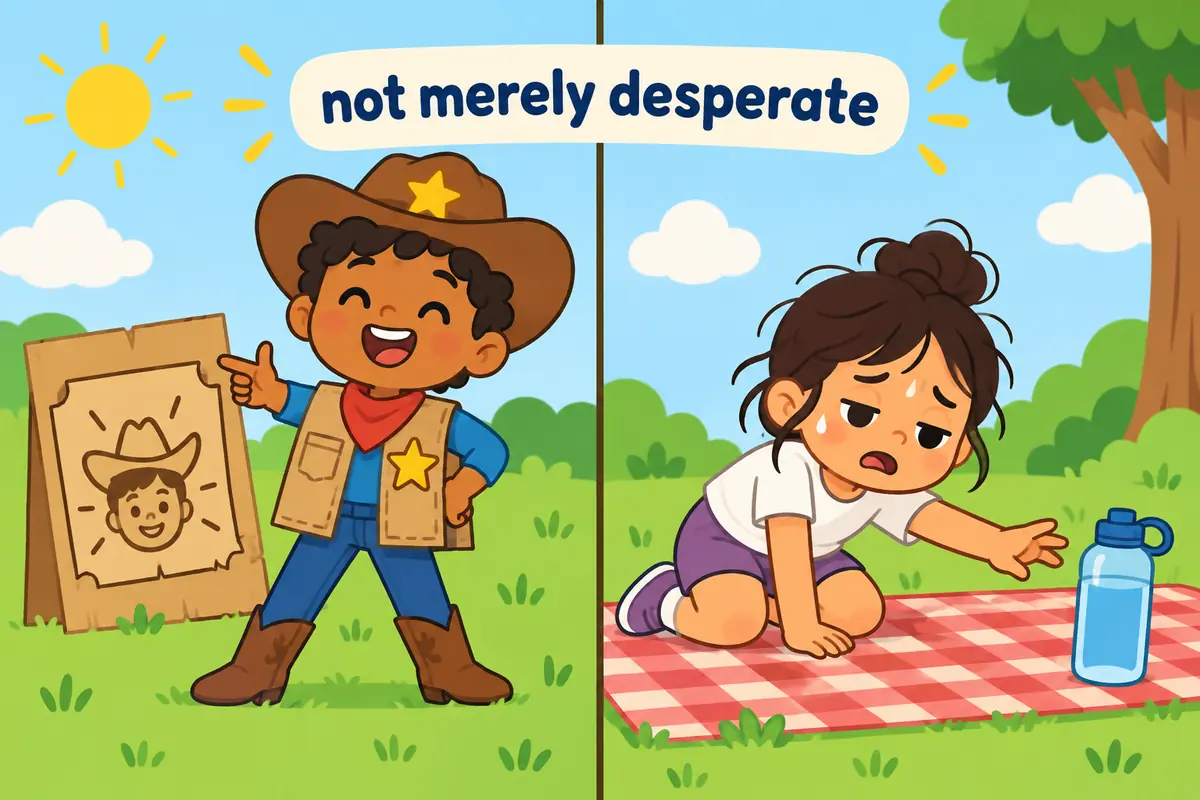
Desperado is a noun naming a bold outlaw. Desperate is an adjective meaning without hope or ready to do anything. They grew from the same Spanish root, which is why they look alike, but only one of them can follow the verb to be in a sentence about feelings.
What is the plural of desperado?
Both desperadoes and desperados are accepted. The form desperadoes follows the older English habit of adding es to words ending in o, while desperados keeps the Spanish plural. Writers who want a period feel often choose desperadoes, and both appear in dictionaries without comment.
Where does the word desperado come from?
The word entered English from Spanish desesperado, which means desperate. That shared root is the reason the noun and the adjective look so similar. Over time the noun narrowed to mean a reckless outlaw, while the adjective kept its broader sense of hopelessness or extreme need.