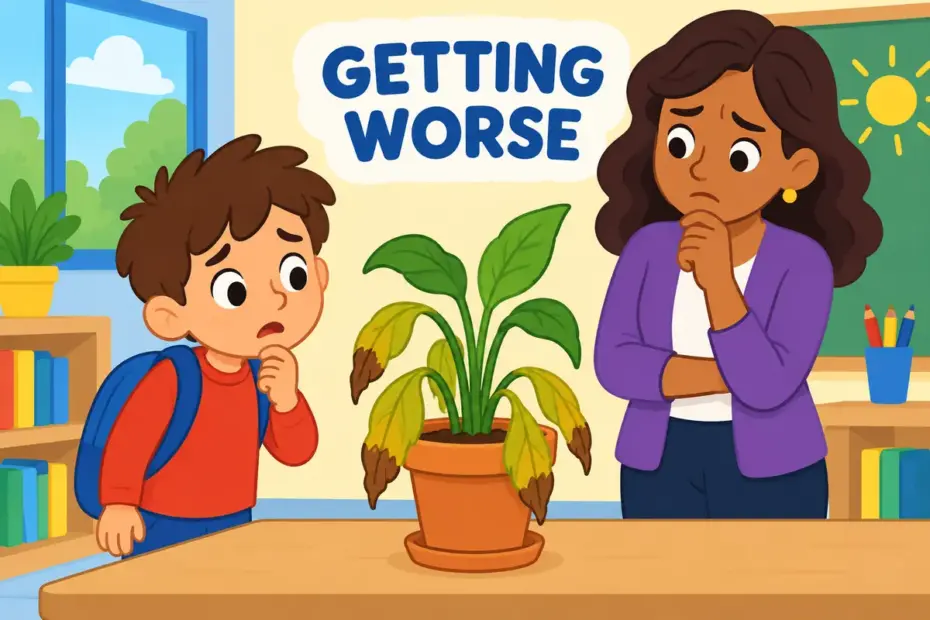
Deteriorate means to become worse in quality, condition or health, usually gradually. To use deteriorate in a sentence, make the thing that worsens the subject: ‘Her handwriting deteriorated after the injury.’ The verb is intransitive, so nothing deteriorates something else. It simply reports a downward change.
Deteriorate at a glance
- Deteriorate is an intransitive verb; its forms are deteriorates, deteriorated and deteriorating.
- The usual pattern is a thing plus the verb, with no object after it.
- Common subjects are health, weather, relations, buildings, eyesight and conditions.
- The word suits reports, medical notes and formal writing more than casual speech.
- The commonest error is giving it an object, as in the rain deteriorated the road.
What does deteriorate mean?
Deteriorate is an intransitive verb meaning to become worse in quality, condition or health. The Cambridge entry for deteriorate keeps the change gradual and usually unwelcome, so a sudden collapse is not quite the same. A friendship deteriorates when small neglects accumulate, while a photograph deteriorates when damp and light work on it for years. Where the change is measurable and often reversible, decline sharply is the better verb, because deteriorate suggests damage that is hard to undo.
| Sense | Plain meaning | Example sentence |
|---|---|---|
| Worse in quality | Lose the standard something once had | The paint deteriorated after two wet winters. |
| Worse in health | Weaken gradually | His eyesight deteriorated slowly. |
| Worse in mood or relations | Slide toward a lower state | Relations deteriorated into open hostility. |
One limitation is worth stating. Deteriorate does not say why something worsened, and it does not promise recovery. A condition can deteriorate for reasons nobody can name, and the word alone never tells a reader whether anyone is to blame.
How do you use deteriorate in a sentence?
Name the thing that changes, then let the verb stand alone. Five patterns cover almost every real sentence.
| Pattern | Example | What it signals |
|---|---|---|
| subject + deteriorate | The roof deteriorated for years. | The thing itself changes; no object follows. |
| deteriorate + into | The discussion deteriorated into shouting. | Names the worse state it finally reaches. |
| adverb + deteriorate | Morale deteriorated rapidly. | The adverb carries the speed of decline. |
| have deteriorated | Conditions have deteriorated since spring. | Perfect tense links a past slide to the present. |
| deteriorate when / if | Leather deteriorates when it stays damp. | A condition that triggers the decline. |
When the cause matters more than the change, writers reach for decay over time, which points to a slow natural process. The two overlap, but deteriorate is the more general and more formal choice.
Deteriorate in a sentence: examples across contexts
Deteriorate keeps one meaning while its setting changes. The eight sentences below move from a health note to a news report, and each names what got worse.
| Context | Example sentence | Why this works |
|---|---|---|
| Health note | Her hearing deteriorated over the winter. | Names a body function and a timeframe, as a clinical note does. |
| Workplace email | Service levels have deteriorated since the system change. | Uses the perfect tense to connect a past event to now. |
| News report | Relations between the two councils deteriorated after the vote. | Makes a relationship the subject, the commonest in journalism. |
| Engineering | The bridge deck deteriorated faster than the model predicted. | Compares real decline with an expectation. |
| Education | Attendance deteriorated once the bus route changed. | Ties a measurable figure to a cause. |
| Home repairs | The fence deteriorated until it finally fell. | Shows a long process ending in a result. |
| Academic writing | Conditions deteriorated steadily during the study period. | Uses a cautious adverb to avoid overclaiming. |
| Conversation | The weather deteriorated, so we went home. | Everyday use with a plain, visible subject. |
Only one of these sentences names a cause, and that is characteristic. Deteriorate reports an outcome, so writers often add a second clause to explain it. crumble under pressure is stronger still and suggests a final collapse.
Deteriorate vs worsen
Deteriorate and worsen describe the same direction, and the choice is mostly one of register. worsen quickly is plain and belongs in speech and headlines; deteriorate is longer, more formal and carries a hint of slow, physical decline.
| Attribute | deteriorate | worsen |
|---|---|---|
| Core meaning | Become worse in quality or condition | Become worse, no matter how |
| Typical subject | Health, buildings, relations, conditions | Situation, symptoms, relations |
| Speed implied | Usually gradual | Neutral; an adverb supplies speed |
| Register | Formal, technical, journalistic | Neutral and everyday |
| Feel | Points to cumulative damage | States a direction only |
Verdict: choose worsen when you need a plain word that fits any sentence, and deteriorate when the writing is formal or the decline is slow and cumulative.
Word forms and grammar of deteriorate
Deteriorate inflects regularly, and its noun appears far more often in print than the verb does in speech. The table also lists the adjective that learners invent.
| Form | Part of speech | Example |
|---|---|---|
| deteriorate | verb, base form | Untreated wood will deteriorate. |
| deteriorates | verb, third person singular | Rubber deteriorates in sunlight. |
| deteriorated | verb, past and past participle | The site deteriorated for a decade. |
| deteriorating | verb, present participle | She watched his health deteriorating. |
| deterioration | noun | The report noted a sharp deterioration. |
| deteriorative | adjective, rare | Incorrect in general use: a deteriorative effect. Prefer damaging or harmful. |
Its noun deterioration is the form you meet in headlines and inspection reports, where it compresses a slow process into one word.
Common mistakes with deteriorate
- Incorrect:
The rain deteriorated the road.Correct: The road deteriorated in the rain. Rule: Deteriorate is intransitive, so the thing that worsens is the subject, never the object. - Incorrect:
The situation deteriorated down.Correct: The situation deteriorated. Rule: The verb already means becoming worse, so down is redundant. - Incorrect:
The friendship had a deterioration.Correct: The friendship deteriorated. Rule: Use the verb for the process; the noun needs a modifier such as a steady deterioration. - Incorrect:
They dilapidated the shed over the years.Correct: The shed became dilapidated over the years. Rule: dilapidate a building is reserved for houses falling into ruin, and even there the word is usually an adjective. - Incorrect:
His mood deteriorated his work.Correct: His mood worsened, and his work suffered. Rule: To name an effect on something else, use damage, harm or worsen something.
Practice using deteriorate
Work through the six items, then read the reason with each answer.
- Fill the gap: Without repairs, the roof will ______.
- Choose the better word: Relations between the teams (deteriorated / declined to) after the dispute.
- Correct the error: The damp deteriorated the walls.
- Build a sentence: use deteriorate into about a quiet argument that becomes a shouting match.
- Spot the register: which belongs in an inspection report, the fence got worse, or the fence deteriorated over two winters?
- Rewrite with the noun: Her eyesight deteriorated quickly. Use deterioration instead.
Answers
- deteriorate — a future prediction keeps the base form after will.
- deteriorated — relations worsen by themselves; declined to needs an object and a figure.
- The walls deteriorated in the damp — the walls are the subject, not the object.
- Model answer: The calm debate deteriorated into a shouting match.
- The fence deteriorated over two winters — a report avoids got and names a timeframe.
- Her eyesight showed rapid deterioration — the noun needs a modifier and a verb of its own.
The bottom line
Use deteriorate in a sentence when something becomes worse on its own, and keep the object out of it. The two facts that decide most sentences are these: the verb is intransitive, so the sufferer is the subject, and it implies a gradual slide rather than a single event. For a plain register, worsen does the same job in half the space.
Frequently asked questions about deteriorate
Is deteriorate a transitive verb?
No. Deteriorate is intransitive, so it never takes a direct object. You say the building deteriorated, not the storm deteriorated the building. If you want to name what causes the decline, add a phrase such as in the rain, or switch to a verb like damage or harm.
What is the difference between deteriorate and worsen?
Both mean to become worse, but they differ in register and feel. Worsen is short, neutral and at home in speech. Deteriorate is formal and suggests a gradual, cumulative decline, which is why medical notes and inspection reports prefer it for health and buildings.
Can deteriorate describe a person?
Only loosely. A person’s health, mood or behaviour can deteriorate, and the verb often appears that way in clinical writing. Saying simply that a person deteriorated is vague and usually needs a noun such as health or condition to make the sentence clear.
Does deteriorate always mean permanent damage?
No, but it leans that way. Deteriorate suggests a decline that is hard to reverse, which is why it suits buildings, eyesight and relationships. If the change is small and easily fixed, a plainer phrase such as got worse or declined slightly is more accurate.
Do you ever wonder how to use the word “deteriorate” correctly in a sentence? This common term refers to the process of something steadily getting worse or declining in quality over time.
When constructing a sentence with “deteriorate,” it is important to understand its meaning and how it can accurately depict various situations. By mastering the usage of this word, you can effectively communicate the idea of something gradually worsening or falling into a state of disrepair.
7 Examples Of Deteriorate Used In a Sentence For Kids
- The old book began to deteriorate with time.
- If we don’t take care of our toys, they might deteriorate.
- Eating healthy food helps our bodies not to deteriorate.
- Let’s clean our toys so they don’t deteriorate.
- Our plants need water or they will deteriorate.
- We should protect our things from the sun so they don’t deteriorate.
- Remember to take care of your clothes, or they will deteriorate.
14 Sentences with Deteriorate Examples
- Deteriorate in academic performance can be avoided by maintaining a balanced study schedule.
- Constantly skipping meals can deteriorate your health, especially during exam season.
- Lack of sleep can greatly deteriorate your ability to concentrate and retain information.
- Deteriorate in mental health can be prevented by seeking help from counseling services available on campus.
- Procrastination can lead to the deterioration of your grades if not managed effectively.
- Ignoring feedback from professors can cause your work to deteriorate in quality over time.
- Deterioration in relationships with peers can negatively impact your overall college experience.
- Neglecting to exercise regularly can lead to the deterioration of physical health, making it harder to focus on studies.
- Over-reliance on caffeine to stay awake can deteriorate your energy levels in the long run.
- Poor time management skills can cause your academic performance to deteriorate slowly over the semester.
- Neglecting to take breaks during study sessions can deteriorate your focus and productivity.
- Deterioration in financial management can lead to unnecessary stress and pressure during college years.
- Deteriorate in communication skills can hinder your ability to network and form connections with future employers.
- Constantly comparing yourself to others can cause your self-esteem to deteriorate over time.
How To Use Deteriorate in Sentences?
Deteriorate means to become worse in condition, quality, or value.
When using deteriorate in a sentence, it is crucial to provide context to ensure clarity. You can follow these steps to effectively use the word:
-
Understand the meaning of deteriorate. It is essential to comprehend that the word implies a process of something worsening over time.
-
Identify the subject that is deteriorating. This could be a physical object, a person’s health, a relationship, or a situation.
-
Use deteriorate in a sentence with the subject and the specific details of how it is getting worse. For example, “The old bridge began to deteriorate due to years of neglect.”
-
You can also include adverbs or adjectives to provide more context. For instance, “Without proper maintenance, the quality of the furniture started to rapidly deteriorate.”
-
Be clear and concise in your sentence to effectively convey the message of deterioration.
Remember, it’s important to use deteriorate correctly in a sentence to avoid confusion. With practice, you will become more comfortable incorporating the word into your writing.
Conclusion
In conclusion, the quality of something can deteriorate over time due to various factors such as neglect, lack of maintenance, or natural processes. By examining the sentences with the keyword “deteriorate,” it is evident that this deterioration can apply to physical objects, relationships, health, or even mental state. It serves as a reminder that it is essential to take proactive steps to prevent or address any decline in quality before it becomes irreversible.
Recognizing signs of deterioration early, seeking help when necessary, and implementing preventive measures can all contribute to maintaining the quality and longevity of different aspects of our lives. Whether it is addressing deteriorating infrastructure, relationships, or one’s own well-being, being attentive and taking action promptly can help mitigate the effects of deterioration and preserve what is valuable.


