A dullard is a person who is slow to learn or understand, and the word carries an old-fashioned, mildly contemptuous tone. To use dullard in a sentence, place it where a noun for a person belongs: “The foreman dismissed him as a dullard.” It is a countable noun, so it takes an article or another determiner.
Dullard at a glance
- Dullard is a countable noun for a person; the plural is dullards.
- It means a slow-witted or stupid person, and the adjective with the same root is dull.
- The word is dated and mildly contemptuous, so it lives in fiction, satire and opinion writing rather than neutral reports.
- Common collocations are dismissed as a dullard, written off as a dullard and the class dullard.
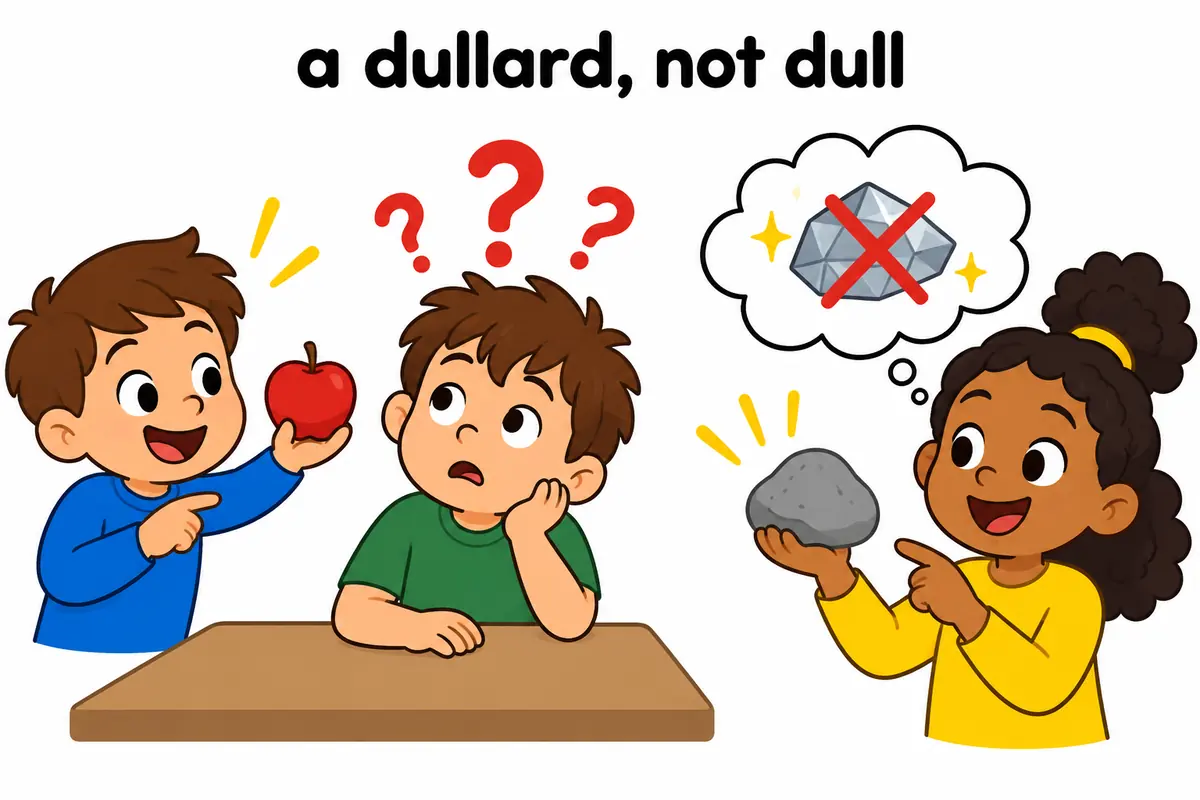
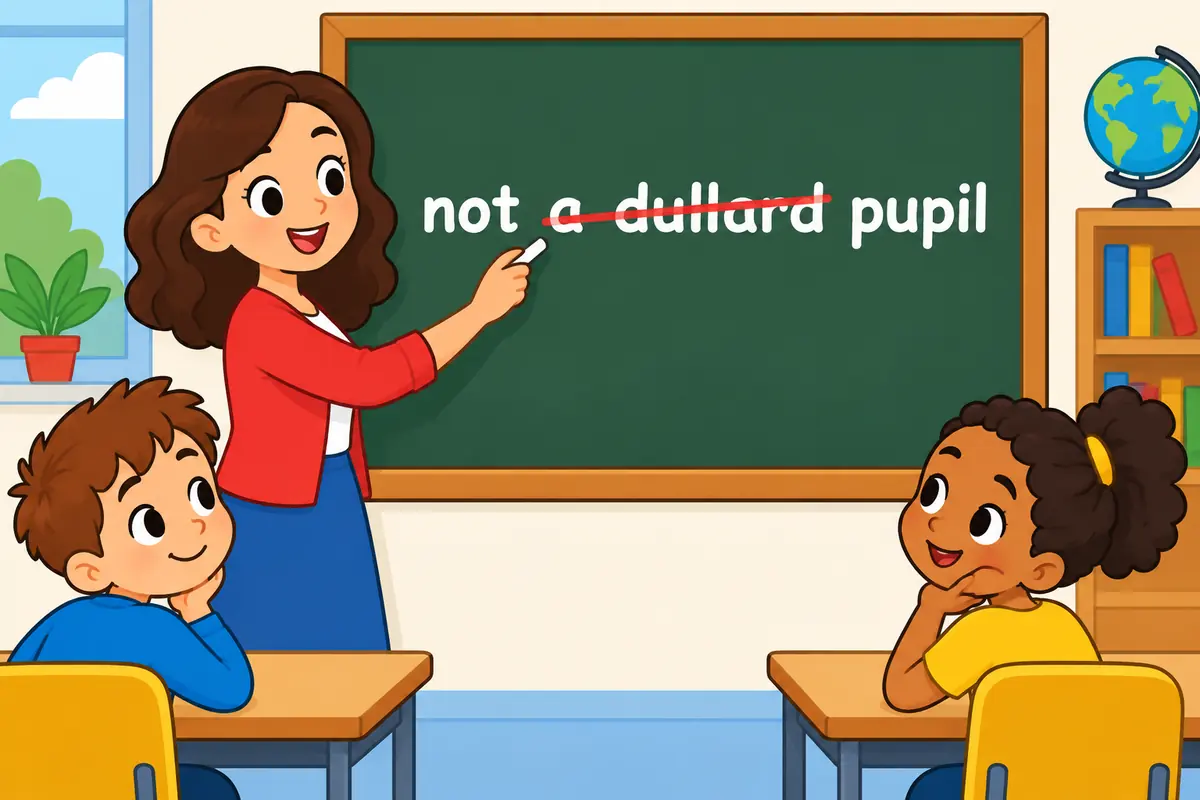
- The commonest error is using dullard as an adjective, as in a dullard pupil, instead of dull.
What does dullard mean?
Dullard is a countable noun meaning a person who learns or understands slowly. The Cambridge entry for dullard gives the core sense of a stupid person, and the root dull adds a shade of unresponsiveness that the plainer insult fool does not always carry. Apply the label to a person, never to a lesson or a machine.
| Sense | Plain meaning | Example sentence |
|---|---|---|
| Slow to learn | Somebody who grasps ideas more slowly than others | The tutor refused to call the boy a dullard in front of the class. |
| Lacking judgement | Somebody who acts without ordinary sense | Only a dullard would ignore a warning that clear. |
| Unresponsive company | Somebody with no lively interest or spark | He played the dullard at parties and waited for the music to end. |
Two limits decide whether dullard is the right word. It is a label for a person and a strong one, so a neutral sentence about learning difficulty needs slow learner or struggling student instead. It also sounds old-fashioned, and the third sense above is the rarest: when a writer means boring rather than dim, the adjective dull is the cleaner choice.
How do you use dullard in a sentence?
Dullard is a noun, so it sits in the same slots as boy or teacher: after an article, after an evaluative adjective, or as the object of a preposition. Five patterns cover almost every real sentence, and the register stays formal or literary throughout.
| Pattern | Example | What it signals |
|---|---|---|
| a / the + dullard | The class called him a dullard. | The standard countable-noun pattern, needing an article. |
| adjective + dullard | The poor dullard missed the point again. | An evaluative adjective placed before the noun. |
| dismissed / written off as a dullard | She was written off as a dullard at school. | An idiomatic passive that reports somebody else’s judgement. |
| the + dullard (generic) | In satire the dullard always gets the last word. | Generic reference to a type, common in essays and comedy. |
| object of a preposition | Nobody expected much of the dullard. | Emphasises the low expectations of other people. |
Dullard in a sentence: examples across contexts
The sentences below keep the same noun while moving from a school story to an opinion column. Each row names who is speaking and why the label lands where it does. A dunce and a simpleton sit nearby but weigh different faults, and a nitwit is the lightest of the set.
| Context | Example sentence | Why this works |
|---|---|---|
| Children’s fiction | The new boy was no dullard, whatever the older children whispered. | The denial sets up a sympathetic character against a playground rumour. |
| Classroom | Calling a struggling reader a dullard teaches the class nothing. | Shows the word doing harm, which is how a teacher would warn against it. |
| Workplace | The supervisor treated every new apprentice as a dullard. | Names a habit of low expectation from somebody with power. |
| News comment | Voters were dismissed as dullards who could not follow the debate. | The plural generalises an insult aimed at a whole group. |
| Historical essay | Nineteenth-century schools sorted pupils into scholars and dullards. | A period label, so the dated tone fits the century. |
| Conversation | He is no dullard; he simply thinks before he speaks. | The negation is the one use that survives in modern speech. |
| Comedy script | Enter the dullard, clutching a sandwich and a broken umbrella. | A stage direction uses the label as a stock role. |
| Opinion column | Treating readers as dullards is a reliable way to lose them. | Turns the noun into an accusation about the writer, not the reader. |
| School report | The phrase a dullard was never written in the master’s careful reports. | The passive keeps the insult at a distance while showing it exists. |
| Academic writing | The study resists the easy claim that a slow reader is a dullard. | Uses the label only to examine it, which suits a careful argument. |
| Sports commentary | The coach never called a substitute a dullard in public. | Shows the word being withheld, which reveals how harsh it sounds. |
| Online forum | Branding every dissenter a dullard ends the discussion. | Names the insult as a way of shutting a conversation down. |
Dullard vs ignoramus
Dullard and ignoramus both insult a person’s mind, but they accuse it of different faults. An ignoramus lacks knowledge, while a dullard lacks the speed to use the knowledge on offer. One can be cured by reading; the other is presented as a permanent trait.
| Attribute | dullard | ignoramus |
|---|---|---|
| Core accusation | Slow to understand | Lacking knowledge or education |
| What is missing | Quickness of mind | Information and training |
| Can it be fixed? | Presented as a lasting trait | Presented as a gap that study can close |
| Typical target | A pupil, employee or rival | A person new to a subject |
| Register | Dated and literary | Blunt and slightly formal |
| Example | The old master wrote him off as a dullard. | The panel exposed the witness as an ignoramus. |
Verdict: choose ignoramus when the fault is missing knowledge, and dullard only when the writer means an inability to take ideas in, and is willing to sound dated.
Word forms and grammar of dullard
Dullard is the only form of its own; the rest of the family is built on the adjective dull, and two of those invented forms in the last row are mistakes learners make. The related blockhead follows the same noun-only pattern, and so does dolt.
| Form | Part of speech | Example |
|---|---|---|
| dullard | noun, singular | The label stung more than the mark on his paper. |
| dullards | noun, plural | The scheme treated honest voters as dullards. |
| dull | adjective, the root | The lecture was dull, and the hall emptied early. |
| dullness | noun, abstract | He hid his dullness behind a loud laugh. |
| dully | adverb | The bell rang dully through the fog. |
| dullardly | does not exist | Write The plan was dulled by delay, not dullardly. |
Common mistakes with dullard
- Incorrect:
He is a dullard student.Correct: He is a dull student. Rule: Dullard is a noun, so the adjective dull belongs before a noun. - Incorrect:
The dullard engine would not start.Correct: The engine was dull and sluggish. Rule: Dullard labels people, not objects or machines. - Incorrect:
She dullarded through the exam.Correct: She stumbled through the exam like a dullard. Rule: Dullard has no verb form, so it needs be or a linking phrase. - Incorrect:
He felt dullard after the test.Correct: He felt dull after the test. Rule: After a linking verb such as feel, use the adjective dull, never the noun. - Incorrect:
That was a dullard idea.Correct: That was a dull idea. Rule: The quality is dull; only a person is a dullard.
Practice using dullard
Work through the six items, then read the reasoning beside each answer rather than the key alone.
- Fill the gap: The older pupils called the newcomer a ______ because he read slowly.
- Choose the better word: The long speech was (dull / dullard), and half the hall fell asleep.
- Correct the error: He is a dullard pupil who needs extra help with reading.
- Build a sentence: use written off as a dullard about a worker whose good idea was ignored.
- Spot the register: which belongs in a novel — the clerk was a dullard, or the clerk was not very bright?
- Rewrite with a neutral phrase: The manager called the intern a dullard. Replace the insult with slow learner.
- Fill the gap: Nobody expected much ______ the dullard in the corner.
- Correct the error: The dullard plan was abandoned after a week.
Answers
- dullard — the noun names the person, and the article a has already supplied the determiner.
- dull — the sentence describes a speech, not a person, so the adjective is required.
- He is a slow learner who needs extra help with reading — a neutral report replaces the old insult.
- Model answer: The technician was written off as a dullard until her design cut the waste in half.
- The clerk was a dullard — the literary noun matches a novel, while the plain phrase belongs in speech.
- The manager called the intern a slow learner — the factual phrase keeps the meaning without the contempt.
- of — the noun follows the preposition of in the fixed frame expect much of somebody.
- The dull plan was abandoned after a week — the quality is dull, and only a person is a dullard.
The bottom line
Use dullard in a sentence as a countable noun for a person, and keep it for fiction, satire or opinion, where its dated contempt does some work. The two facts that decide most sentences are that dullard is a noun, so it needs an article, and that it labels a person, never a quality or a thing. Where the tone must stay neutral, slow learner is the safer choice.
Frequently asked questions about dullard
Is dullard an insult?
Yes. Dullard labels a person as slow-witted, and its old-fashioned tone makes it sound like a schoolyard taunt from an earlier century. It is milder than some modern insults but still contemptuous, so a neutral report would use slow learner or struggling student instead.
What is the difference between dullard and dull?
Dullard is a noun for a person, and dull is the adjective that describes the quality. You say the pupil was dull or the pupil was a dullard, but never the pupil was dullard. The same split runs through fool and foolish, or coward and cowardly.
Can dullard describe a woman?
Dullard is not marked as masculine, so it can describe anyone, and the plural dullards covers a group. In older fiction it lands most often on men and boys, which is a habit of those stories rather than a rule of the word. Its meaning stays the same whatever the subject.
Is dullard still used today?
Dullard survives mainly in fiction, satire and opinion writing, where its dated flavour is the point. In everyday speech most people reach for idiot, fool or a plainer phrase. Use it when you want that older, literary sting, and choose a neutral term when you do not.