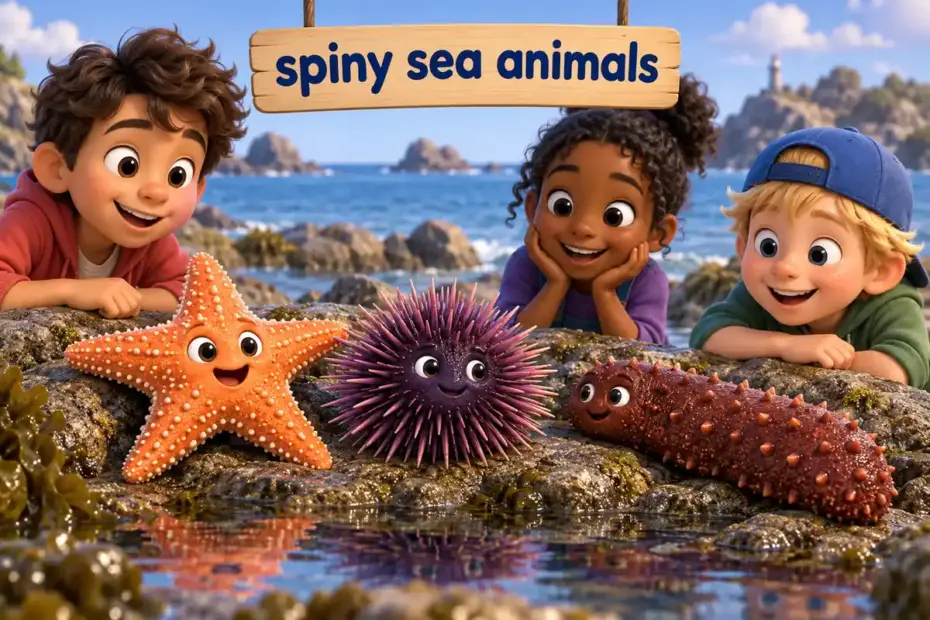
Echinoderms names with pictures introduce the spiny sea animals that live only in salt water, from starfish and sea urchins to sea cucumbers and feather stars. This guide lists the main names, explains the features they share, and shows each word in a clear sentence.
Echinoderms Names With Pictures at a glance
- An echinoderm is a marine animal with spiny skin and tube feet.
- Common echinoderms include starfish, sea urchin, sand dollar and sea cucumber.
- All echinoderms live in the sea; none live in fresh water or on land.
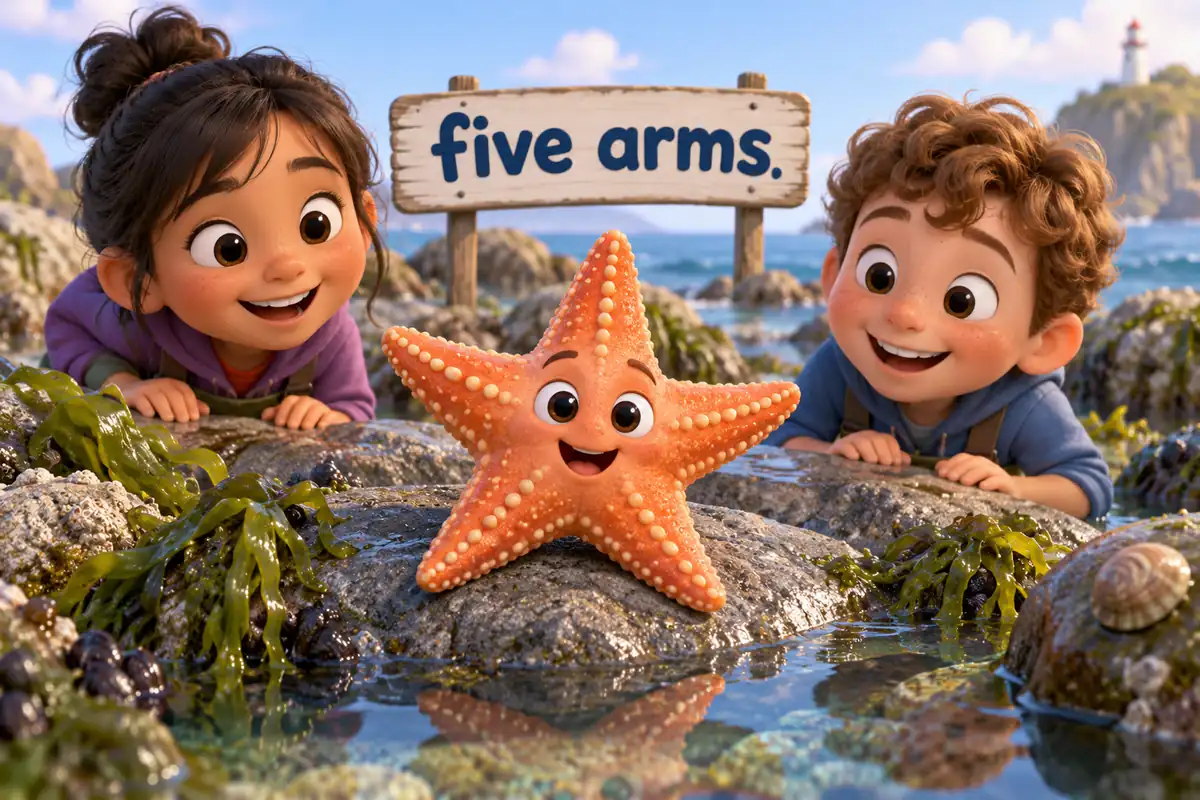
- Adults usually show five-fold symmetry, as the starfish arms suggest.
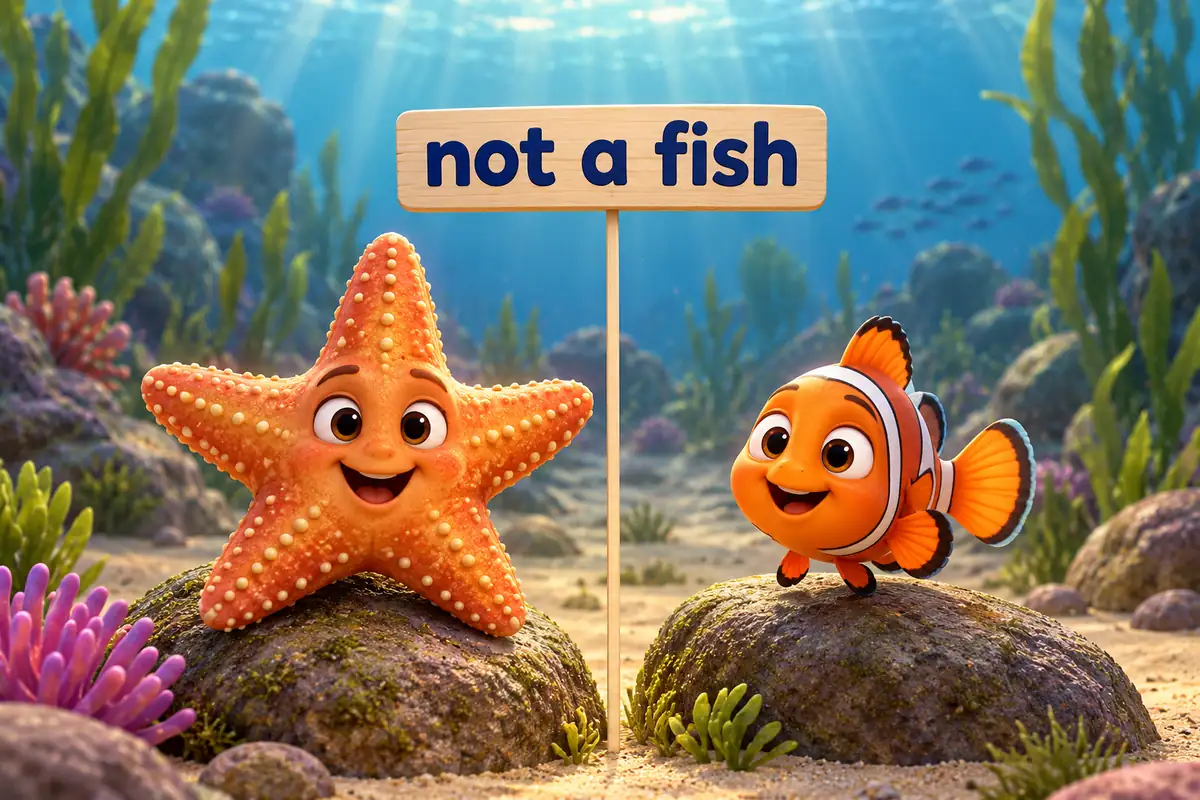
- The commonest error is calling a starfish a fish, which it is not.
What are echinoderms?
Echinoderms are a group of marine animals defined by spiny skin, a network of water-filled tubes and rows of small tube feet used for moving and feeding. The name comes from words meaning spiny skin, which is easy to see on a sea urchin. A page of starfish sentence examples shows one of the group in everyday use.
| Group | Members | Main feature |
|---|---|---|
| Sea stars | starfish, brittle star, basket star | Arms spreading from a central body. |
| Sea urchins | sea urchin, sand dollar | Round shells covered in spines. |
| Sea cucumbers | sea cucumber | Long, soft body with no arms. |
| Crinoids | feather star, sea lily | Feathery arms that filter food. |
This guide keeps to the echinoderms a reader meets in a rock pool or an aquarium, so rare deep-sea species are left out.
Common echinoderms names in one list
The table below pairs each name with a short description and a fact a learner can remember. The scientific name for the starfish, sea star, appears here because the animal is not a fish at all.
| Name | What it looks like | Key fact |
|---|---|---|
| Starfish | Five arms around a centre | Also called a sea star. |
| Sea urchin | A round shell covered in spines | Moves on hundreds of tube feet. |
| Sand dollar | A flat, round, pale disc | A flattened kind of sea urchin. |
| Sea cucumber | A long, soft, leathery body | No arms; crawls on the sea floor. |
| Brittle star | Long, thin, snaking arms | Arms break off to escape danger. |
| Feather star | Many feathery arms | Waves its arms to catch food. |
| Sea lily | A crinoid fixed to a stalk | Grows on the sea floor like a flower. |
| Basket star | Branching arms that curl | Spreads a net to trap prey. |
| Sea apple | A round, colourful cucumber | A sea cucumber with bright colours. |
| Heart urchin | A heart-shaped buried shell | Lives buried in the sand. |
| Sea biscuit | A rounded, burrowing urchin | Lives buried under sand. |
| Sun star | A starfish with many arms | Often has more than five arms. |
How do you use echinoderm names in a sentence?
These names are countable nouns, and a few are two-word phrases. The frames below cover the common uses.
| Pattern | Example | What it signals |
|---|---|---|
| a + name | I saw a starfish in the pool. | One countable animal |
| plural name | Sea urchins hide in cracks. | The whole kind |
| name + noun | a sea cucumber body | A part or feature |
| a group of + plural | a group of brittle stars | A collection |
| there are | There are urchins under the rock. | Stating what exists |
Echinoderm names in a sentence: examples across contexts
The names appear in science lessons, aquarium signs and travel writing, alongside other sea creatures such as the sea turtle and the wider turtle family.
| Context | Example sentence | Why this works |
|---|---|---|
| Classroom | Our teacher explained that a starfish is not a fish. | The name is the subject. |
| Rock pool guide | Look for sea urchins in the shaded cracks. | The plural names the kind. |
| Aquarium sign | The sea cucumber feeds on the sandy floor. | The name takes an article. |
| Science report | Brittle stars shed an arm to escape a predator. | The plural is the subject. |
| Nature blog | A feather star waved its arms in the current. | The name begins a scene. |
| Conversation | I have never touched a sand dollar. | The name follows a verb. |
| Diving log | Sea lilies grew on the deep reef wall. | The plural names the group. |
| Story | A basket star curled around the branch. | The name keeps a detail. |
| Beach walk | We found a sand dollar on the tide line. | The name follows a verb. |
| Museum label | Sea lilies anchor to the floor by a stalk. | The plural names the group. |
Which echinoderm is which?
Match the name to the shape you can see, and the choice becomes clear.
| Shape | Name | Example |
|---|---|---|
| Five arms from a centre | Starfish | The starfish clung to the rock. |
| Round and spiny | Sea urchin | A sea urchin bristled in the pool. |
| Long and soft, no arms | Sea cucumber | The sea cucumber slid over sand. |
| Feathery waving arms | Feather star | The feather star swayed gently. |
| Flat, pale and round | Sand dollar | A sand dollar lay on the beach. |
Shape alone settles most cases, since the arms, spines and soft body each point to a different group. The tube feet underneath confirm it when a live animal is close enough to see.
Spelling and word forms of echinoderm names
Most names add -s for the plural, and two-word names pluralise the last word. The group word follows the same pattern.
| Form | Part of speech | Example |
|---|---|---|
| echinoderm | noun | This echinoderm has spiny skin. |
| echinoderms | plural noun | Echinoderms live only in the sea. |
| starfish | noun | A starfish has five arms. |
| starfish | noun, same plural | Two starfish rested on the rock. |
| sea urchin | noun | The sea urchin is covered in spines. |
| sea urchins | plural noun | Sea urchins graze on seaweed. |
Common mistakes with echinoderm names
Mistake 1: a starfish is called a fish. Incorrect: A starfish is a fish. Correct: A starfish is an echinoderm. Rule: the name is traditional; the animal is not a fish.
Mistake 2: the article before echinoderm is wrong. Incorrect: a echinoderm. Correct: an echinoderm. Rule: echinoderm begins with a vowel sound, so it takes an.
Mistake 3: a two-word name is written as one word. Incorrect: a seacucumber. Correct: a sea cucumber. Rule: the compound name keeps a space.
Mistake 4: a countable name loses its plural. Incorrect: I saw two urchin. Correct: I saw two urchins. Rule: these names add -s after a number.
Mistake 5: a two-word name is pluralised wrongly. Incorrect: two sea cucumber. Correct: two sea cucumbers. Rule: pluralise the last word of a two-word name.
Practice using echinoderm names
- Fill in the blank: A ___ has five arms and lives on the sea floor.
- Choose the better word: A sea urchin is an (echinoderm / fish).
- Correct the error: We saw two starfishs and a sea cucumber.
- Build a sentence: use a group of with an echinoderm name.
- Spot the register: which line suits an aquarium sign, (a) A starfish, or (b) Common sea star, rocky shore habitat?
- Fill in the blank: A ___ hides in a crack and is covered in spines.
Answers
- starfish, because it has five arms and lives on the sea floor.
- echinoderm, because that group has spiny skin.
- We saw two starfish and a sea cucumber; starfish keeps the same plural.
- A group of brittle stars hid under the flat rock.
- (b), because an aquarium sign uses precise, formal labels.
- sea urchin, because it is spiny and hides in cracks.
The bottom line
Echinoderms names with pictures cover the spiny sea animals that live only in salt water, from the starfish and sea urchin to the sea cucumber and feather star. Remember the two shared features: spiny skin and tube feet. Keep the traditional name starfish but describe the animal as an echinoderm, since it is not a fish.
Frequently asked questions about echinoderms
Why is a starfish not a fish?
A starfish is not a fish because it has no backbone, no fins and no gills like a fish. It is an echinoderm, a group defined by spiny skin and tube feet. The name starfish survives from older usage, so many scientists now prefer the clearer term sea star for the same animal.
Do echinoderms live in fresh water?
No, echinoderms live only in the sea, from shallow rock pools to the deep ocean floor. Their bodies keep the same salt balance as seawater, so they cannot survive in fresh water. That is why you never find a starfish or sea urchin in a river or a lake, only in salt water.
Can echinoderms grow back lost arms?
Many echinoderms can regrow a lost arm, and the starfish is the best-known example. The brittle star can shed an arm to escape a predator and grow a new one later. This regrowth takes time and energy, so it is a survival strategy rather than an everyday event.
How does an echinoderm move?
An echinoderm moves using hundreds of tiny tube feet, which work like small water-powered suction cups. Water fills a network of channels inside the body and pushes the feet out one by one, so the animal creeps slowly across rock or sand. The same tube feet also help it grip food and hold on in a current.